


Numbers in the examples on this page are hypothetical and for illustration only. Return targets are not guarantees, and investors can lose money.
How are Investors Paid in Syndications?
Preferred Returns
Preferred returns (“Prefs”) are utilized in a real estate syndication structure and refer to the threshold where profit distribution between the investor and deal sponsor begins. This can also be called a hurdle. Investors receive 100% of the distributable cash flow until this threshold (typically 6%-10% preferred return), then above that threshold, the syndicator receives some of the distributable cash flow.
The distributable cash flow is the gross revenues minus expenses, debt service, and fees.
The preferred return creates an incentive for the sponsor to do their job well. If the real estate deal does go south, it’s the LP investor who takes the risk. So to correct for that, when the sponsor also puts his/her own capital in the investment, the preferred return “hurdle” gives the sponsor incentive to do everything they can to make sure that the syndication deal goes well so that they can earn their carried interest profit split.
The main reason a real estate syndicate to not offer the preferred return is that it delays their profit split. This is a huge misalignment of interest with the passive investor.

Aside from the lower risk for the potential investor, the fact that the operator is willing to offer a preferred return is a sign of confidence. The operator is essentially saying, “We are so confident in this investment property that we are willing to forgo payment until the investors get a good return first.” But be warned, the general partners are the smartest people in the room… when they give a pref, they are often taking more of the back end if the syndication investment outperforms targets.
Distributing Cash to Investors (Waterfalls)

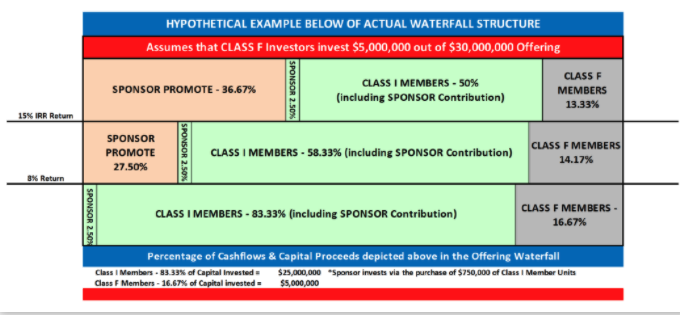
A waterfall refers to the overall distribution of funds and tiers, but it often explains how profits are split after the preferred return (e.g., 70% limited partner and the 30% general partner split).
As an LP, I don’t really like these because they are confusing and can be skewed in all types of ways. Complexity usually benefits the house (GP), which is why Wall Street tries to make things confusing to disempower the masses. Ok, that might be a little of my opinion, but here is what I think about traditional investing.
Preferred Return Exceptions

True Preferred Return
In a true preferred return (also known as “hard preferred return”), the operator only receives a portion of the profits from the cash flows or sale proceeds after you (the passive investor) receive your entire preferred return.

Preferred Return
w/ Operator Catch-up
For a preferred return with catch-up, once the preferred return is achieved, the operator receives all or most of the profits until the operator catches up to the equity split amount that you (the passive investor) have already received from distributions. This type of catch-up provision allows the operator to receive its entire equity split as originally agreed upon by you.

Return of Investor Capital
Most real estate syndicates have a dwindling principal, if the principal is paid down through payments above the preferred threshold/triggers (i.e. refinance or supplemental loan, when the real estate investment hits 80% ROI or over a 15% IRR), then the preferred return would be calculated as a percentage of that lower principal. Some operators will say that this is a good investment strategy, so you’re not paying taxes on the passive income. However, your preferred returns start to diminish, and the depreciation each year should offset all the distributions you receive anyway.
For example, if you had originally invested $100,000 into a real estate syndication deal and in year 3 there was a refinance and you received $40,000, then your preferred return would be a percentage of $60,000.
What if a Deal Goes South?
(Claw-back Provision)
A provision included in certain real estate partnership agreements, whereby a special distribution tier is included in the equity waterfall that allows for the limited partner (LP) to “claw back” cash flow previously distributed to the general partner (GP). In the event that at the end of the real estate syndication deal the LP has not achieved its preferred return, the GP must give back some or all distributions previously made to the GP until such point that the LP hits its preferred return. This is rare.


In the scenario below, without the Class B catch-up, the sponsor has the risk of paying all distributable cash flow to investors from both property operations and from the capital transaction, leaving little to no cash for them. This can lead the deal sponsor to sell it to get their equity back, or keep getting more deals (receiving an acquisition fee for each new investment opportunity) and forget about this investment property.
The best way to make sure interests are aligned is to create a waterfall scenario where the sponsor and investors make money from all phases of property ownership.
With Class B Catch-up
The example below shows an 8% Preferred Return with a 70/30 split and a Class B Catchup Distribution
Let’s say you have a real estate syndication structure with a waterfall during property operations that says the following:
- Distributable cash will be split 70/30 between Class A and Class B members, respectively, in the order below:
- Class A members will be paid all of the distributable cash until they receive a non-compounded, cumulative annualized return of 8% (the preferred return). Determined quarterly and calculated against the Class A Unreturned Capital Contributions.
- Class B will receive an annual, non-compounding, cumulative catch-up distribution of 3.43% (8%/3.43% is equivalent to a 70/30 split).
- Any remaining distributable cash will be split 70/30 between Class A and Class B.
To show how this works in numbers, let’s assume that Class A had contributed $10 million and the property generated an annual cash flow return of $1,000,000 (or 10% calculated against the Capital Contributions of Class A Members). In this scenario,
Class A would be entitled to: An annual return of $800,000 ($200,000/quarter)
Class B would be entitled to: An annual return of $343,000. However, since there was only $200,000 to pay to Class B in that year, Class B has a deficiency of $143,000 and will be compensated from future cash flow or proceeds from a Capital Transaction (e.g., refinance or disposition of property).
If there are arrearages (deficiencies) for both Class A and B, then the Capital Transaction waterfall compensation with Class B Catchup Distribution would look like this:
- First, repay the Unreturned Capital Contributions of Class A Members; then
- Make up arrearages in Class A Preferred Returns; then
- Make up arrearages in Class B Catchup Distributions; then
- Split any remaining cash 70/30 between Class A and Class B.
Without Class B Catch-up
The example below shows an 8% Preferred Return with a 70/30 split and no Class B Catchup Distribution
Let’s say you have a waterfall during property operations that says the following:
- Distributable cash will be split 70/30 between Class A and Class B members, respectively, in the order below:
- Class A members will be paid all of the distributable cash until they receive a non-compounded, cumulative annualized return of 8% (the preferred return). Determined quarterly and calculated against the Class A Unreturned Capital Contributions.
- Any remaining distributable cash will be split 70/30 between Class A and Class B.
To show how this works in numbers, let’s assume that Class A had contributed $10 million and the property generated an annual cash flow return of $1,000,000 (or 10% calculated against the Capital Contributions of Class A Members). In this scenario,
Class A would be entitled to: An annual return of $800,000 ($200,000/quarter), plus 70% of the remaining $200,000, or $140,000; and
Class B would be entitled to: 30% of the remaining $200,000, or $60,000.
Any arrearages (deficiencies) in Class A Preferred Returns will be deferred and made up from future cash flow or proceeds from a Capital Transaction, at the Manager’s option. There is no “catch-up” for Class B, so whatever they get in any given year is all they ever get.
The Capital Transaction waterfall without a Class B Catchup Distribution would look like this:
- First, repay the Unreturned Capital Contributions of Class A Members; then
- Make up arrearages in Class A Preferred Returns; then
- Split any remaining cash 70/30 between Class A and Class B.

[Please stick to the “straight splits” and the “prefs” that you’re used to.]
Don’t go chasing waterfalls
I like very simple 70/30, 80/20, or 90/10 splits where returns are even and very transparent.
A downside of prefs is when a deal does not perform, and it looks like the GP will never beat the pref… well, they might dump the deal just because they won’t be able to beat the hurdle (pref), and that might not be in the best interests of the LPs.
*Caveat: you can have a deal where it seems like it is a good pref or high LP split, like an 80/20 LP/GP split, but the leads/syndicators can just be taking large acquisition fees and therefore paid before investors anyways.
Conclusion and Key Takeaways
Preferred Returns Create Investor-First Incentives – When used properly, preferred returns ensure LPs receive a set return (usually 6–10%) before the sponsor shares in profits. It’s a sign of alignment—operators only get paid after hitting investor benchmarks.
Catch-Up Clauses Benefit the Sponsor – Preferred returns with GP catch-up allow the sponsor to receive 100% of profits after the pref is paid until their equity split is met. This can delay LP upside and should be clearly understood before investing.
True Pref vs. Catch-Up Pref – A “true” pref means LPs always stay ahead in the waterfall. With a catch-up clause, sponsors can back-load their share. Complexity in waterfalls often favors the sponsor, so clarity is critical.
Return of Capital Impacts Future Pref – If a refinance or return of capital reduces your principal, your pref return is now calculated off a lower base. It might look tax-friendly, but it quietly reduces your future cash flow.
Clawbacks Are Rare but Protective – Some deals include clawback provisions where GPs must return profits if LPs don’t meet their pref at the end. These are uncommon but a sign of strong investor protections.
Simple Structures Often Favor the LP – A straight 70/30 or 80/20 split with no catch-up is often cleaner and easier to model. Complex waterfalls with layered tiers and side classes tend to hide sponsor-friendly terms.
Sponsors May Dump Deals to Beat the Pref – If the project underperforms and it’s clear the pref won’t be met, sponsors might rush to exit, potentially misaligned with LP long-term value.
High LP Splits Don’t Always Mean Better Returns – Some deals offer flashy 80/20 splits, but sponsors front-load profits through acquisition and asset management fees. Always look at the full economic picture, not just the split.
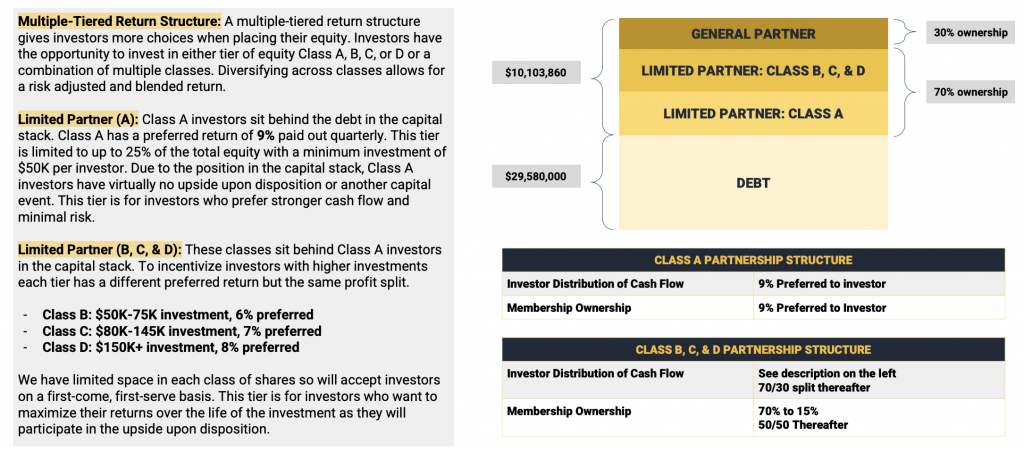
In this payout scheme the GP is trying to incentive investors that invest larger amounts.
This is educational content, not tax, legal, or investment advice. We are not attorneys, CPAs, or financial planners. Please let us know if you need a referral to a 💼 CPA, ⚖️ Lawyer, or other vendor here.
Talk it through with us
Questions on “Investor Returns” as you look at real deals? Join The Wealth Elevator investor community and bring them to your onboarding call.
Join the club and book your onboarding callJoining is free.

The podcast behind this course
The Wealth Elevator Podcast
Lane's show for accredited investors on passive syndications, taxes and alternative investments. Many of the lessons in this course started as episodes.
Listen on Apple PodcastsWatch on YouTube