


Numbers in the examples on this page are hypothetical and for illustration only. Return targets are not guarantees, and investors can lose money.
Risk-Adjusted IRR
When comparing two deals, almost everyone prioritizes the investment return with the higher IRR….. the problem with this is that most don’t look at the potential risk, specifically the risk-adjusted IRR.
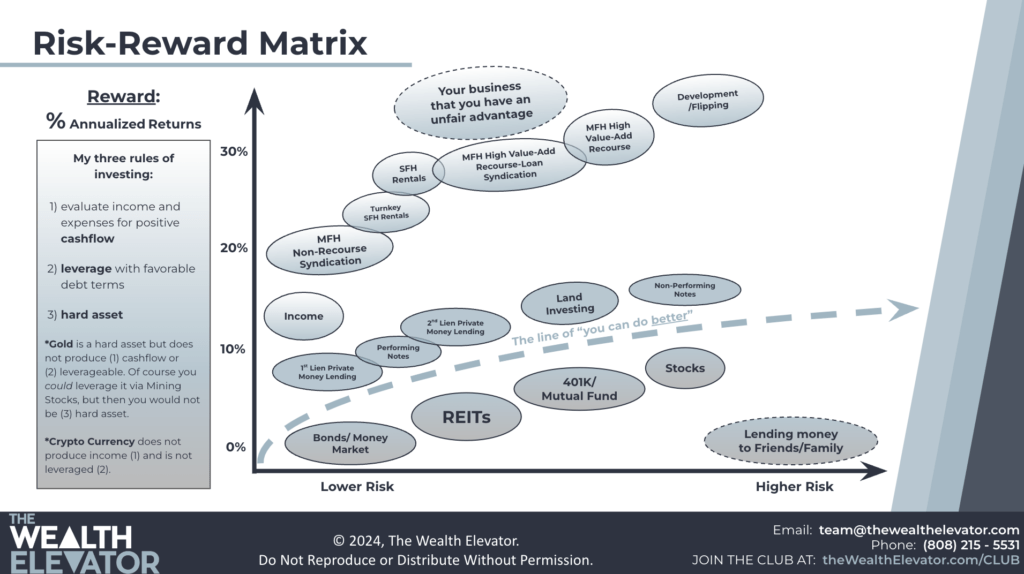
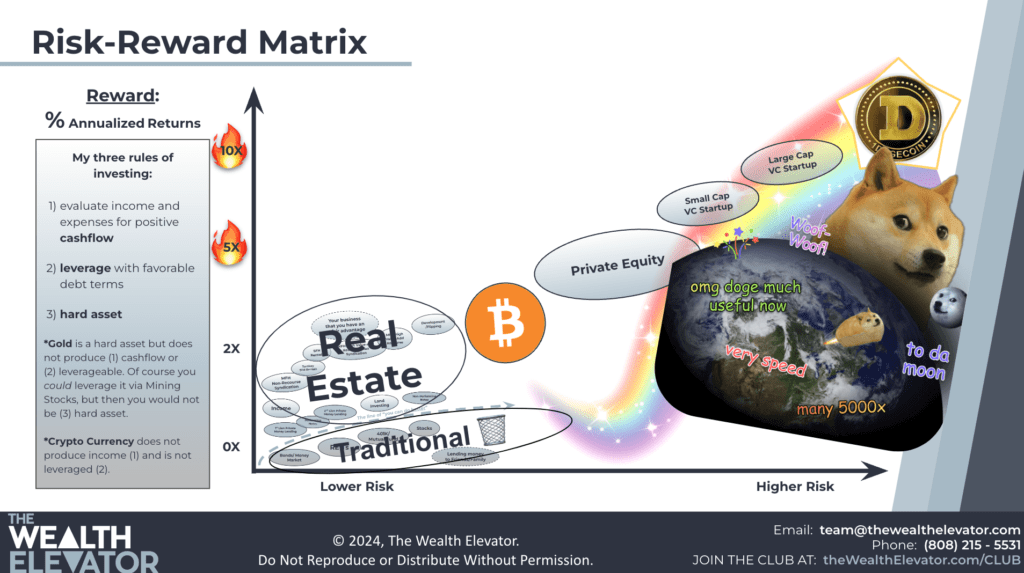
In Howard Marks’ book, the most important thing this chart illustrates is that the further out on the investment risk curve, the greater your range of outcomes. There is a risk return tradeoff, the greater risk, the higher potential return. Which is why it is important for investors to understand their risk tolerance prior to making an informed investment decision.
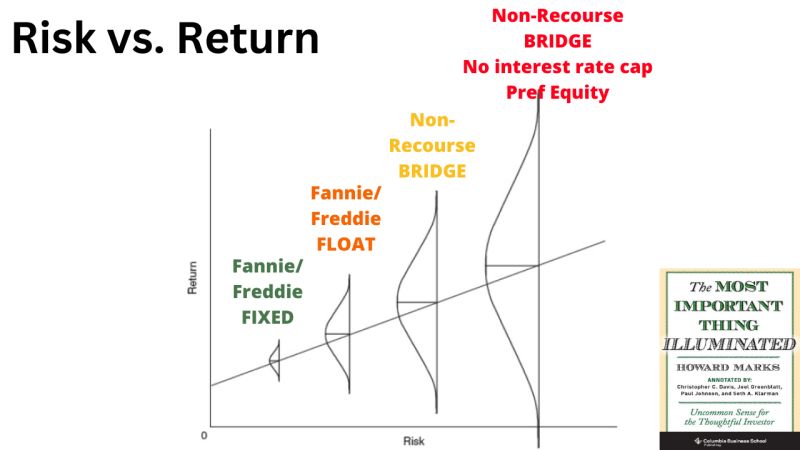
Yes, you could get a higher potential return at 30% IRR, but you could also get a 0% IRR when you go with higher risk (think bridge loan real estate investments with pref and no interest rate cap).
I added in color, how to think about managing risk from the lens of a multifamily investor in terms of debt.
For example, investing with a Fannie/Freddie fixed-rate loan, you will have a prepayment penalty if you pay it off before maturity, BUT there is less volatility:
– You don’t have a loan that matures at the wrong time
– You don’t have an interest rate cap to buy
– You know your payment for the next 5, 7, 10 years
So the 15% proforma IRR will probably be +/- 5% (between 10%-20% IRR).
A higher risk investment comes with more reward…
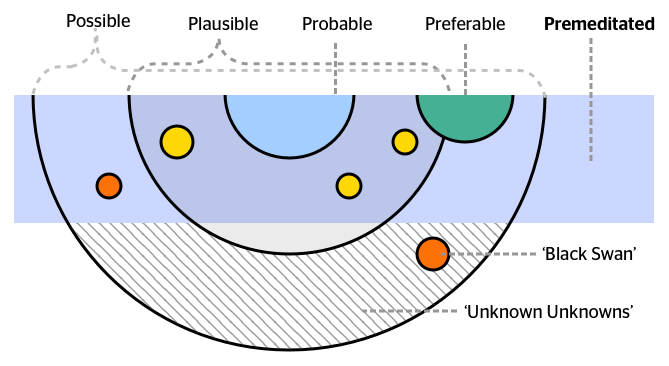
To wrap up the esoteric concept of risk, when investors converse, they often mention what’s known as a “black swan” event. This term refers to highly improbable occurrences with significant impacts. While rare, black swan events are not unheard of—think of them as akin to a Category 5 hurricane striking the same region multiple times within a few years. It’s essential to recognize the unpredictable nature of these events. They are typically unprecedented and emerge from conditions that are impossible to foresee.
Nevertheless, the best proactive investment strategy is to diversify your portfolio across numerous opportunities over a substantial period, ideally between four to seven years. This approach helps mitigate the overall risk associated with these unpredictable events and market volatility, ensuring a more stable and secure investment portfolio.
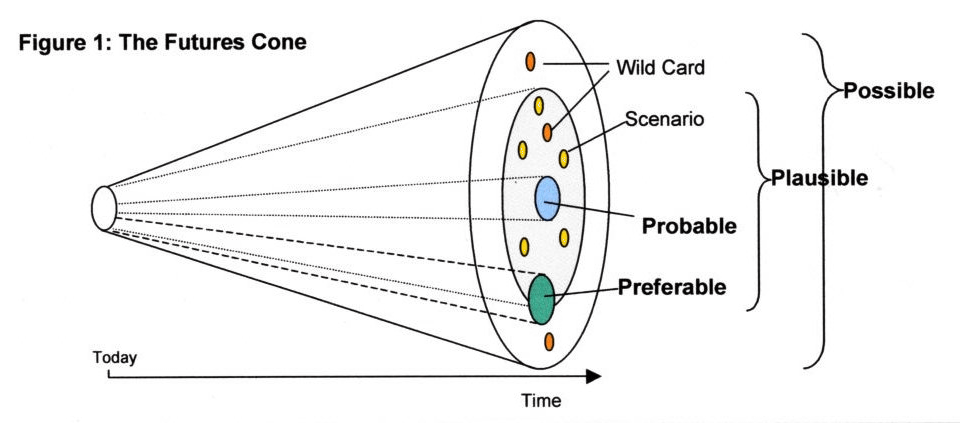

The goal of this Syndication eCourse was to have you learn the basics and be aware of some of the nuances of syndication deals so you can carry on an informed conversation with another passive investor.
Don’t be worried if, for example, this next section goes over your head:
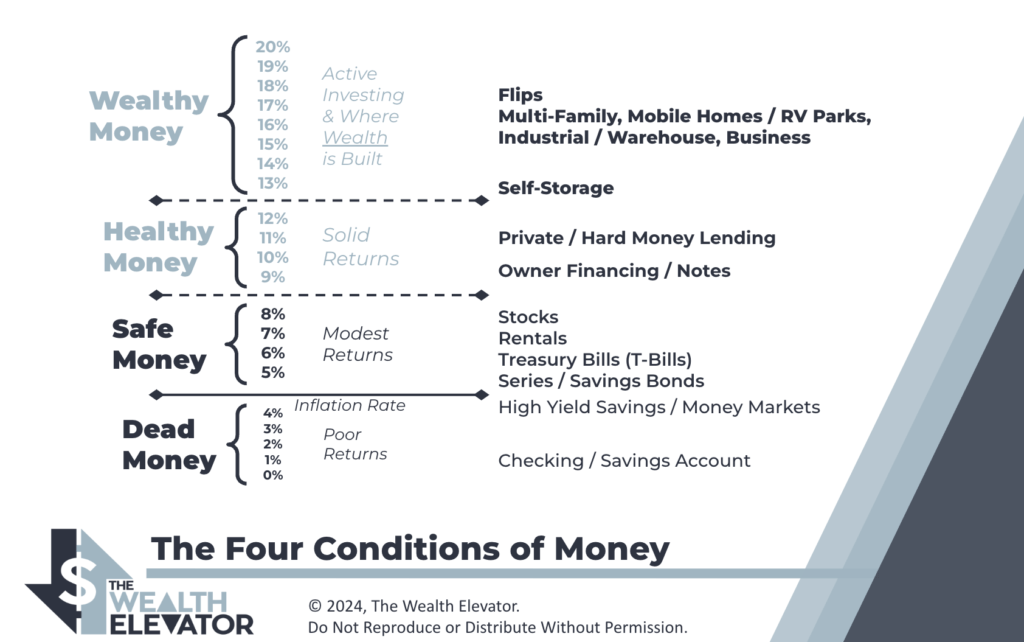
Does Value-Add Really Offer Downside Protection?
A common refrain in support of value-add investment strategies is that they offer downside protection since the business plan is increasing the income and value of the property, thereby decreasing the negative impacts of weaker performance and valuation environments. Note – development deals are heavy value add, whereas most of our stabilized projects are light value add.
Conceptually, this makes sense, but does it play out in the real world? To answer this question, we must define “downside protection”. When people make this point, they are usually pointing to a higher stabilized DSCR or lower LTV when defining downside protection in this context. This can demonstrate downside protection since NOI can decrease by a certain extent and still break even. Similarly, the asset’s value can decrease while still maintaining an equity value in excess of the cost basis.
While DSCR and LTV are great risk metrics, it is harder to judge a value-add investment by these numbers since they do not account for the execution risk associated with the business plan. For example, if a deal stabilizes to a strong LTV and DSCR, it says nothing about the riskiness of the business plan to achieve those metrics. However, if you look at the going-in LTV and DSCR, the investment might look unreasonably risky since a heavy value-add may have a very high LTV and negative cash flow (below 1.00x DSCR) upon takeover.
So, while it is true for a stabilized asset that has already been value-add to have more downside protection given the favorable cash flow and value relative to cost basis, the risk of the business plan must be considered. Today, many value-add opportunities trade for 3 to 4% cap rates, which means the margins are extremely thin or negative from the outset, depending on the financing. In a scenario like this, downside protection is somewhat limited. The only place you can go (need to go) is up! Meanwhile, if you’re able to buy a stabilized property with no meat on the bone at slightly above a 5% cap rate, you have great downside protection day one, since you don’t have to increase revenue, decrease expenses, or make capital expenditures to enjoy strong cash flow and the LTV/DSCR are reasonably strong without taking any execution risk.
From one perspective, downside protection is mostly determined by capital structure. A solid investment can be overwhelmed with too much leverage, requiring the investment to perform perfectly to refinance or sell positively. The term of the debt, whether it be short or long, also contributes to downside protection. A shorter maturity necessitates value creation to occur in a shorter period and doesn’t offer the investment opportunity to amortize the leverage down.
Personally, I’m not a fan of amortization because I’m looking to maximize cash flow for myself and my investors. However, it is good to know that the amortization function exists after the initial interest-only (IO) period expires on our 10-year debt. If all goes as planned, we very well may refinance or sell prior to the expiration of the IO period, which will optimize cash flow. But if the property or the market underperforms, the consequence is not substantial and hopefully temporary, as the long-term capital structure protects against selling in an adverse time.
I’m not saying all bridge loans are bad (see Section 4) – we have been extremely successful utilizing bridge loans in situations that call for it, again, when the deal calls for it, as bridge loans make good deals good and bad deals worse. However, we are seeing rampant use of bridge loans for deals today, which we feel do not justify the added risk and essentially create a mismatch between the investment and the capital structure.
Utilizing Permit Data for Analyzing New Supply
One area of focus for Limited Partners (LPs) should be permit data, a vital indicator of upcoming new supply in any market. The current economic landscape—marked by cooling markets and anticipated rate cuts—presents a potential once-in-a-career opportunity to acquire assets at favorable prices. Understanding the dynamics of new supply can help LPs evaluate potential investments with greater foresight.
Permit data gives a crystal-clear view of the volume of projects in the pipeline, projecting when new units might hit the market. Platforms like RealPage (normally this costs over $10-20k in subscription costs, and why our due diligence goes beyond that of a typical LP) offer quarterly updates on multifamily permits across U.S. metros, providing insights into how many projects developers are committing to in various regions. By analyzing this data, you can anticipate if a market might face an influx of new supply, which could impact occupancy rates, rental rates, and absorption rates in the coming years.
For example, in high-growth markets like Phoenix, where a large number of units are under development, rent growth is currently flat, reflecting the market’s temporary oversupply. Permit data can reveal trends showing a decrease in new starts, signaling that today’s oversupply may convert to a shortage in the next couple of years. When there is a downturn in new construction permits, a subsequent supply-demand imbalance is likely, often resulting in rental growth and increased property valuations.
Here’s how investors can leverage permit data:
Timing the Market: If current permits are below equilibrium levels—typically around 400,000 annualized units—this could mean a supply shortfall is on the horizon. This predictive insight allows investors to position themselves strategically, benefiting from potential rental growth as supply tightens.
Mitigating Risk in Overbuilt Markets: Knowing the amount of new inventory planned in a market can reveal whether a property may face competitive pressure from newly completed projects. It allows you to assess economic occupancy rates more accurately, especially if tenants begin upgrading to newer properties, which can impact cash flow.
Guiding Rent Projections: Adjusting rent growth assumptions based on anticipated supply helps make underwriting more precise. Instead of assuming uniform growth, you can account for periods of low or high rent growth, aligning projections with actual supply trends.
By closely tracking permit data as part of the syndication due diligence process, LPs can gain a clearer perspective on market conditions, reduce exposure to unexpected supply-side risks, and seize opportunities aligned with market cycles. This approach allows investors to benefit from periods of tight supply, maximizing both cash flow and appreciation potential.
Bringing you back to the real world of imperfections and never a 100% risk-free investment: While permit data offers valuable insight, it should never be the sole factor in disqualifying an investment. A high volume of permits in a hot market often reflects strong underlying demand, which can sustain growth even with new supply. Remember, if a market is attracting developers, there’s usually a compelling reason—whether it’s population growth, job creation, or economic vibrancy. There is a trade-off in tertiary markets as discussed in this video, “What kind of deal?”.
Capital Calls
The more deals a sponsor does, the higher the likelihood that they are going to have to make an unanticipated capital call for one of their properties. If a sponsor has not had things go wrong, then they have not been in business long enough. A capital call is a request by an investment manager (GP) for additional funding from investors in an existing investment. In fund structures and other types of investments, capital calls can be a routine function (for example, in one development deal we have done, we asked 50% of the people’s investment upfront so we could buy the land and the 2nd 50% when we were ready to start construction). Conversely, in value-add real estate acquisitions, capital calls are not an anticipated action in 99% of deal structures. This means that when a capital call is made for a real estate asset, there is something wrong with the property’s business plan or the market, in most cases, with real estate,e the property occupancy is suffering below the breakeven point and bleeding cash reserves or a large unexpected expense has come up.
Capital calls are viewed as a very negative thing in the industry, and they are – we are very thankful we have never had to make one. Although I have had to make 100k-300k personal loans to deals to get us out of a rough patch to avoid a capital call. As far as full transparency, here is a discussion of exceptions to plan, out of 40+ deals so far. Our worst deal, where I had a bad partner and had to remove them, resulted in a positive gain for investors.
However, the only thing worse than a capital call is an unfunded capital call. In a scenario like this, the investors are either unwilling or unable to come up with the extra capital deemed necessary to remedy the situation or ride out the storm. This could result in a temporary issue turning into a permanent loss of capital if a forced sale must take place or if the lender is forced to foreclose on the asset.
If a sponsor’s investors are well-capitalized and have dealt with difficult situations before, they are more likely to work towards a solution with the sponsor that may include a necessary capital call. Sponsors are usually very focused on raising capital and rarely slow down to ask LPs what the source and structure of their capital is and if they can meet capital calls in the future. This line of questioning may scare investors away as well.
More importantly, this is where it is good to work with a GP who has ample balance sheets and doesn’t want a “scar on their face”. I would not personally work with a sponsor with less than 2-3M net worth, so that if anything happened, they could personally patch the situation. Luckily, when you work with us, our combined net worth of the operating partners (not just loan guarantor GPs) is 10x that number, and we are personally financially solvent. I personally use infinite banking 😁 to store this dry powder. Check out the full e-course here.
A capital call scenario has pros and cons for joint ventures and syndications. Joint ventures are usually done with only one major investor contributing 80 to 90% of the equity for the investment. This major LP is usually a family office or fund. These types of investors represent larger pools of capital and only have one or a few decision makers. This means that if a capital call is needed, it can be done so relatively quickly, but it is potentially riskier since the capital call is relying mostly on one major source of capital. Family offices and funds are extremely sophisticated, so they are typically more open to a capital call to correct course than private equity individuals which tend to get scared at the first sign of trouble and want to bail on a deal right away.
Capital calls do not have to be made on a pro rata basis, but are usually made so as to avoid dilutions. Capital call provisions in joint venture and syndication operating agreements should be carefully reviewed by both sponsors and investors to ensure they are comfortable with the ramifications, such as whether capital calls are mandatory, and if there is a penalty or the level of dilution if an investor does not meet the obligation. In other words, in most cases, if you, the LP, are faced with a rare capital call and you are caught without any liquidity, then it is typically not the end of the world. In the best case, you might be diluted as if new capital being brought in just expands the capital pool, and more people to split the returns. On some rare occasions, dilutions might hurt past investors to a slightly higher degree.
In syndications, there are many investors, so the risk of whether an investor will meet the capital call is diversified across many investors. However, the wealth level of syndication investors varies drastically. Some investors are high net worth individuals with millions in case, while others may be making their first private real estate investment with their last $50k. Many sponsors in syndications opt to make a manager advance to the investment if additional capital is needed, rather than making a capital call to tens or hundreds of investors, especially if the capital need is minor. Manager advances are usually made as a loan at 0% up to 12% (or equal to the preferred return).
After all this doom and gloom, I think it would be helpful to discuss the top three ways to avoid capital calls in the first place. First, conservative underwriting (See the Numbers section) will usually lead to underpromising and overdelivering. By assuming a conservative stabilization period to implement the business plan, issues of timing are less likely to come up. Conservative assumptions regarding pro forma rents, vacancy, and operating expenses also help avoid cash crunch-related problems, such as the inability to service the debt.
Next are reserves and contingencies. We factor in an operating reserve of roughly 1 to 3 months of operating expenses and debt service, which is placed into the property’s reserve account at closing.
For understanding how the numbers work. On a 300-unit Class C asset we had that was struggling (that we eventually 2x’ed everyone’s money in 3 years), I estimated that if occupancy dropped to 50% we would be bleeding 20k a month. Seems like a lot of money, but if everyone put in an additional 5% investment ($5k on their original 50k investment), then that would pool together 500k of additional reserve that would last 25 months – more than enough time to turn the ship around through the rough patch or recession. Obviously, that is still unacceptable, but important to understand the severity, as I have once met LPs that were too conservative, keeping around way too much additional cash reserves because their understanding of a capital call was off.
Additionally, we reserve an ongoing capital expenditures allowance of about $250/unit/year, which is paid out of cash flow (this is in addition to the lender’s replacement reserve). By doing this, we are reducing our projected cash flow but are increasing the likelihood of underpromising and overdelivering on distributions. Lastly, we reserve a 10% capital expenditures contingency at closing based on the capex budget. We want to avoid the need for a capital call in the case of construction cost overruns.
Finally, the last way to avoid capital calls is to invest in robust growth markets where the fundamentals improve property performance and value over time, reducing the risk of a cash crunch or maturity risk. In desirable markets, there is a diverse growth story that results in more stable performance as well as more liquid capital markets. For example, if there is a liquidity crunch due to a loan maturity, in a strong market, there will be more lenders offering more favorable terms to refinance the asset and solve the pending maturity, which may otherwise require a capital call to successfully navigate.
While we have never made a capital call, we remain cognizant of potential downside scenarios and focus on how we can best mitigate risk, even if that were to require making a capital call. In the end, our reputation and our investors’ long-term best interests are the most important factors driving our business.
Don’t Work With Randos
People in and outside of our Mastermind bring me deals all the time. My first question is, how do you know this person?
In vetting deals, it is often the people component that has the greatest amount of impact on the success of a deal. I don’t invest with anyone I don’t know personally (one degree of separation).
None of this “I know a guy that knows a guy” where that guy is not even an investor, and I hear it second hand.
This is another reason I don’t like the single-family home investor world, and that it is a lower barrier to entry, and it is often filled with people trying to “get rich quick, no add value people.” I feel there is a higher rate of people who need to “put food on the table” from vendors, brokers, and peers. Which is why I don’t really like going to local real estate meet-ups or free online forums

Most people in this space are able to make profits off of unsophisticated investors. This is another reason I spent thousands of dollars to travel across the country to get access to high-quality people who came from the same high-net-worth professional pedigree and were also taking action.
Case and point: Wholesalers are famous for this. They want proof of funds and a letter of intent to purchase with no access to any financials? Who would ever offer on a property without seeing the numbers first?
The reason they do this is that they have a seller who does not even trust the wholesaler and needs to qualify the buyer first. A lot of these jokers will sell a property higher than the past listing price when the expired listing just closed a few weeks ago. If these bozos spent as much time building their buyers lists as they did actually looking of good deals… they would likely make a lot of money.
Talk it through with us
Questions on “Risk vs Return” as you look at real deals? Join The Wealth Elevator investor community and bring them to your onboarding call.
Join the club and book your onboarding callJoining is free.

The podcast behind this course
The Wealth Elevator Podcast
Lane's show for accredited investors on passive syndications, taxes and alternative investments. Many of the lessons in this course started as episodes.
Listen on Apple PodcastsWatch on YouTube