


Numbers in the examples on this page are hypothetical and for illustration only. Return targets are not guarantees, and investors can lose money.
What is a Good IRR for Real Estate?
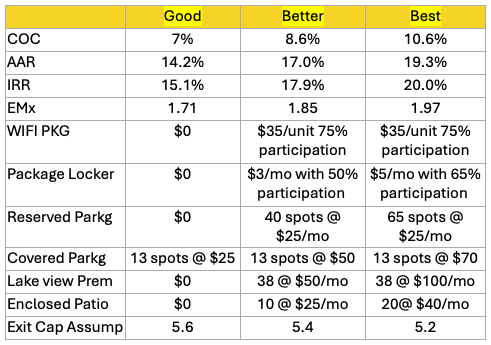
One of the main attractions of value-added real estate investments is their operational status, contrasting sharply with angel investing and venture capital, which often lacks an income-generating product. In value-add real estate investing, the risks aren’t as binary; it’s not strictly an all-or-nothing scenario. There’s a concept in the industry known as “value engineering”, which allows for adjustments if budgets overrun or plans need to change, which is common. This flexibility lets you modify the extent of improvements or even alter the overall business plan. Typically, such changes require coordination between the general partnership and the bank, which oversees the capital expenditure budget as outlined in the business plan. This investment strategy allows for various levels of implementation once a real estate deal begins.
IRR is a calculation that can be manipulated by whoever does the calculation (mostly around what potential return a passive investor can continually get with the cash flow they get off the property). Moving the refi or sale of the investment property up a year can create a higher IRR of up to 20-30%!
A good IRR used to be 100% in 5 years which was the gold standard. But as real estate investments got harder to find, 80-100% total return in the 2020s seems to be the gold standard – which includes positive cash flow at high single digits. Of course, this can be manipulated greatly based on assumptions when calculating IRR (which you are going to learn a lot about in this module). This is your job as a real estate investor to determine if the right assumptions are used (see “Cap Rate Gate” below), but I don’t really look at the return IRR because it’s highly manipulated by sneaky syndicators. I personally look at the total return over the 5-6-year period and focus on the assumptions that were used to get that proforma 5-year return:
Major Factors in the proforma return:
- Cap Rate to Reversion Cap delta (ideally 0.5-1.0% increase)
- Assumed rental income increases per year (ideally 0.0-2.5% increase per year)
- Assumed full occupancy (ideally less than 95% not including economic vacancy)
- Ability to bump the rents (This is the most difficult for LPs to verify)
What else do you look at?
Return = Cashflow + Appreciation (Market Appreciation + Forced Appreciation)
A lot of the stabilized real estate investments with some value-add I go into have the total return made up of about 50% cashflow (during the hold period) and 50% appreciation (paid at exit) where half of all the gains are paid out during the life of the hold (typically quarterly) due to cashflow and the other half of the gains are paid out at the sale or exit of the investment property due to forced appreciation.
A development project or heavy value add which is a minority part of my portfolio will likely have 0% coming from cash flow and 100% coming from the sale or exit of the property. Everyone has their own criteria for what they are looking for. It is important to know to make informed investment decisions about what you are looking for but know that no one real estate syndication is going to hit your investment target perfectly and your job is to acquire dozens of these deals that get your weighted average where you want to be.




What is Forced Appreciation?
Market Appreciation is getting lucky. It’s when you buy an investment opportunity and it magically goes up in price… similar to when you hear the story of someone buying a house in the Bay Area for 600k and it is worth 850k soon after. It’s based on luck or a good investment decision but essentially we see this as “easy come, easy go”.
The other side of appreciation that we focus on is Forced Appreciation because we have control over this side and often times we can execute in good and bad times (independent of what is going on in the world).
Forced appreciation occurs in multifamily real estate when you increase the income and/or decrease the expenses. The more Net Operating Income (NOI) a multifamily asset produces the higher the price of the asset itself.
In practical terms, we “force” this appreciation by increasing the rents for each unit. Generally speaking, we do this by:
- Rebranding the property and aggressively marketing it
- Extensively renovating the exterior of the property
- Landscaping
- Painting
- Building facades
- Etc
- Renovating or adding common areas
- Lounges
- Dog parks
- BBQ areas
- Pools
- Etc
- Renovating the individual units themselves
- Adding washers, dryers, and dishwashers
- Partnering with brokers who secure high-paying tenants
- Much more…

On the expenses side of the balance sheet we reduce costs by:
- Implementing a strategic preventative maintenance plan
- Renegotiating maintenance contracts
- Going green
- Installing “low flow” toilets and sinks
- Replacing light bulbs with LED bulbs
- Updating old “power-hungry” appliances
- Much more…
Market Appreciation is Luck…
but Luck = Opportunity + Preparation
What is “Market Appreciation” and how do we capitalize on it?
Market appreciation occurs when demand increases for properties in a certain market. This causes the price of all properties in the market to increase in price. It’s no secret that many real estate investment markets in the country have dramatically increased in price on just the supply vs demand because we tend to invest in asset classes (like workforce housing) that have a supply shortage, and in better markets (and in even better sub-markets) – the concept of buying in emerging markets.
There are many factors that drive market appreciation, below is a list of some of the major factors:
By investing in a market that is growing, and projected to continue to grow, investors can reap the benefits of this overall market appreciation as their individual rental property rises in price in line with the overall market.
We target highly specific markets that we identify as major growth markets. These markets are growing and the fundamental drivers of that growth are strong. For example, take Huntsville, Alabama as a “market”. We also drill down into the sub-markets which are higher in growth than the market average.
Talk it through with us
Questions on “IRR and Appreciation” as you look at real deals? Join The Wealth Elevator investor community and bring them to your onboarding call.
Join the club and book your onboarding callJoining is free.

The podcast behind this course
The Wealth Elevator Podcast
Lane's show for accredited investors on passive syndications, taxes and alternative investments. Many of the lessons in this course started as episodes.
Listen on Apple PodcastsWatch on YouTube