


Numbers in the examples on this page are hypothetical and for illustration only. Return targets are not guarantees, and investors can lose money.
What to Look for When Analyzing Deals
Being a good real estate investor (not an over-the-top one who wastes a lot of time with deal analysis) requires that you look at the right financial metric. For example:
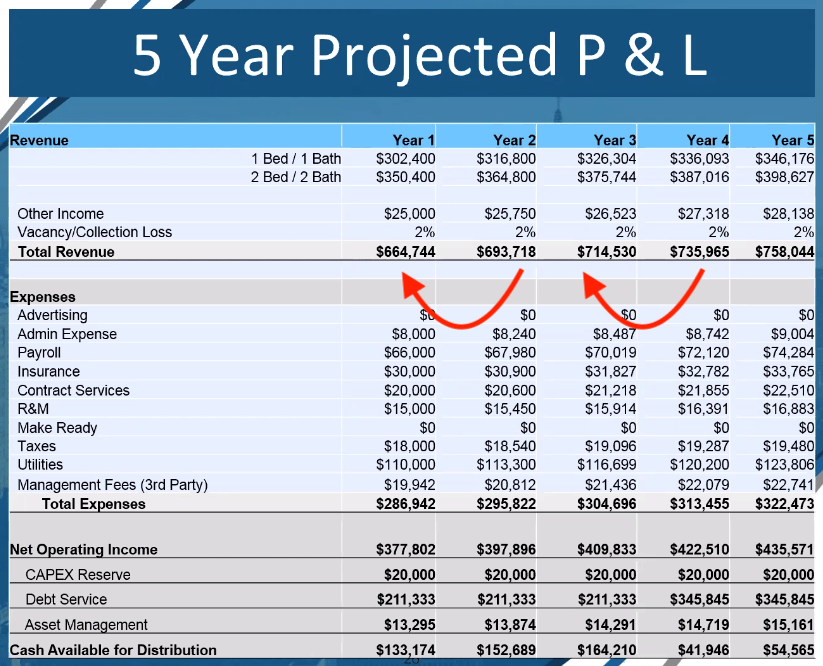
Rent Increases
You may have to calculate this for yourself when you analyze deals, as most syndicators will not openly point this out because they might be being too aggressive. 3% here is a very high estimate. We try to use rent escalators of 2% even in strong markets like Dallas or Houston.
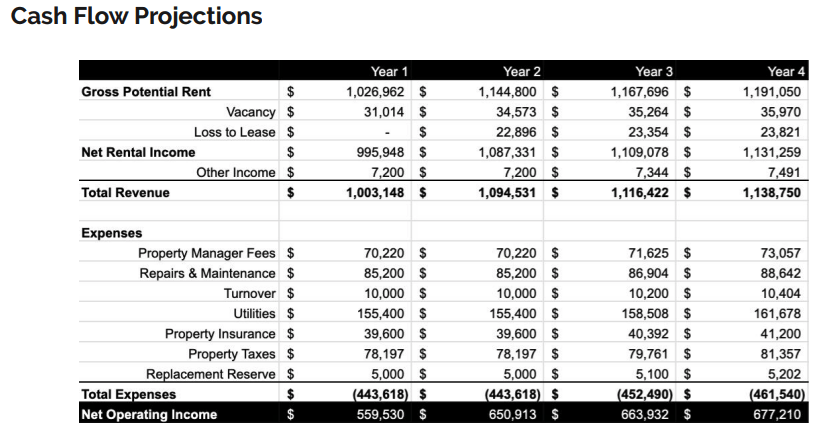
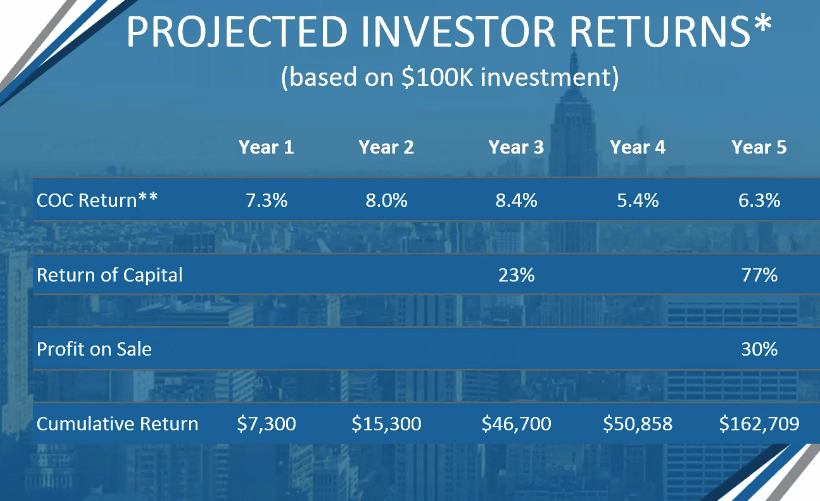
Vacancy, Loss to Lease, Expenses
In a potential real estate deal, when it comes to property analysis, don’t just look at the total net operating income; see if you can spot what is not working in terms of Income, Vacancy rate, Loss to Lease, or Operating Expenses. The annual rent increases after the first-year bump is 2%. This is acceptable for this good market. However, the Vacancy & Loss to Lease (people not paying) is too low. Usually, we like to see a Vacancy of 5-10%, depending on the market, with 10-15% in the first year as we kick out bad tenants. The Loss to Lease (or deadbeats not paying) is typically 2-5% with a surge of 3-8% in the first year. Expenses at a bit over $4,000/unit are good.
Breakeven Point
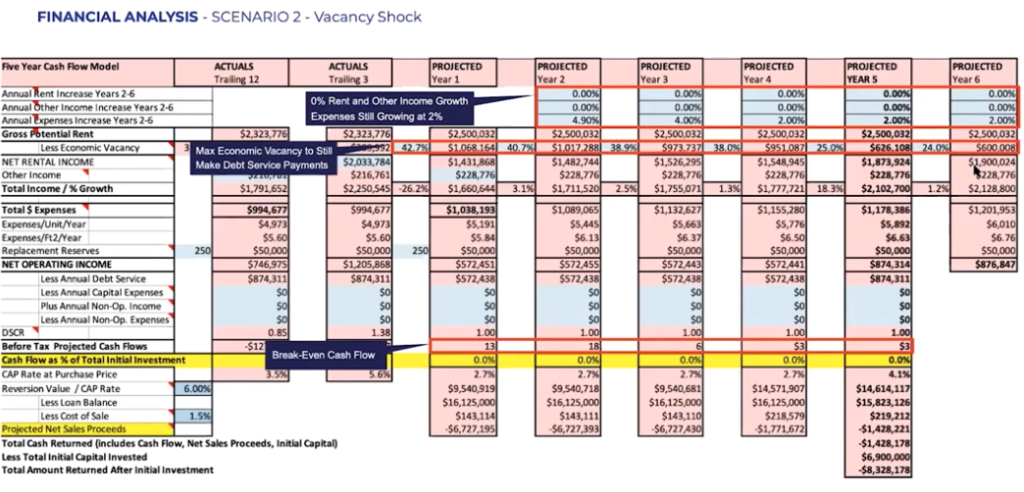
The biggest risk in all real estate investing is keeping it occupied (or economic occupancy – people actually paying). One way of determining this is by asking what the break-even point is. Be careful that this stat can be manipulated and you as the investor, need to be sophisticated enough to ask the right question (or fall victim to “syndicator rope-a-dope”) in order to make an informed investment decision – for example if you are asking for occupancy (w/ assumed 3% economic vacancy) or economic occupancy with economic vacancy accounted for? Also, are rent increases included? Now this can start to get very difficult to pin down a sponsor for a real number, but it’s a start, and at least you are aware of these games. We don’t like to assume that the “full occupancy” will be greater than 92-95% occupied (especially in the first year), plus the assumption that ~3% of those tenants will not pay, therefore bringing max economic occupancy down to 89-82% economic occupancy. PS – reversion cap (6%) looks really conservative however this real estate deal is near Waco Tx (smaller tertiary/”turd”tiary 💩 market) where reversion caps should be much higher than solid secondary and tertiary markets.
Cash-out Refi
A cash-out refi is part of the above pro forma in year 3 in order to come up with the total return. A refinance is a big “if.” I would rather see how the investment property performs without a refinance event and just a straight sale.
Check Your Numbers!
Deal
Rent-to-value ratio: Should be 1.0-1.5% for class B and C multifamily real estate
Cap Rate: – Estimate an exit cap rate of 0.5-1.0% higher than the current prevailing market cap rate for comparable properties of the same class in the market/submarket (NOT the subject property’s cap rate) to account for market changes.
Equity multiplier: Should be 1.8- 2x over 5 years, or at least an 80% return in 5 years. But the equity multiplier is just a quick way of looking at the total return. You need to check the other assumptions of the underwriting to make an informed decision and be sure this Equity multiplier isn’t just wishful thinking.
Cash Flow: 5-8% cash flow a year is about average for stabilized assets.
Purchase Price: In a light value-add deal, should be $55k-85k per unit in purchase price.
Rehab/Rent
Rent increase after rehab: Should be 10-15% or less.
Stabilized annual rent increase thereafter: 2% increase is a good, conservative number.
Economic vacancy after initial rent bump: Expect to see 15-20% vacancy if bumping rents by more than 15%.
Stabilized economic vacancy thereafter: Should be 10-12% conservatively.
Amount spent on rehab:
– $2-4k per unit is a basic upgrade. It will get you basic stuff, paint, carpet, flooring, etc.
– $4-8k per unit is a high-end upgrade. It will get you kitchen countertops, backsplashes, appliances, etc.
Verify that rent rolls match the pro forma
Are the expenses going up similar to rent increases? Generally, they should be the same percentage or close.
Fees
Acquisition or Organizational Fee: This fee is usually a small percentage of the purchase price of the investment property (typically 1-3%).
Asset Management Fee: To reimburse the sponsor for actively managing the property (typically 1-3% of revenues (gross rents))
Equity or Equity Placement Fee: Paid to an internal or external team for raising funds (typically 0-3%). This is tricky… lump this into the acquisition fee, which should but 0-3% altogether.
Disposition Fee: This is the fee for the work involved when selling the property (typically around 1-3%).
Financing or Loan Fee: This can be 0.5-1%. This is tricky… lump this into the acquisition fee.
Construction Fee: If there’s a significant amount of renovation or development, there may be a fee charged for overseeing the construction (typically 3-6% of hard construction costs).
Expense Amount: $4k per unit is normal for a stabilized property. I think this should just be included in the asset management fee.
Loan/Funds
Loan term: Longer-term debt is better than bridge debt to ride out economic cycles. 8-12 years is the sweet spot for term. Too long and has large prepayment penalties. Too short and may have to refinance at a bad time economically.
Co-investment: Sponsors will usually put in 5-10% of the investment (unless they’re doing a lot of real estate syndication, in which case putting in 10% in every deal is not feasible).
How much of the capital in a fund is invested in cash, short-term investments, and long-term investments?: 10-20% of cash and short-term investments is good. Below 5% is bad.
Is the fund always open? If it’s not open, the liquidity of your funds will be more difficult. If the fund is open, ask for last quarter returns and trailing 12 months of total return.
Debt service coverage ratio: Should be 1.25 or higher.
Liquidity: Post-close liquidity should be at least 10% or at least $250/unit.
Questions to Answer When Conducting Real Estate Deal Analysis
- What are they doing to achieve the pro forma rents, and how do they know their expectations are achievable?
- What are their assumptions for expenses, and how do they know they’re reasonable?
- What are their assumptions for economic vacancy (i.e., vacancy, concessions, bad debt, etc.) and the resulting economic occupancy?
- What are their assumptions for annual income and expense growth, and what are they based on?
Check Your Numbers
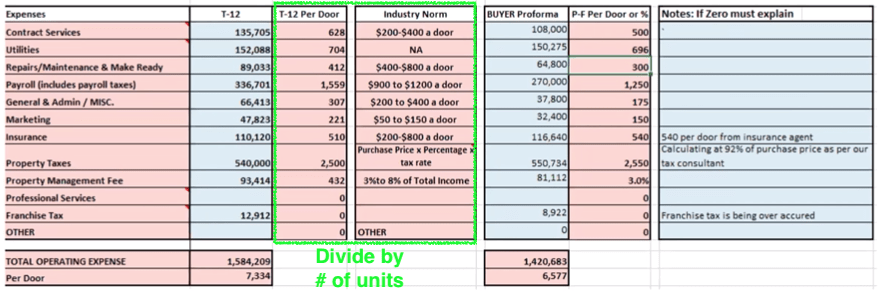
Here are some rules of thumb on the Profit & Loss statement
Note: The following analysis is out of the scope of most LPs’ due diligence. It would definitely be unusual for an LP to ask for breakouts of the following.
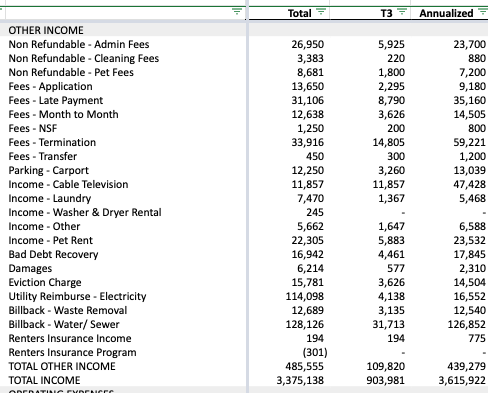
What’s “other income”?
All the other income the property makes, other than rents. See above an example from a 240-unit Class B+ asset.
For our large apartment complexes, we typically have 20-30 days (all during helping investors sign their PPMs and facilitating wires) to conduct an exhaustive review of all the moving pieces related to this business and asset we are looking to buy.
While those teams are busy getting in all the units, we are executing a file audit, making sure the paper copies match up with what is listed online. During this, we also check to make sure the names match, rents are the same, end of lease is consistent. It seems very tedious, but the process can be sped up by taking a holistic look at rent rolls, leases, and actual bank statements. Experience also comes into play (a few mistakes written in figurative blood) on what to look out for as inconsistencies. For example, a greatly increasing occupancy from 85% to 92% in the last six months might mean that the seller put in warm bodies into the property to get over the 90% occupancy mark, so we would audit those leases to see if they were properly screened. It’s a lot of data, but this stuff isn’t rocket science.
While we are able with the review financials with the second set of eyes of our property management team, we recognize that we do not have the facility technician expertise of a HVAC tradesman, despite myself being a Facility Engineer for a medial office and building for the Federal Government for a short stent before jumping ship to work for myself. We hire third-party inspectors who are the facility system experts to come on-site to review all the major systems. Think of it as your property inspector for your house, but without all the nonsense that the inspector says they are not an expert in home component XYZ. We get true experts, if they were not not they would not be commercial vendors… they would be a dude inspecting residential houses with an iPad and a ladder. We typically make sure we bring in the following outside inspectors: a roofing company to check/validate the condition of the roof; an HVAC specialist to inspect a large sample size of A/C units to give us an overall condition report. If needed we also pay plumbers, who put cameras down main lines at each building; foundation experts to review soil content and inspect any previous/potential building shifting (we have been burned and learned from this and now it is a standard operating procedure); pool company to check on pool/equipment; and an IT audit to review all computer equipment onsite.
If the scope of work is over the capability of our property management team, we will get General Contractors to start refining the intended scope of work, and getting bids on that work to get hard numbers.
As you can imagine, a lot of things are going on between getting a property under contract, putting the word out to investors, and finally closing. We try to underwrite with more conservative numbers, and often times, projections improve the week before closing.
Actuals vs. Projected – which to use in underwriting?
The actual income and expense numbers the seller provides you for your underwriting should be close to reality, but even if they are, you’ll operate the property differently. Your numbers will be different, and it will likely be calculated differently. For example, the old seller might account for the maintenance and repairs differently and not capex, or they might stuff additional salaries or underreport salaries of staff. This is where the art of apartment investing comes into play and where we need to do a lot of detective work to come up with a reasonable proforma that we can run the asset on. Luckily, we have past experience and many of our own assets to benchmark with, and we also independently use our property managers’ experience and total portfolio insight, too. We really like it when our property manager gives us an operating budget proforma lower than ours because this is a good sign that we will beat our projections.
Now, do you use trailing 12-month financials or from the last three months (T12 or T3)?
Remember that the purpose of your underwriting is to project a picture of the future as accurately as possible. If the property had high vacancy for the six month period up to six months ago, then got units renovated, new marketing, or something else improved, and filled those units, it could be safe to say that the next 12 months of rent income will be more like the last three than the six months starting a year ago. So T3 for income. This is where the detective work goes on, where you request information from the seller, broker, and look for other signs to verify the “story”.
You start at the big expenses very carefully – insurance, property tax, and repairs. Other big expenses like utilities and property management are easier to project.
Insurance – Some could be $225/door, others $300+. Nothing beats having real quotes from insurance brokers with whom you have had a working relationship.
Property tax – this can be very hard to confirm. Will it go up when the sale is recorded? Or three years later? What is the county’s formula for calculating property tax? Go to the assessor’s website, call the county, and talk to the broker. Experienced brokers know how it’s calculated and when it goes up. We usually account for a blanket increase in the coming years, which can be as high as two times the current, especially in aggressive tax states (to fuel growth) like Texas.
Repairs – These are sent to buyers and include other things in repair costs, like capital improvements. If an owner is upgrading a unit from laminate countertops to granite, that is not a repair; that is a capital improvement. They didn’t have to do that; they chose to, so the unit would look nicer. But they are operator, not accountants, and in our case, not the most sophisticated at keeping good records. In many cases, expenses got thrown into the same bucket as leaky faucet repair and plugged toilets. Look for repair expenses and be sure to include supplies, maintenance, and turnover expenses. They are often broken out separately, but for you to decide if they make sense, lump them together. The rule of thumb might be $300-$600/unit, but if it’s higher, do a property tour and see for yourself. Is it a very nice property? Then why so much on repairs? Or is the repair expense very low? Does the owner do repairs himself or herself? So are they not accounting for his time and expenses? These are questions that the GP digs for, but as an LP, this is just food for thought.
Utilities – there will probably not be much opportunity to tweak these because it is normally what it is. Implementing RUBS or a partial bill-back utility program will require some time to implement, and some will move out.
Management – if the owner has one or two people on staff and their payroll is reasonable, it might be a good plan to keep those people at take over. The property could be significantly overstaffed, or there could be some staff costs hidden off the books. PM costs greatly range based on property size, from 3% for larger properties to 8% for properties under 50 units. This is where we work with our property manager to create a scope and fee estimate and plug the number into our projections.
Marketing – if the seller’s numbers are $0, that might be a good indicator that they get drive-by traffic or the free listings work for them. We plan on using marketing to get the optimal amount of traffic to be able to have an ample tenant pool to select from and eventually build a waitlist, which is why we can be pre-leased over 103%.
Landscaping, pest control – these aren’t huge percentages of expenses. It accounts for yard maintenance, snow removal, trees and bushes to trim, ponds, and storm runoff issues.
Talk it through with us
Questions on “Analyzing Deals” as you look at real deals? Join The Wealth Elevator investor community and bring them to your onboarding call.
Join the club and book your onboarding callJoining is free.

The podcast behind this course
The Wealth Elevator Podcast
Lane's show for accredited investors on passive syndications, taxes and alternative investments. Many of the lessons in this course started as episodes.
Listen on Apple PodcastsWatch on YouTube