

My Experience Starting in Syndications
At the end of the day, the number analysis (what assumptions were used) is only 1/2 of the battle in vetting a real estate syndication deal to invest in. The first is people. Never work with anyone you don’t know, like, or trust. That is how I lost $40,000 in my first LP deal.
Whenever I get a pitch deck, I usually know if I’m going to invest in it even before I run the numbers because I know the syndicator, I know them personally and we have a relationship outside of real estate.
People in our Family Office Ohana Mastermind bring me real estate syndication deals all the time but if it’s a cold contact I always ask “Who the heck is this deal sponsor?”
Typically, the answer is they found the syndication opportunity on some sales page funnel, internet forum, or worse got it from a cold email out. A sophisticated investor would call these real estate syndicates “daisy-chain deals”.
It sounds basic, but I Google stalk the general partner and find them on Facebook and LinkedIn. In this day and age, if a real estate syndicator does not have a digital footprint that is their authentic self I don’t want to work with them — plus I want to work with real people, not robots. Ultimately, what I am doing is trying to see if any trusted LP investor in my network knows the operator.

#BluePantsBrownShoes
Real estate is all marketing, whether it’s a $500,000 primary residence or a $20M syndication investment opportunity. I was at a family office consultation and an institutional firm sent a consultant to represent them in investor relations. As I was doing my due diligence on him and the firm, I found that he was also previously in investor relations for another firm in another asset class on top of being just a run-of-the-mill life coach. It’s unfortunate that in this world brown shoes, blue pants, and grey hair are looking the part.
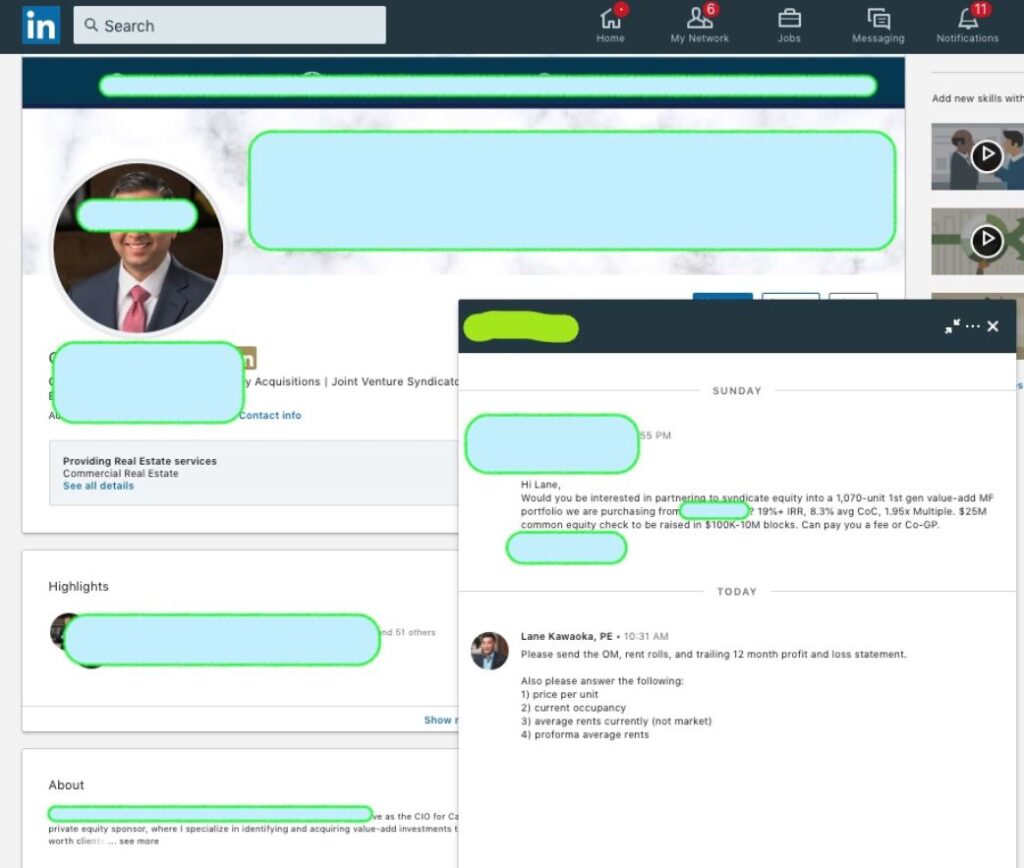
Another random cold pitch is shown here. It is very rare that these COLD pitches ever lead somewhere. Most times it is just a waste of time. Everyone can create a nice logo, and website, and take a pretty profile picture. Check out these past deal webinars so you are not taken as an amateur syndication investor who has never seen a deal.
To edge into why social proof and fake influence metrics are sought, here is some insight from global marketing consultant and author of the Marketing Rebellion, Mark Schaefer :
“Whether we are online or offline, we use social proof every day to make low-risk decisions when we don’t have the whole story. Our behavior is often driven by the assumption that people with lots of followers may possess more knowledge about what is correct, popular, or ideal — a herd mentality”
”People just don’t dig deeper to see if somebody is legitimate or a list of followers is real so it’s possible to be rewarded for simply faking it. And many do. While badges of social proof can be gamed, humanity cannot. Nurturing true authority through authenticity, meaningful content, and an engaged group of followers will lead to a legitimate reputation and business.”
Some Things I Learned Along the Way
Numbers are a big part of real estate syndication investing and if you find the right deal, any half idiot can do okay (like my Atlanta deal where we more than 2x investors’ money in 2.5 years). If you want to grab the P&Ls and rent rolls, I’ll run the deal for you and see how the numbers really work. Numbers don’t lie, people do.

Remote Operator
I had a Rule where I would not invest in a deal where the main operator was living in Hawaii/California and buying a property in Texas. At the very least it needed to be a short 1 hour flight or less. More leniency will be given if the operator passes the other rules listed.

Types of Investors
Initially, I liked investing with professionals who got paid a six-figure salary because indicates that they were able to execute a plan to achieve a college-level degree (showing commitment and execution) and hopefully (relying on social proof) can hold down a high-responsibility job. After leading union-based construction crews and over 250M of horizontal construction projects, it makes me laugh at how people outside the realm of the contractor world can expect to effectively manage this type of staff. It does not take much technical knowledge of construction. I see some operators who have made the transition to multifamily investing smoothly but many do not.

Is this a Side Gig?
I am all for people going after their dreams but they are not going to use my 50k to get started and build a track record in passive real estate investing or screw it up. I’ll be damned if they are 80/20-ing their time and attention at their day job and managing my money. Today, I only will work with full-time operators. After leaving my day job, I know firsthand what it takes to commit to a lifestyle and what happens when you “burn the boats”.

Track Record
You might trust a syndication sponsor but try to find someone who has actually invested with them before and gotten a good experience with them. Again, trying to find at least a couple of past projects that are at least going well. Don’t be that first sucker! Let it go to friends, family, and fools!
I’ve listened to so many sponsors be “super excited” to pitch their deals.

Quick Tip: Whenever I see a non-branded email from a business person I always think: “Fly-by-night” operator.
If you’re trying to run a legitimate business, then stop using your @gmail, @yahoo, @outlook, etc. emails. Not saying someone who has a business branded @email address means they are legit, but it’s a start.

One of my favorite stories on managing due diligence came from a well-known investor who passed on a hedge fund because of a raincoat. Here’s the story:
The investor wanted to get to know the manager better, so they agreed to go on a hike. Halfway up the mountain, it began to downpour. Unfortunately, the manager hadn’t checked the forecast and spent the latter part of the hike completely drenched. The (dry) investor realized at that point that the manager was a little too focused on the adventure ahead of him and not at all focused on managing the predictable risks along the way. The investor passed due to concerns over risk management.
We haven’t passed on any managers over rain gear, but I think the point is relevant. In poker, you must observe everything about a player: betting patterns, style of play, tolerance for risk, and personality. You piece together an understanding of the person from the data in order to get a sense of their tendencies. The same applies to due diligence on people. Fortunately, we have a lot more data to work with than at a poker table.
Talk it through with us
Questions on “My Experience” as you look at real deals? Join The Wealth Elevator investor community and bring them to your onboarding call.
Join the club and book your onboarding callJoining is free.

The podcast behind this course
The Wealth Elevator Podcast
Lane's show for accredited investors on passive syndications, taxes and alternative investments. Many of the lessons in this course started as episodes.
Listen on Apple PodcastsWatch on YouTube