


Is a Sponsor/GP/Syndicator the operator or just raising capital?
Some real estate investors want to work directly with the operator but there are some issues with that one being that the operator is obviously going to be biased to their asset class and particular deals.
Whereas the deal sponsor can be less biased. In a way they act as a non-captive broker like how we work with clients to get them the best infinite banking policy regardless of whether it is with Penn Mutual, Ameritas, Mass Mutual, or Guardian. In this world, however, a broker without a license like a Series 7 is a big no-no in terms of SEC securities laws and even then fiduciary responsibility is a laughable topic. The downside of a syndicator is that they just work with those unproven operators who just pay them the highest bounty (illegal if non a broker-dealer) for capital raised. Think about this, if there is a good operator then they probably have a lot of investors and don’t need to pay a pop-up real estate sponsor. The other side of the coin is if the general partner is well connected and has high ethics they can provide an insider point of view on the underlying asset and be that unbiased source for diversified deal flow so the limited partner can actually have a life and enjoy their money and not be a professional investor (spending more than 10 hours a month hunting deals and the right sponsor to work with).
Said in another way, some syndicators are mostly in the middle-person role of sorts; partnering with others who do the primary LOI/PSA/operation roles. Some of them will do their own due diligence on each deal and don’t rubber stamp the primary operator. That additional review layer definitely can add value in oversight and deal selection. A fee well spent for some types of limited partners.
Crowdfunding websites are an example of a “broker” where they go out to find deals but they apply a hidden fee level to market the deal to multiple investors that they have found often these crowdfunding website opportunities have been watered down to go out to the unsophisticated “retail” investors who are very lazy, have zero peer networks. and just want to go to a crowdfunding website… very similar to 99.9% of people going to the 401k mutual fund options. At one time we looked at using a crowdfunding website to fund our deals and did not like the high fees and thought that having potential investors at $1,000-10,000 minimums was not going to be worth it due to the headaches that are typical of lower minimum limited partners.
Back to the question at hand, should you work with the operator or the sales guy…. I mean syndicator/capital raiser?
The hard part is that it’s really freaking tough to tell… and without a Community like our FOOM and strong relationships that go deeper than a 20 min phone call or a beer or two with another peer Accredited investor it’s like operating in the dark. This was me in 2013-2017 when I had to quite frankly kiss a few frogs. There are a lot of educational guru programs out there that pay $30-50k and the content tells you to make it as a new operator/syndicator is to take a lot of selfies to put on social media and fake it till you make it. Every amateur general partner (newbies with under 500 million in assets to 5B AUM firms presents themselves as quite successful, established with experience and connections).
Sometimes these groups will offer Mentorship/Coaching on how to be a GP. From my experience, only 2-4% of those who pay that exorbitant fee actually breakthrough after 2 years of grinding (faking it till they make it and some broker gives them a halfway decent deal – or they force through 99% of deals that are crap). The way the education business works is that 96-98% of those who did the program give up because investors to those unproven students in the program – funny huh!
Personally, I want to work with someone operator or syndicator who is a decision maker in the GP and holds no less than 25% of the GP voting rights. There are a myriad of deals out there, typically by newer guys who have 8-20 GPs. Most of them are on the team to just bring in 500k-1M of LP investor capital. This is a huge red flag in terms of SEC securities law. I see this as a potential issue for LPs with so a large co GP structure or cooks in the kitchen with some motivations not purely aligned with what is best for the LP. In my earlier deals, it was really frustrating to get anything done and it was detrimental to the asset. But those days are mostly over because you folks come in with the Hui and we come in with as much as 10-12M into one deal and collectively control the majority of the voting rights. This is important because on my one bad deal where we had a dishonest and incompetent GP, our group was able to quickly vote them out and I was able to control the GP on behalf of my LPs.
I have mentioned earlier that once a firm gets over 500M or 1B in assets under ownership they are to a certain level of sophistication where they have shed their newbie status and an LP might not need to see 10%+ of the GP skin in the game. Highly reputable first don’t put any skin in the game as a data point, yet you see these stubborn LPs don’t look at the whole picture. But anyway… some syndicators might fudge their assets under management/ownership even though they only brought in 250k or 1M in a 50M deal where 15M of required capital was needed (less 6% of the equity) yet they count the score as 50M of AUM. So it’s tricky… and everybody does it but the question is on all these deals on your so-called track record sheet how much GP% stake did you have? Today, as of early 2022, we have funded over 150M in equity from our Hui group alone. That is a fraction of these venture capital-powered crowdfunding websites and often 10-20x our competitors taking selfies on social media or 2-3x those who are actually running legit operators.
Here is some parting advice:
- Commit. The lucrative world of private investments is not for the weak or flaky who are quick to change their mind. Most funds will require a commitment to a long-term vision of the management and investment windows of 3 to 7 years. Are you up to the task? If you like to jump from one investment to another… this isn’t for you.
- Communicate. Management should communicate with you regularly, so be sure you stay in touch from your side. Discuss with management any issues or problems you have.
- Be Humble. Don’t expect to know everything about everything. Trust the experts in their fields. If they know what they’re talking about, then it’s time to step back and let them get to work – that is if you are working with a proven team.
To avoid bad deals, ask the right questions, and do your due diligence. Don’t work with random people!
I constantly get pitched in some shameful ways like Facebook Messenger and cold texts to bring our group into random deals with total strangers.
On the flip side, just because an operator has supposedly many successful full-cycle (exits) deals with high average returns, they might just be the lucky guy who invested in the right times and then changed their underwriting style or business plan.
Like beta and alpha in the stock market, returns include both a market component (largely out of the operator’s control) and an operating component (largely based on the acquisition terms plus the operator’s skill and resources). Those who depend on the market for their returns will be at the mercy of the market when things go south.
Ironically, it’s likely that a true professional (i.e., seasoned, tenured) operator’s returns may not be as high as some big-name, newer operators in rising markets. Some of these less seasoned name brands have taken major risks (using extreme leverage or short-term debt, for example) that have paid off in a rising market.
But let’s see where these risks could land them when the market turns against them. Investor equity in high-leverage deals can evaporate when just a few things go wrong. We watched this happen to too many investors in previous cycles like 2008 and before.
The projected and past returns should always be evaluated in light of the risks including…
- The operator’s experience, team, and operating capabilities
- The type of debt, the term, loan-to-cost, and DSCR
- The acquisition price and value-add opportunities
- The underwriting assumptions (like occupancy, revenue growth, the exit cap rate, and much more)
- A sensitivity analysis considering ongoing interest rate hikes, deflation, higher vacancy, etc.
- The operator’s real financial skin in the game
- The barriers to entry around the property and/or asset class
It is tough for most investors to accurately account for all these items when evaluating an operator and an investment opportunity. It is challenging for us to do so, and this is our job with a lot of unfair networking positioning advantages on the average LP. The next section will help you understand some of the numbers behind this deal to increase the odds of achieving your investment goals.

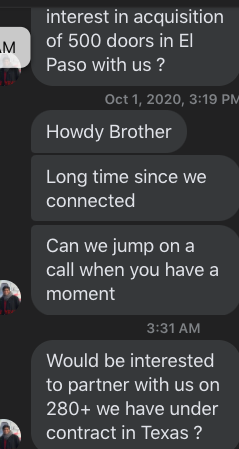
All these strangers reaching out to me belong on the Wall of Shame…
Questions to Ask the Sponsor
Because private investments are passive and investors will have no hand in management, the most vital step in the whole process is scrutinizing the managers, their experience, and track record. You can find the complete list in our Due-Diligence Scorecard & Checklist.
Here are some questions to ask:

Experience
- How long has the sponsor team been in place?
- How long have the principals been in real estate investing?
- How many assets have they acquired or currently own, manage, etc.?
- Have they gone through an up-and-down cycle?
- Did they go through the Real Estate Crisis in 2008?
- How familiar are they with the property location?
- Have they ever had to make capital calls on past deals?
- Search LinkedIn and Facebook and contact mutual friends to get references
Track Record
- What were the projected returns vs. actual performance?
- Can they explain their losses?
- How good are the deals? Risk/reward, target ROI, downside protection.
- What is the fund transparency? Will you show the assets and performance in the fund?
- What percentage of deals hitting the sponsor’s desk get reviewed (ideally less than 25%) and what percentage gets funded (ideally less than 10%)?
Leadership Team
- Who are the major players on the team, what do they do themselves, and what do they outsource?
- Any criminal history or financial background issues that I should know about (including what I might find if running a background check?
Financing
- Are the GPs financing with their own cash reserve and net worth, or are they dependent on loan sponsors/key principals to qualify for debt? When the sponsors get loans, the lender requires that they have a certain net worth (e.g., equal to the loan amount) and cash reserves (10% of the loan amount).
Operation
Do they have in-house property management or are they using outsourced professional property management?
- Does the property manager/management team have experience with similar projects in the market?
- Does the property manager have a stellar reputation in the industry and are respected by their peers?
- Are they committed to bringing value to the project (for example, in the case of multifamily, to create a great apartment community)?
- How likely is it that the property manager going to efficiently execute the project’s business plan?
- Is there a track record of solid, quantifiable success as a property manager?
- What type of education does the property manager have?
- Are the property manager’s skills being constantly improved and updated?
- What types of deals does the fund invest in? (Debt, equity, asset type, deal size, location, value-add, or performing.)
I can’t say this enough. Even if your deal’s sponsor has done everything else perfectly, the wrong property manager or management company can cause an otherwise solid project to unravel. Spend some time making sure that the sponsor has the right person for the job.
Other Things to Look Out For
Money Going Hard
Many general partners put up substantial amounts of money that is non-refundable after a certain point in the diligence phase. This is called your money going hard. It’s a dirty little secret that many operators will force a deal to happen with loose underwriting rather than pull out of the deal and eat $50,000 to $200,000 of their non-refundable earnest money.
Capital Raisers
In the past couple of years, there has been a new breed of sponsors that call themselves “capital raisers”. Many of them are violating securities laws because they’re being paid transaction-based compensation, despite not having a broker-dealer license from FINRA. These capital raisers seem to be coming up with all kinds of creative “loopholes” around broker-dealer laws that just don’t hold up. Over the past few months, I’ve seen or heard about the following suspect practices:
- Capital raisers receiving compensation from the investment’s acquisition or asset management fees
- Capital raisers get a portion of the management or sponsor entity in proportion to how much they raise, this is also known as “Deferred equity structures”
- Having an excessive amount (over a dozen) of individuals in the sponsor team
- Capital raisers marketing to unsuspecting investors, claiming to be “part of the General Partnership”. NOTE: Do your due diligence, you can verify who’s in the GP by checking the PPM or Investor Summary/Deck
Ok, so how do I prevent myself from going into one of these questionable deals? Take a look at the entire GP sponsor team and ask what are the roles here. It is unusual to have more than 3-4 people in the sponsor team – any more and they are likely capital raises for hire which is illegal. It’s fine if they have a legit role but be wary. Remember our due diligence is with the “operator” not the “marketer” of the deal.
Talk it through with us
Questions on “Operators and Syndicators” as you look at real deals? Join The Wealth Elevator investor community and bring them to your onboarding call.
Join the club and book your onboarding callJoining is free.

The podcast behind this course
The Wealth Elevator Podcast
Lane's show for accredited investors on passive syndications, taxes and alternative investments. Many of the lessons in this course started as episodes.
Listen on Apple PodcastsWatch on YouTube