


The Cost to Syndicate a Real Estate Deal
Now that we’ve gotten past the “what is real estate syndication” part of the course, we can get into the costs and syndication fees.
The first logical question is about the cost of a real estate syndication deal.
There are several major fixed cost items that every syndication requires, including: Real estate contract attorney, SEC attorney, earnest money deposit, diligence, preparation of private placement memorandum and SEC filings, loan application fees, and more.
So, let’s break them down. As some fees are percentage-based, I’m going to create a hypothetical $2,000,000 syndication deal.
- Population growth
- Job growth
- Demographics
- Interest rates
- Desirability of the market itself
- Attorney for Purchase Contract – $3,000
- SEC Attorney for PPM – $12,000
- Earnest money deposit – 1% – $40,000
- Diligence – $25-$50 per door – $4,000
- Loan Application – 1% – $40,000
- Other Financing Costs – 0.5% – 1% – $20,000
Total Costs – $119,000 to get the real estate investment done, of which $40,000 goes toward the purchase.
So the total fixed costs are $79,000 or 2-5% of the total deal price. As you can see, this is not cheap!
The real estate syndicator has to front all of the money, and if the investment property doesn’t close, most of that money can be lost. So, you can see one reason why syndicators are compensated pretty well.
And you can also see why an unscrupulous real estate sponsor might manipulate the numbers to sell a deal that might not be so great – they’ve already put some skin in the game.

If you have not yet, please review at least a couple of past syndicated real estate deal webinars. This way, you have some basis in reality of what deals look like and the academics you are learning in this ecourse come alive!
Conclusion and Key Takeaways
Real Estate Syndicates Are Expensive – And Risky for the Deal Sponsor – Between attorneys, earnest money, diligence, and loan costs, upfront syndication expenses can exceed $75K–$100K. These costs are typically fronted by the deal sponsor and are largely unrecoverable if the real estate project doesn’t close.
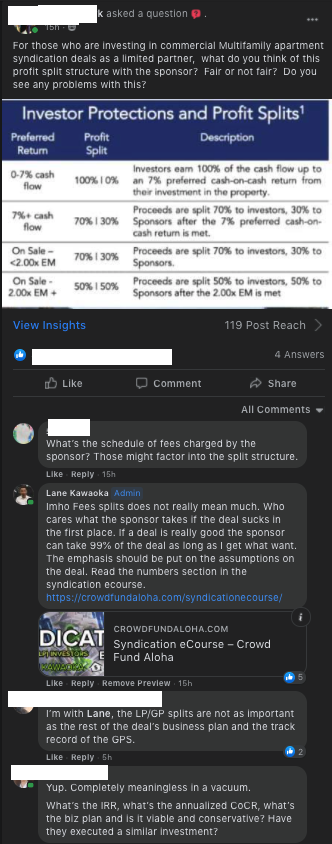
Syndicators Don’t Work for Free – Understand Their Incentives – Sponsors are compensated through fees (acquisition, asset management, and exit) and a share of the profits. A typical structure might be a 70/30 split after a preferred return, with the GP earning 25–50% of upside depending on deal performance.
High Fees Aren’t Always Bad – Look at the Whole Picture – Just because a real estate syndication company charges higher syndication fees doesn’t mean it’s a bad syndication deal. Strong operators with a track record of solid returns often justify premium pricing. Focus on net returns to LPs—not just the fee schedule.
Fees Reflect the Work Behind the Scenes – Not Just Greed – Syndicators carry operational risk, investor relations duties, and often personal liability on the loan. Quality sponsors earn their fees by managing a complex, high-stakes process from the acquisition of the real estate property to exit.
GP Skin in the Game Helps Align Interests – But Isn’t Everything – While it’s good for sponsors to invest alongside the limited partnership, the more important factor is whether the syndication deals have strong underwriting, realistic assumptions, and a reasonable structure that rewards everyone fairly.
Brokerage and Management Fees May Also Apply – Know What’s Layered In – Some GPs earn commissions through affiliated brokerages or property management arms. These should be disclosed and evaluated, but again, judge based on total deal economics, not isolated line items.
Not All Returns Are Equal – Vet the Numbers, Not the Marketing – Sponsors may tweak splits or assumptions to make deals look more attractive. A sophisticated real estate investor will dig into the underwriting and focus on net LP returns, not just pretty pitch decks.
Understand What You’re Paying For – These Are Packaged Products – Syndication deals are essentially investment products. Your job as an individual investor is to assess the operator, the market, and the underwriting assumptions to determine if it’s priced fairly based on what’s “under the hood.”
How Does A Syndicator Make Money?
Your Sponsor is not going through the labor of finding good deals, operating it, putting their name on the loan, and all the issues/liability that comes with taking on passive investors (with their own personalities) for free.
Syndicators typically earn between 25% and 50% of distributable cash (carried interest) generated from operations, refinance, or sale of a property, which may be paid as a direct split between the members and the syndicator (i.e., 70/30) after the preferred return, if there is one.
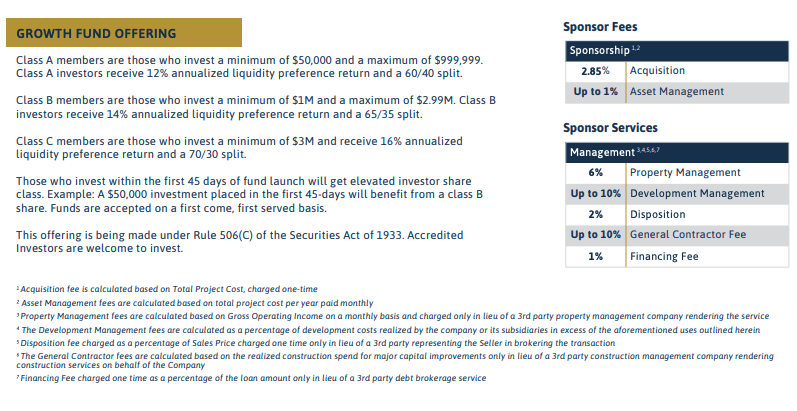
Fees. Real estate syndication fees are an expense of the syndication and may be collected by the syndicator on a monthly, quarterly, or annual basis. The typical fees a syndicator may earn are shown here:
Financial planners and the Wall Street Industry have been known to take the majority of returns, often with no skin in the game or carried interest.
Check out some of the hidden fees in more traditional assets.
What Type of Fees Are Paid to Syndicators?
The above fees can be broken down into the three main fees (so you might have to combine some of the above fees under one of the categories below):
- Acquisition fee (paid % of the asset price) – normally 1-3%
- Asset management fee (paid % of the income the asset produces) – normally 1-3%
- Exit or disposition fee (paid % of the sold asset price) – normally 1-3%
- Development fees (this is present in development deals) – example
Real Estate Brokerage Fees – A syndicator who is a licensed real estate broker or agent in the state where the property is located may also earn commissions or fees for providing licensed brokerage activities to the syndication, including:
- Commissions on the purchase of the investment property
- Resale commissions
- Property management fees (if the sponsor team does not live near the asset and hires a 3rd party property management company). On your 1-8 unit, you might be paying 8-10% of rent,s but commercial property manager compensation plans are different. Normal ranges are 3-6% with some fixed salary costs for staff.
Expense Reimbursement – In addition to the above fees and distributions a syndicator may earn, the syndicator can get reimbursed for payments it makes to third parties during organization of the company, due diligence/acquisition, or operation of the property. Sometimes, if a property is off market, the sponsors might pay a finder’s fee to the wholesaler who found the deal (range 1-3%)

NOTE: Just because these fees are high or the split structure has too much going to the GP does not disqualify it. This is what unsophisticated investors think who have a surface level of understanding of these deals. Again, it’s all in how much meat there is on a deal. For example, our process for setting fees and splits is to underwrite conservatively for LPs to get 80-100% ROI on their money in 5 years. If the deal is very fat due to our deal-finding ability, we will bump up our fees. Hopefully, you are starting to see these investments as products, and they have a set market price. Your job is to determine if under the hood of these packages is it is underwritten properly and with a good sponsor.
Understanding the GPs’ fees will tell you what their incentives are and how they operate. Don’t always choose the sponsors with the lowest fees. Sometimes, high fees are just the cost of doing business when they generate great returns for you.
This is educational content, not tax, legal, or investment advice. We are not attorneys, CPAs, or financial planners. Please let us know if you need a referral to a 💼 CPA, ⚖️ Lawyer, or other vendor here.
Talk it through with us
Questions on “Costs and Fees” as you look at real deals? Join The Wealth Elevator investor community and bring them to your onboarding call.
Join the club and book your onboarding callJoining is free.

The podcast behind this course
The Wealth Elevator Podcast
Lane's show for accredited investors on passive syndications, taxes and alternative investments. Many of the lessons in this course started as episodes.
Listen on Apple PodcastsWatch on YouTube