


Your Role as an LP – Limited Partnership Agreement
When you receive the PPM, you will also be given the Limited Partnership agreement. Here’s what to focus on as a passive investor:
Capitalization
- The partnership agreement will list the different interest classes in the deal, commonly seen as Class A (limited partner) and Class B (general partner) investors. One class will have capital only (LPs), and the other will have capital and services (GPs)
GPs’ Rights and Duties
- This will outline what the general partner’s responsibilities are, such as making business decisions, managing business operations, and representing the partnership entity. The general partnership has a fiduciary duty to act in the best interests of the limited partnership.
GP Removal
- The two most common ways a GP is removed are GP willingly resigns, giving a notice to the LPs, or they are voted out for “Good Cause” by a certain number of LPs. The number of days’ notice, percentage of votes required, and definition of “Good Cause” will be in the LP agreement.
Accounting Policies
- The company’s fiscal year will be defined. LPs will have access to the accounting records, and the agreement will explain how individual partners can make a reasonable request to see them.
Disassociation of an LP
- This will outline the conditions under which a silent partner or limited partner can be removed. This can include engaging in purposeful conduct that is harmful to the business entity or business owner. However, this is very rare as LPs typically do not make operational decisions, which limits their personal liability and grants some limited liability protection under the Limited Partnerships Act or Partnership Act.
Termination of the Company
- The company is only terminated by the sale of the property or by a majority vote to dissolve. The agreement will describe the distribution of the company’s assets upon termination.
Tax Documentation
- Profit and loss allocations from operations/capital transactions will be detailed. A “tax representative” from the GPs will be designated.
Dispute Resolution
- The limits of what can be sought by a disputing party are defined, should there be a dispute between the LPs and GPs. You should seek your own legal counsel to look over the PPM and the agreement.
Immaterial Errors & Addenda
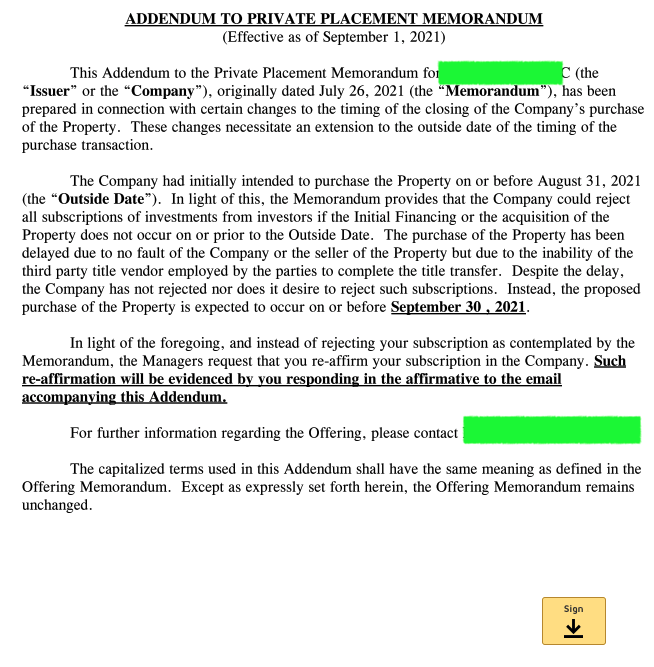
There are no legal documents that are perfect. Oftentimes times PPM documents are form documents with sections changed out and customized, but never written from scratch. Common errors that are immaterial are incorrect spellings, differences in minimal investments (overridden by management approval), or grammatical errors. Again, no document is perfect but if there are more than a handful of errors it is up to you to as an investor… at the end of the day you should not be working with anyone you do not trust and a perfect legal document does not mean jack if you are working with dishonest people.
We are not giving you legal advice on anything here, but one practical way of dealing with this is to get a memorandum of understanding to clarify some of the inconsistencies you found. Just going through this exercise can see how the operator works through and communicates the inconsistencies – think of it as working with your spouse on a pre-nuptial… if you can’t do it amicably, then maybe you should not get married.
Small issues that are inflexible or material are stated as maximums of the capital raise or capex budget numbers that are not caveated as estimates or hard capped. These are hard numbers and will require an Addendum signed by all investors – see example below (where the silly mistake that the legal/GP team made was hard typing a closing date (without leaving it open). A practical lawyer will write the PPM to allow for some variability to avoid a complete rewrite and re-filling of the PPM documents.
Tax Hack
Use passive losses to save on your taxes!
Conclusion and Key Takeaways
The LPA Is Where the Real Rules Live – The Limited Partnership Agreement (LPA) spells out how the partnership actually operates—everything from GP duties and accounting policies to LP rights and exit procedures. Read it just as carefully as the PPM.
Not All Capital Is Created Equal – LPs are typically passive investors contributing capital only, while GPs invest both money and sweat equity. Know which class you’re in (Class A or B) and what that means for returns and decision-making.
GPs Can Be Removed—But It’s Rare – Most LPAs allow for GP removal under “Good Cause” or resignation with notice. It’s a safeguard, not a get-out-of-jail-free card. Make sure the process and thresholds are clearly defined.
No Control = Less Liability – LPs generally can’t make operational decisions, but that also limits your liability. The LPA will outline exactly how disputes are handled and under what conditions LPs can be removed.
PPMs Are Living Documents—Kind Of – Minor errors (like typos or wrong investment minimums) are common and usually immaterial. But anything that materially affects the deal (closing date, max raise, capex budget) must be corrected with a formal addendum.
A Flawless Document Doesn’t Equal a Flawless Sponsor – Legal perfection doesn’t matter if the sponsor is shady. A sloppy doc might be forgivable; bad communication or unwillingness to clarify terms is not. Think of it like a pre-nup—how the sponsor handles issues says a lot.
Be Prepared Before You Sign – Have your funds ready, title details finalized, and accreditation proof in hand. Delays in paperwork or verification can cost you a seat at the table in competitive deals.
Verification Requirements Vary by Structure – Whether you invest individually, as a sole proprietorship, jointly, through an entity, trust, or self-directed retirement account, your proof of accreditation and legal paperwork must match the ownership structure exactly.
Distributions Follow Title and Tax Structure – ACH details must align with the title under which you invest, and you’ll need to know how your entity files taxes (1065, 1120, etc.) to ensure proper K-1 reporting.
Legal Advice Isn’t On the Menu – Sponsors should not and will not give you legal or tax advice. Loop in your CPA and attorney early in the process so you don’t run into surprises post-close.

PPM Signing Guide
Below are steps you can take to prepare for investing.
✅ STEP 1 – TALK WITH YOUR CPA/ATTORNEY ABOUT TITLE & INVESTMENT
- Talk with your CPA &/or attorney to confirm that how you plan to take title(legal name under which you will invest) is best for your situation. Consider both tax and estate planning perspectives.
- You will not be able to change the title for one year from the date of acceptance.
- The sponsor should not provide tax or legal advice throughout the life of the investment.
✅ STEP 2 – MOVE FUNDS PRIOR TO SUBMITTING PAPERWORK
- Ensure the full investment amount is in the account from which you or your Custodian will wire to the sponsor.
- Be aware of mail time & check clearing periods required by all parties involved in moving your funds.
✅ STEP 3 – GATHER PROOF OF ACCREDITED INVESTOR STATUS
- In 506(c) offering, which requires proof of accreditation. To protect the investment and all investors, you will need an outside company like VerifyInvestor to confirm accreditation. Here is a video on the steps to getting certified.
- The expiration date on verification expires 90 days after the date of evidence sent to VerifyInvestor.com.
- If a deal is 506C, here is a video on the steps to getting certified.
Have an Attorney/Accountant/Broker-Dealer/Investment Advisor complete the letter as per the template & return it to you. You should obtain one (1) letter per equity owner (see Third Party Verification Letter Instructions by Title Type) document based on your title.
- Keep the letter(s) to submit to VerifyInvestor during the investment process.
- If you choose not to obtain a Third Party Verification Letter, you will need to upload other proof of accreditation to Verify Investors that they require based on your title type.
✅ STEP 4 – ADDITIONAL PREPARATIONS REQUIRED BASED ON TITLE TYPE
ALL TYPES
- For all title types below, you will need to collect ACH instructions for the account where our future distributions will need to be sent. This account must have common ownership with the account from which you will send us your wire to fund your investment, or we may require additional paperwork. In addition, the bank to which we send the ACH must be a United States bank.
- Ensure your title is fully set up, including any legal documents, tax IDs, and bank accounts required.
Individual or Separate Property
- If you are married & live in a Community Property State (AZ, CA, ID, LA, NV, NM, TX, WA, WI, PR), then your spouse must sign a Community Property Waiver in front of a Notary. Instructions will be provided.
Joint or Community Property
- Both spouses/partners will need to execute the Subscription Booklet, & both will need to prove they are Accredited Investors.
- Plan to provide a unique email address for both spouses/partners as well as their unique SSNs.
LLC or Corporation
- Gather & prepare to submit the fully executed Operating Agreement (LLC) or Articles of Incorporation, Minutes, & Bylaws showing all signers (Corporation).
- All members/owners will need to prove they are Accredited Investors if the entity is not Accredited.
- Prepare to send names of all signers & their unique email addresses for paperwork purposes.
- Contact your CPA to identify how your entity does or will file taxes, as this is required for the K-1: Partnership (Form 1065), C-Corporation (Form 1120), S-Corporation (Form 1120-S), Retirement (Form 5500), or Disregarded Entity (Single-Member). Since a Disregarded Entity does not file a return, you will also need to provide the legal name, tax ID, and address of the actual Beneficial Owner that includes the tax information on its tax return (required on K-1).
Trust
- Gather & prepare to submit the fully executed Trust Agreement, Certification of Trust, or Trust Abstract.
- All equity owners will need to prove they are Accredited Investors if the Trust is not Accredited.
- Prepare to send names of all signers & their unique email addresses for paperwork purposes.
Self-Directed Retirement Account
- Contact your Custodian to know how you are required to document the title, the Custodian’s mailing address to use, as well as the Custodian’s EIN or the investor’s created Self-Directed IRA EIN to use on investment paperwork.
- You will also want to obtain the Custodian’s incoming ACH instructions to provide in our Subscription Booklet for future distributions we will send to you.
- Gather & prepare your Custodian’s paperwork that they require to initiate an investment, selecting to “expedite” your investment and to obtain a physical signature from your Custodian(you will send these Custodian documents to the Sponsor to review first).
✅ STEP 5 – SET ASIDE TIME TO COMPLETE INVESTMENT PAPERWORK
- Once the Offering is available online, set aside 1 hour to complete the paperwork necessary to invest.
- Once submitted, you will receive an email requesting that you reply with key information. Responding quickly will speed up the review of your paperwork.
- Be prepared to respond to emails within 24 hours when additional items are required.
Third Party Verification Letter Instructions by Title Type
Note: Many of our opportunities are put out at 506(b) deals; therefore, we do not need third-party verification.
In a 506(c) investment, all investors will need to prove that they are accredited in order to be accepted into this investment. To ease the accreditation verification process for you, we recommend you obtain a Third Party Verification Letter (template provided) in advance of our equity raise to help you when you submit to Verify Investor during our Subscription process. Letters expire within approximately 3 months.
- If investing as an individual/separate property, you will need to obtain a Third-Party Verification Letter in your legal name (matching the way you are taking title).
- If investing jointly, there are different rules with VerifyInvestor.com based on whether you and your co-investor are legally married or not.
- If married, you will need to obtain a Third-Party Verification Letter referencing your names as a married couple (i.e., John Smith and Jane Smith). Use the “Additional Notes” field in the Third-Party Verification Letter to state that you and your co-investor are married.
- If unmarried, each individual will have to obtain his/her own Third-Party Verification Letter. Each letter should reference only one individual
- If investing with an entity (i.e., LLC, Corporation), it will be accredited in one of two ways: the entity itself is accredited, or the entity is accredited via the Natural Persons that make up the membership of the entity.
- If the entity itself is accredited(assets exceed $5MM), only one Third-Party Verification Letter referencing the legal name of the LLC/Corporation is required. If the entity was recently formed, follow the Natural Persons instructions below.
- If the entity is accredited via the Natural Persons who make up the membership, each person will need to obtain a Third-Party Verification Letter. If the equity ownership is represented by another entity or trust, drill down to the lowest entity or trust to identify the natural persons who make up equity ownership. If your third party is willing to do so, have the letter made out in the name of the entity.
- If investing with a trust, it will be accredited in one of two ways: the trust itself is accredited, or the trust is accredited via the Natural Persons that make up the equity ownership (typically Grantors/Settlors for Revocable Trusts).
- If the trust itself is accredited (assets exceed $5MM), only one Third-Party Verification Letter referencing the legal name of the Trust is required. If the trust was recently formed, follow the Natural Persons instructions below.
- If the trust is accredited via the Natural Persons who make up the equity ownership, each person will need to obtain a Third-Party Verification Letter. If the equity ownership is represented by another entity or trust, drill down to the lowest entity or trust to identify the natural persons who make up equity ownership. If your third party is willing to do so, have the letter made out in the name of the trust.
- If investing with a self-directed IRA, you will need to obtain a Third-Party Verification Letter in your own legal name (as if you were subscribing individually).
- If investing with a Solo 401(k) or a Checkbook IRA LLC, please refer to your legal documents. If an LLC was used for the retirement account setup, please follow the instructions above for “entities”. If a trust was used for the retirement account setup, please follow the instructions above for “trusts”.
This is educational content, not tax, legal, or investment advice. We are not attorneys, CPAs, or financial planners. Please let us know if you need a referral to a 💼 CPA, ⚖️ Lawyer, or other vendor here.
Talk it through with us
Questions on “LP Role and Signing Guide” as you look at real deals? Join The Wealth Elevator investor community and bring them to your onboarding call.
Join the club and book your onboarding callJoining is free.

The podcast behind this course
The Wealth Elevator Podcast
Lane's show for accredited investors on passive syndications, taxes and alternative investments. Many of the lessons in this course started as episodes.
Listen on Apple PodcastsWatch on YouTube