


Numbers in the examples on this page are hypothetical and for illustration only. Return targets are not guarantees, and investors can lose money.
Getting into the GP
In order to qualify as a General Partner or fund manager, you would need:
- A net worth of over $3M or
- Bring in at least $200,000+
As much as I recommend most investors fund no more than 5-10% of their net worth into any one investment opportunity… Ultra high net-worth families don’t play by the same rules, and in this case, they can get a little more bang for their buck.
Providing Earnest Money for Syndications: High net worth investors have another investment opportunity to participate in real estate syndications by providing earnest money. Similar to home purchases, earnest money is a deposit made when submitting an offer. This concept applies to commercial real estate as well. However, there can be more risk involved in retrieving the money if certain conditions in the purchase and sale contract are not met.
In competitive markets, the GP investor may need to put in significant amounts; the GP stake could be as much as half a million or a few million dollars, to make their offer stand out and have a higher chance of acceptance. In the hottest markets, they may need to waive contingencies like financing and inspections. If the project does not proceed and close, the earnest money becomes at risk. For this reason, make sure you have a written agreement on how your money is paid back to you, defining the rate, terms, and timeline.
For newer GPs who lack substantial net worth and liquidity to provide earnest money, high net worth investors may see an opportunity to offer short-term funding in exchange for a small percentage of the general partnership. The specific percentage can range even more than being a KP, because it is widely contingent on the GP’s needs.
Initially, this strategy may seem riskier compared to being a KP or loan guarantor. However, one can mitigate risks by understanding how the general partners plan to close the deal on time and where they would source additional funds to fulfill the earnest money commitment if needed.
It’s important to note that when putting up earnest money, the risk is limited to the amount deposited and within a one to three-month period where things are up in the air. In contrast, being a KP or loan guarantor exposes one’s entire net worth to potential deficiency judgments in case of project failure for the life of the project (1-10 years).
Not interested in doing hard work to build relationships with brokers or run a large deal, and being responsible for everyone’s money in a syndication?
One opportunity for high net worth Accredited investors is to join a General Partnership as a Key Principal/Loan Guarantor.
Super LPs, Sideletters, Loan Guarantors: For most LP passive investors, the average investment in deals tends to be around $50,000-200,000. This falls right in line with my guideline to not invest more than 5-10 percent of your net worth or into any single project to maintain diversification. However, higher net worth investors have additional opportunities available to them.
One option is what can be referred to as a “super LP,” which isn’t an official term in the space but sounds really cool for purposes of this section, and I normally buy them all the drinks they want at the events we do! These investors contribute larger amounts than typical limited partners, ranging from a quarter million to over a million dollars. This benefits the GP by enabling faster capital raising, reducing administrative fees, and minimizing the number of tax returns to be completed.
The general partnership is thus incentivized to work with these super LPs, as it’s a mutually beneficial arrangement.
As a higher net worth investor on the Rooftop, if you find a deal you like and are comfortable with the sponsor, consider making a larger investment than usual. Initiate the inquiry with a phone call or email to the GP, asking if there are any incentives for any larger investment over X amount. This may result in better treatment, such as a preferred rate of return or an equity boost. These arrangements are often documented through side letters or email MOUs between the involved parties.
Some investors seek out new and less experienced operators and write large checks, aiming to negotiate better splits and arrangements. While this practice occurs, I personally don’t recommend it. It involves investing with newer operators who have less experience, and that always brings risk.
Key Principals (KPs) or Loan Guarantors: Another tactic employed by larger net worth investors in syndications is to become a key principal (KP) or loan guarantor on a project. In real estate ventures involving bank loans, there are qualifications to meet in order to obtain the loan. One of those is that the combined net worth of the individuals must be equal to or greater than the loan amount. Typically, a key principal group within the general partnership signs their names as recourse or non-recourse guarantors.
If you trust the individuals involved, it may not be a bad idea to sign your name as a key principal and receive a share of the general partnership in the process. However, it is not recommended to engage in this strategy with newer operators, especially if their combined net worth is below the $30 million threshold. Think about it. If the GP’s track record and success are legitimate, why is their personal net worth so low? Consider the downside should a deal go south, even in a non-recourse deal with “bad-boy carve outs,” which essentially means that the debt can turn to recourse if there is any foul play involved by the sponsors.

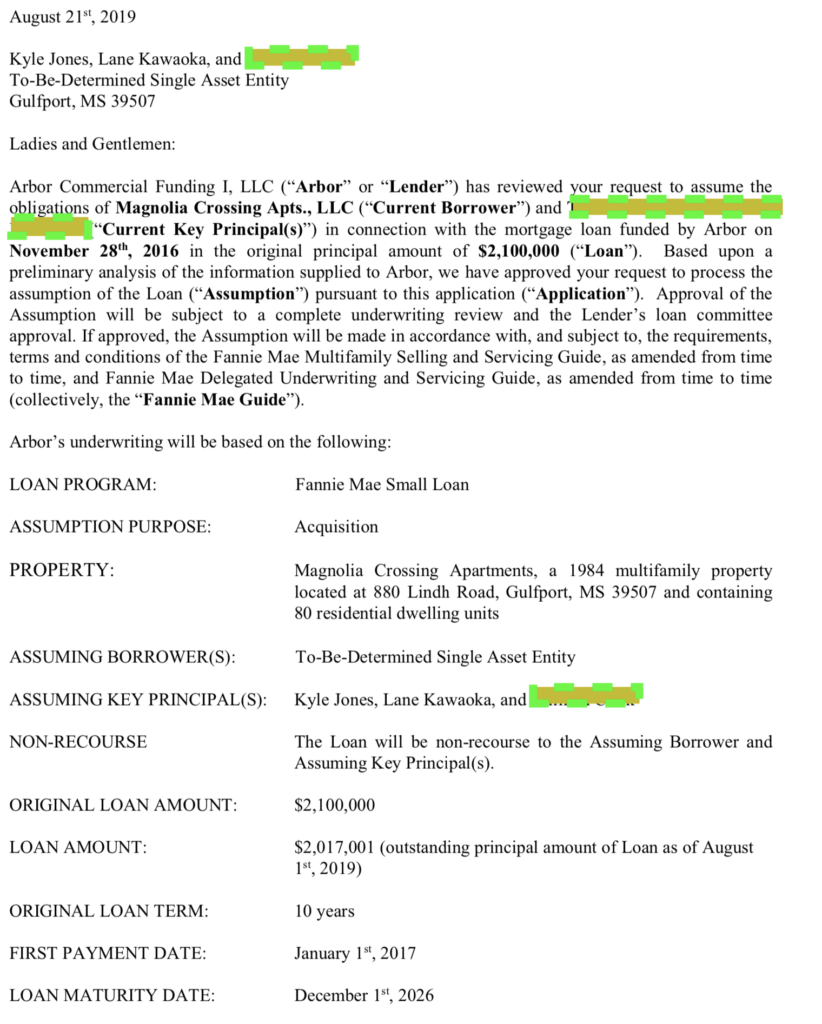
Here are the loan documents that I signed to take over a non-recourse loan as a KP/Loan Guarantor. We had another high net worth guy also sign with us, and he was compensated for it as part of the GP.
This could be you (minimum $3M net worth required)…
Multi-Class Vs Dual Tranche Equity Structures for Larger LP Partners (over 250k+)
There are nearly infinite ways to structure an investment partnership, but there are a few common terms and structures that sometimes cause confusion. For this discussion, we are covering multiple investment classes (often Class A and Class B members with different investment minimums – note naming conventions can be anything as we have called this A1, A2, A3 in the past too) as well as dual tranche structures (also with Class A and Class B memberships) which have a preferred equity/subordination component.
We recently introduced multi-investor class deal structures to entice larger investors to commit $250k-500k+ in deals to qualify as a Class B (again naming convention means nothing since some members always thing Class B is something special whereas we can name the classes whatever letter or name so just fyi) member in our operating agreement, which gives investors preferential terms, or “major investor status”. Typical terms (not standard by any means) include a $75,000 minimum investment, an 8% cumulative / compounding preferred return, a 30% promotion up to a 15% IRR, and a 50% promotion thereafter. However, for Class B members receiving major investor status, the minimum investment is $500,000, the preferred return is 9%, and there is a 30% promotion with no additional promotion tiers. This enhanced deal structure provides approximately a 1% higher projected IRR (17% net IRR instead of 16%) and provides superior downside protection through the higher preferred return.
The important point to note about this structure is that Class A and Class B investors are pari passu, which means cash flow and profits are distributed on a pro-rated basis with no priority given to any members. Even though Class B investors are owed a higher preferred return, this in no way impacts the returns of Class A investors. The enhanced Class B economics are funded solely out of the General Partner’s (sponsor) share of the deal. Essentially, the sponsor is foregoing a portion of the promote by providing major investors a better deal.
The dual tranche equity structure, on the other hand, utilizes a senior/subordinate structure to reallocate risk/returns to various investment members. In this structure, Class A investors are owed a fixed rate of return (typically 9% or 10%), which is paid out before Class B members receive any distributions. Class A members are senior to the Class B equity, which provides for a cash flow and value cushion since all the cash flow and sale distributions are first owed to the Class A members. This structure could also be described as preferred equity (Class A) and common equity (Class B). In exchange for being subordinate to Class A members’ preferred distribution and return of capital, Class B members receive all the upside above the fixed rate of return, which enhances returns assuming project-level returns exceed the cost of the Class A capital on a net of sponsor fee / promote basis. In exchange for higher projected returns, Class B members accept a greater level of risk because of their subordination to Class A members.
Additionally, since most deals have projected cash flows below the Class A member preferred distribution rate of 9% or 10%, Class B members see lower cash flow distributions than they otherwise would. However, if the deal works out, the returns upon sale are more substantial. This senior/subordinate structure is very different than the pari passu nature of the multi-investment class structure described earlier. It is important to carefully understand the mechanics of the deal structure you are investing in and to pay attention to the nuances of the ways deal structures allocate risk and reward, as well as incentivize certain actions by investors and sponsors.
Sometimes, if there is no official class of investors in the marketing materials or PPM, a larger investor may approach a sponsor to see if this is a possibility. This would be what is called a “side-letter agreement”. Some attorneys don’t like them, some do them all day long, and are happy that it is not just another “hand-shake deal” done by a bunch of real estate investors. Again, the golden rule is to put relationships first. Speaking on the General Partner side of the fence here, many high-level operators don’t memorialize their long-term relationships (thus making attorneys’ heads explode) and go off long-term mutually beneficial relationships that extend beyond one deal. It has been taught to me by my GP mentors that the best business operators live by a code and keep their key business relationships for the long term.
Past Incidents
Full insurance/natural disaster write-up in the New Investor FAQ sheet.
Here is a short list of some of the major impacts we have faced so far:
1) At least 5 documented fires (three of which burned down the structure – here was one of them that we eventually sold for 129% Total Return or 2.29X Equity Multiple – over the 2.5-year ownership period, which equated to an IRR of 32%)
2) Two full-front hurricanes
3) Multiple tornadoes (these are the easiest and the least of our worries because they are the simplest claims and isolated incidents, plus there is much city support when it happens)
4) One tree falling on a roof, taking out a dozen units
5) And a freak ice storm in Texas – who knew!
In progress, rebuild of our Irving property that burned down. Upgraded from 1990s to 2022 standards!
Further Discussion on Insurance
Consider the following:
1) We carry adequate insurance coverage. Even more so than we would feel is cost-effective, but is mandated by the uber-conservative bank to over-insure the asset where they have the greatest amount of interest in the capital stack.
2) As with all disasters, we carry commercial-level insurance, which includes loss of rent. The only trouble here is paying for costs out of our operating account in the period between when the insurance company checks are cut to us, the owner. This is why we have adequate working capital, cash reserves, and the sponsors are personally well-capitalized to minimize the chance for a capital call. Even in that extreme circumstance, we have countless ways to cut costs, which is why we invest in this type of asset class. In past cases, units have been out of service for weeks or months; however, in a way we are “off the clock” racking up our loss rent checks even though the units are not occupied.
3) We always get third-party claims adjusters to maximize the claim paid to us. In our experience, we have gotten up to 2-3x what the claim settlement was originally proposed. Most amateur operators would accept these… I know when I was a single-family home investor from 2009-2015, I would have done just that and would not have had the capital to pay for a claims adjustor, plus the claims adjustor would not want to work my small claims anyway. In many cases, we come out ahead of where we started before the unfortunate incident! Once we were able to use a “hailstorm” to get brand new roofs with just the $5,000 deductible on our already perfectly fine roof. Although we are not thrilled when any instance takes place because it stresses our asset management team’s bandwidth temporarily (it’s our job, we know!). We are cautiously optimistic that we can come out ahead!
4) When we had the unprecedented ice incident in Texas in 2021 and all the little mom and pop amateur landlords were frantically bugging their overwhelmed property managers who were trying to find any plumber in town, we were knocking out our own work orders with our in-house maintenance staff. This was a great example of our staff’s ability to be self-sufficient. Of course, we do share human resources and some supplies if needed among assets in the same metro.
5) One of our fires burned down an entire building under construction. In this circumstance, it puts us in a better position because at that point, the GC owns the delivery of the final product, and they are ensuring the completed product. Although it is not our job as the owner, Lane’s attitude when he was in the construction industry was that every contractor/owner wants a completed project to move on to the next one and as the owner we want the contractor to complete the project in such fashion to make a fair profit so we can do business again. It comes down to honor. So we do our part to ensure contractors are not cutting corners to ensure a properly paid insurance claim (which would probably result in a huge loss or bankruptcy by the CG) by doing the little things like recommending and in some cases paying for wifi security cameras to keep an eye on expensive materials like lumbar, quality assurance to ensure safety protocols are met, and communicating with municipalities site impacts we feel its the right way to do business and that we are all accountable to a project that is on time, on budget, and meets expectations. Lane spent 12 years as an engineer mostly on the owner’s side overseeing construction and unfortunately, a lot of it was on the boring side ensuring the project was covered insurance wise, documentation, arguing unforeseen conditions with contractors… or in other words a lot of the stuff that had to be done due to the existence of lawyers and natural disasters/acts of god/human factors errors.
Overall, passive investors should not worry about specific events, and why we always recommend diversifying your portfolio with not more than 5-10% of your net worth into any one deal. By doing that, you can relax and let your GP (who is incentivized to achieve the same goals) do the stressing and legwork that is necessary to manage the asset (and property management team) to maximize the returns.
Talk it through with us
Questions on “GP / LP Strategies” as you look at real deals? Join The Wealth Elevator investor community and bring them to your onboarding call.
Join the club and book your onboarding callJoining is free.

The podcast behind this course
The Wealth Elevator Podcast
Lane's show for accredited investors on passive syndications, taxes and alternative investments. Many of the lessons in this course started as episodes.
Listen on Apple PodcastsWatch on YouTube