


Conclusion and Key Takeaways
Ignore “Equity on Sale” Projections in Early Years – These figures are theoretical and assume a mid-hold exit that isn’t actually planned. Focus on total return at the projected sale year (usually year 5) and don’t get distracted by modeled “what-if” year-by-year equity charts.
Reversion Cap Rate Should Be Conservative – Smart underwriting assumes a 0.5–1.0% increase in exit cap rate from the market cap, not the subject property’s current cap. This adjustment adds a buffer for softer market conditions at sale.
Occupancy is the Most Volatile Line Item – While rent growth is easier to predict, occupancy rates swing the most and create the biggest impact on actual returns. Projections should include a cushion for dips in both physical and economic occupancy.
Rent Increases Post-Rehab Must Be Justified – A 10–15% rent bump may be possible with $2,500–$3,500 per unit in upgrades, but verify with market comps and demand tests. Every unit won’t turn over in year one—this is a gradual process.
Avoid Overweighting Refi Proceeds – Returns dependent on a cash-out refinance are speculative. Focus first on performance without a refi. Treat any mid-hold refi upside as a bonus, not a guarantee.
Loan Type and Prepayment Penalty Matter – Yield maintenance loans offer low rates but high exit costs. If the business plan anticipates a 3–5 year sale, these penalties can reduce returns. Consider step-down prepay structures as alternatives.
Break-Even Occupancy Should Be ~70% – Most stabilized deals should break even around 65–75% economic occupancy. If a sponsor claims a lower breakeven, verify what’s included—full expenses, debt service, and economic vacancy.
Legacy Hold ≠ ,Lazy Hold – Long-term holds (7–15 years) can outperform if the asset is higher quality, located well, and fits your portfolio strategy. They also align interests when the operator has a personal stake in the outcome.
Stress Test Scenarios Are a Must – Good sponsors should show return sensitivity to changes in cap rate, interest rate, and occupancy. If a 10% cap rate or 70% occupancy breaks the deal, it’s not conservatively underwritten.
Actuals Trump Projections – Always compare the trailing 12-month (T12) financials against the pro forma. Look for inflated income or suppressed expenses, especially in repairs, taxes, and insurance.
Insurance and Property Taxes Can Sink a Deal – Always confirm realistic quotes for insurance and factor in reassessments or aggressive property tax increases, especially in states like Texas.
Cash Reserve Strategy Shows Sponsor Discipline – Look for healthy operating reserves (e.g., $250/unit), capex contingency (5–10%), and working capital to cover unexpected costs. Deals with razor-thin buffers are a red flag.
Sponsorship Alignment Goes Beyond Co-Investment – Ask how much capital the GP is putting in, but also look for long-term involvement, onsite presence, and conservative underwriting. Skin in the game is about behavior, not just dollars.
Cap Rate Claims Are Often Manipulated – Subject property cap rates are often based on inflated income or reduced expenses. Use T12 NOI and market cap rate comps to validate pricing, not what brokers or sponsors say the cap is.
The budget details say that $2500-$3500 is planned in upgrades for each unit, but the larger budget breakdown only accounts for $250,000 worth of interior repairs. Can you please explain these numbers?
While we have an overall game plan on the interiors, the PM will “test” units between the $2500 to $3500 range to see how the market responds to make sure we get the best bang for the buck. If we can get a $50 rent increase for a lower rehab cost, that only makes things better. We also won’t be able to immediately rehab every unit (need to wait for units to become available), so it’s a slow churn that will take time. Most projects never rehab every single unit in the complex anyway, from that practical/logistical standpoint, but also to leave meat on the bone for when we eventually sell.
Should you factor in a pre-payment penalty?
A prepayment penalty is a clause in a mortgage contract stating that a penalty will be assessed if the mortgage is paid down or paid off within a certain period.
If you’re newer to evaluating commercial loan terms on these private placements, some people underwrite using fixed-rate debt, which has longer terms, but then their hold period is less than the loan term, and using fixed-rate debt, your exposure to the risk of prepayment penalties (yield maintenance) is pretty massive.
To have a longer term is, on the surface is safer because in case of a recession, you are not forced to sell or refi in a down market. 8 years or more is preferred for the term. However, longer terms typically (not always) come with prepayment penalties and yield maintenance (PP/YM) ,which can be pretty big. In the roaring years of 2012-2016, when rents would go up 3-6% a year, no one cared about those big prepayment penalties, as they would be minor compared to the NOI increase and thus increase in property value. Most operators do not take into account the prepayment penalties when underwriting, much like how we don’t underwrite or project to refinance in 3 years, although we could. This is another reason why we choose to run the deal out longer, since this greatly decreases the impact of PP/YM, since there is typically a step-down component to the fees, the longer you hold on to the loan, or if you use hybrid loans, which we tend to pick.
As a side note, this latest 15-year term on this past deal is so long that we believe our next buyer, 3-6 years from now, would be happy to assume our loan, which would never bring PP/YM into play.
Is there a disadvantage to a legacy hold in a syndication?
The opposite of a legacy hold is a 3 to 6-year business plan to force appreciation on a property and sell it. Or a 5-year pump and dump. Sometimes certain properties line up better for a long-term play (higher grade properties such as B or higher, also what type of location). And the conditions of the market always change. I think of it as going with the flow and taking the best exit strategy at a time.
On this past deal, the operator lived there and saw it as an opportunity to pick up the 2% asset management plan. That’s a real retirement plan! Personally, I try to align myself with the operator as much as I can, and nothing makes me feel more comfortable than when the lead investor has a long-term outlook.
Legacy can mean anywhere from 5-20 years hold. In MFH/Commercial, anything longer than 5 years is a really long time. Think of it like dog years.
In the end, it’s all a personal portfolio question. If you have a lot of 2-year developments or 5-year pump-and-dump investments, you might want to think of diversifying in terms of hold lengths.
What is your guess on what you will do with the super low rents like $550 whenthe market is $750? For a 2-bed/2-bath, is it a 10% bump? When would the rent in this example get to market rates?
That is how it is going to look on the macroscale when you are just looking at monthly numbers, but underneath the surface, you are bumping up individual units up $50 on renewals and $100 on make-readies. Every individual unit is a negotiation in itself, based on occupancy at that time, which Airbnb and the hotel industry are known for and is called Dynamic Pricing. Institutions use expense software (perfectprice.com) for their $15/hour staff to not screw it up, but we do this intuitively. This is happening on an individual unit basis for a couple of years as natural turnover happens. In this case, it’s a huge difference where rents are at and where things should be so it’s a little unique (good problem to have) and we want to be sensitive, but we did not say it in the webinar for obvious reasons (I can get into the story offline) but the landlord only likes to rent to “older people.” We are here to make money for investors, but secondarily, we want to run a good business, create a good community, etc.
Below is a screenshot of how rents have been tracking on a smaller deal with a mix of rehabbed units (green) and make-ready (blue) from the original rents (tan).
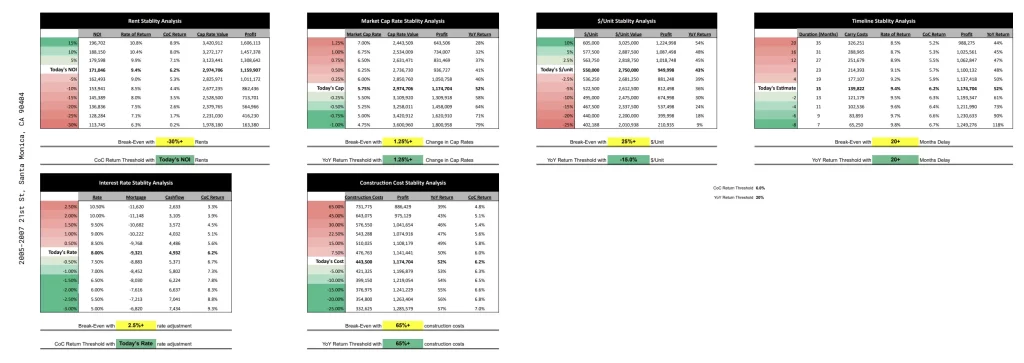
Sensitivity Analysis? What would be the breakeven point for occupancy % in the event of a market downturn with current rents?
Breakeven occupancy is around 50-70%. Typically, from deals, the breakeven point on occupancy does not vary more than +/- 5%.
What is our break-even point?
- From an occupancy standpoint, the breakeven is around 70%.
- When I stress tested based on the 5-year return, the cap rate would have to go to 10% to “break even,” but since we have long-term financing, I would expect we’d just hold and cashflow.
Is the capex budget based on actual bids? What is the contingency % (buffer) in the underwriting for this?
The budget came from the property management company, but the repairs are pretty standard, and $4500/unit is a healthy budget, especially with little exterior improvements, which were done by the seller. I’ll have to double-check on contingency %, but there is a cash reserve which serves as the overall contingency.
In addition to reserves ($300/unit) for the overall contingency, we plan to keep working capital in the bank equal to 1 month’s rent for the entire property. On the capex budget specifically, Property Management (PM) has kept roughly a 5% contingency in their numbers, but this is continually getting refined, so I wouldn’t put too much stock into that.
What are operating expenses in an apartment deal?
Operating expenses, often called OpEx, are the day to day costs required to run the property. This includes payroll, repairs, landscaping, utilities, insurance, property management, and vendor contracts. These are recurring costs that keep the building functioning.
Every dollar spent on OpEx reduces net operating income, and net operating income is what determines the value of the property.
Why do operating expenses matter so much to investors?
Because small changes in expenses can create huge swings in property value.
Assume a 100 unit property generates $1,200,000 in annual income.
Scenario A
OpEx equals 45 percent
Expenses equal $540,000
Net operating income equals $660,000
Scenario B
OpEx equals 55 percent
Expenses equal $660,000
Net operating income equals $540,000
That is a $120,000 difference in income purely from expenses.
At a 5 percent cap rate:
Scenario A value equals $13,200,000
Scenario B value equals $10,800,000
A 10 percent swing in OpEx erased $2,400,000 in value. Nothing about the property changed except expense discipline.
What is a healthy operating expense ratio?
There is no universal number, but many stabilized apartment properties operate in the 40 to 50 percent range depending on age, location, and staffing model.
What matters more than the exact percentage is whether the number is realistic for that specific asset and whether the operator is actively managing it.
Who controls operating expenses, the property manager or the asset manager?
The property manager executes daily operations. They handle tenants, maintenance, and staffing.
The asset manager protects the investment. Their role is to question invoices, approve budgets, benchmark vendors, and keep expenses aligned with the business plan.
If no one is actively playing the asset manager role, expenses tend to creep upward over time.
What’s the cap rate that it’s buying at? What’s the exit cap rate assumption?
Purchase Cap Rate is a little over 6.3% on actuals, a little under 6% tax adjusted. Sub-market cap rate 6.25%. Exit or reversion cap rate assumed 7.25%
Subject property purchase Cap rates are severely over-estimated in most cases by brokers/sellers/syndicators, so I don’t really pay much attention to it. The reasoning is that to get to that number, typically expenses are always left out or income is inflated, so it’s bad data. Those top-of-the-line items are again always manipulated and can throw the calculated cap +/-2.0. The only true way to determine is to get the trailing 12-month Profit and Loss Statement, but at that point, you have the information to underwrite it fully.
In class B/C, I have been using 6.5-7.5% reversion cap depending on the market. For example, 6.5 in Dalla,s whereas 7.5 in Gulfport, MS. These days, nothing is over 7.5% cap (unless it’s a truly off-market deal and/or a fringe deal under 60-units). I find the current prevailing caps from my friends who are apartment operators and ping them what they used on their last deal. Another way is to talk to a broker who has their pulse on the market and knows you need the number for underwriting purposes (and he is not selling you a deal).
In addition, the mere fact that we are doing value add and buying assets that have a management problem (that we can fix) means the property is not performing as it should.
[LPs shouldn’t care so much about the subject property’s cap rate because it’s just a result of what the syndicator paid for a property based on the underwritten NOI and what they thought they could do with the deal]
[On heavy value add projects of 10-20k or more rehab per unit, it is possible to bring a B property to B+, thus making the trading Cap Rate decrease to a high multiplier. However, I would still look for 0.5%+ increase in the reversion cap.]
Is there da epreciation claw-back when the property is sold?
Yes, you have to pay taxes on the gain unless you are able to 1031 into the next like-kind deal. But this is the case with any investment. Sorry, no magic tax evasion here.
But most investors are in 2-3 dozen deals, so by that time, you should be swimming in several hundred thousand dollars of suspended passive losses, which will more than offset the selling of a few buildings a year.
This is educational content, not tax, legal, or investment advice. We are not attorneys, CPAs, or financial planners. Please let us know if you need a referral to a 💼 CPA, ⚖️ Lawyer, or other vendor here.
Talk it through with us
Questions on “Numbers Due-Diligence FAQ” as you look at real deals? Join The Wealth Elevator investor community and bring them to your onboarding call.
Join the club and book your onboarding callJoining is free.

The podcast behind this course
The Wealth Elevator Podcast
Lane's show for accredited investors on passive syndications, taxes and alternative investments. Many of the lessons in this course started as episodes.
Listen on Apple PodcastsWatch on YouTube