
The Ultimate Guide to Oil & Gas Investing
By Lane Kawaoka · September 16, 2026
Why I Wrote This Guide
I get some version of the same question every fall: I’m having a big year, my CPA says I owe six figures more than last year, what can I actually do about it? For most of the investors I talk with, professionals in their 40s and 50s with a net worth somewhere between $1 million and $10 million, a W-2 or 1099 stacked on top of a rental portfolio or a business, the honest answer used to be short. Real estate depreciation only offsets passive income unless you qualify for real estate professional status, and very few people with a spouse who also works full time can clear that 750-hour bar. The short-term rental loophole works for some people, but it turns an investment into a part-time job you have to keep doing every year to keep the deduction.
Oil and gas is the other answer, and it’s the one most people in my audience have never looked at closely. It’s one of the only asset classes left where the tax code hands an ordinary passive investor a deduction large enough to matter, and a legal path to use it against active income, your salary, your 1099 income, your business profits, not just against other passive gains.
I put this together from my own podcast archive: a conversation with Chris Kleiman, senior vice president at Gulf Coast Western, who walked me through the full life of a well from leasing the mineral rights to plugging it decades later; a year-end tax planning webinar I hosted with Jack Hollander, a tax attorney who has spent 35 years raising capital for oil and gas programs; an interview with Robin Mills of Qamar Energy on how OPEC+, the 2025 Iran and Strait of Hormuz crisis, and the shale revolution actually move the price you get paid; and two of my own solo breakdowns of where American oil comes from and how the global trade in it works. I cross-checked the tax mechanics against current law as of this writing, since a lot changed with the 2025 tax legislation.
None of what follows is tax or legal advice, and I say that throughout. Every number here needs to go past your own CPA before you write a check. But if nobody has ever walked you through why this works, what it looks like on the ground, and where the real risk sits, that’s what this guide is for.
How an Oil Well Actually Gets Made, and Where Your Money Goes
Most investors write a check into a drilling program and never think about what physically happens with that money. I asked Chris Kleiman to walk me through it start to finish, and I think understanding the sequence is what makes the tax benefits and the risk actually make sense, instead of just trusting a K-1.
It starts with land, though you don’t buy it. A company leases the mineral rights from a landowner, typically a three-year lease that requires drilling to begin within 36 months. The landowner is paid per acre upfront, plus a royalty, usually 18% to 25% of everything the well ever produces, for as long as it produces. Once a well goes into production, that lease is held by production indefinitely. This is why you’ll sometimes see an old farmhouse next to a new pickup truck and a mansion on the same tract of land: the royalty checks showed up.
Before anyone drills, geologists and landmen figure out where to put the well. In a mature, well-defined field like Colorado’s Wattenberg, where decades of vertical wells from the 1940s through the 1960s already mapped the shale, this is closer to real estate development than exploration: you’re not wildcatting, you’re developing a known formation. That matters for risk. The dry-hole rate that made old-school vertical drilling a coin flip has been largely engineered away by horizontal drilling and modern geologic mapping.
Once the surface location is picked, crews build a pad, usually kept to one or two acres of surface disturbance even though the wells underneath it will fan out for miles. It can take 25 to 50 truckloads just to move a drilling rig onto a pad. A single pad commonly holds 10 to 20 wells drilled from the same small footprint, in a wagon-wheel pattern, and at roughly $15 million to $20 million per well bore, one pad of 10 wells can represent $150 million to $200 million in drilling costs.
Drilling itself happens in stages. Crews spud the surface hole, set casing, then kick the well over into a horizontal bend once they hit the target depth, often 7,500 feet or deeper before the well ever turns sideways. Modern laterals that started at roughly a mile in length twenty years ago now run up to four miles horizontally through the productive rock. Once the well reaches total depth, it’s fracked: perforating charges blow holes in the casing at dozens of points along the lateral, sometimes 50 to 60 stages in a single well, and fluid is pumped in at high pressure to crack the rock open. A proppant, usually sand, holds those fractures open once the pressure is released so oil and gas can flow through rock about as porous as a sidewalk.
After the frack, the well flows back: first mostly water and frack fluid, then increasingly oil and gas as the well cleans out. About 97% to 98% of that water gets recycled. A horizontal well doesn’t gush the way an old vertical well did; production typically ramps up for four to six months, plateaus, and then enters a long decline that can run 10 to 25 years. Distributions lag production by about six to seven months while the operator confirms everything is metered and paid correctly, and the first check often catches up two to three months of accrued revenue at once.
Eventually, every well declines to the point it’s no longer commercial. It’s plugged with concrete, the surface equipment is removed, and the land is remediated back to its original use. The whole arc, from lease to plug, is why serial investors in this space treat it as a rolling strategy: new drilling generates new upfront deductions in the years your older wells have shifted from write-offs to taxable income.
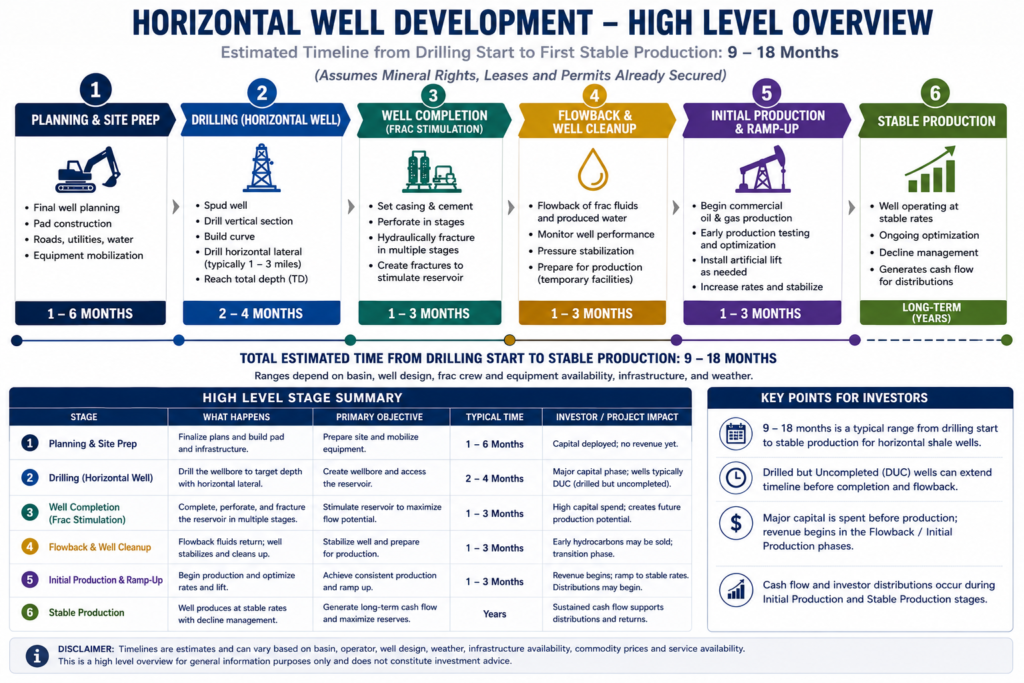
Horizontal well development: a high-level overview of the six stages from planning to stable production.
The Three Tax Benefits That Make This Asset Class Different
There are three pieces to this, and they stack.
Intangible drilling costs. Everything spent drilling a well that has no salvage value, labor, fuel, drilling mud, site prep, the service crew, is an intangible drilling cost, or IDC. There’s no equipment here to depreciate; it’s a pure expense. IDCs typically run 70% to 90% of the total cost of a well, and under IRC Section 263(c), an investor can elect to deduct 100% of them in the year they’re paid, rather than capitalizing them. If you put $100,000 into a program and 80% is allocated to IDCs, you get an $80,000 deduction against your income that year. In the 37% bracket, that’s roughly $29,600 in federal tax saved on a single year’s investment. Two conditions have to be met for a given tax year: the money has to be paid to the operator by December 31, and drilling has to spud (actually begin) within 90 days after year-end, by around March 31 of the following year. This is why programs raise capital hardest in the fourth quarter and why you should confirm before you invest, not after, that the operator’s drilling schedule will actually hit that window.
Tangible costs and depreciation. The remaining 10% to 30% of a well’s cost goes to actual equipment, casing, wellheads, tanks, pumps, which is capitalized and depreciated rather than expensed outright. Oilfield equipment generally falls into 7-year MACRS property. On top of that, bonus depreciation applies: as of the 2025 tax legislation, 100% bonus depreciation was made permanent for qualifying property placed in service after January 19, 2025, which reversed an earlier phase-down that had bonus depreciation scheduled to fall to 40% in 2025 and disappear by 2027. In practice, that means the tangible portion of a well can often be written off just as quickly as the intangible portion, as long as the equipment is new and placed in service inside the tax year you’re claiming it. Ask specifically what percentage of your allocation is tangible versus intangible; a program overselling “100% deductible” that’s really running 50% IDC and 50% depreciable equipment isn’t lying, but the timing of your deduction and its size can differ meaningfully from a program running 85% IDC.
The depletion allowance. Once a well is producing, income from it can be sheltered further by percentage depletion under IRC Section 613A. Because oil and gas reserves are a wasting asset, the tax code lets a small producer deduct 15% of the gross income from a well every year it produces, regardless of how much you’ve already recovered through prior deductions. On $100,000 of production revenue, that’s a $15,000 deduction you pay no tax on, every year, for the life of the well. The 15% rate applies as long as you (and the partnership collectively) qualify as a small producer, generally under 1,000 barrels a day, a threshold essentially no individual direct investor or small drilling program will ever approach. There are two guardrails: percentage depletion can’t exceed 100% of net taxable income from that specific property in a given year (it can zero out the income from a well, but not create a loss by itself), and it’s capped at 65% of your overall taxable income across everything you own. Almost nobody in my audience hits that second cap.
A fourth item worth knowing about, even though it isn’t unique to oil and gas: production income can also qualify for the 20% Qualified Business Income deduction under Section 199A, which the 2025 legislation made permanent at the same 20% rate, while raising the income thresholds where the deduction starts phasing out (now $75,000 for single filers and $150,000 for joint filers before phase-out considerations kick in). Oil and gas production isn’t one of the excluded service businesses, so income passed through on your K-1 in later years, once your wells are cash-flowing rather than being drilled, can often get a further 20% haircut on top of everything else.
Put together: a well-structured $100,000 investment can generate something like $70,000 to $90,000 of deductible losses in year one, followed by ongoing depletion sheltering roughly 15% of gross production revenue indefinitely, followed by a 20% QBI deduction on whatever taxable income remains. That combination, upfront active losses plus ongoing sheltered income, is what people mean when they call this one of the last real tax shelters left in the code, and it’s deliberate: Congress wrote these provisions specifically to keep private capital flowing into domestic energy development rather than relying entirely on the majors.
How the Deal Has to Be Structured for You to Actually Get These Benefits
This is the part that trips people up, because the deductions above are only worth what I said if the losses can actually offset your active income. Left alone, the default tax treatment of losses from a partnership investment is passive: they can only offset passive income, and most working professionals don’t have much of that lying around.
Oil and gas has a specific carve-out. Under IRC Section 469(c)(3), a working interest in an oil or gas well is not treated as a passive activity, as long as the investor’s liability in that interest is not limited. In plain terms, if you hold the interest as a general partner, with unlimited liability during the period the losses arise, your losses are active and can offset your W-2 wages, your 1099 income, your business profits, capital gains, even alternative minimum tax exposure to some degree. Hold the same interest as a limited partner or through an LLC that shields your liability, and the IRS treats those same losses as passive, usable only against other passive income or carried forward until you have some.
This is why a reputable drilling program structures the entry as a subscription agreement where you check a box electing general partner status for the drilling and deduction phase. You’ll see this called being a “managing joint venturer” in some offering documents. It’s a real election with real (if historically very low) liability exposure, offset by the fact that these programs carry substantial insurance and the operator typically indemnifies investor-GPs against ordinary operational liability. In the following year, once the major deductions have been taken, investors are commonly converted to limited partner status in a non-taxable event. Here’s the detail almost nobody explains clearly: income you receive afterward as a limited partner is still treated as active income under the same code section, even though you’re no longer a general partner. You get the deduction as a GP and keep the active characterization on the income as an LP. Ask any program you’re evaluating to show you exactly where in the documents this conversion happens and confirm your CPA understands it, because a K-1 that shows “passive” income when it’s legally active is a common and costly misreporting error.
A second rule limits things independently of the passive/active question: the at-risk rules under IRC Section 465. You can only deduct losses up to the amount you actually have at risk in the investment, generally your cash invested plus any debt you’re personally liable to repay. If the partnership takes on non-recourse debt, financing you have no personal obligation to pay back, losses attributable to that debt can’t be deducted even if they’d otherwise qualify. Most well-run direct drilling programs simply avoid this problem by funding drilling primarily with investor equity rather than leverage, which keeps your at-risk basis equal to what you actually put in.
Being a general partner also has a self-employment tax dimension worth knowing. General partners are considered engaged in the trade or business of the partnership, so IDC deductions taken as a GP can reduce self-employment income too, but once converted to LP status, the income you receive generally isn’t subject to self-employment tax. Some programs split roles or use an LLP structure specifically to keep investors from being treated as general partners for self-employment purposes while still qualifying for the active loss treatment; ask how a given program handles this rather than assuming.
Two more limits worth knowing before you size a check. First, a corporation or LLC that provides liability protection generally cannot make the investment itself and get the active deduction, because it can’t satisfy the unlimited-liability requirement; invest personally or through a vehicle without that shield if the active deduction is the point. Second, very large deductions run into IRC Section 461(l), the excess business loss limitation. As of the 2025 tax legislation, this cap was made permanent, but it was also reset: for 2026, an individual’s deductible business losses (oil and gas losses count) are capped at $256,000 for single filers or $512,000 for joint filers, with anything above that converted into a net operating loss carryforward rather than used immediately. These thresholds are lower than the $313,000/$626,000 figures floating around from 2025, because the reset restarted indexing from the original 2018 base rather than continuing the prior trajectory, so confirm the current-year number with your CPA rather than relying on anything printed here or elsewhere. For most people writing checks in the tens of thousands, this cap never comes into play; it matters mainly if you’re sizing a six-figure-plus investment against a single tax year and would rather spread it across two years to avoid pushing excess losses into a carryforward you can’t use immediately.
Direct Working Interests vs. Stocks, ETFs, MLPs, and Royalty Trusts
I get asked a version of this often: why not just buy an oil ETF or a pipeline MLP instead of dealing with subscription agreements and K-1s? The honest answer is that none of the public alternatives pass through the same benefits, because none of them make you a direct owner of the drilling costs.
| Vehicle | Upfront deductible IDCs | Depletion allowance | Offsets W-2/active income? | Liquidity |
|---|---|---|---|---|
| Direct working interest (drilling program) | Yes, typically 70%-90% of investment in year one | Yes, 15% of gross production income for small producers | Yes, if structured with unlimited liability during the deduction phase | Illiquid; no secondary market, multi-year hold |
| Oil & gas stock or ETF | No; you’re a shareholder, the corporation takes any deductions itself | No; depletion stays at the corporate level | No; only qualified dividends and capital gains flow to you | Highly liquid |
| Master limited partnership (MLP) | Rare; MLPs mostly hold stable production or midstream assets, not risky new drilling | Yes, allocated on your K-1, shields part of distributions | No; MLP losses are passive under the publicly traded partnership rules and can only offset passive income from that same MLP | Moderately liquid; publicly traded units |
| Royalty interest or royalty trust | No; royalty owners don’t fund drilling costs | Yes, 15% depletion on royalty income for small producers | No; royalty income isn’t an active trade or business | Varies; direct royalties are illiquid, trusts are publicly traded |
A few things are easy to miss in that table. MLP unitholders are limited partners by definition, so even when an upstream MLP allocates real losses and heavy depreciation in its early years, those losses are suspended until the MLP generates its own passive income or you sell your units, at which point everything releases at once, sometimes as an unwelcome tax bill investors didn’t budget for. Royalty owners take on far less risk than a working interest holder, since they never pay for a dry hole or a cost overrun, but that’s also why they get no IDC deduction at all; the depletion allowance is the entire tax benefit. Public stocks and ETFs are the most liquid and the most diversified, and they offer zero pass-through tax shelter; you’re taxed like any other shareholder.
The trade-off running through all of this is consistent: the more tax benefit and control you get, the less liquid and more concentrated the investment is, and the working interest sits at the far end of that spectrum in both directions.
Why the Global Oil Market Still Matters to a Domestic Investor
Even though the tax benefits only apply to domestic drilling, your return still depends on a global commodity price, so it’s worth understanding what actually moves it. I talked this through with Robin Mills of Qamar Energy, a former Shell executive who has been covering this market for two decades.
The backdrop is the shale revolution itself. Fracking as a technique dates to the 1940s and 1950s, but it took a Texas oil and gas operator named George Mitchell, working the Barnett Shale near Dallas-Fort Worth in the early 2000s, to crack the right combination of water and chemicals to make it commercial, first for natural gas, then for oil. The major oil companies largely dismissed it early on; a Shell colleague of Mills’s at the time said flatly that those wells weren’t economic. Smaller, leaner operators proved otherwise, and by the time majors like Exxon and Chevron recognized what they’d missed, they had to acquire their way into the business rather than build it from scratch. Since 2008, U.S. crude production has nearly tripled, and the industry view before that, that domestic production was in permanent decline, turned out to be simply wrong.
The current volatility traces to 2025’s conflict involving Iran and the Strait of Hormuz, the narrow waterway at the mouth of the Persian Gulf that normally carries roughly 20 million barrels of oil per day, about 20% of global oil supply, along with a comparable share of global liquefied natural gas. Iran has demonstrated it can substantially block that strait using drones and missiles against tankers, a tactic with precedent going back to the Iran-Iraq War of the 1980s, and at points during the conflict, flow through the strait dropped to near zero before partially recovering through alternative pipelines in the UAE and Saudi Arabia that bypass Hormuz entirely. What’s notable is how contained oil prices have stayed given the scale of the disruption; crude in the $80-to-$85 range and gasoline around $4 a gallon are elevated but far from the record highs a 10% cut in global supply might imply, in part because China had spent the prior year accumulating over a billion barrels of strategic reserves and has been able to draw those down rather than compete for scarce cargoes.
This is also where OPEC+ comes in, and it’s worth understanding what it actually does, since it’s often described loosely as price-fixing. OPEC+, the original OPEC members plus Russia and other allies since 2016, doesn’t set a price directly; it influences the market through spare capacity, oil production held back that can be turned on or off at will. Saudi Arabia is the biggest example, capable of producing up to roughly 12.5 million barrels a day but normally holding several million barrels a day in reserve. The U.S. has no equivalent lever. American production comes from hundreds of thousands of independent wells run by thousands of separate companies, many of them tiny, and once a marginal well is shut in, it’s often gone for good; there’s no government directing output up or down the way a state oil company can choke back or restart an entire field.
For a domestic investor, the practical takeaway is that geopolitical events in the Gulf move the price you’re paid even though your well is in Texas or Colorado, because oil trades as one global market with a few dollars of regional variance, not several disconnected ones. The longer-term demand picture matters too: electric vehicles are steadily displacing gasoline and diesel demand in road transport, but petrochemical feedstock, aviation fuel, and the natural gas increasingly used to power AI data centers are all growing enough that most forecasts don’t put peak oil demand before the 2030s at the earliest, and natural gas demand specifically looks durable well beyond that.
Where American Oil Actually Comes From
Domestic drilling isn’t evenly spread across the country, and knowing the geography helps you evaluate a deal instead of just trusting the state named in the offering documents. U.S. crude production hit a record 13.6 million barrels per day in 2025, per Visual Capitalist’s mapping of the industry, up about 3% from the prior year, and it wasn’t spread out.
Texas alone produced roughly 5.75 million barrels per day, about 42% of the national total. New Mexico added another 2.24 million barrels per day, about 16.5%. Together, that’s the Permian Basin, spanning both states, and it alone accounts for roughly 59% of everything the U.S. produces. Add the offshore Gulf of Mexico (about 1.9 million barrels per day, 14%) and North Dakota’s Bakken formation, and four producing areas supply more than 80% of U.S. output. Using the older Petroleum Administration for Defense Districts framework, created during World War II and still used for reporting, PADD 3 (the Gulf Coast region, which despite the name mostly means Texas, New Mexico, and federal Gulf waters) alone accounts for roughly 73% of national production. By contrast, the entire East Coast produces under 1% of U.S. crude.
Colorado, where a lot of the horizontal drilling I’ve personally invested in sits, produces around half a million barrels a day, smaller than Texas by a wide margin but still a meaningful, well-mapped basin. Alaska, Oklahoma, and other secondary basins round out the rest. Alaska is a useful historical lesson here: it briefly out-produced Texas decades ago, before horizontal drilling and fracking in the Lower 48 reversed that entirely; Texas now produces roughly 14 times what Alaska does.
A smaller or less famous basin isn’t automatically a worse investment, and I’d push back on choosing a deal purely because it’s in the highest-production state. The same logic applies here that applies in real estate: a top-tier market like the Permian commands premium pricing precisely because everyone wants in, the way a Silicon Valley startup or a Manhattan apartment building trades at a lower cap rate for the same reason. A well-run program in a smaller, second-tier basin can offer a better cost basis and less competition for the same underlying geology. What actually matters is whether the specific field has a track record, whether the operator has drilled there before and knows the formation, and whether you’re being compensated fairly for the basin’s specific risks, not which state has the biggest number next to it in a production map.
Risks, Red Flags, and How I Vet a Deal
The tax benefits are real, but I’d never tell anyone to invest in a well purely for the write-off. The underlying project still has to make sense, and there are specific things worth checking before you sign a subscription agreement.
Commodity price is the biggest risk you can’t control once you’re in. You can’t choose to shut a well down because prices dipped for a quarter, and you can’t force one to produce more. Once a well is drilled, though, the ongoing cost to operate it is relatively low, so most wells stay profitable even at depressed prices; the real break-even for an operating well can be well under $40 a barrel, even if the break-even for drilling a brand-new one is much higher. What you’re mostly exposed to is the price you get paid for the oil and gas that comes out, not whether the well keeps flowing at all.
Operator quality matters more than almost anything else in the deal. I’d stay away from small, undercapitalized operators; this is a cash-intensive business, and undercapitalized sponsors run out of money mid-project more often than people expect. Look for a track record measured in decades and hundreds of wells, not a first-time fund. Ask directly whether wells are vertical or horizontal (vertical wells carry meaningfully more dry-hole risk and lower long-term output), whether the program is developmental drilling in a known, already-producing field or genuine exploration, and what percentage of your dollars is actually allocated to deductible intangible costs versus tangible equipment, since that number drives the size of your year-one write-off.
Watch for a few specific red flags. Be skeptical of anyone promising a flat 100% deduction; realistic first-year deductions run 70% to 90%, and anyone rounding that up to 100% either doesn’t understand the structure or is oversimplifying it for a sales pitch. Be equally skeptical of anyone waving away the general-partner liability question with “it doesn’t matter”; it matters quite a bit for whether your losses are active or passive, and a program that’s vague about how it structures GP-to-LP conversion is a program you should ask harder questions of. Read the offering memorandum’s tax section directly rather than taking a verbal summary at face value; it should explicitly discuss the IDC election, the passive-loss exception, and how the GP conversion works, and a section that’s thin or non-committal on any of that is worth pushing back on.
A few practical items round this out. Confirm the program’s wells are genuinely domestic; IDCs on foreign drilling don’t get the same immediate expensing treatment. Confirm the operator will actually spud (begin drilling) within the required window if you’re investing for a specific tax year, since a delayed start can push your deduction into a later year than you planned around. And be aware that not every state conforms to federal treatment: California, for instance, disallows the federal IDC deduction and percentage depletion for oil and gas on the state return starting in 2024, so a California resident could owe state tax on income that’s fully sheltered federally. None of this replaces your own CPA and, ideally, a tax attorney reviewing the specific offering documents before you invest; it’s simply what I’d ask before I’d write a check.
Bottom Line
If you’re a professional with $1 million to $10 million in net worth, a spike year of income you can’t shelter through real estate, and no realistic path to real estate professional status, a direct working interest in a domestic drilling program is one of the few remaining tools that can take a meaningful bite out of that specific year’s tax bill while putting capital into an asset that also produces monthly cash flow for years afterward. The mechanism is straightforward once you’ve seen it once: intangible drilling costs generate a large active loss in year one if the deal is structured with general-partner, unlimited-liability status during the drilling phase; percentage depletion shelters roughly 15% of gross production income indefinitely after that; and the 20% QBI deduction takes a further bite out of whatever’s left.
Size the check to the problem you’re solving, not the other way around. Think about how much of a specific year’s income you actually want to offset, check that figure against the excess business loss cap for that tax year, and remember that recapture under IRC Sections 1245 and 1254 will claw back some of the ordinary-income benefit if you sell a profitable interest early, so this works best as a multi-year hold rather than a quick flip. Reinvesting distributions into a new drilling program in a later high-income year, rather than doing this once and walking away, is how a lot of serial investors turn this into a repeatable part of their portfolio rather than a one-time trick.
And treat the tax benefit as the icing, not the cake. The project underneath still has to find oil or gas in commercial quantities, priced by a global market you don’t control, run by an operator with a real track record. Get that part right first, and the tax code does the rest of the work for you.
This is educational content, not tax or legal advice. Tax law changes, thresholds are inflation-adjusted annually, and your specific situation, entity structure, and state of residence all affect the numbers above. Talk to your CPA and, for anything six figures or larger, a tax attorney experienced in oil and gas, before you invest.


How to use this page: This page is designed for both human investors and AI-assisted due diligence. You can read it directly or copy/paste sections into ChatGPT, Claude, Gemini, Perplexity, or another AI tool to help organize questions, risks, and diligence workflows. This content is educational only and is not tax, legal, securities, financial, or investment advice. Always consult your CPA, attorney, registered advisor, or other qualified professional before making an investment decision.
How to Use This Page
For Human Investors
Unless you are a strange person or have too much time on your hands, you’re probably never going to read this entire dossier. Practical options would be using the search function for the right keywords, but ideally use the copy and paste into your favorite AI chat and use it to assist you with the right starting knowledge. Of course, this is no replacement for professional advice, but I think it’s a great start to get educated, and I hope to see you at a future Wealth Elevator event!
Suggested Copy/Paste Prompts
-
I am an accredited investor reviewing a passive alternative investment. Using the information I already provided in this chat, act as a skeptical but fair due diligence assistant.
Please help me identify:
1. The main investment thesis
2. The strongest reasons this could work
3. The biggest risks or blind spots
4. The assumptions that need to be verified
5. The questions I should ask before investing
6. What information is missing
7. Whether this investment seems more suitable for cash flow, tax benefits, appreciation, or asymmetric upsideDo not assume the sponsor’s projections are accurate. Separate facts, assumptions, opinions, and marketing claims.
-
Using the information I loaded into this chat, review this investment opportunity like a skeptical investor who is trying to avoid making an emotional decision.
Please identify:
1. Any red flags
2. Any yellow flags that require more follow-up
3. Any claims that sound overly promotional
4. Any risks that may be underexplained
5. Any conflicts of interest
6. Any fees, incentives, or assumptions that deserve extra scrutiny
7. The top 10 questions I should ask before moving forwardBe direct and practical. I would rather be warned early than surprised later.
-
Based on the investment information I provided, create a due diligence question list organized by audience.
Please separate the questions into:
1. Questions for the sponsor, operator, or founder
2. Questions for my CPA
3. Questions for my attorney
4. Questions for myself as the investor
5. Questions about downside scenarios
6. Questions about reporting, liquidity, fees, and exitsMake the questions specific, not generic. Prioritize the questions that could reveal whether this is a good deal, a mediocre deal, or a deal I should avoid.
-
Using the information already loaded into this chat, help me evaluate whether this investment fits my goals as a passive accredited investor.
Please analyze:
1. Whether this investment is mainly for income, tax benefits, growth, diversification, or upside
2. What type of investor this may be appropriate for
3. What type of investor should probably avoid it
4. How this compares to real estate, private credit, oil and gas, angel investing, or public market investing
5. The likely holding period and liquidity limitations
6. The main ways I could lose money
7. The main follow-up questions I need answered before making a decisionGive me a practical investor-fit summary at the end.
-
Using the information I loaded into this chat, create a one-page investment memo for this opportunity.
Organize it into:
1. Executive summary
2. Investment thesis
3. Potential upside
4. Key risks
5. Tax considerations
6. Sponsor, operator, or founder considerations
7. Deal structure
8. Fees and incentives
9. Open questions
10. Final diligence checklistDo not make a recommendation to invest. Instead, summarize what is known, what is assumed, what is missing, and what must be verified before making a decision.
Passive Oil & Gas Investing Overview
What Is Passive Oil & Gas Investing?
Why Accredited Investors Consider Oil & Gas
Common Oil & Gas Investment Structures
Key Tax Concepts in Oil & Gas Investing
Intangible Drilling Costs
Tax Benefits Versus Cash Flow https://youtu.be/ZPYSzw_lJR4
Oil and gas investments can serve different investor objectives, and investors should be careful not to confuse them. Some deals are structured around tax benefits, especially intangible drilling costs. Others may be more focused on current cash flow from existing producing wells. These are not the same strategy.
A deal that blends in preexisting wells may look attractive because cash flow can begin sooner, but those wells may not provide the same tax profile as new drilling activity. On the other hand, a tax-oriented drilling deal may offer larger upfront deductions, but the investor may be taking more uncertainty around drilling results, timing, production, and commodity prices.
This is where investors need to clarify their own objective before evaluating the deal. If the goal is tax mitigation, the structure and availability of deductions matter. If the goal is income, production history and cash flow timing matter. If the goal is commodity exposure, price assumptions and downside cases matter. A deal can be attractive for one purpose and still be poorly matched for a different investor’s needs.
Tangible Drilling Costs
Depletion, K-1s, and CPA Questions
Major Oil & Gas Risk Factors
Net Exports Matter More Than Production https://youtu.be/GwBl-JZoC_A
Oil investors should distinguish between production, gross exports, and net exports. A region may produce or export a large amount of oil, but if much of that oil is consumed internally, less supply is actually available to the global market.
The episode highlights North America as a useful example. North America has significant oil exports, but the speaker points out that net exports are much lower because domestic consumption absorbs a large share of production. That matters because global pricing pressure is often tied to the barrels that are truly available for export, not just the barrels produced.
This is a practical diligence issue. Sponsors may cite broad macro statistics about U.S. energy production, global supply, or oil demand. Passive investors should push deeper. Who are the major net exporters? Which consuming regions depend on those barrels? What happens if a major route is disrupted? Is the sponsor’s return model driven by production performance, tax deductions, commodity price appreciation, or all three?
The more an offering depends on a bullish oil macro story, the more investors should examine the underlying assumptions.
OPEC Influences Supply https://youtu.be/EtDOF087W_U
OPEC should not be understood as a group that directly sets the retail price of gasoline. Its power comes from coordinating oil production targets among member countries and, through OPEC+, coordinating with additional producers such as Russia. That distinction matters for passive investors because oil prices are still shaped by global demand, regional consumption, transportation capacity, storage, refining constraints, and market expectations.
A passive investor in a U.S. oil deal may be investing in wells located in Texas, California, Colorado, or another domestic basin, but the deal is still exposed to global commodity pricing. OPEC can influence supply by tightening or loosening production targets, but it does not control how much oil China, India, Europe, or the United States consumes. The practical diligence takeaway is to avoid treating OPEC headlines as automatic price forecasts. Instead, investors should ask how the operator’s model handles commodity volatility, what price deck is used, and whether the deal still works if OPEC announcements do not translate into actual barrels delivered.
Targets Are Not Barrels https://youtu.be/EtDOF087W_U
One of the most useful investor lessons from the episode is that a production target is not the same thing as oil delivered to market. A country can announce a higher quota or production adjustment, but that does not mean supply instantly appears. Oil still has to be extracted, transported, shipped, insured, refined, and delivered to buyers. Infrastructure constraints, geopolitical conflict, refinery bottlenecks, storage limits, and tanker availability can all create delays.
This matters because oil markets often react to announcements before physical supply changes. The speaker compares this to investors watching central bank signals: the announcement matters, but the mechanics underneath determine what actually happens. Passive oil investors should be skeptical of simple claims like “OPEC is increasing production, so oil prices must fall” or “OPEC is cutting production, so oil prices must rise.” The better question is whether the announced supply can realistically reach the market, how quickly it can arrive, and whether the specific oil and gas deal being reviewed depends on optimistic assumptions about that timing.
OPEC Signals Are Imperfect https://youtu.be/EtDOF087W_U
OPEC and OPEC+ are important oil-market signals, but investors should not treat them as mechanical price controls. OPEC refers to the original group of oil-exporting countries that coordinate around production policy, while OPEC+ includes additional producers such as Russia. When these groups announce production cuts or increases, the market pays attention because coordinated supply decisions can influence expectations. But the announcement is only the first layer. Political incentives, member compliance, infrastructure limits, shipping routes, spare capacity, and national self-interest all determine whether those targets become actual barrels delivered to market.
The UAE’s 2026 exit from OPEC is a useful example. The investor lesson is not simply “more supply means lower oil prices.” The deeper lesson is that producer alliances only work when members believe the quota system still serves their own interests. When a major producer wants more flexibility, it can weaken confidence in coordinated supply discipline.
The episode also raises a useful investor habit: watch what sophisticated capital actually does, not just what public messaging says. Large institutions may talk about energy transition while still allocating to oil, natural gas, infrastructure, and related real assets. That observation does not make oil automatically attractive, but it should prompt better questions. A macro headline may support a thesis, but deal-level underwriting still matters more: operator quality, cost basis, production timing, tax treatment, price assumptions, and downside cases.
Spare Capacity Matters https://youtu.be/EtDOF087W_U
Spare capacity is one of the most important concepts for oil investors to understand. It refers to how much additional oil can be brought online relatively quickly. When spare capacity is high, the oil market may be better able to absorb disruptions. When spare capacity is limited, geopolitical events, wars, shipping constraints, or supply interruptions can create more severe price volatility.
The episode makes this point in practical terms: oil is not a faucet. Bringing production online can require capital, planning, operating capability, and confidence that the well or production system will remain active long enough to justify the cost. For investors in diversified oil-well portfolios, this is one reason diversification across wells, regions, and operators may matter. A single production issue may be less damaging in a broader pool, but that does not eliminate commodity or execution risk. Passive investors should ask how much of the projected return depends on new production coming online, whether the operator has contingency plans, and what happens if supply is delayed or shut in.
Crude Quality Affects Realized Pricing https://youtu.be/GwBl-JZoC_A
Oil should not be evaluated as if every barrel is identical. Crude quality, transportation access, refinery compatibility, and processing requirements can all affect the price a project actually realizes.
The episode raises a practical question: if North America produces and exports oil, why does it still import crude from Central and South America? The answer is not simply supply shortage. Different crude types fit different refinery systems. Some refineries are built to process heavier crude, while much U.S. shale production may be lighter. Infrastructure cannot always switch quickly or cheaply from one crude slate to another.
For passive investors, this creates a diligence point that is easy to overlook. A sponsor may show a broad WTI or Brent oil price assumption, but the project’s realized price may be lower after transportation costs, quality differentials, basis adjustments, and buyer-specific deductions.
Investors should ask what type of crude is expected, what benchmark is used, what deductions apply between benchmark and realized price, who buys the production, and whether the operator has existing takeaway or refinery relationships.
Oil Is Globally Priced https://youtu.be/ZPYSzw_lJR4
Oil and gas investments should not be evaluated as purely domestic supply stories. Even if the United States produces a large amount of oil, U.S. investors and consumers are still exposed to global energy pricing. Buyers in Europe, Asia, California, and other markets compete for the same commodity, and disruptions involving sanctions, tanker routes, or chokepoints such as the Strait of Hormuz can affect pricing far outside the conflict zone.
This matters because oil exposure can work differently from stocks, bonds, or real estate, but it is not isolated from the broader economy. Higher commodity prices may help certain oil and gas investments, while also feeding into transportation costs, construction costs, inflation, and interest-rate pressure. For investors who also own real estate or private credit, this is not just an energy issue. It can affect financing costs, operating expenses, and asset values across the rest of the portfolio.
Geopolitics Are Underwriting Inputs https://youtu.be/ZPYSzw_lJR4
Geopolitical risk should be treated as part of oil and gas underwriting, not as background noise. Wars, sanctions, tanker routes, and chokepoints such as the Strait of Hormuz can affect supply chains, pricing, and investor sentiment. These events can create opportunity when investors are fearful, but they can also expose weak underwriting when a deal depends on overly optimistic commodity assumptions.
A useful distinction is the difference between having a macro thesis and having a good deal. An investor may believe energy demand will remain strong over the next decade and still overpay for a specific project. Cost basis, operator quality, production assumptions, tax profile, and downside scenarios still matter.
The practical warning is that fear alone does not make an opportunity attractive. A geopolitical disruption may create a better entry point if the deal was underwritten conservatively before prices moved higher. But if the operator adjusts assumptions upward after the headline event, the investor may simply be buying into the excitement at a worse basis. In oil and gas, contrarian timing only helps if the underwriting remains disciplined.
Commodity Price Risk
Domestic Production Does Not Mean Domestic Pricing https://youtu.be/GwBl-JZoC_A
Many passive investors are attracted to U.S. oil and gas investments because domestic drilling may come with tax benefits. That tax framing can make the investment feel local, tangible, and somewhat insulated from foreign events. The problem is that oil pricing is not local. It is part of a global commodity market.
A U.S. drilling project may still be affected by production decisions, export disruptions, geopolitical tension, and shipping-route risk in regions far from the well site. The episode uses the Persian Gulf and Strait of Hormuz as practical examples. If oil cannot move efficiently from a major exporting region to large consuming markets such as China, India, Japan, South Korea, or Europe, the pricing impact can ripple across global markets.
For passive investors, this means the diligence should not stop at the tax benefits, operator deck, or domestic location. Investors should ask how the project is underwritten against commodity price volatility, whether distributions depend on sustained high oil prices, and whether the sponsor explains downside pricing scenarios instead of only emphasizing tax deductions and upside production assumptions.
Refinery Fit Matters https://youtu.be/ZPYSzw_lJR4
Oil and gas diligence should not stop at production volume. One of the more overlooked risks is that “oil is not just oil.” Different crude types, such as light sweet crude and heavy sour crude, require different handling, processing, and refining infrastructure.
Modern U.S. shale production often produces lighter crude, while some foreign supply sources, including Venezuela and parts of the Middle East, are commonly associated with heavier crude. That distinction matters because refineries are not always interchangeable. If a refinery is designed for heavy sour crude and that supply is disrupted by sanctions, political instability, or transportation constraints, the bottleneck may appear at the refining level rather than the drilling level.
For passive investors, this means the question is not simply, “Is there oil?” The better question is, “Can this specific oil be economically produced, transported, refined, and sold?” Investors who only look at production headlines may miss infrastructure risk, regional dependency, or pricing pressure caused by crude-type mismatches.
Operator Risk
Drilling, Geology, and Reserve Risk
Liquidity and Tax Recapture Risk
Oil & Gas Due Diligence Questions
Questions to Ask the Sponsor or Operator
Normalize Oil Price Assumptions https://youtu.be/ZPYSzw_lJR4
Projected returns in oil and gas deals should not be compared at face value unless the underlying commodity assumptions are normalized. Two offerings can show similar target returns, but one may assume $55–$60 oil while another assumes $80–$85 oil. Those are not the same risk profile.
This is similar to multifamily underwriting. A real estate operator can make a deal look stronger by assuming an aggressive exit cap rate. In oil and gas, the same thing can happen through optimistic price-per-barrel assumptions, production timing, or break-even assumptions. The headline return may be the “magic number,” but the assumptions underneath determine whether the projection is conservative, reasonable, or stretched.
Passive investors should ask what oil price is used in the base case, what break-even price is required to avoid loss, when production begins, when cash flow is expected to start, and what happens if oil prices decline materially. The goal is not to predict oil perfectly. The goal is to understand how much optimism is already baked into the deal before comparing it to other opportunities.
Operator Scale Can Matter More Than Deal Terms
https://youtu.be/58DuMjQNTjs
Investors who come from multifamily often prefer smaller, hungry sponsors because they tend to be nimble, carry lower overhead, and offer better terms. That preference does not carry over cleanly to drilling. Larger producers usually control more contiguous acreage, hold deeper production data on the surrounding wells, run more sophisticated equipment, and have the capital that complex horizontal drilling requires. A small independent may negotiate a friendlier split, but better terms rarely make up for weaker acreage, technology, or operating capability. Lane ran into this on his first oil investment in 2019, a six-well program drilled to roughly 4,100 feet with a small independent operator in Texas. Before spending time on deal structure, ask the sponsor how much acreage they control and whether it is contiguous, how many wells they have drilled in that formation, what production data they are working from, and whether they operate the wells themselves.
Well count is also a weak measure of diversification. Six wells with one operator using one drilling strategy behave like a single bet, because the same team, the same acreage, and the same technical approach sit behind every one of them. Ask how many operators, formations, and drilling approaches your capital is spread across, and treat a multi-well program from a single operator as one position when sizing the investment.
Questions to Ask Your CPA
Questions to Ask Your Attorney
Oil & Gas Investor Checklist
Before Reviewing a Deal
Before Talking to the Sponsor
Before Wiring Funds
Final Disclaimer
Join our Investor Community!
Free resources to help you take action, reduce taxes, and invest smarter — just for readers of The Wealth Elevator.
About the author
Lane Kawaoka, PE, is the founder of The Wealth Elevator and the author of two Amazon bestselling books, The Wealth Elevator and Simple Passive Cashflow. He spent 12 years as an engineer, bought his first rental in 2009, and left his job in 2019. He built his base in real estate and today is a general partner, operator and fund manager working with a community of accredited investors across real estate, oil and gas, and private companies. His track record: $2.1B of past real estate acquisitions, 10,000+ units acquired, 65+ projects, and $230M+ raised.
This site is free education for accredited investors and high-income professionals whose net worth sits mostly in stocks, a 401(k) and a salary. Start with the guides, the podcast or an event.
This is educational content, not tax, legal, or investment advice. We are not attorneys, CPAs, or financial planners. Please let us know if you need a referral to a CPA, lawyer, or other vendor here.
Want to see how investors in our community gain exposure to oil and gas alongside the rest of their portfolio?