


Numbers in the examples on this page are hypothetical and for illustration only. Return targets are not guarantees, and investors can lose money.
Distributions Like Clockwork
“Having participated in 5 syndication deals in the COVID-19 era, they have all hit that mark at least.” -investor
Just make sure you understand the underwriting process and that they are not raising extra capital to pay you out like a Ponzi scheme.

Lenders (banks) do not allow you to pay out of the operating account in the first two quarters on Fannie/Freddie loans, so if you are having distributions in the first two quarters (especially paid monthly), it is unlikely to have positive cash flow. They are paying you out of your own capital.
It’s completely obvious they are doing this when the payouts are exactly 2% every quarter. It’s not underwriting excellence, it’s fraudulent activity.
It’s a form of manual underwriting designed to appease investors and improve the customer experience or display deal performance before any true underwriting criteria have been met.
Stated in a different way… When you ask most passive investors if they want “monthly distributions (rather than quarterly or yearly payouts) on passive investments,” the answer is Duh, I want to be paid monthly and as early as possible say the week after I invest. #Facepalm
Here is where we stand:
From a marketing use case, it makes sense. If it motivates/excites people, especially unsophisticated prospective customers, however, in practice, monthly distributions require a compromise on deal structure, risk mitigation, and long-term underwriting performance.
GP/Sponsors wanting to offer the benefits of frequent payouts and perceived stability are going to have to OVER-RAISE in some form or another. By over-raising, they are essentially taking more money from investors than they necessarily need… and then turning around and immediately paying back those investors with their own extra money. Essentially, it’s like another loan taken out just to make investors happy.
This is most easily explained when you look at some offers that promise returns right away — perhaps 1-2 months — after close.
A non-stabilized property (the classic value-add multifamily deal), then even though it may be currently cash-flowing, it’s going to take 3-6 months of capex renos and upgrades and just general operational fine-tuning to start humming along. And that is contingent on lenders who will not allow distributions to go out unless the syndicator over-raises and hides the money in a separate account.
During the first few years of a property value add cycle, cash is inconsistent. This is why we have traditionally gone with quarterly payouts.
Running a lean operation (more returns for passives due to less admin staff) and promising monthly payouts — especially in the first few years, as I just mentioned — is going to mean scrambling each month and in practice it will mean some payouts the first week of the month, others the last week, and everything in between.
A sponsor may as well tell their investors, “I’ll pay you when I feel like it.” But this will upset most passive investors, but could honestly be the best thing for the deal to have the professional operator make that call because, after all, they know what is best, aligned with the success of the project, and risk management, they have the most to lose by a failed investment.
Sponsors offering monthly distributions must overraise at the start, and always keep money in the kitty for this very purpose, to be able to meet their promise of frequency and timing of payouts.
That said, many investors still say they would prefer monthly payouts. But you, at this point in this Syndication LP course, are a lot smarter than the average Accredited investor.
Project Level Returns vs Returns for Passive Investors
Understand the difference between project-level returns and what actually goes in your investor’s pocket. Project level returns (before sponsor cut) should obviously be fat, but don’t get tricked by thinking that is what you get or could get as an LP investor.
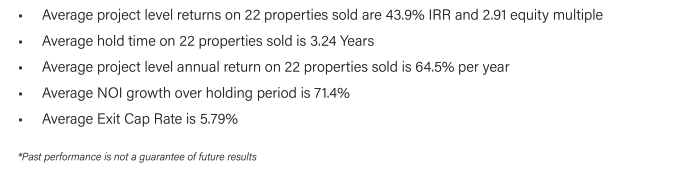
Here is an example of a sponsor playing some games with “43.9% IRR and 2.91 Equity Multiple,” but this is on the project level… not what passive investors got. It might be a 50/50 split, and LPs might only be getting 22% IRR or 1.4 EM, which is not that great.
Live Webinars
Some investors like to come on LIVE webinars and ask “stump the chump questions” to see how sponsors respond. Most of our investors 80% of them, will never come to the LIVE webinar because most passive investors are busy and just catch up on the replay. From our data, a good portion of repeat investors don’t even watch the webinar. A smooth-talking presentation does not correlate at all to the operator’s underwriting standards to run numbers for operational efficiency and risk mitigation.
I am sorry if you still believe in Santa Claus and the Easter Bunny, but most “live questions from the audience” at live webinars are plants from the sponsor. Even if the questions are not planted, we can choose to answer the ones we like and ignore the others that are “too much information.” Confused minds say NO, and many things just are over the head of passive LP partners… at the end of the day, it comes down to track record and underwriting performance.

Side note… when I am bored, I will attend some lower-level operators and watch their presentation so I can be entertained by other operators asking ridiculous questions to troll the competing operator.
Live Events Show Me How Legit an Operator Is
The truth is that most real estate conferences are manufactured and fake,, where most of the speakers are newbies. I personally stopped going to these because even with my fraud detection and understanding of underwriting practices and underwriting strategy, I can’t even make an informed decision to tell who is legit on the stage or who shows up to these things. In my opinion, nothing replaces a pure passive investor peer group that actually invests in these deals.
The only real ones are industry-level conferences put on by National industry leaders. The audience is not retail investors (like you) but family offices and institutional Wall Street people.
Again, a Live in-person spectacle does not correlate at all to the operator’s underwriting process to safeguard your capital.
Limited Time Offer
Do not get wrapped up in the “we are 79% filled…. 97% filled… 3 more spaces left” marketing speak.
Sometimes the fact that an offering gets filled so quickly is because you have 2-8 daisy-chain syndicators (illegal per SEC) that are brought in to raise 1M, which should be done in a few hours anyway.
That said, it should not take you more than a few hours to complete due diligence as a passive investor, so there is really no reason to get your commits/sign/wire in the first 48 hours an offering is open.
Pref-Equity Partner
Not to be confused with A1 or LP investors that are given a fixed rate of return that mimics a debt investor in a deal. That sort of “pref-equity” is just a marketing term.
The true “pref-equity” term is talking about a large hedge fund, family office, or insurance company coming in with some GP controlling interests or option to take over, should certain metrics not be met.
Sometimes these “pref-equity” partners can replace the need for the larger bank note, taking up 90%+ of the equity stack. I have seen it some times where no LPs are aware that this even is happening (although it might not matter).
If anything… ~3/4ths of the time, having a “true pref-equity partner” is a good thing where the “pref-equity” partner is “smart money” and knows that what we have is truly a deal. Sometime,s having a “pref equity” partner can be the complete opposite, where they are sort of like predators and can control the entity.

An LP has really no way of knowing, so I would not really pay much attention to it. The syndicator can spin it either way.
Capital Stacks + Crowdfunding Websites + Sponsor Bias
Its a ‘cat & mouse’ game… MORE TO COME!
Vetting a Sponsor
In my opinion, the sponsor of a deal is the most important component. If you focus on the deal or the asset class, or the opportunity at the expense of underwriting the sponsor, you will most likely regret it. So, of course, most of my advice is related to sponsor vetting.
- Ask for a list of every deal they have ever sponsored. And if they can produce it, analyze performance data on each deal.
- Interview them about their track record. “What’s your best deal to date? Why do you think that deal was so successful? What’s your worst deal to date? Is there anything you felt you could have done to make it perform better? What changes have you made since that deal to ensure pro-forma performance can be achieved?”
- Ask for their financials – a lot of sponsors would say no to this request, but it doesn’t hurt to ask. Banks get it on every deal, and they have a superior capital stack position, so if banks can get financials, investors should at least ask. “I’m betting on you, can you share some high-level financials like a personal financial statement or a global cash flow summary?”

- Ask for prior investor references on all the good deals and especially the bad deals, and actually contact them. It will mostly be a highlight reel, so find a few good questions that aren’t softballs. “In your opinion, what’s the sponsor’s biggest flaw? Is there anything about how they do business or communicate you would change?”.
Bet on the jockey, not the horse. When you find a good sponsor, stick with them. If they perform well for you a few times, then try and invest in all their subsequent opportunities, even if small amounts spread over multiple projects.
This allows your investments to have some diversity. The truth is, if a sponsor crushes the pro-forma 9/10 times and you are invested in the 1/10, well, yikes…
Talk it through with us
Questions on “Underwriting Tactics and Manipulation” as you look at real deals? Join The Wealth Elevator investor community and bring them to your onboarding call.
Join the club and book your onboarding callJoining is free.

The podcast behind this course
The Wealth Elevator Podcast
Lane's show for accredited investors on passive syndications, taxes and alternative investments. Many of the lessons in this course started as episodes.
Listen on Apple PodcastsWatch on YouTube