


Other common investment opportunities of the wealthy consist of the following:
Solar

Solar is an investment opportunity that can lead to tax credits which vary
Short Term Rentals
This investment strategy helps to qualify an investor as “an active participant in a portfolio” — to qualify as a real estate professional for tax reasons. Most commonly done when one spouse makes a lot more than the other, allowing one to qualify as a real estate professional to write off the other’s active income.

Websites
This video delves into the business of buying websites that are already generating profit. Think of it as purchasing an apartment with the intention to renovate it for added value (increasing income to increase NOI). This approach stands in contrast to venture capital firms, which often focus on ideas without any current revenue, betting more on the potential than existing financials. Here, we’re looking at stable, possibly flourishing, businesses. The speaker, whom I respect and have joined in mastermind groups before, shares insights into this unique investment landscape, which is outside the hard asset or real estate ecosystem.
As an accredited investor exploring options and other alternative investments beyond my usual interests, it reminds me that while understanding the basics is necessary, recognizing my limits as a passive investor is crucial, too. Belief in the project (the horse) is important, but so is trust in the people (the jockey) behind it. This contrasts with certain real estate investing, where the focus is more on the asset (the horse) than the team (the jockey) managing it.
In practice, constructing such an efficient frontier requires statistical data on the returns and volatilities of the assets considered, as well as their correlations. The efficient frontier is a theoretical construct, but it serves as a powerful tool for portfolio management by helping investors make informed decisions before they fund alternative investments based on their risk-return preferences.
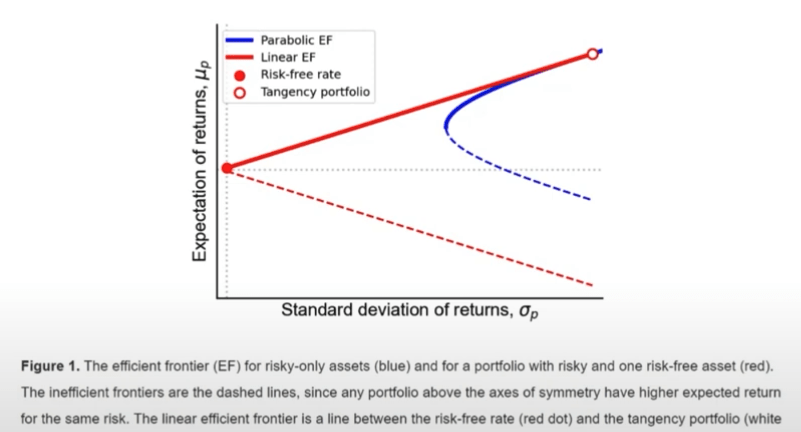
The concept of the efficient frontier is a fundamental part of modern portfolio theory, introduced by Harry Markowitz in 1952. Similar to the Sharpe Ratio concept, it represents an idealized spectrum of portfolios that offer the highest expected return for a given level of risk, or the lowest risk for a given level of expected return. As investors, we aim to optimize this. Here’s a breakdown of this concept:
- Portfolio Composition: The efficient frontier is comprised of various combinations of all possible risky assets. Each point on the frontier represents a portfolio that has a strong return for a given level of risk among all possible combinations of risky assets.
- Risk vs. Return Trade-off: The efficient frontier illustrates the trade-off between risk (usually measured as the standard deviation of portfolio returns) and return. Portfolios that lie on the frontier are considered optimally balanced because for any increase in risk, there is a corresponding increase in expected return.
- Diversification: One of the key insights from Markowitz’s theory is the benefit of diversification. By holding a mix of assets that do not perfectly correlate with each other, investors can form portfolios on the efficient frontier that have lower overall risk for the same return, or higher returns for the same level of risk, compared to any direct investment in a single asset.
- Shape of the Frontier: The efficient frontier typically curves upwards and to the left in a graph where return is on the y-axis and risk (volatility) is on the x-axis. This shape reflects the increasing marginal returns expected from taking on additional risk.
- Choice of Portfolio: Investors can use the efficient frontier to choose a portfolio that aligns with their risk tolerance and investment objectives. Those who are risk-averse would select a portfolio closer to the left-hand edge of the frontier (lower risk and lower return), while more risk-tolerant investors might choose a position further to the right (higher risk and higher return).
More on Private Equity
These are NOT real investments
Deeper Learning
Invest in Coffee Farms Webinar
Visiting the Panama Coffee Farms
Mobile Home Park Investing Interview – Kevin Bupp
Talk it through with us
Questions on “Other Investments Part 4: Websites, PE, VC, & More” as you look at real deals? Join The Wealth Elevator investor community and bring them to your onboarding call.
Join the club and book your onboarding callJoining is free.

The podcast behind this course
The Wealth Elevator Podcast
Lane's show for accredited investors on passive syndications, taxes and alternative investments. Many of the lessons in this course started as episodes.
Listen on Apple PodcastsWatch on YouTube