


Numbers in the examples on this page are hypothetical and for illustration only. Return targets are not guarantees, and investors can lose money.
Evaluating the loan terms
A commercial loan is a bit more complicated than your typical residential, 30-year, amortized fixed-rate mortgage loan. The major components of the 30-year amortized commercial loan are the rate, repayment term, loan amount, and pre-payment penalties.
The leverage or loan amount is determined by which market the asset is located in. Fannie Mae/Freddie Mac have lists of tier 1-3 markets; tier 1 markets allow for the most leverage, whereas tier 3 markets are allowed less leverage. Tier 1 markets are mostly primary markets like San Francisco, New York, Seattle, where there are low Cap Rates. Tier 2-3 markets are typically the secondary and tertiary markets that we target due to higher Cap Rates in order to cash flow. Therefore, a borrower’s loan proceeds or leverage amount is less than that of the tier 1 markets.
Investors will argue that the largest indicator to look at for the stability of the loan is the loan term length. Loans are typically amortized over 30 years with a balloon loan payment at the end of the repayment term, but the loan might need to be refinanced or reset after the loan term expires. The loan repayment range is typically between 3-15 years. The longer the loan term, the more conservative the loan offer because you are able to have a lot of time to reposition the asset in case the market goes soft and/or interest rates increase. But if you think about it, most times when the market goes soft, interest rates will decrease as the FED will lower rates to stimulate the economy. Either way, you don’t want to be holding on to an expiring loan and forced to make a new loan if you are not ready or in a high-rate environment. We like to go into a loan with a term longer than 8 years. So the longer the better… until you take into account some other terms that are correlated to a longer term, like prepayment penalties.

Longer is not always better…
Investors usually choose yield maintenance on a 10-year loan term length because it allows the lender to provide the lowest possible interest rate and highest possible leverage. The trade-off is that investors limit their options. Here are some downsides: yield maintenance has an extremely expensive prepayment penalty, borrowers often find themselves unable to sell or refinance when desired, or borrowers may be forced to sell on an assumption basis (i.e., new buyer assumes existing loan), which usually reduces the price achieved at sale.
I often see projected $0 financing fees upon sale, or exit cap rates that do not account for the lower sale price due to loan assumption in a syndicator’s 5-year underwriting analyses. Here are some ways to account for yield maintenance in deals:
Underwrite to a 10-year hold
- One way to accurately project leveraged IRR in a 10-year loan scenario while also reflecting yield maintenance is to simply underwrite to a 10-year hold. This will conservatively lower IRR expectations (due to the time value of money) and also ensure that the sponsor and investors are comfortable with the returns, even if they are stuck holding the deal until closer to loan maturity.
Raise the exit cap rate
- To account for yield maintenance on a 5-year hold, raise the exit cap 25 basis points (bps) (i.e., 0.25%) or calculate the yield maintenance prepayment penalty assuming a sale at 5 years.
Use an alternate loan type
- Other permanent loan options avoid yield maintenance altogether – repayment options with shorter terms, more aggressively declining prepayment penalties (step-down), or floating rate loans which offer cheaper prepayment.
Value-add business plan keeps you out of trouble
- Adding value to your investment property is critical to maximize returns and often to protect your downside risk. Instead of worrying about interest rates going up or having to refinance with your note coming due in 1-3 years (oh my!), one can eliminate this P&L risk by increasing the amount of equity by forced appreciation. To use a sports analogy, sometimes the best defense is a good offense (value add) or to keep putting points on the board. In a value-add deal that is executed well, the operator builds forced equity month by month. If that progress holds for a year or two, the added value can make a refinance easier, even in a tougher market. It is not a given; rates and lender terms still matter. If you have the buy-hope-pray model, then you need to worry about your loan term being too short and/or your interest rates increasing on you.
Bridge Loans
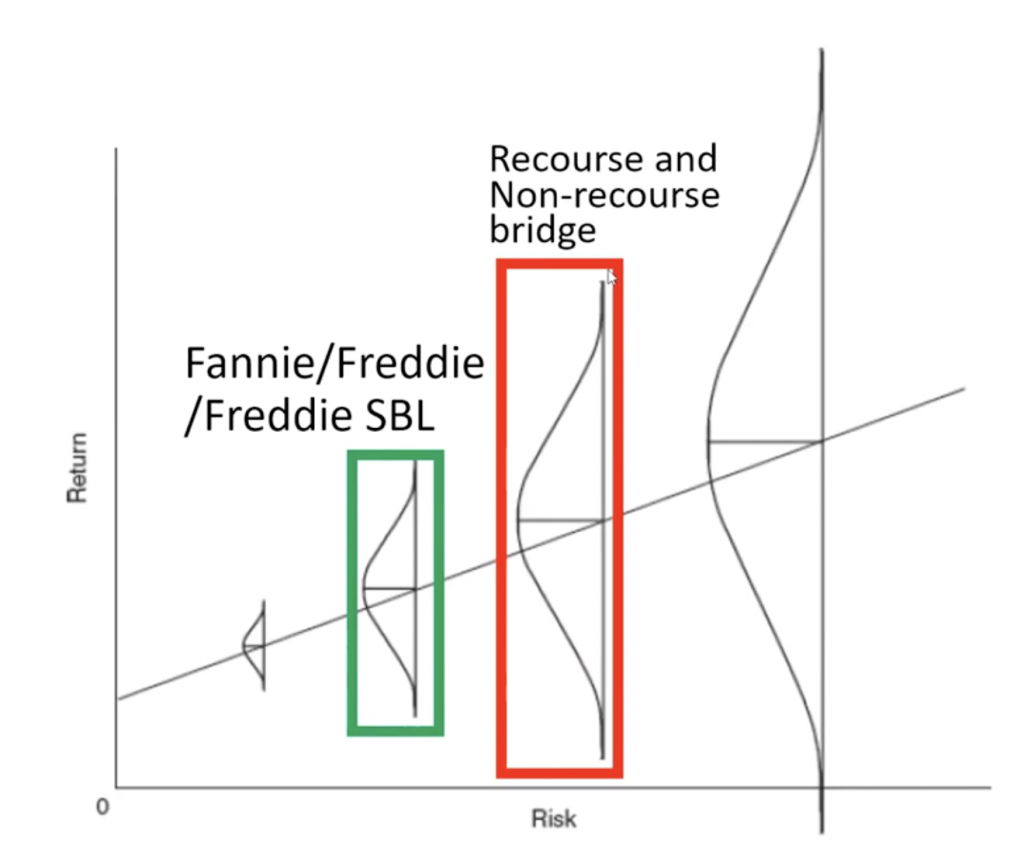
Virtually all commercial real estate utilizes debt to enhance returns and improve deal structure. Debt must be conservatively factored into one’s analysis of structuring the best deal for them, and equity returns must be evaluated on a risk-adjusted basis. Adjusting returns for risk simply means evaluating returns within the context of the risk associated with potentially achieving said returns.
Debt is one of the largest factors when it comes to risk, so it is important to understand how the leverage, interest, and term of the proposed debt structure impact the overall risk of the investment. Higher leverage loans may increase projected returns, but also increase the risk of losing money in a downside scenario. Higher leverage is usually accompanied by a higher interest rate, which negatively impacts cash flow and could put the investment in a negative cash flow scenario if the business plan targets are not achieved. Floating-rate debt and fixed-rate debt also carry their own respective risk factors. Floating-rate debt can negatively impact cash flows if interest rates rise during the ownership of the property. Meanwhile, fixed-rate debt can adversely affect a sale since fixed interest rate loans usually have a very strict and expensive prepayment penalty.
Finally, the term, or duration, of the investment’s loan is also a risk factor since a shorter-term loan can create a scenario where the loan becomes due at a time when the property’s value is such that it is unable to obtain new financing to pay off the existing debt. A situation like this can force a sale at the exact worst time, which may cause equity investors to lose some or all of their initial investment.
While permanent financing is relatively straightforward, bridge loans demand different underwriting and often have added complexity. In my view, investments financed with a bridge loan should be underwritten to a 3-year hold, since that is usually the loan term. Typically, the expectation is to sell or refinance within that period.
A 5-year projection for a bridge loan requires assuming a refinance when the bridge loan matures; however, refinancing creates uncertainty and complications in the model while welcoming a litany of questions from investors. Moreover, I believe it is misleading to call a 3+1+1 bridge loan a “5-year loan” and underwrite to a 5-year hold without including the necessary extension fees in the underwriting model.

Bridge Loan Test
Although refinances are best avoided in underwriting projections, it is nonetheless critical to perform exit tests and stress the possibility of refinancing out of the bridge loan at maturity. This can be done by stressing the property’s revenue while also raising the exit cap and interest rate to see if the projected take-out loan still has proceeds sufficient to pay off the existing bridge.
Bridge loans are ideal for executing turnaround business plans, but very few deals today actually pass this stringent bridge loan exit test. To avoid this possible downside scenario, investors seeking the flexibility of a bridge loan but are buying properties without high upside should opt for a lower leverage, lower interest Freddie Mac floating-rate loan (Freddie floater).
Here are some additional nuances that must be considered when analyzing a bridge loan:
- Interest reserves
- Cap Ex reserves
- Replacement reserves
We always assume these reserves are fully spent in the model. Replacement reserves can often be negotiated out of bridge loans (at least for the first year), but it is still wise to factor reserves into terminal NOI to avoid overstating projected sales prices.
Beware: There was a deal that was floating around out there where LP investors thought the deal was going very well. From the LP point of view, they were getting their 2% pref every quarter, and the monthly reports were very rosy. But underneath the surface, the Bridge Loan was underwater, and the sponsor group was secretly shopping the deal to get out from underneath the loan. Now likely that the situation will end fine (because it’s real estate and things typically end well), but a bridge loan can stress a deal’s financials.
How Important Are Interest Rates if They Go Up?
In short, interest rates don’t really matter. It’s a bit counterintuitive because those who do the buy and hold (and pray) model have their spreadsheets and know a 0.5% movement in interest rates can bring your cash flow from 200/month down to 75/month.
This deal is mainly a value-add play, and we are making more than 3/4ths of our money in equity build-up, not cash flow, so that is where the “we don’t care” comes from. And the deals we do this on have a lot of meat on the bone to value add and more than make up for the carrying costs.
Think of it this way… a house flipper is fine playing 10- 16%+ interest rates because he is going to value add the property. The same idea is happening here.
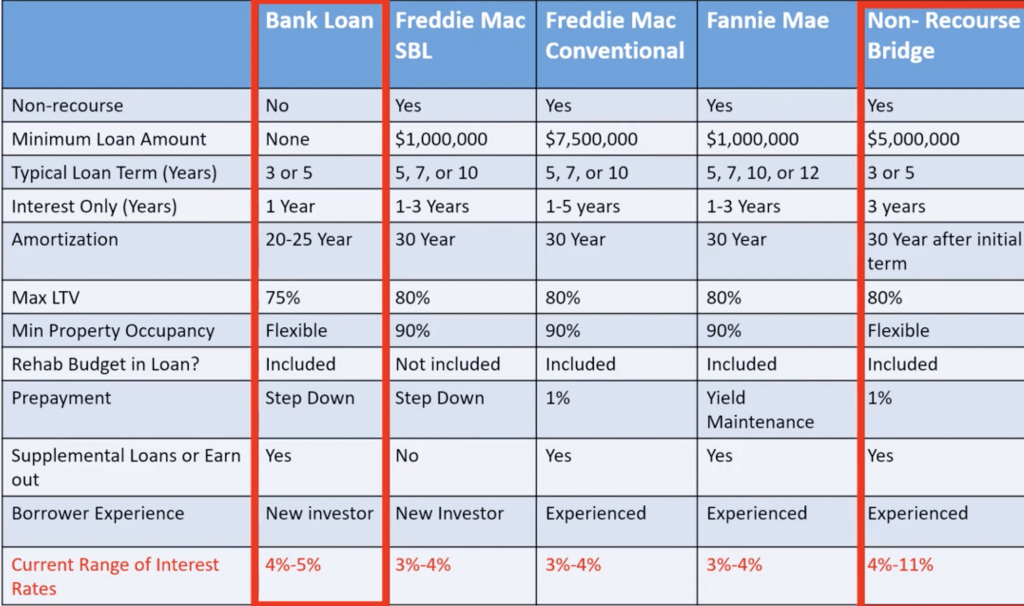
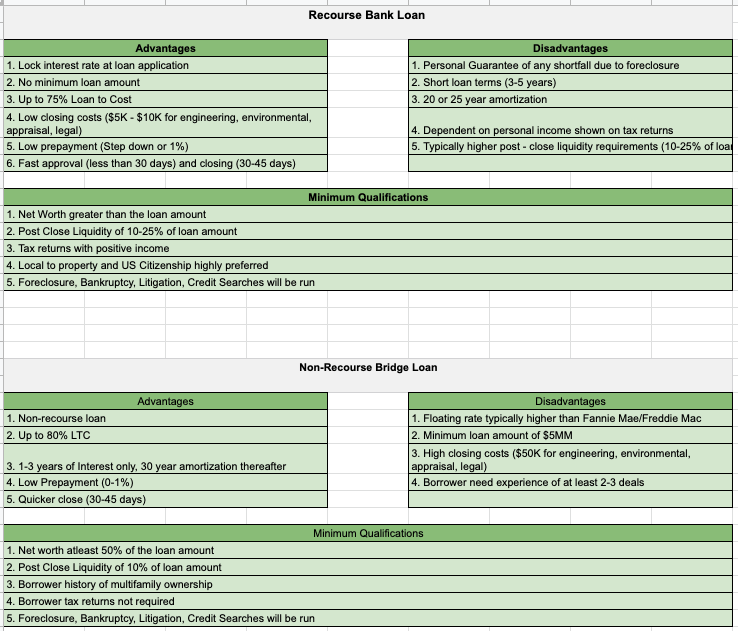
Bridge loans are not inherently more risky. But it does magnify a good deal as well as a bad one.
Detailed Analysis Example
[Coach’s comments in ALL-CAPS]
Summary:
- Address: xyz, KY
- 140-unit apartment complex
- Class B-/C+ built in 1967
- $68k/unit purchase price
- 8% pref, 70/30 split
- 3% acquisition fee [SUPER HIGH]
- 1% asset management fee
- They have their own in-house property management company
- 15.15% IRR, 1.85x multiple over 5 years
Assumptions:
- 10% first-year rent increase
- 3% market rent increases after the first year
- 2.5% Expense Growth YoY
- 6% Vacancy YoY (8% yr 1)
- 4%, 2%, 1% YoY Loss to Lease
- 6.09% entry cap ASK WHAT THE REVERSION CAP… I’D LIKE TO SEE IT 6.75-7.25 for this market
Student Concerns:
- This is only a 1% rent-to-value ratio deal, NO BUENO
- They are using 3% market rent increases. That seems normal from my research, but just something to think about. 2% FOR THIS MARKET IS BETTER
- They are only estimating an 8% vacancy in the first year during a renovation where they raise rents by 10%. They aren’t renovating all the units, but it still seems low. Also, the following years only estimate a 6% vacancy. THEY BETTER HAVE 3% ECONOMIC VACANCY IN ADDITION TO THIS
- The price per unit seems high for this class of property, which explains the 1% RV ratio.
- The estimated cash-on-cash is set at 8% (same as pref), but I don’t see how it’s exactly 8% every year. That just seems weird. IT DOES NOT MATTER. IF THE GP CAN’T PRODUCE, THEN THEY OWE YOU THE PREF… UNLESS THEY CAN’T AND THEY GO UNDER 😛
3% ACQUISITION FEE IS VERY HIGH, THAT’S HOW THEY ARE MAKING MONEY!
Talk it through with us
Questions on “Loan Terms” as you look at real deals? Join The Wealth Elevator investor community and bring them to your onboarding call.
Join the club and book your onboarding callJoining is free.

The podcast behind this course
The Wealth Elevator Podcast
Lane's show for accredited investors on passive syndications, taxes and alternative investments. Many of the lessons in this course started as episodes.
Listen on Apple PodcastsWatch on YouTube