


Commercial vs. Residential market value evaluations
A residential real estate appraisal differs from a commercial real estate appraisal. The appraisal process, when conducting a commercial property appraisal, unlike a residential property, the assessed value is determined using income as the valuation method. The more income a property brings in, the higher the valuation.
The commercial real estate valuation formula is Value = Net Operating Income (NOI) / Capitalization Rate (also called the prevailing cap for that particular asset/asset class/sub-market). Capitalization Rate (Cap rate) indicates the rate of return that is expected to be generated on a real estate investment property. For example, a class B residential property in a great part of Dallas might trade for 4.25% (+/- 0.25), where a class B industrial property in a rough part of Dallas might trade for 6.25% (+/- 0.25). In other words, we don’t have control over this Capitalization Rate as it’s what assets are trading for (a factor of this number). We have control over the NOI, and we can increase income or decrease expenses.
Net Operating Income (NOI) equals all revenue from the property (all rental income, fees, and other income) minus all reasonably necessary operating expenses.
Cap rates are expressed as percentages and vary from market to market. Within each market, cap rates have a historical range. For example, if a property had $300,000 in NOI and the cap rate in that market was 5%, you’d expect the property valuation to be at around $10 million ($300,000 / 5% = $6 million).
This Capitalization Rate (“Cap rate”) often gets mixed up with what the asset is performing at (the cap rate)… see, it’s confusing. Read on to learn this important concept to conduct your own comparative market analysis and not be like most unsophisticated Accredited investors that don’t know the difference and just say broad comments like “the caps are shrinking” just to make themselves look cool.
“Probably the most important thing in this course is to understand how to determine the investment value”
What is “Cap Rate Gate?”
It’s when a syndicator manipulates the reversion cap rate to greatly influence the exit sale price, which in turn greatly impacts the total returns, so they can attract investors to a deal.
Typically, expenses are always left out or income is inflated, which can throw off the cap rate by +/- 2.0. The only true way to determine a subject property’s cap rate is to get the trailing 12-month Profit and Loss Statement (“T12”), but at that point, you have the information to underwrite it fully. Asking for the P&L might be bad form from a passive investor’s perspective because it might come across as too much information, and a sponsor might not want to work with an annoying investor.
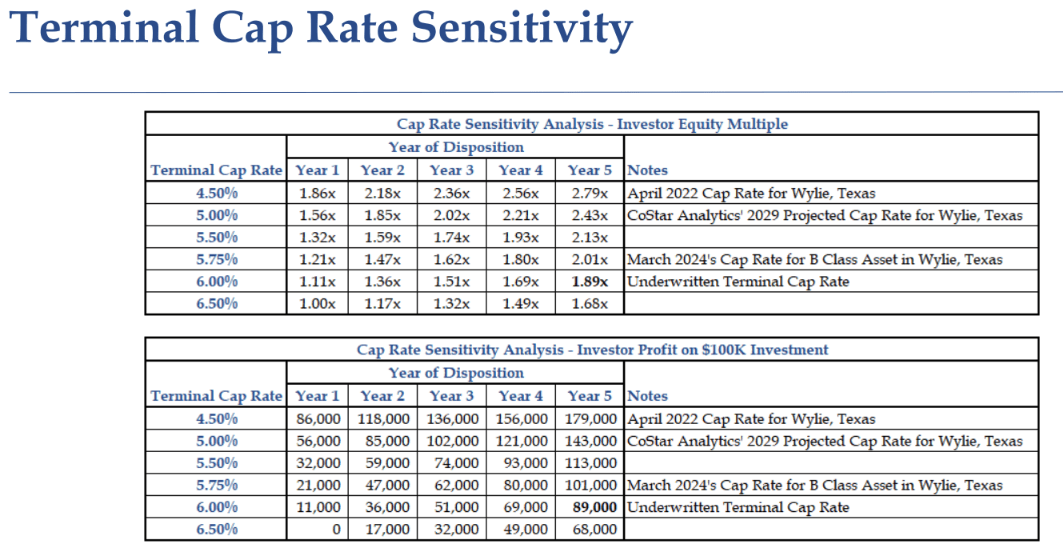
The reversion cap rate is a “wild-ass guess” to begin with, but an increasing cap rate means it’s a softer market, and you are not going to be paid as much for your NOI. To be a conservative underwriter, you like to see the reversion (exit) cap rate +0.5-1.0% higher than the starting cap rate. Using anything less than +0.75% is simply “kicking the can” down the road, hoping the market trends up.
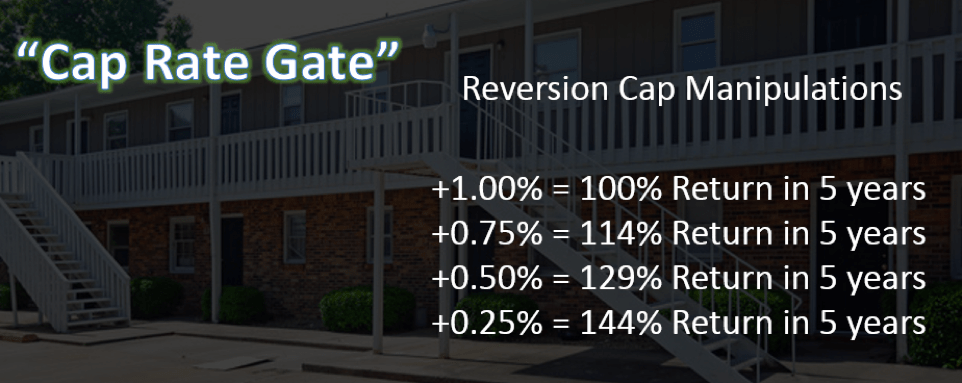
For example if your prevailing (not your starting) Cap Rate for that asset class and market is 6.25% then you want to use 6.75-7.25% as your reversion cap rate.
See here how much it impacts the total return. This is why you need to look under the hood and stop taking the “sticker price” for face value.
Make sure you understand this because this is super important in real estate investing. And it takes a while to understand this as it is a bit counter intuitive. So if you want to be conservative in the future you increase the reversion cap… yes increase. I think people get this confused with what a Cap Rate is of the property and what Cap Rate is used in the market price calculations. It’s two different things with the same word.
For example, lets take a class B residential property in 2021 in Dallas might be running well at a 6 Cap. But the prevailing Cap Rates that similar assets are being traded at in that same market would 5.0-5.5 Caps. The 6 Cap again is what the property is running at, which is different than the prevailing Cap, which is 5.25. In order to do proper underwriting, we want to increase the prevailing Cap (5.25) by 0.5-1.0 to come up with the reversion or exit Cap of 5.75-6.25 to assume that the market to be weaker in the future. A common mistake is to take into account what the current Cap the asset is performing at, which is really an independent number from what the prevailing asset is. If the subject property’s Cap is higher than the prevailing, then that’s good, it’s performing better than similar assets, but if it’s less, it is likely the reason for the discount, and a sign that there are operational inefficiencies. Using less conservative (lower) Exit Cap assumptions will increase the sales price and inflate our total returns.
What is the going cap rate for these types of properties?
The two biggest factors are the class of property and the class of the location. This throws the Cap rate 0.25 +/-.
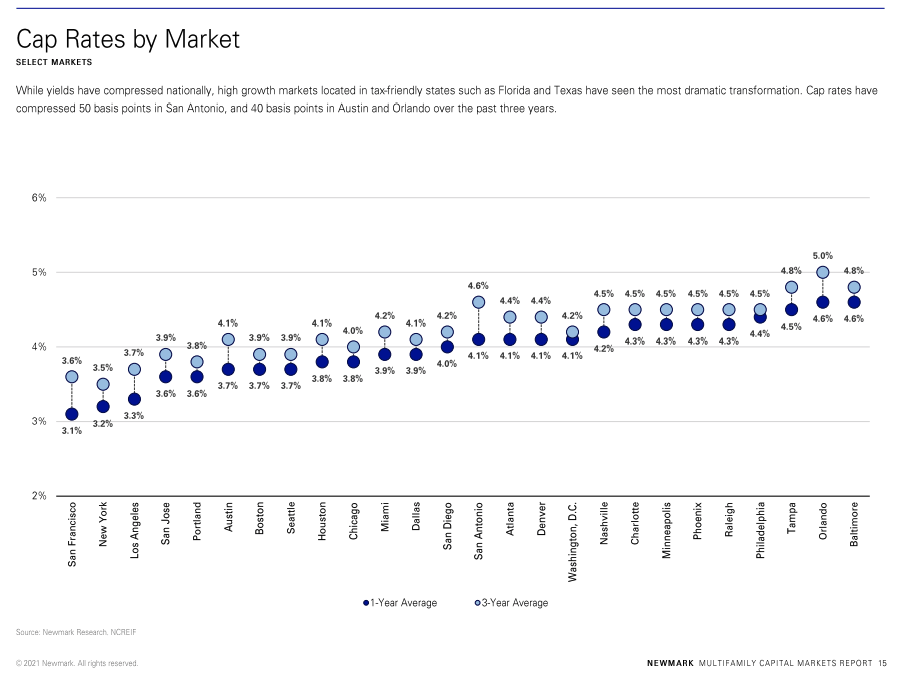
Class A in Dallas (2020) … let’s just call that 4.5 plus or minus a 0.25% Cap today.
Class B in Houston (2020) … let’s just call that 5.0 plus or minus a 0.25% Cap today.
Class B in Los Angeles (2020) … let’s just call that 3.5 plus or minus a 0.25% Cap today.
Class B in a tertiary market like Huntsville, AL… those assets trade for high 5s or low 6s.
How Important Are Cap Rates at the Beginning of a Deal?
Cap rates are severely overestimated in most cases from brokers/sellers/syndicators so we don’t really pay much attention to it on the front end of the deal during acquisition. The reasoning is that to get to that number, typically expenses are always left out or income is inflated – so it’s bad data to begin with. Those “above of the line” items are again always manipulated and can throw the calculated cap +/-2.0. The only true way to determine is to get the trailing 12-month Profit and Loss Statement but at that point, you have the information to underwrite it fully.
In class B/C, we have been using a 6.5-7.5% reversion cap depending on the market. For example 6.5 in Dallas, whereas it could be a 7.5 in Gulfport MS. These days, nothing is over 7.5% cap (unless it’s a truly off-market deal and a fringe deal under 60-units). I find the current prevailing caps from our operator peers who are apartment operators. Another way is to talk to a broker who has their pulse on the market and knows you need the number for underwriting purposes (and he is not selling you a deal).
In addition. the mere fact that we are doing value add and buying assets that have a management problem (that we can fix) means the property is not performing what it should be.
How do I set the Reversion Rate in my underwriting?
If you wanted to manipulate the total return, the one cell on the spreadsheet that is the go to “fudge this cell” or “sharpen the pencil” is the Reversion (Exit) Cap Rate.
You want to see the Reversion (Exit) Cap Rate 0.5%-1.0% higher than the Market Cap Rate. Notice I am using the Market Cap Rate for similar assets (Class A, B, or C) in similar submarkets (locations within the same city), NOT the Subject Property Cap Rate.
On class B/C investments, I have been using 6.5-7.5% reversion cap (2019) depending on market. These days nothing is over 7.5% cap (unless it’s a truly off-market deal and a fringe deal under 60-units).
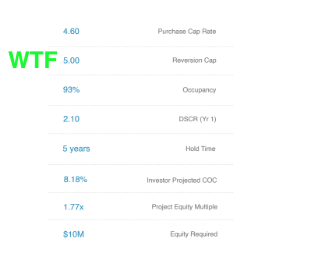
Exception: Only case where you might do a -0.25 to +0.5 cap rate reversion increase because you are doing medium to heavy value add (15k-50k per unit) therefore taking a B/C class property to an A/B+. More info.
The Subject Property Cap Rate in-place is calculated on the T12, but in underwriting we don’t really take it into account to determine a Reversion (Exit) Cap Rate. Instead, we are going off the prevailing Cap Rate for that class of property in that market.
Conclusion and Key Takeaways
Commercial Property Value Is Driven by Income – Unlike residential real estate, commercial property valuation is based on Net Operating Income (NOI) divided by the market cap rate. More income = higher value.
Cap Rate and Property Performance Are Not the Same – The property’s in-place cap rate (based on T12 NOI) reflects how it’s performing, while the prevailing market cap rate reflects what other comparable property are trading at. Don’t mix the two.
Reversion Cap Rate Assumptions Are Easy to Manipulate – Sponsors can inflate projected returns by using unrealistically low exit cap rates. Conservative underwriting uses a reversion cap rate that’s +0.5% to +1.0% higher than the current market cap.
Cap Rate Expansion Has a Huge Impact on Value – A small increase in cap rate significantly lowers property value. From 2021 to 2024, rising cap rate market conditions resulted in price drops of 30–40%—a major opportunity for those getting into real estate investing today.
Cap Rates Help Compare Deals Across Markets – A 6.5% cap in a tertiary market may be more attractive than a 4.25% cap in a Tier 1 market if cash flow is your goal. But always consider risk and market fundamentals.
Cap Rate Alone Isn’t Enough – Brokers often inflate income or hide expenses to present an attractive cap rate. Always verify numbers with the trailing 12-month P&L before relying on any stated cap.
Use Cap Rate Spread to Gauge Profit Potential – Investors make money when the cap rate exceeds the interest rate on the loan. A wider spread = more profit potential when leverage is used responsibly.
Reversion Cap Rate Should Be Based on Market, Not Property – Don’t base your exit assumptions on how the property is performing today. When you conduct property assessments, use the market cap rate for similar assets in the same submarket, then build in conservatism.
A Higher In-Place Cap Than Market Cap Is a Good Sign – If the asset is running at a higher cap rate than comparable sales, that could signal operational upside or a below-market price.
This One Metric Can Fudge the Whole Deal – If you only check one assumption in the pro forma, make it the reversion cap rate. It’s the easiest number to manipulate and has the biggest impact on projected IRR.
Below is an updated chart which I will try to update from time to time. Note when the spread is small or negative that is the time to take shelter. But as long as that spread exists investors should see it as a green light from a macro market standpoint. Of course investors and operators should look at each individual deal and market and not this super high level indicator.
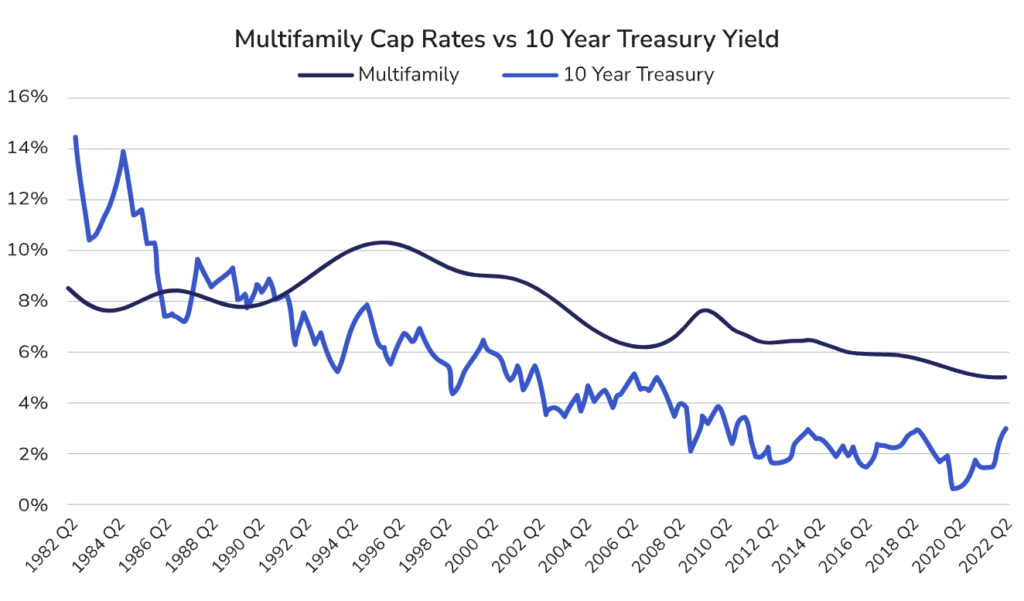
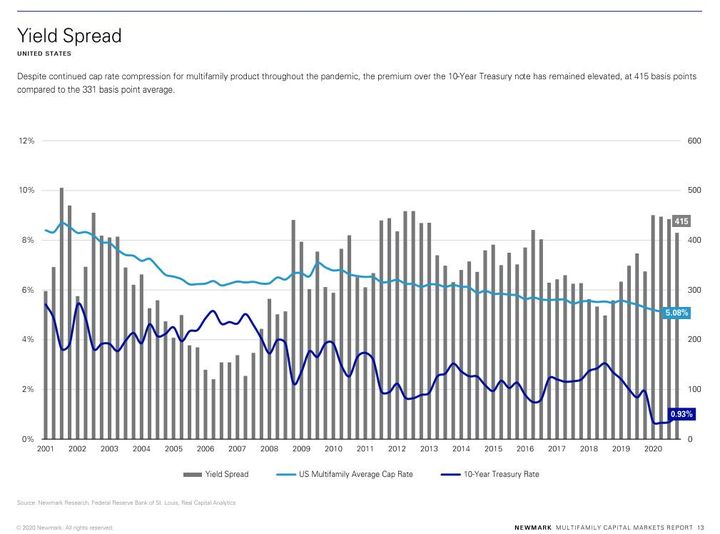
Apartment Cap Rates vs. Interest Rates
Test Your Understanding – [NOI / Cap Rate = Price] Examples
The cap rate is the ratio between a property’s net operating income (NOI) and its purchase price. It provides investors with a snapshot of the property’s potential return on investment. A lower cap rate indicates a higher valuation, while a higher cap rate suggests a lower valuation.
Now, let’s consider a hypothetical property with a consistent net operating income (NOI) of $1,000,000:
- At a 3% cap rate, the property’s value would be $33,333,333 ($1,000,000 / 0.03).
- At a 4% cap rate, the property’s value would be $25,000,000 ($1,000,000 / 0.04).
- At a 5% cap rate, the property’s value would be $20,000,000 ($1,000,000 / 0.05).
- At a 6% cap rate, the property’s value would be $16,666,666 ($1,000,000 / 0.06).
Notice how a slight increase in the cap rate significantly decreases the property’s value. This underscores the inverse relationship between cap rates and property prices.
The recent rise in interest rates has led to an expansion of cap rates. As interest rates increase, investors often demand higher returns, resulting in higher cap rates. Consequently, property values may decrease, presenting opportunities for discerning investors.
Let’s now examine the net operating income (NOI) growth required to offset cap rate expansion:
- From a 3% to a 4% cap rate: To maintain the property’s value at $33,333,333, the NOI would need to increase to $1,333,333 ($1,333,333 / 0.04 = $33,333,333).
- From a 4% to a 5% cap rate: Similarly, to sustain the property’s value at $25,000,000, the NOI would need to grow to $1,250,000 ($1,250,000 / 0.05 = $25,000,000).
- From a 5% to a 6% cap rate: To maintain the property’s value at $20,000,000, the NOI would need to increase to $1,200,000 ($1,200,000 / 0.06 = $20,000,000).
This illustrates the challenge of compensating for cap rate expansion solely through NOI growth.
So, why is now a favorable time to invest in real estate?
- Cap Rate Expansion: From mid-2021 to 2024, cap rates have rose from 3.5% to 6%, leading to a 42.9% decrease in property values. Deals secured in 2024, partly due to changing interest rates, are being bought at prices around 42.9% lower than before. This means investors are getting the same income stream for much less, with potential for significant long-term appreciation.
- Potential for Value Appreciation: As cap rates adjust, opportunistic investors can acquire properties at discounted prices, positioning themselves for potential value appreciation as market conditions stabilize.
- Historically Low Interest Rates: Despite recent increases, interest rates remain relatively low compared to historical averages. Locking in favorable financing terms can enhance returns and mitigate risks.
- Income Generation: Real estate continues to offer stable income streams through rental payments, providing a hedge against market volatility.
- Diversification: Real estate presents an opportunity to diversify investment portfolios, spreading risk across different asset classes, markets and vintages.
In conclusion, understanding the interplay between cap rates, property values, and market dynamics is essential for informed real estate investing. By capitalizing on current market conditions and seizing opportunities, investors can position themselves for long-term success in the ever-evolving real estate landscape.
This is educational content, not tax, legal, or investment advice. We are not attorneys, CPAs, or financial planners. Please let us know if you need a referral to a 💼 CPA, ⚖️ Lawyer, or other vendor here.
Talk it through with us
Questions on “Market Evaluation” as you look at real deals? Join The Wealth Elevator investor community and bring them to your onboarding call.
Join the club and book your onboarding callJoining is free.

The podcast behind this course
The Wealth Elevator Podcast
Lane's show for accredited investors on passive syndications, taxes and alternative investments. Many of the lessons in this course started as episodes.
Listen on Apple PodcastsWatch on YouTube