


Other Investments You Might See Out There….
Life Settlements

What is a Life Settlement?
A life settlement transaction is the sale of a life insurance policy to an investor in exchange for a lump sum payment. The amount received by the policy owner is less than the death benefit, but more than its cash surrender value of the policy.
The investor maintains the policy – paying all policy costs and/or premiums. Thus, the investor receives the death benefit upon the demise of the insured.
A life insurance policy is a saleable asset, no different than a home or automobile.
Why Would Someone Want to Sell Their Policy?
There are many reasons why a policy owner may no longer want or need to retain their life insurance contract. Below are some common scenarios:
The Need for Cash
- Policyholders may need to pay for healthcare/long-term care, supplement their retirement, purchase a retirement home, fund grandchildren’s educations, or check off items on their “bucket list”
No Longer Needed
- Their spouse has passed away, their children/heirs are self-sufficient, or the changes in the federal estate/tax laws.
Increased Policy Premiums
- The life insurance policy premiums have become too expensive due to the age of the insured, improper funding, or lack of policy performance.
- For whatever reason, the owner of the policy realizes that they can turn their life insurance contract into a living benefit and receive a lump sum payment that they can utilize in their remaining years.
Below are the pros and cons of Life Settlement Investment:
Pros
Attractive Returns
- Double-digit interest rates with no loss of principle.
Fixed Dollar Return
- The dollar yield to the insured’s life expectancy is known before the investment.
Non-correlated Asset
- Returns are not tied to external factors such as the stock market, interest rates, housing market, or political environment (low volatility). In other words… No Market Risk.
Quality Asset
- Policies are backed by America’s oldest and most financially sound life insurance companies.
Regulated Industry
- The life settlement industry is regulated in 45 states.
Invest with Retirement Funds
- Custodial accounts are available to convert your current qualified retirement plan.
Win-Win Opportunity
- A life settlement investment is a win-win opportunity because both the buyer and the seller come out on top.
Your Success Doesn’t Depend on Someone Else’s Management Skills
- This might be the biggest reason your financial adviser isn’t talking to you about life settlement transactions. Once you invest in life settlements, there aren’t really any more decisions to be made, other than whether you want to expand your life settlement portfolio or sell to other buyers. The only variable for which you have to account is time.
Cons
Longevity
- The insured may exceed their life expectancy.
Feature Item 2
- The funds will be tied up in the investment until the policy matures.
Credit Risk
- There’s a possibility that an ‘A’ rated life insurance company would not pay a death claim.

How Long Have Life Settlements Been Around?
In a 1911 Supreme Court ruling in the case of Grigsby vs. Russell, Justice Oliver Wendell Holmes Jr. ruled that life insurance contracts can be sold as an asset.
The Life Settlement market has been in existence for 20 years and is a top alternative investment.
“Viatical Settlements” became popular in the 1980s due to the influx of HIV/AIDS diagnoses. A viatical settlement refers to a terminally ill person with a life expectancy of 2 years or less.
“Life Settlements”, or “senior life settlements”, refer to an elderly or unwell senior with a life expectancy of 3 to 15 years.
Why Haven’t I Heard of Life Settlements?
Most financial advisors are not aware of alternative investments. If he/she works for a brokerage firm, the types of investments sold are limited to what the brokerage firm offers.
Some financial advisors are not allowed to participate in alternative investment options.
In addition, due to their broker-dealer restrictions, they do not have an understanding of the market due to their lack of participation. Wall Street does not want you to know about a little-known asset class known as life settlements.

How Can I Participate in a Life Settlement?

Direct Purchase
This option may be the most efficient in terms of costs; however, life settlements require an analysis by an expert. You want to have an expert assist you with the process. It is NOT a ‘do-it-yourself’ project.
Minimum Investment: $15,000 (this amount can vary depending upon the death benefit amount of the policy and the life expectancy of the insured).
Direct Fractional Shares
A large policy is divided into smaller portions and sold individually to several investors. Each investor owns a portion of the policy. This can also be done with several policies.
Minimum Investment: $25,000.


Private Equity Fund
This option allows you to purchase a portion of a fund comprised of hundreds of policies – a great strategy for diversification purposes.
Minimum Investment: $250,000+.
Note Investing
The mortgage note is an IOU that can be purchased at a discount in the right situation. Performing notes are when the borrower is current on payments, and non-performing notes are when the borrower is late or in default.
Many investors higher than $1M net worth who have realized that owning actual rental properties is not scalable. Investing in notes can be a great portfolio diversification option for the “tinkerer”; you don’t even need to get your hands dirty interacting with tenants, and there’s minimal travel involved.
Due to the COVID-19 pandemic and volatility in stock prices, there has been an increase in demand from investors who are ditching the equity markets and going into hard assets such as real estate, especially turnkey rentals.
Some are going as far as owning the notes on these properties to collect a predictable income stream of 10-13%. I personally try to stay on the equity side if I believe in the deal, but debt deals/lending can be a good play for more conservative investors (see below for more info). And it is an idea of retirement account investing.

Types of Notes
Based on the legal ownership structure and municipality, there are two types of notes:
Notes and Mortgage
Lender is the first Lien Holder on the Property, and the Buyer is the Title Holder
Land Contracts
Lender is the Title Holder, and the Buyer is making payments until paid off.
How to Invest in Mortgages?
Should the borrower default, the lender may exercise their rights as spelled out in the mortgage document.
Trust deeds, deeds of trust, and mortgages have similar wording and have a few differences, but serve mainly the same purpose.
These loans can be bought and sold just like any other commodity. If someone were to buy at “face value,” they would be paying the loan amount remaining at the agreed-upon interest rate for the remaining term. Buying at a discount means that you purchase the note for less than the face value, thereby increasing your yield.
There are two loan documents created when a person borrows money to purchase a home:
Promissory Note
A promissory note is evidence of a promise to pay a debt and is signed by the borrower. The terms “loan” and “note” are often used interchangeably with “promissory note.”
Security Document
A security document, such as a mortgage, is a document that is recorded at the county showing that the borrower pledges the property as collateral against the loan. The type of security document varies by state and can be a mortgage, deed of trust, or trust deed.
Investing in Mortgage Notes vs. Real Property — Similarities
Collateral
The underlying collateral for a note is the building and/or land itself. You should value the underlying collateral of your note investment as if you will own the property (because you just might). Typically, you can use online resources like Zillow or Redfin to get a range of values. To get more accurate, you would order a broker price opinion (BPO) to have the property valued against other local properties. Ideally, you want the value of the collateral to be higher than the unpaid principal balance of the note. Why? Because if you have to foreclose, you want to make sure that after all legal and liquidation expenses, you capture at least your original investment. Return on capital is more important than return on capital!
Title
Just as you want a clear title when purchasing a home, so too is the case when investing in a note. For new notes, you will obtain a lender’s policy to ensure your note will be recorded in the desired lien position. For existing note purchases, you will want to review the existing lender’s title policy to ensure that it is transferable.
Insurance
Note investors should make sure the borrower has appropriate insurance for the collateral and that the note investor is listed as the Mortgagee on the Evidence of Insurance certificate issued by the insurance company. When listed as a Mortgagee on the insurance policy, the insurance company knows to issue a check to both the Mortgagee and the Borrower. In addition, if the policy is changed or canceled, the Mortgagee is notified and can take corrective action. If the borrower does not have hazard insurance, then you, as the lender, should originate Force Placed Insurance at your expense so that, should the home be destroyed, you can at least recover your original investment and expenses. FPI can be added to the borrower’s account as a “recoverable cost” if you follow the procedures required by the CFPB.
Lien vs. Ownership
The first difference is the most obvious. The real estate is not owned by the note holder: the note holder has a lien position against the real estate. If the borrower breaches the terms of the loan agreement, the lien holder can foreclose upon their interest and acquire title to the property.
Borrowers vs. Tenants
Note investors manage their borrowers, and real property owners manage tenants. Both tasks can be outsourced. Note, investors may outsource the collection tasks to a servicing company, just as real estate owners can outsource rent collection and upkeep to a property management company.
As a note holder, your main responsibility is to collect the payment and make sure taxes are being paid and insurance is current.
Taxes & Leverage
When purchasing real property, it is typically easy to find 60-80% financing from a bank or private lender. Leverage is more difficult to obtain for note investors. Although it is possible to obtain a loan against a note investment (hypothecation), it is far less common and reserved only for the highest quality investors, and usually at above-market rates. Most note investors should assume that they will be required to pay cash for a note or find a “money partner” to fund the acquisition.
Also, when owning real property, the landlord has some great tax advantages, such as depreciation, loan interest, and passive income that is taxed at a lower rate. The note investor does not receive these benefits, since a note is considered personal property and is taxed at ordinary income rates. Because of this, note investing works well with a Roth IRA or self-directed IRA since the income and growth are tax-free.
Credit Underwriting
When making a decision on a note investment, the borrower’s credit and capacity to make regular payments are equally as important as the value and quality of the collateral. The process of evaluating the borrower’s credit and ability to pay is called “underwriting” the loan. Individual investors should set standards for their borrowers in accordance with their own appetite for risk.
Document Underwriting
Not only should an investor underwrite the borrower, but a full review of the loan documents should be made. At a minimum, the review of the note, the Deed of Trust (or Mortgage), any previous assignments, allonges, lender title insurance policy, servicing notes, and payment history should be completed. If any gaps in the chain of assignment are found, that could cause problems should a foreclosure be needed, and a borrower could challenge the validity of the note if any defects/gaps are found.
In purchasing real estate, there is typically a purchase agreement and a Deed. The purchase agreement details the terms of the purchase, and the deed is recorded to put the public on notice of the new owner and that the transaction has closed. In a note purchase, there is also a purchase and sale agreement which spells out the terms of the note purchase, but instead of a Deed, the instrument that is recorded is called an Assignment of Mortgage or AOM. The previous note holder is assigning the beneficial interest of the note to the new note owner with a notarized AOM, and once that document is recorded on the county records, the new note holder is now the lender of record.
Foreclosure
When a note investor is not paid, foreclosure is the final recourse. The process of foreclosure varies by state and may be judicial or non-judicial depending on how the state’s statutory scheme is set up.
Foreclosures may require substantial upfront fees paid to attorneys and/or trustees and can be a stressful process for a note investor to undertake. The risk of foreclosure is directly related to the quality of the note investment and the quality of the borrower. Good quality borrowers are as important to note investors as good quality tenants are to real estate investors. Generally, loss mitigation tactics should be deployed to work with a borrower to get them back on track with the payments. It can be a long, time-consuming process, but it will pay off in resumed income on the note.
Buying Notes – Example
The concept of “buying at a discount” is fundamental to note investing. Let’s look at an example to illustrate the point.

If we were to buy a $100,000 note at face value of $100,000 and it is paying 7% interest on a 30-year term, our return would be 7%.
As a note investor, we don’t pay face value, so we discount our purchase offer. If we were able to buy this loan for 60% of the unpaid balance, or 60 cents on the dollar, the return on our money would be 13% instead of 7%.
Considering that banks are paying roughly a whopping .2% (that’s right! 2 tenths of 1 percent) on deposits, this strategy multiplies our earnings to returns that few can show.
Buying discounted notes is a powerful way to increase our passive cash flow (or “mailbox money,” as we call it). These high returns are why the distressed and discount note space is so attractive to us as private investors.
NOTE: I don’t invest in notes, because I don’t get the passive losses from the investment!

Insider Tip from Lane
Triple Net Deals (where you collect rents and have the corporate-backed tenant pay for improvements and maintenance are lower risk but also lower return. The same can be said for Life Settlement investing (no tax benefits). Those sectors are considered more “endgame” investments.
If you are under $2-4M net worth, you will likely need to invest in higher-risk reward reward-profile deals. I honestly think you can’t beat the risk-reward profile of stabilized multifamily buildings with a little bit of value add.
How to Vet Note Deals
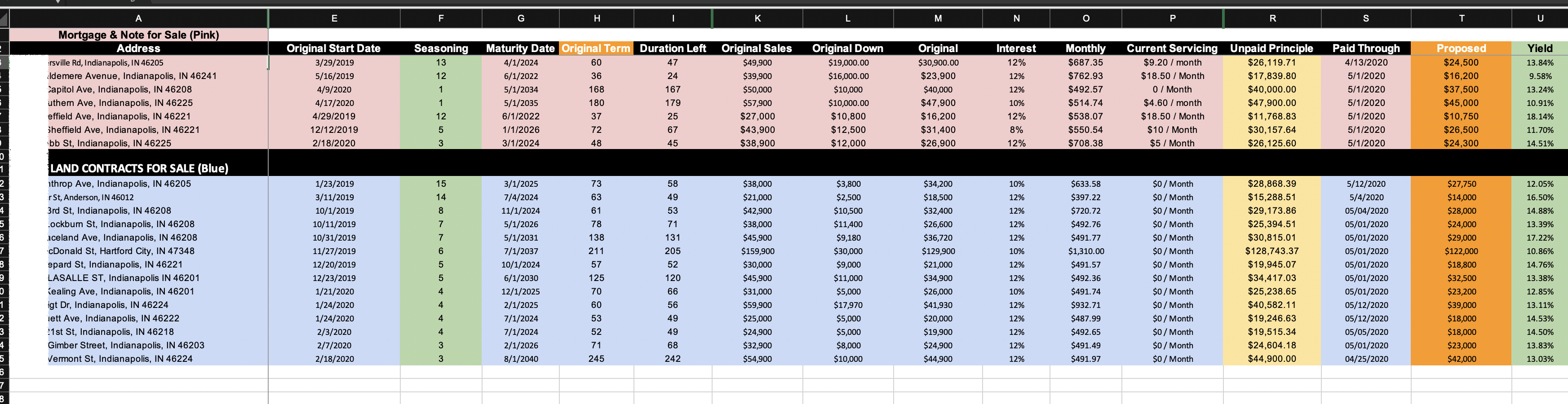
Below is an example spreadsheet of all the above criteria:

Why Do Banks Sell Their Notes?
Banks and GSEs (Government Sponsored Entities like Fannie/Freddie Mac) are not good at owning Real Estate and foreclosing. They profit on the spread, which is the difference between the rate at which they lend money and the rate at which they borrow.
Due to government regulations (that would take up several pages), when a borrower defaults on a loan, the lender must reserve a significant amount of money to service that loan.
When this happens, that money is no longer available to lend and costs the banks the profit that they could have earned.
With the huge volume of defaulted loans in the past half dozen years or so, lenders have found it more lucrative to sell the notes at a discount than to take them through to foreclosure.
We, as investors, benefit by being able to work out the loan with the borrower in a variety of ways. Avoiding lengthy and expensive foreclosures (the length and expense vary by state) is one of the many reasons selling loans is a viable option for lenders.
How can we help the homeowner?
When we purchase a note, we are buying the payments as well as all the original rights that are spelled out in the documents. These rights include the right to modify or change the loan with the permission of both parties, and the right to renegotiate or foreclose.
In most cases, your returns are higher when you successfully work with a borrower to return them to the path of on-time payment rather than foreclosing.
When the borrower has returned to paying on time and has done so for six months (this is called “seasoning”), we have the option of selling that loan as a re-performing loan at a higher price than what we paid. This spread is our profit.

Foreclosure Laws – Deed in Lieu
When we cannot work out a solution to get the borrower paying on time, sometimes the lender must foreclose. Foreclosure procedures vary by state; it is important to research them to determine whether you want to purchase notes in particular states.
An alternative to foreclosure is accepting a deed in lieu. A deed in lieu of foreclosure occurs when the borrower hands over the property to the lender to satisfy a loan that is in default. When a borrower agrees to the deed in lieu, the borrower’s credit remains unaffected, which is why this strategy is often preferable to foreclosure.
When a lender takes a property back via foreclosure or deed in lieu of foreclosure, the lender becomes the owner of the property.
Note Exit Strategies
Mod and Sell
- Do a simple purchase, modify, markup, and sell. As discussed earlier, when we can turn a non-performing loan into a performing loan, we can sell the loan for a much higher price than we paid. The “mod and sell” strategy is a very lucrative business model.
Title
- Brokering is a method where a note seller wishes to sell a note, and you find the buyer. The buyer tells you what they will pay, and you offer less to the seller. The difference between the sale price and the accepted price is your profit. Brokering is one way to generate income with no money out of pocket.
Selling a Partial
- “Selling a partial” refers to selling part of the income stream of the note. The note holder sells a portion of the payments (usually a set number of payments from the front-end of the loan) to another investor at a price that will result in an agreed-upon yield for the investor. After the investor receives all his payments, the payments revert to the note holder. With partials, you get the best of both worlds–you get your money back so that you can buy another note, and at some point in the future, while continuing to receive payments from the note.
Foreclosure Exit Strategies
Foreclosures are inevitable in the note business. Despite our best efforts to avoid them, they will happen, and you will end up with a property on your hands. Remember, you picked up the property for the discounted price of the note. That’s the beauty of dealing in Real Estate-backed notes.
Below are some options, out of many, available to you. As an investor, you will want to put your property to its highest and best use. Many factors, such as the local Real Estate market and your comfort level with being a landlord, go into making this decision. Research the home’s market before deciding on an exit strategy.
Auction
- Investors who want to deal only with paper (“paper” is another word for loan, mortgage, etc.), not properties, want to get out of the house as quickly as possible, usually through a foreclosure auction or trustee sale.
Hold and Rent
- A note investor may want the rental income from a property to diversify cash flow. In this case, the investor will keep the home, renovate it, and then rent it out.
Fix and Flip
- To realize a high profit in the short term, the investor may rehab the home and sell it at retail. Again, this could be very profitable due to the cost of the discounted note.
Investing in Notes with Your Retirement Funds
You can invest in notes from a self-directed IRA, have all the profits returned to the account, and enjoy the tax benefits of the IRA.
You don’t get the great tax benefits or bonus depreciation like syndication deals, but it is great for a tax-sheltered retirement account.
Talk it through with us
Questions on “Other Investments Part 2: Life Settlements & Note Investing” as you look at real deals? Join The Wealth Elevator investor community and bring them to your onboarding call.
Join the club and book your onboarding callJoining is free.

The podcast behind this course
The Wealth Elevator Podcast
Lane's show for accredited investors on passive syndications, taxes and alternative investments. Many of the lessons in this course started as episodes.
Listen on Apple PodcastsWatch on YouTube