


How to Check a Syndication Company
To search for a real estate syndication company “must” go to the SEC website (called EDGAR – I don’t know what it means, but I can assure you the government spent a lot of money on it).
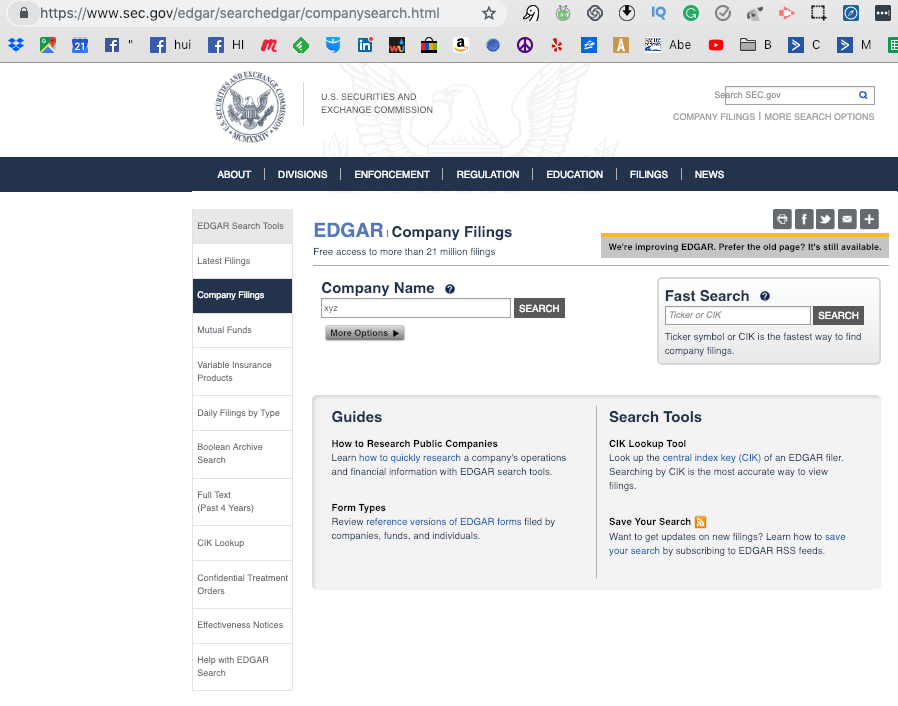
You are looking for a form D for the deal. Query the LLC name…
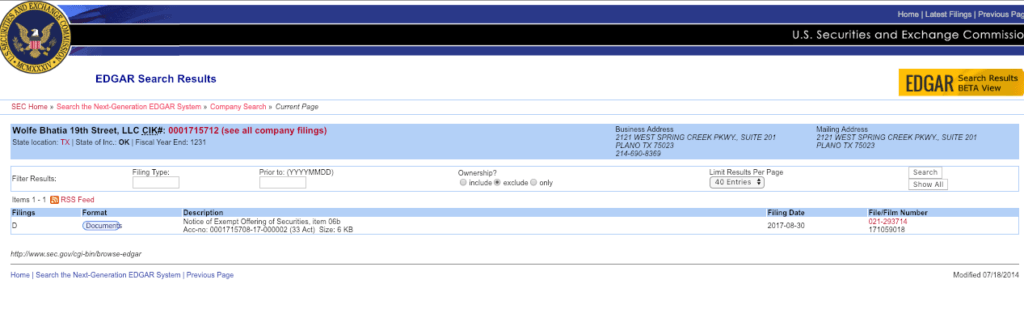
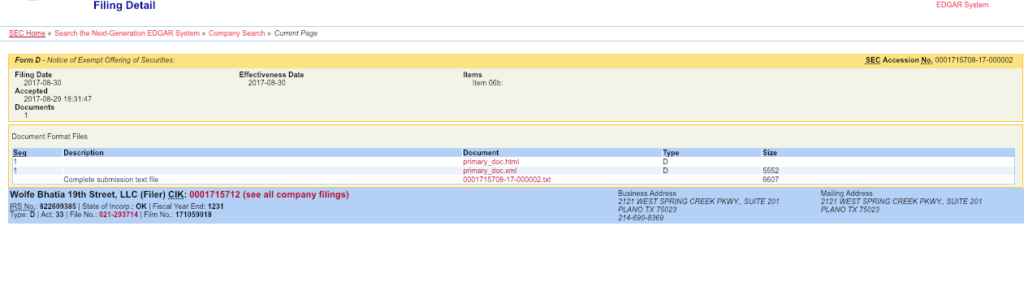
Then you can read the docs here…
Background Checks
How to check a broker (regulatory check): BrokerCheck: Research Brokers & Investment Advisers
Skin in the Game
Also worth noting is that it’s incredibly important when making informed decisions to know that the general partner has ownership and invested in their own real estate syndication deals and that they are risking their assets alongside yours. Most investors want to know what percentage of the manager’s liquid net worth is in the syndication investment, and will often request documents to prove it.
Performance
On every disclaimer on every document you will read from a properly structured syndicated real estate deal, it will say: “Past performance is not indicative of future results.” I’m generally not a fan of legalese, but this bit should be taken as gospel. Historical returns are in the past, and without understanding them in the context of the strategy, the risks taken, and the changing nature of the strategy in the market, then those returns are meaningless. Statistics lie. At the very least they can mislead: Did you know that the Vatican City has 5.9 Popes per square mile? True fact.
Let’s go through another quick example. If a deal sponsor tells you: “We returned 100% last year.” Are you:
(a) Excited 😀
(b) Interested 🤔
(c) Skeptical/unsure 🤨
(d) Overwhelmed by feelings of inferiority over your own lousy returns 🤕
If the answer is anything other than lots of ‘c’ with a little bit of ‘b’ then you need to learn more about what performance in a real estate syndication deal means. (If your answer is ‘d’ I suggest yoga 🧘)
Performance needs to be understood in context. What risks did the real estate syndicator take to make 100%? What is the volatility a limited partner can expect on those kinds of returns? (No matter how great a passive investor’s returns are, they only need to lose 100% once to wipe it all out.) Statistics like Sharpe ratios, maximum drawdown, correlation, and volatility can only really be helpful in the context of the market and the strategy that contributed to that performance.
I once met with a general partner who returned 142% in 2009 and 55% in 2010. Those were eye-popping returns, and they had all the right service providers and statistical ratios to “prove” how credible and great they were.

The manager told me that their whole strategy was to analyze momentum price signals, because “when you focus on one thing all day you get pretty good at it.” They were a complete black box as far as their model and their investment process, but the manager shared one aspect of the model: “When the market goes up we are able to capture those returns, but as soon as the market starts to drop, the model shuts down in order to mitigate any losses.” Classic baloney. (Explanation: Unless you know whether the market will continue to go down or up you can’t determine when to turn the model on or off. He was basically implying that they could perfectly predict the direction of future price action in the market.)
I passed on the fund, and it literally blew up the next month. (To be fair, I didn’t realize it would blow up so soon, though I did know that it would inevitably blow up with those returns coupled with no credible explanation of how they produced them or why they would persist.) The moral is that it’s hard for an individual investor to find an edge and generate consistent returns, and historical performance (whether good or bad) has to be understood in full context.
Conclusion and Key Takeaways
Always Verify with the SEC – EDGAR is Your First Stop – Before investing, search for the real estate syndicate’s Form D on the SEC’s EDGAR database. It’s the baseline for verifying if a deal is properly filed and helps avoid unregistered syndication offerings or fraudulent activity.
Don’t Rely on Past Returns Alone – Performance Needs Context – A flashy 100% return means nothing without understanding the risks, volatility, and strategy behind it. Consistent returns with transparent methods beat out black-box strategies every time.
Sponsor Skin in the Game Signals Alignment – Ask how much of the sponsor’s liquid net worth is invested. A meaningful personal stake ensures the sponsor is just as motivated to protect capital and drive returns as the limited partnership is.
Beware of Operational Red Flags – Process Matters – Over half of hedge fund failures stem from operational failures. Look out for things like in-house fund administration, single signatories on cash transfers, or revolving accounting firms. These details matter.
Blind Pool Funds Limit Transparency – If you can’t vet the individual assets upfront, it’s hard to gauge risk or performance. A seasoned sophisticated investor may prefer a single-asset syndication for better control and visibility into what they’re investing in.
Hot Returns Often Mean Hot Risk – High monthly volatility, aggressive underwriting, or unexplained losses signal deeper issues. Funds with strategies that don’t align with actual performance metrics are likely heading for trouble.
External Fund Administration Is a Must – Independent third-party administrators bring credibility and oversight to fund operations, especially in pricing, valuations, and cash flows. Without one, the risk of fraud increases substantially.
Legal Structure and Transparency Go Hand-in-Hand – Sponsors creating multiple shell entities or switching offices within the same firm may be trying to limit liability or obscure information. Always ask why legal and operational structures exist as they do.
Watch for Sponsor Creep – Fee Structures Can Quietly Shift – Once trust is built, some sponsors raise fees or underwrite more aggressively. Stay alert to changes in proformas, GP splits, or assumptions that skew returns for LP investors.
Due Diligence Isn’t Optional – It’s Your Best Risk Management Tool – Ask hard questions about operations, structure, service providers, and performance. Use our due diligence checklist to go beyond the pitch deck and uncover hidden risks before you invest.
Invest Smarter, Avoid Costly Mistakes,
and Gain the Edge of a Master Investor
Process: Operational and Investment

Now that you understand more about the people you’re working with, you want to understand the structure and processes that constrain them.
I know what you are thinking—operations are boring. The sexy stuff is how people come up with their brilliant investment ideas. Unfortunately, the operations and business side of the fund are not trivial matters. Research has shown that over half of all hedge fund blow-ups occur due to operational issues that have nothing to do with the investment process. As unappealing as it is to try to figure out the nuances of how Net Asset Value is calculated and reconciled with the fund administrator, it’s even less appealing to lose a billion dollars because you didn’t take the time. (Yes, turning over every stone means turning over the ugly ones too.)
I’ve seen institutional investors pass on funds for reasons that may not be immediately obvious problems to a new real estate investor. This is again why I personally do not like to invest in funds or blind pools where I cannot vet the individual assets that we are buying. In order words, I like single-asset deals where I know what I am investing in so I can perform my own due diligence on the asset after I have done my due diligence on the sponsor. Blind pool funds and funds are really hard to determine what is going on from a financial standpoint. Finally, I have seen some sponsors throw their junk deals into a blind pool fund and serve up to unsophisticated real estate investors looking for diversification. Think of it as the investment world of a hot dog!
Below are some examples. If you can think through the issues or potential issues with each real-life scenario below, then you are off to a good start:
A small fund required a single signatory on cash transfers.
Like any other business, embezzlement can be a problem for hedge funds. Requiring a single signatory to move cash, particularly for a small fund, means that a founder/key employee can potentially loot the place without limits. It’s not unheard of for a business owner to get served divorce papers, and then decide it’s time for an early retirement in a tropical, non-extradition-friendly country. On a less major scale, an employee may embezzle smaller amounts systematically over time. Hedge funds generally have much higher asset liquidity than traditional businesses, and therefore cash stewardship is of utmost importance. For these reasons, institutions usually require double signatories on cash transfers, often with one signatory being a credible, independent fund administrator.
A fund had legal entities for their marketing, deal sourcing, and investment divisions of the firm.
Separate legal entities are put in place to limit liability (and potential transparency) between entities. Whenever a manager puts legal shields in place between different operational aspects of a fund, the investor should have a very clear understanding of why that is the case. In this case, the reasons didn’t pass the smell test and were likely in place to obscure important information for investors.

A large, well-known fund had used a Big-4 accounting firm as its auditor since inception and worked with several offices of the firm over the course of their relationship.
Accountants understand the concept of multiple legal entities all too well. For example, each office of PWC may have its own separate legal entity which protects the greater organization and other offices from shared liability. In other words, working with 3 different offices of the same firm can be like working with 3 completely different firms. Another fact about accountants: If they find a problem with a fund (or a company), they will often resign rather than report their suspicions. In this particular example, 3 offices of the same accounting firm resigned over the course of the life of the fund. Unfortunately, most investors just thought: “Well, the manager has used a credible firm since inception, therefore it’s all kosher.” Wrong.
The same fund in the previous scenario above managed its fund administration internally.
Approximately 90% of all hedge fund frauds would be eliminated through the use of a credible outside fund administrator to manage valuation, NAV reporting, subscriptions/redemptions, and the back-office functions of a hedge fund. Bernie Madoff in-sourced his administration. He couldn’t have reasonably pulled off his fraud had he used a credible outside administrator.

Sponsor Creep: This is where a sponsor builds up a good investor base and starts to increase fee structure, GP splits, and worse starts underwriting more aggressively to make the proforma look better than it is.
A fund was down 3% in one month.
This by itself isn’t a problem. Some funds have high volatility and +/- 5% or more in a month isn’t unusual. The problem was that this particular fund’s investment strategy was expected to generate a slow, consistent half percent a month. A drawdown of one month of 3% in the context of that strategy was a red flag. The next month, the fund was down 9% and subsequently lost another 20% before shutting down.
A fund had rehypothecation agreements in place with its Prime Broker, a major, well-respected Wall St. bank.
Rehypothecation is when the fund lends its securities to its prime broker. The broker can then use the securities as collateral to lend against, and will generally pay the fund a small fee in return, which helps lower the fund’s brokerage expenses. Here’s the bottom line: When Lehman Brothers went bankrupt, this small distinction determined who ‘owned’ the assets. It was the difference between blow-up or solvency for many funds. (Literally, billions were lost or saved over this nuanced operational detail.)
This is educational content, not tax, legal, or investment advice. We are not attorneys, CPAs, or financial planners. Please let us know if you need a referral to a 💼 CPA, ⚖️ Lawyer, or other vendor here.
Talk it through with us
Questions on “Due-Diligence Procedures” as you look at real deals? Join The Wealth Elevator investor community and bring them to your onboarding call.
Join the club and book your onboarding callJoining is free.

The podcast behind this course
The Wealth Elevator Podcast
Lane's show for accredited investors on passive syndications, taxes and alternative investments. Many of the lessons in this course started as episodes.
Listen on Apple PodcastsWatch on YouTube