


Numbers in the examples on this page are hypothetical and for illustration only. Return targets are not guarantees, and investors can lose money.
Preferred Return Vs Cash Flow
We have covered this previously, but wanted to cover it from a slightly different angle to answer the question “How does preferred return work?”. In passive real estate investing, some investors are confused about the implications of preferred return on cash flow and erroneously believe that an 8% preferred return rate means that they are expected to receive an 8% cash-on-cash distribution. A preferred return is simply a partnership structure that provides investors a minimum rate of return prior to sharing any profits with the sponsor via a promote. This does not mean that accrued preferred return stipulates a minimum level of cash flow distribution. Meanwhile, cash-on-cash return projections are the actual forecasted annual cash flow.
For example, an investment opportunity could have an 8% preferred return rate, but the average cash on cash over the projected hold period is only 6%. This has become the reality for most deals these days, which is why more investors have been bringing up this question about preferred returns and their relation to cash on cash.
Accrued preferred return doesn’t imply cash on cash returns, so investors seeking to understand an investment’s cash flow projections should focus on average and yearly cash on cash.
Investor Structure/Split Example
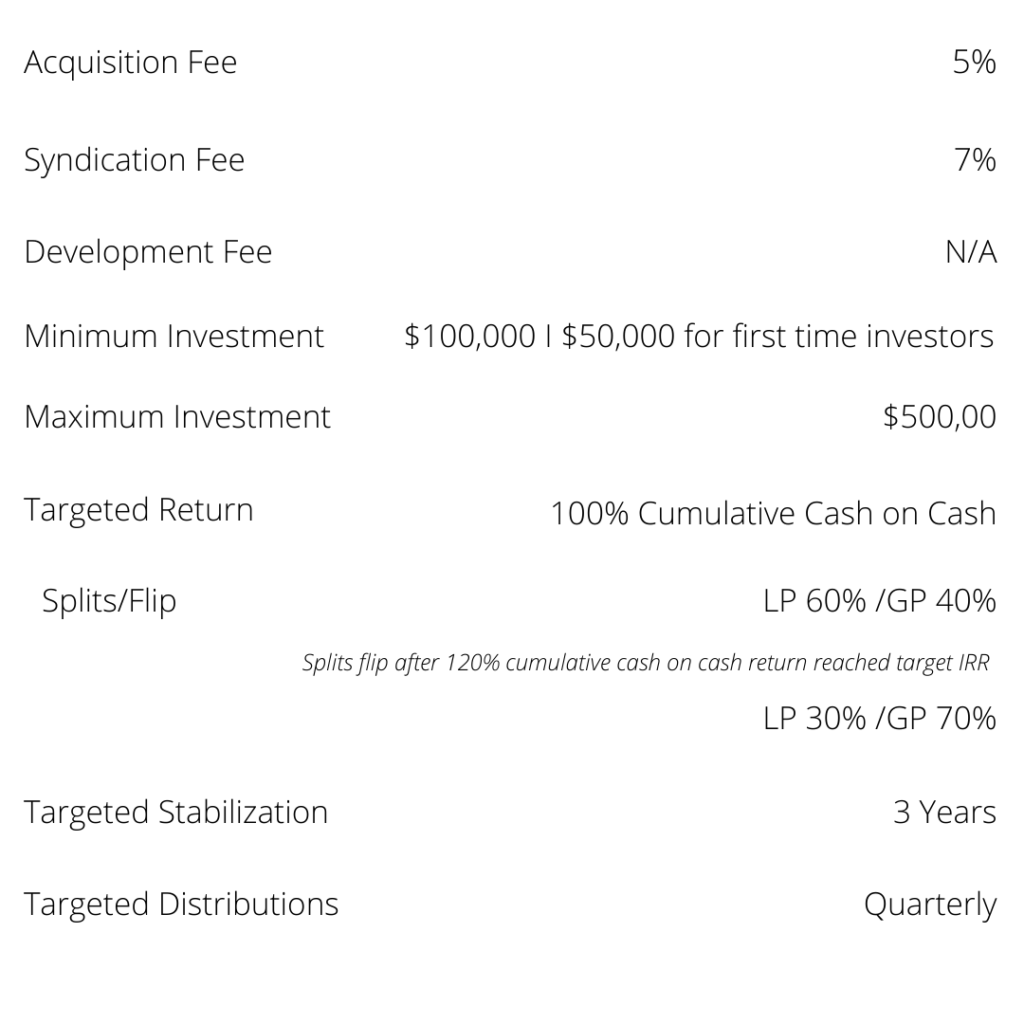
Investor Returns
An alternative structure is a straight split of distributable cash (e.g., 50/50 or 75/25) between the investors and the syndicator.
Debt investors may earn simple, preferred interest on the amount of their investment, while the syndicator and/or equity investors keep the rest.
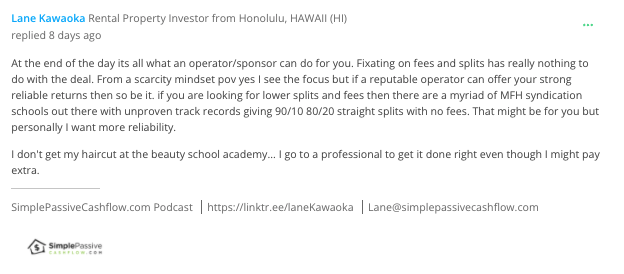
There is no normal range for deals that warrants a good deal, but I have seen deals range from 50/50 to a 90/10 profit split. 90% going to the LP seems good, but that means that 1) the GP is not being compensated much (But Lan,e who cares) and 2) it signals a thin deal to begin with.
Do not evaluate a deal just by the profit split (this is the third time repeating this)… look at the projected returns and check the assumptions, which we will get to in the second half of this module.
Now that you understand the basic terminology of how a syndication can split profits and fees, I’d argue the most important takeaway of all is understanding the incentives behind all the splits of profits and fees.
- Higher Preferred Return and High Fee Deals – This incentivizes the sponsor to close more deals instead of maximizing cash flow.
- Waterfall Distribution Based on IRR – Deals with large GP incentive split levels to sponsors once certain IRR%’s are achieved, may incentivize the sponsor to find ways to artificially increase the IRR in order to trigger the agreed-upon higher GP split waterfall distribution.
- High Returns for Sponsor – The deals that tie the performance of the investment with a large GP split incentive for the sponsor will create more incentive for the sponsor to produce high returns.
Investing in a Deal with Preferred Returns
Some investors will only invest in deals where there are prefs. This is very nearsighted because:
- Preferred returns have nothing to do with the actual deal (vacancy, business plan, underwriting).
- The GPs are the smartest people in the room, and they have engineered the payout scheme to entice investors but extract maximum (but hopefully fair) compensation for themselves. A pref typically is paired with a not-so-advantageous back-end split once the pref or hurdle is reached. So if a deal really gets knocked out of the park, that’s when the GPs really win.
True Preferred Return
Let’s say The Wealth Elevator is giving an 8% cumulative true preferred return, then a 70/30 split.
Cons of a Pref: Prefs are good for passive investors because they can put them first. But this can also disenfranchise a sponsor if the GP falls too far behind, where catching up to the pref becomes impossible. If a sports team is eliminated from making the playoffs, they still play the game, but a sponsor might not do the same if they have limited bandwidth where their attention and focus might actually make them money.
Real Talk:
I’ll be honest here, as a sponsor, I don’t like prefs for me and my family because I don’t get paid for my efforts. I do want to make investors happy, so if we said we were going to pay out an 8% target return (not a pref) in the first year, and we fall a little short, I might forgo my sponsor cut to make investors whole for that year. That is entirely at my discretion, and in the grand scheme of things, it is a good business practice, and we are in a relationship business where we rely on happy customers coming back and bringing their referrals.
Sometimes things happen where it is entirely outside of my control… and maybe we miss our target a bit for a year or two… yes I don’t want to walk away with zero compensation, I don’t think that is fair and everyone signed the paperwork knowing that there was risk involved to not hit projections 100%. At the same time, if there was some oversight or I feel investors got a little unlucky with how something ended up, I have no problem reaching out of my compensation to make it right because I have honor… It’s the right thing to do. The last time I checked, no one gave me a tip when we 2X people’s money in 2.5 years (60% ROI per year!).
As an LP, I never liked prefs or fancy waterfalls because I knew the GPs were always taking a higher cut of the upside to trade off the pref (earlier returns for the GP). I always preferred straight splits where everyone was compensated from the beginning to the last dollar consistently.
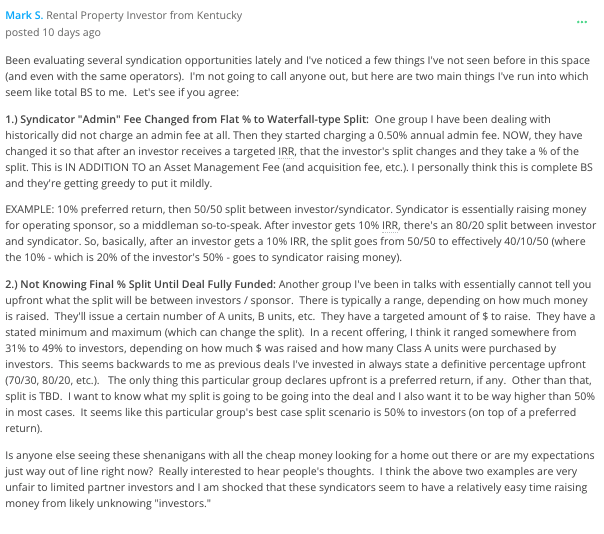
Flipped GP/LP Split (Waterfall/huddle)
See two examples below:
Example 1:
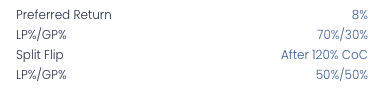
Once investors get their original money back plus 20%, the split scheme changes from 70% LP / 30% GP to 50% LP / 50% GP. This is less desirable for LPs, but then again,n the GP needs to be motivated to make money or continue to run the deal with good motivation.
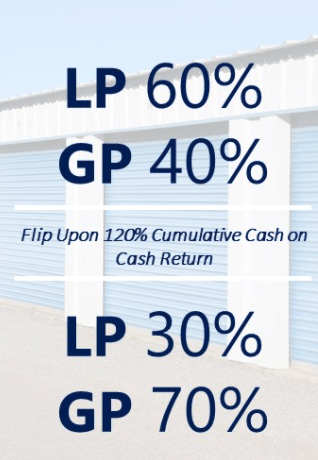
Example 2:
Once investors get their original money back plus 20%, the split scheme changes from 60% LP / 40% GP to 30% LP / 70% GP. Again, this may not be a deal killer for an LP. It might be an amazing deal or a more “greedy” money grab for the GP… we don’t know.
That said, in this particular deal, the total returns were 2x your money in 10 years, and the acquisition fee sum was 10%, which is 3-4x the average of what I normally see.
See below:

Example 3:
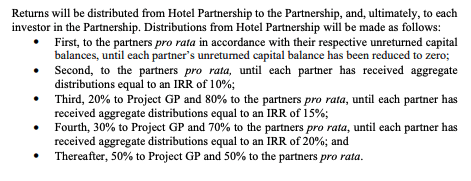
The following is from a hotel deal, which can be considered a different set of norms. Instead of a percentage ROI as the trigger for the hurdles, the trigger is at an IRR amount (essentially the same thing).
Hotel deals can potentially be more lucrative (less recession-proof than long-term rentals). One can also say that it is more handy work by the operator, and thus, compensation towards the GP is warranted. Plus, there are fewer operators in this space.

Preferred return’s primary role is for marketing plays (enticing investors to invest).
It is not correlated to what kind of deal it is (development or stabilized).


Talk it through with us
Questions on “Preferred Return” as you look at real deals? Join The Wealth Elevator investor community and bring them to your onboarding call.
Join the club and book your onboarding callJoining is free.

The podcast behind this course
The Wealth Elevator Podcast
Lane's show for accredited investors on passive syndications, taxes and alternative investments. Many of the lessons in this course started as episodes.
Listen on Apple PodcastsWatch on YouTube