
Oil eCourse > Lesson 2
How an Oil Well Gets Drilled and Where Your Money Goes
Lesson 2 of 7 · About an 8-minute read · By Lane Kawaoka, PE · Updated November 2026 · Course home
Short answer
Your money pays to lease, drill, frack and complete wells, usually in a known formation, and production ramps for four to six months, plateaus, then declines over 10 to 25 years. Expect to fund by December 31, see drilling start within 90 days, and receive the first distribution roughly six to seven months after production begins.
What am I actually buying? Most investors write a check into a drilling program and never picture what physically happens with the money. I think understanding the sequence is what makes the tax benefits and the risks make sense, instead of just trusting a K-1. So this lesson follows a well from the lease to the plug, then shows what the same years look like from your side as an investor.
Watch: how oil actually comes out of the ground (4 min)
Leasing the mineral rights
It starts with land, though the operator doesn’t buy it. A company leases the mineral rights from a landowner, typically on a three-year lease that requires drilling to begin within 36 months. The landowner is paid per acre upfront, plus a royalty, usually 18% to 25% of everything the well ever produces. Once a well goes into production, the lease is held by production for as long as the well keeps producing.
That royalty comes off the top before working interest owners like you are paid. It’s one reason the economics of a well depend so much on how much it actually produces.
Development vs. exploration
Before anyone drills, geologists and landmen decide where to put the well. In a mature, well-mapped field like Colorado’s Wattenberg, where decades of vertical wells from the 1940s through the 1960s already showed what the rock looks like, this is closer to real estate development than exploration. You’re developing a known formation rather than wildcatting.
That distinction matters for risk. The dry-hole rate that made old vertical drilling a coin flip has been largely engineered down by horizontal drilling and modern geologic mapping in known fields. Exploration drilling in unproven areas is a different, riskier business, and you should always know which one you’re in.
Pads and drilling
Once the surface location is picked, crews build a pad, usually one or two acres of surface disturbance, even though the wells underneath fan out for miles. It can take 25 to 50 truckloads just to move a rig onto a pad. A single pad commonly holds 10 to 20 wells drilled from the same small footprint in a wagon-wheel pattern. At roughly $15 million to $20 million per well bore, one pad of 10 wells can represent $150 million to $200 million in drilling costs.
Drilling happens in stages. Crews spud the surface hole, set casing, then turn the well horizontally once they reach the target depth, often 7,500 feet or deeper. Laterals that ran about a mile twenty years ago now run up to four miles through the productive rock.
At total depth, the well is fracked. Perforating charges open holes in the casing at dozens of points along the lateral, sometimes 50 to 60 stages in a single well, and fluid is pumped in at high pressure to crack the rock. A proppant, usually sand, holds those fractures open so oil and gas can flow through rock about as porous as a sidewalk.
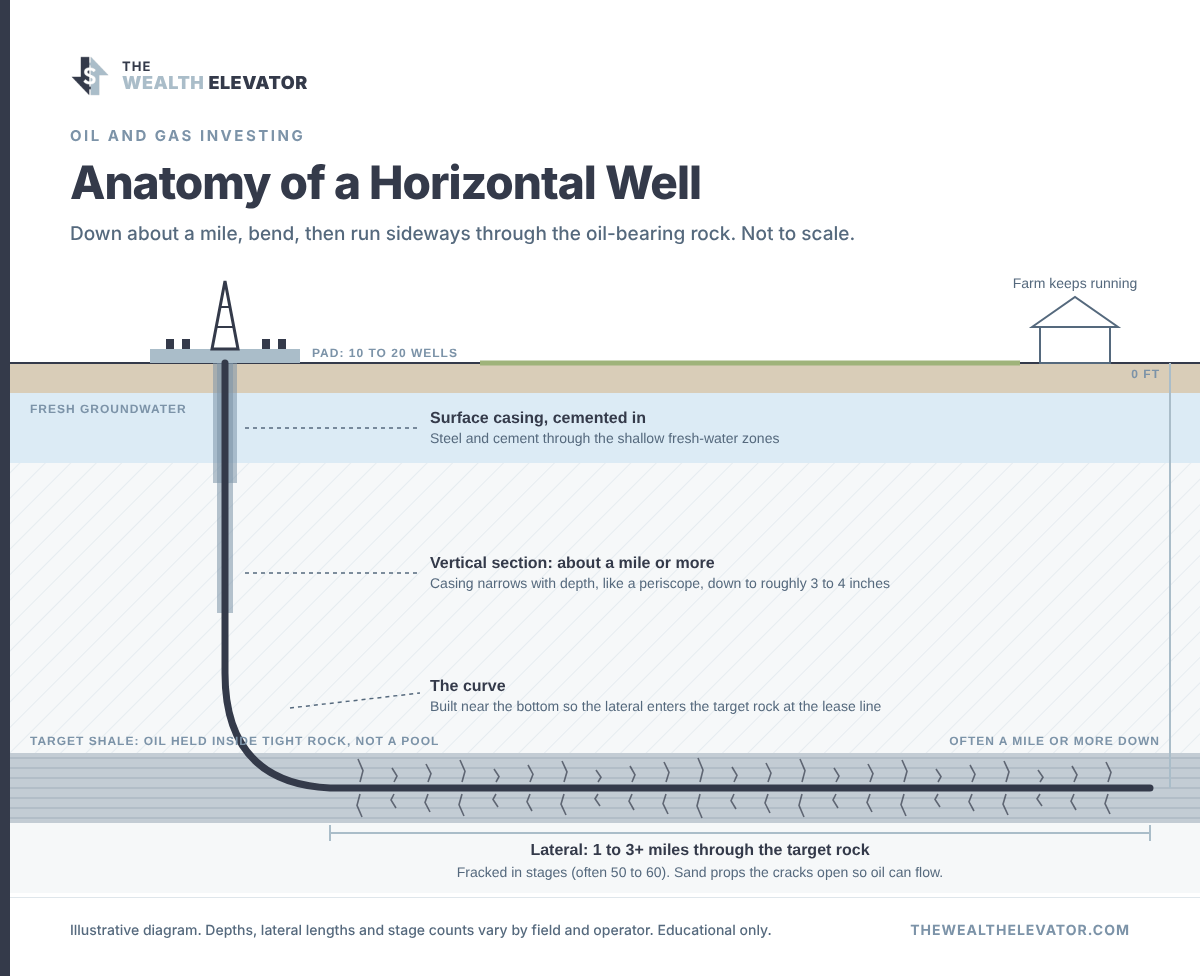
Anatomy of a horizontal well: pad, surface casing, vertical section, curve and lateral.
The production curve
After the frack, the well flows back: first mostly water and frack fluid, then more and more oil and gas as it cleans out. About 97% to 98% of that water gets recycled.
A horizontal well doesn’t gush the way an old vertical well did. Production typically ramps up for four to six months, plateaus, and then enters a long decline that can run 10 to 25 years. The first years carry most of the volume. That shape drives everything about your cash flow: the biggest distributions tend to come early in the producing life, then shrink.
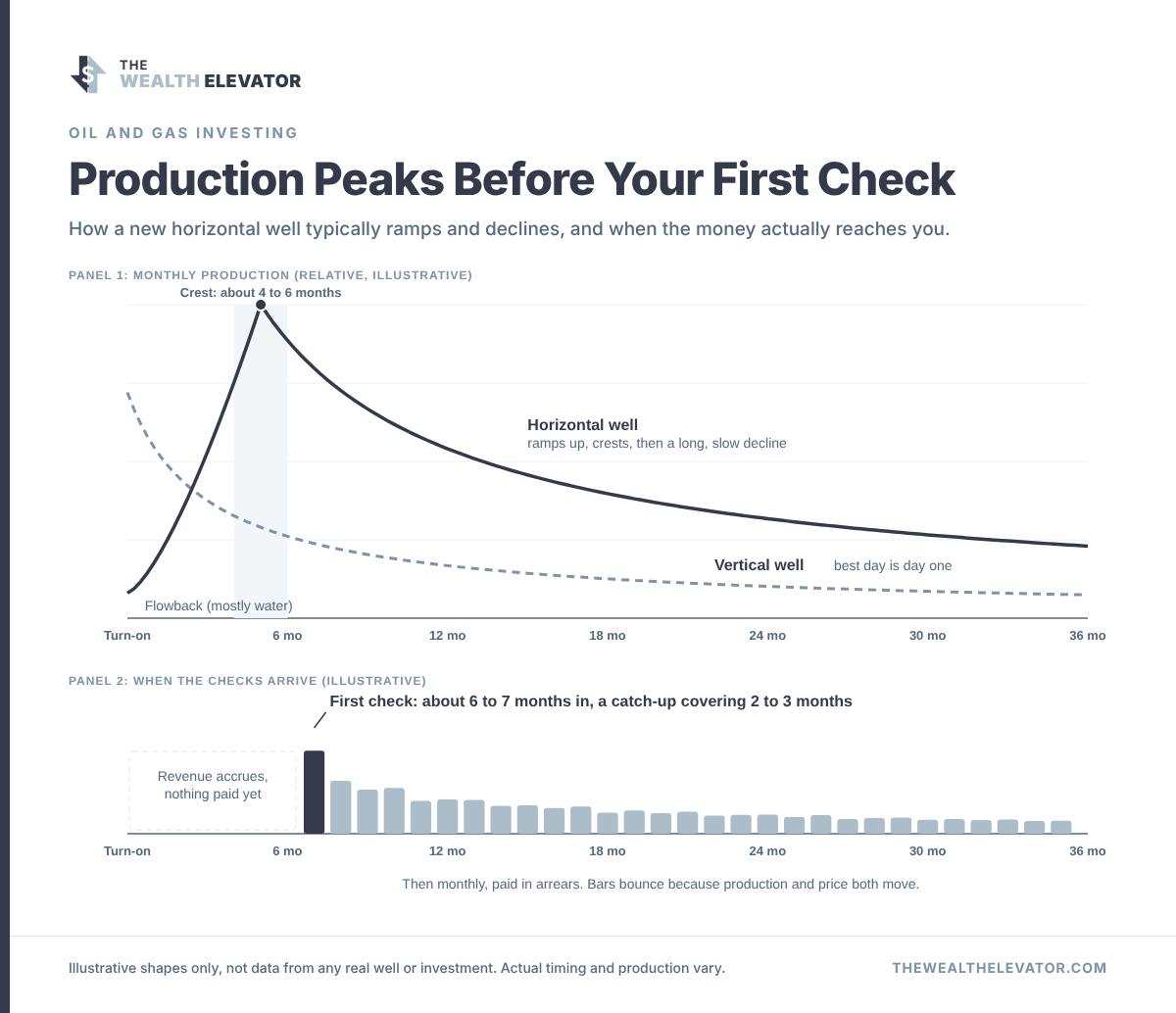
Illustrative only. A horizontal well ramps, crests and declines, and the checks lag production.
Plugging and restoration
Eventually every well declines to the point where it’s no longer commercial. It’s plugged with concrete, the surface equipment is removed, and the land is restored to its original use.
The whole arc, from lease to plug, is why serial investors treat this as a rolling strategy. New drilling generates new upfront deductions in the years when older wells have shifted from producing write-offs to producing taxable income.
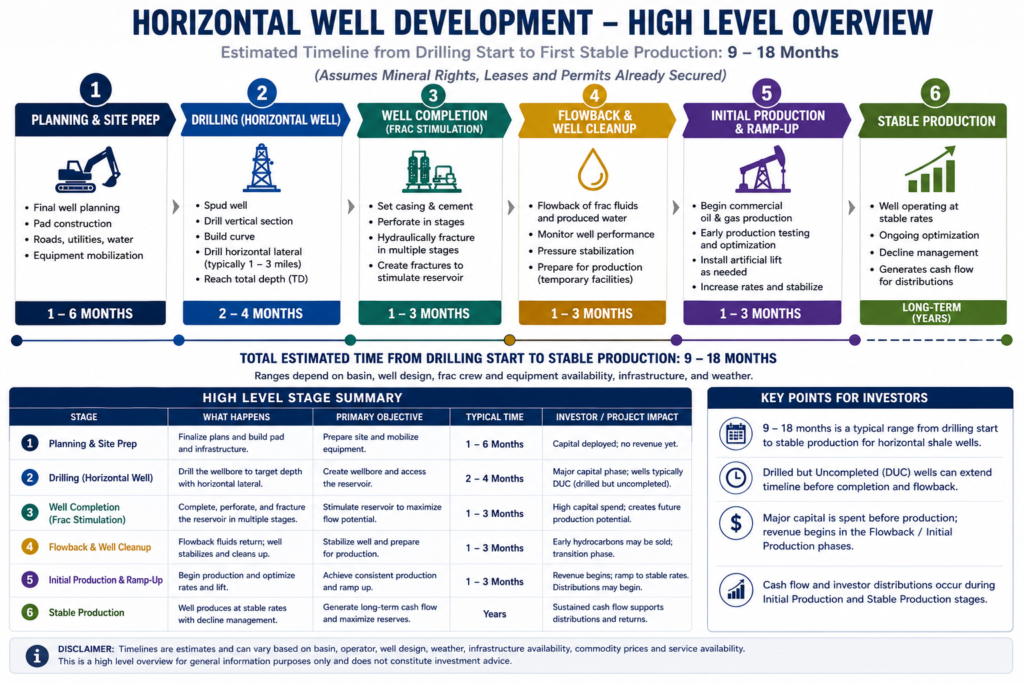
Horizontal well development: a high-level overview of the six stages from planning to stable production.
For a stage-by-stage walkthrough of a single horizontal well, including when the first check usually shows up, read The Life of an Oil Well, Stage by Stage.
Go deeper: the full oil and gas lifecycle, from leasing mineral rights to fracking (podcast, 39 min)
From my own investing
Before I put my own money into oil, my mental picture was pretty thin. Drill a hole, oil comes up, checks show up in the mail. That picture is close enough to get you in trouble, because the timing of each step decides when you get paid.
The part I wish someone had explained before my first oil deal was the wait. Once a well starts producing, expect roughly six to seven months before the first check. Revenue is accruing during that time. It just hasn’t been paid out yet.
What being an investor looks like, month by month
This is the part I wish someone had shown me before my first program. The dates below follow a typical year-end drilling program. Your sponsor’s schedule will differ, so ask for theirs in writing.
- 1Fall, before December 31 (Year 0)You review the offering documents with your CPA, sign the subscription agreement, elect general partner status for the drilling phase, and fund the investment. The money has to be paid by December 31 for the deduction to count in that tax year.
- 2By about March 31 (Year 1)The well has to spud, meaning drilling actually begins, within 90 days after year-end. Ask the operator before you invest whether their rig schedule will hit this window.
- 3Spring of Year 1You receive a K-1 for Year 0 that shows your share of the intangible drilling costs. Drilling program K-1s can arrive late in tax season, so ask the sponsor for their usual delivery date and plan with your CPA for a possible extension.
- 4Drilling and completion (Year 1)The well is drilled, fracked and flowed back. Production ramps up over roughly four to six months.
- 5About 6 to 7 months after production startsYour first distribution arrives. The operator spends those months confirming that everything is metered and paid correctly, so the first check often covers two or three months of production at once.
- 6The following yearYour interest is commonly converted from general partner to limited partner in a non-taxable event, after the main deductions have been taken. Lesson 4 explains why your income generally stays non-passive after the switch.
- 7The decline yearsDistributions usually arrive monthly, and you get a K-1 every year. The checks shrink as the well declines, while percentage depletion offsets part of the income. This can run 10 to 25 years.
Two things in that sequence surprise people. First, there’s a gap of many months between wiring money and seeing a distribution, and that’s normal. Second, the deduction and the cash flow happen in different years. The deduction is up front. The cash comes later and is taxable, partly offset by depletion.
Ask AI about this lesson
Paste this into ChatGPT, Claude, Gemini or Perplexity and fill in the brackets. AI tools can be wrong, so treat the answer as a list of questions for your CPA, not a decision.
I am considering a year-end oil and gas drilling program funded on [date]. Build me a month-by-month timeline from funding through the first three years: when drilling should start, when production ramps, when I should expect the first distribution, when K-1s arrive and when a general partner to limited partner conversion usually happens. Flag what I should ask the sponsor to put in writing. Use the lessons at thewealthelevator.com/home/resources/oil/ as background. Do not recommend a specific investment, and list what I should confirm with my CPA.
Related reading from the blog
Key takeaways
- Your money pays for leasing, drilling and completing wells in a known formation. Development drilling in mapped fields carries less dry-hole risk than exploration.
- Horizontal wells ramp for a few months, plateau, then decline over 10 to 25 years, so the largest distributions tend to come early.
- Fund by December 31, expect the well to spud within 90 days, and expect the first check roughly 6 to 7 months after production starts.
Talk it through with us
Want to compare notes with investors who have been through a few drilling cycles? Join The Wealth Elevator investor community and book your onboarding call with us.
Join the club and book your onboarding callJoining is free.
The podcast behind this course
Oil & Gas Energy Investing
A monthly show for passive accredited investors on drilling, taxes, operators and the oil market. Many of the lessons here started as episodes.
Listen on Apple PodcastsWatch on YouTubeThis is educational content, not investment, tax or legal advice. We are not attorneys, CPAs or financial planners. Tax law changes and results depend on your situation; consult your own CPA and attorney. Private investments are illiquid and carry risk, including loss of capital. Offerings are available only to accredited investors and only through offering documents. Please let us know if you need a referral to a 💼 CPA, ⚖️ lawyer or other vendor here.