
Short answer: In oil and gas investing, who drills the well matters more than it does in apartments. The majors and large independent operators control the best connected acreage, have data from thousands of nearby wells, and use technology small drillers cannot afford. The trade-off is that outside investors take the operator’s terms and have little control.
In December 2019 I made my first oil investment: a fractional interest in a six-well drilling project in Texas, run by a small independent operator. The wells were targeting a depth of roughly 4,100 feet. Before I wired anything, I flew out to walk the operation and sat down with the people running it.
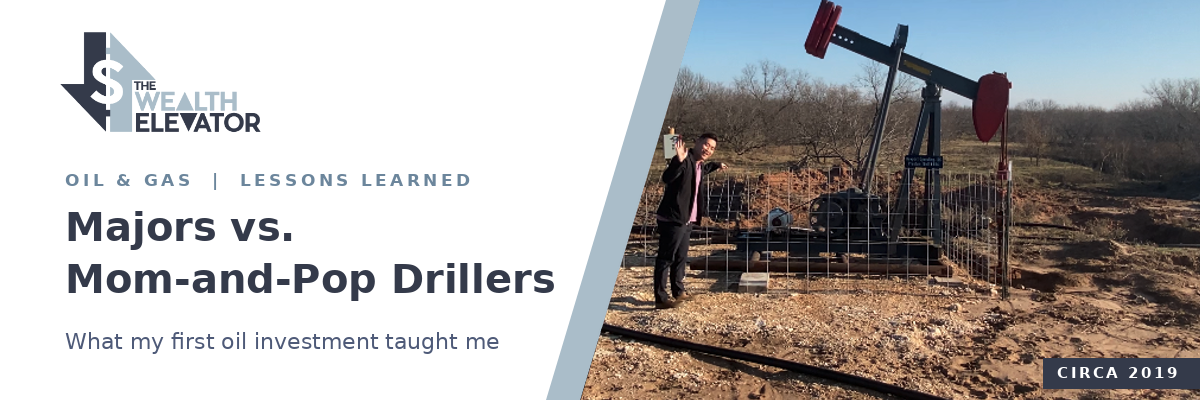
I still have a photo from that trip. I’m standing next to a pump jack that is about twice my height, and I’m not a tall guy. Everything out there was simple and mechanical, and without realizing what it meant, I liked how low tech it all was.
I kept the check small on purpose. I wanted firsthand experience with the operator, the deal structure and the tax reporting before I ever considered something larger. I had found the operator myself, with no fund manager or broker between us, and I thought I was doing exactly what a sharp private investor is supposed to do. The instinct was a good one. I had just carried it into an asset class where it works backwards.
Where the instinct came from
By 2019 I had been buying apartments for years, and in multifamily the playbook is to go find the smaller operator. A sponsor with a few hundred million dollars of acquisitions behind them is still hungry. They need your capital and they are still building a track record, so limited partners tend to get a better split, lower fees, and deal terms a big institution would never offer.
Move up to the institutional shops and the product starts to behave like a bloated REIT. There are layers of management fees, sometimes a fund sitting on top of another fund, and the return gets shaved at every level before it reaches you.
The reason the small operator can compete is that the asset is the same either way. A 200-unit Class B building doesn’t care who owns it. A small sponsor can buy that building, hire the same third-party property manager, and run the same renovation plan as a firm ten times its size. In apartments, size mostly adds overhead.
So I walked into oil with that thinking. Cut out the middleman, find the grassroots guy, get as close to the asset as possible.
What “the majors” means
In the strict industry sense, the majors are the giant integrated oil companies: ExxonMobil, Chevron, Shell, BP and TotalEnergies. Integrated means they own the whole chain, with drilling at one end and refineries and gas stations at the other.
When investors like me say “the majors,” we usually stretch the term to include the large publicly traded independents that only drill and produce, such as ConocoPhillips, Occidental (Oxy), EOG and Devon. These companies operate thousands of wells and report every quarter to analysts who pick their numbers apart.
I asked Robin Mills about this on my podcast. Robin is the founder and CEO of Qamar Energy, a former Shell executive, and the author of The Myth of the Oil Crisis. His history lesson surprised me, because the majors did not start the shale boom. They missed it.
Robin was at Shell when George Mitchell was experimenting with fracking in the Barnett Shale in Texas. He remembers a Shell colleague looking at Mitchell’s wells and saying, “Those wells are not economic. We wouldn’t drill those wells.” In Robin’s telling, it took smaller companies with low overhead to keep experimenting until the formula worked. Mitchell came first, then companies like EOG and Continental.
The majors were built for a different job in those years: giant, multi-billion dollar projects in deep water and the Arctic. Eventually Exxon and Chevron realized what was sitting in their own backyard and bought their way in. Robin’s summary is that the shale industry has now consolidated around the US majors and companies like Occidental. As he put it, shale “has eventually become a big boys game, but that wasn’t how it was in the early days.”
At the other end is the mom-and-pop operator. That might be a family business with a few dozen older vertical wells, a couple of pumpers on payroll, and financing from a local bank or from investors like the 2019 version of me. They were never part of that shale story. They are still producing oil the way it was done before it.
Why size works differently underground
An apartment sponsor’s edge comes from deal structure and execution, and a small team can do both well. In oil the edge comes from the rock and the equipment, and both of those reward scale.
The majors hold the best land
The best acreage in the proven basins has been bought up, mostly through acquisitions. Oxy picked up a huge Colorado position when it bought Anadarko in 2019. Chevron did the same by acquiring Noble Energy in 2020 and PDC Energy in 2023. Those deals gave them large, connected blocks of land in places like Weld County, where the geology is already well understood.
Connected acreage matters because modern wells run sideways. A horizontal well can travel two or three miles underground, and you can only drill that if you control the land along the whole path. A small operator with scattered leases is usually left with the fringe acreage or with older vertical wells that the big companies sold off.
If you want to see what a horizontal well looks like from lease to plug, and when the checks actually start, I walked through it stage by stage in the life of an oil well.
Big operators also have the data. When a company has drilled thousands of wells in one county, its production forecasts are built on actual results from next door. That makes outcomes more predictable, though never guaranteed.
The majors bring the best technology
The project I bought into in 2019 was conventional drilling: go down about 4,100 feet and put a pump jack on top. That is how oil was produced decades ago. The large operators go deeper, then turn the well sideways for miles, fracture the rock in dozens of stages, and install artificial lift equipment from day one so production doesn’t stall when the natural pressure in the reservoir fades.
They also capture the natural gas. Gas comes up with the oil almost everywhere you drill, and gathering it takes pipelines and processing equipment that cost real money. Many mom-and-pop operators can’t justify that spend, so the gas gets wasted. A large operator sells it, which means a second revenue stream from the same well.
What those wells taught me
Walking that operation, I couldn’t see any of this. I liked how down to earth the business felt. It was close to farming, something you could watch happen in front of you.
The low tech feel I found so reassuring was the thing I should have questioned. Six wells felt diversified to me, but they were all the same kind of well, on the same acreage, with one small operator. I have nothing bad to say about the people I invested with. They ran the kind of operation they said they ran. My error was in the category I chose: a small operator simply does not have the acreage position, the well data or the equipment budget that drive results in this business today. Starting small turned out to be the best decision I made, because the lesson was cheap.
Where the majors fall short
Bigger is not automatically better, and anyone considering this space should know the trade-offs.
- A small operator will negotiate with you. A large one sets the terms, and an individual investor has no leverage to change them.
- As a passive owner in someone else’s wells, you don’t decide when they drill, what they spend, or when they shut a well in. If the operator moves its budget to another basin, your acreage waits.
- Large operators tend to keep their strongest locations for their own balance sheet, so whatever gets offered to outside capital deserves a hard look.
- Big companies carry heavy overhead. Robin’s story about Shell is the proof: a major can pass on wells that a lean operator would make work, and it can be slow to try anything new.
- Getting alongside a large operator usually means higher minimums, accredited investor requirements, and a long hold with no easy exit.
And none of it removes the basic risks. Wells come in dry, prices swing, and a large operator can still have a bad year.
What still carries over from apartments
Two habits from multifamily did survive.
The first is going direct. Buying shares of Exxon or Chevron gives you exposure to the company, and it does not give you ownership in the wells. Private investors typically get alongside a large operator through a non-operated working interest, where you own a slice of specific wells that the operator drills and runs. That direct ownership is also where the tax treatment for drilling costs comes from. So I still want as few layers and fees as possible between me and the well. I just stopped trying to economize on who is drilling it.
The second is underwriting everyone on the same assumptions. With apartments, I rerun every sponsor’s numbers through my own spreadsheet. The same habit applies to oil. Operators build their projections on whatever oil price they choose, so it helps to restate every projection at one conservative price before comparing them. Once everything is on the same footing, the outliers are easy to spot.
Frequently asked questions
What are “the majors” in oil and gas?
In the strict sense, the majors are the giant integrated oil companies: ExxonMobil, Chevron, Shell, BP and TotalEnergies. Investors often stretch the term to include large publicly traded independents such as ConocoPhillips, Occidental, EOG and Devon.
Why does operator size matter more in oil than in apartments?
In apartments the asset is the same whoever owns it, so a small sponsor can compete on deal structure and execution. In oil the edge comes from the rock and the equipment, and both reward scale.
What are the downsides of investing alongside a large operator?
You take their terms, you have no control over when they drill or what they spend, you may not be offered their strongest locations, and access usually means higher minimums and a long hold with no easy exit.
Does buying oil company stock give you ownership in the wells?
No. Shares give you exposure to the company. Private investors typically own a slice of specific wells through a non-operated working interest.
I’m not a CPA or a financial advisor. This is my own experience and general education, and it is not a recommendation for your situation.
I’d rather you learn this from my 2019 photo than from your own. If you want to be around investors who compare notes on deals like this, come join our community inside the club.