
The Life of an Oil Well: From Mineral Lease to Plugged Hole, Stage by Stage
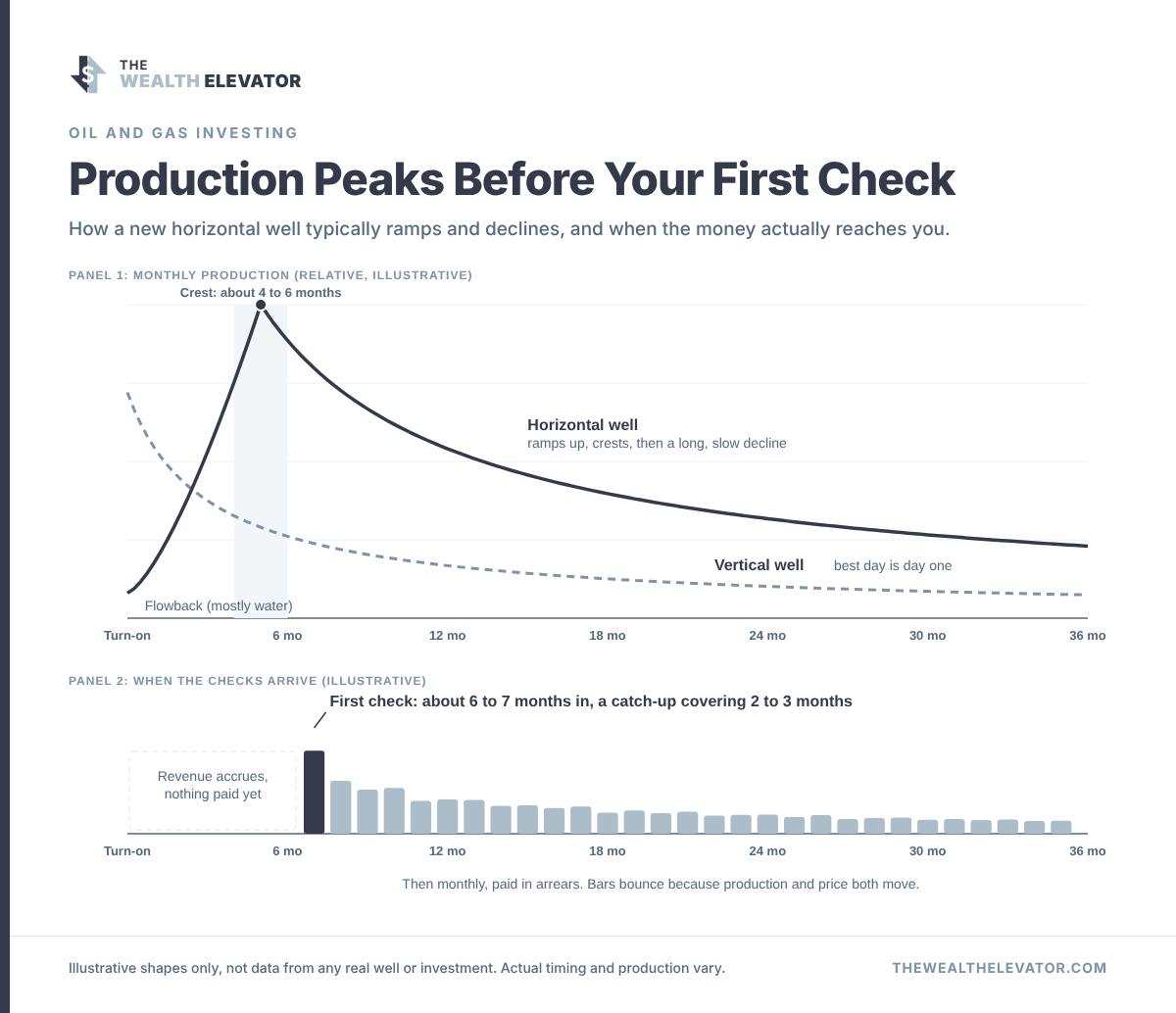
Short answer: A new horizontal oil well usually ramps to peak production about four to six months after it’s turned on, and the first investor check typically arrives six to seven months after first production. After that, checks come monthly, paid in arrears, while the well declines over roughly 10 to 25 years until it’s plugged.
Before I put my own money into oil, my mental picture was pretty thin. Drill a hole, oil comes up, checks show up in the mail. That picture is close enough to get you in trouble, because the timing of each step decides when you get paid, why the checks move around, and which deals I now pass on.
So on a recent episode of the podcast I asked a senior vice president at an oil and gas firm that partners with large public operators to walk through every step in order, starting with leasing the land and ending with plugging the hole a couple of decades later. Below is that sequence, with my own notes as a civil engineer and as a passive investor who has been reading production reports since my first oil investment in December 2019.
The whole timeline at a glance
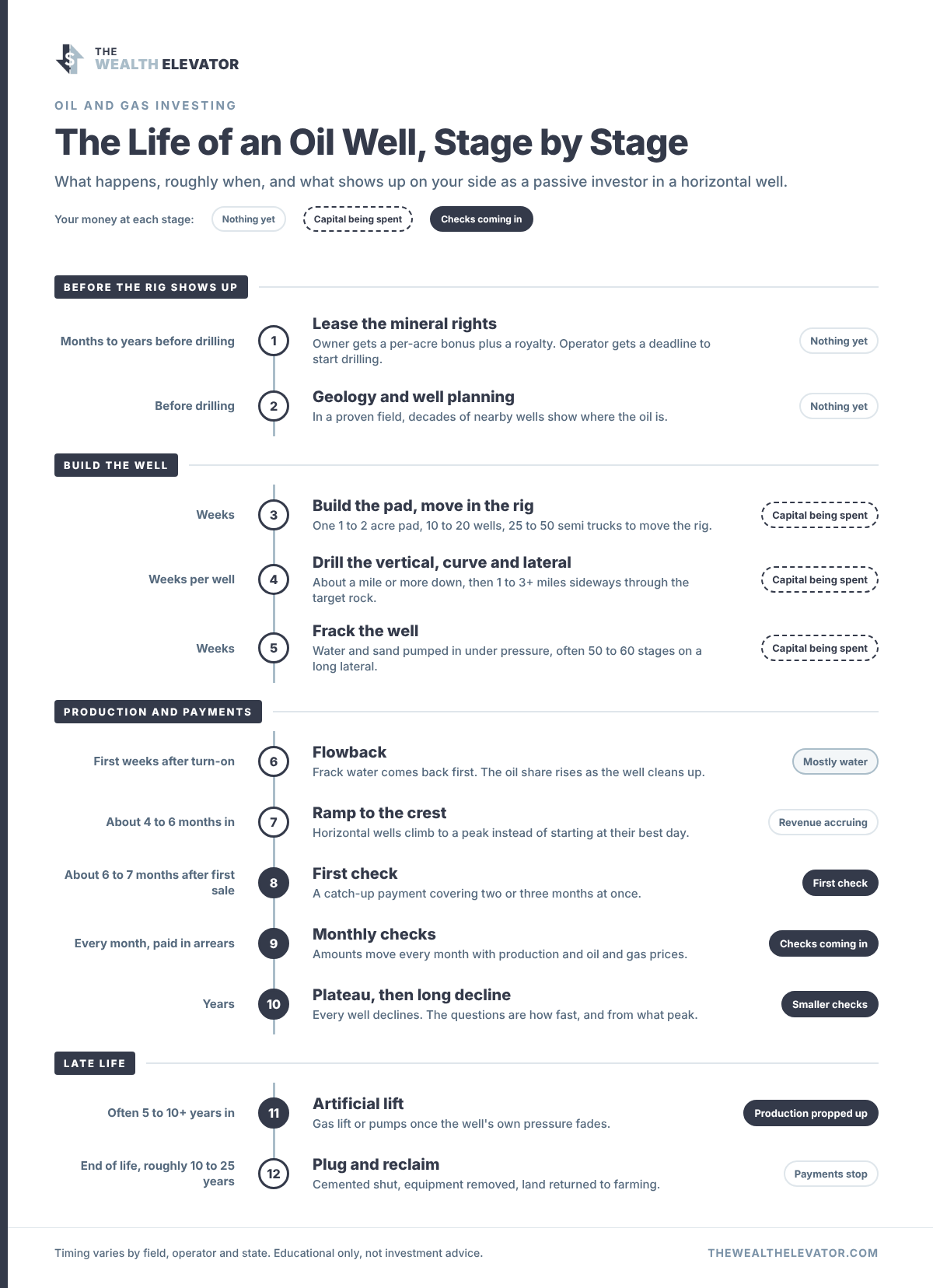
| Stage | Roughly when | What a passive investor sees |
|---|---|---|
| Mineral lease signed | Months to years before drilling | Nothing yet |
| Geology and well planning | Before drilling | Nothing yet |
| Pad built, rig moved in | Weeks | Capital is being spent |
| Vertical, curve and lateral drilled | Weeks per well | Capital is being spent |
| Fracking (completion) | Weeks | Capital is being spent |
| Flowback | First weeks of production | Mostly water coming back |
| Ramp to peak | About 4 to 6 months after turn-on | Production rising |
| First check | About 6 to 7 months after first production | A catch-up payment covering a couple of months |
| Monthly checks | Ongoing, paid in arrears | Amounts move with price and volume |
| Plateau and decline | Years | Smaller checks over time |
| Artificial lift | Often 5 to 10+ years in | Production propped up |
| Plugging and reclamation | End of life, 10 to 25 years | Payments stop |
1. Leasing the mineral rights
Oil companies usually don’t buy the land. In most producing states the mineral rights can be split off from the surface rights, so one family may own the farm and another may own what is a mile underneath it. The operator leases the minerals.
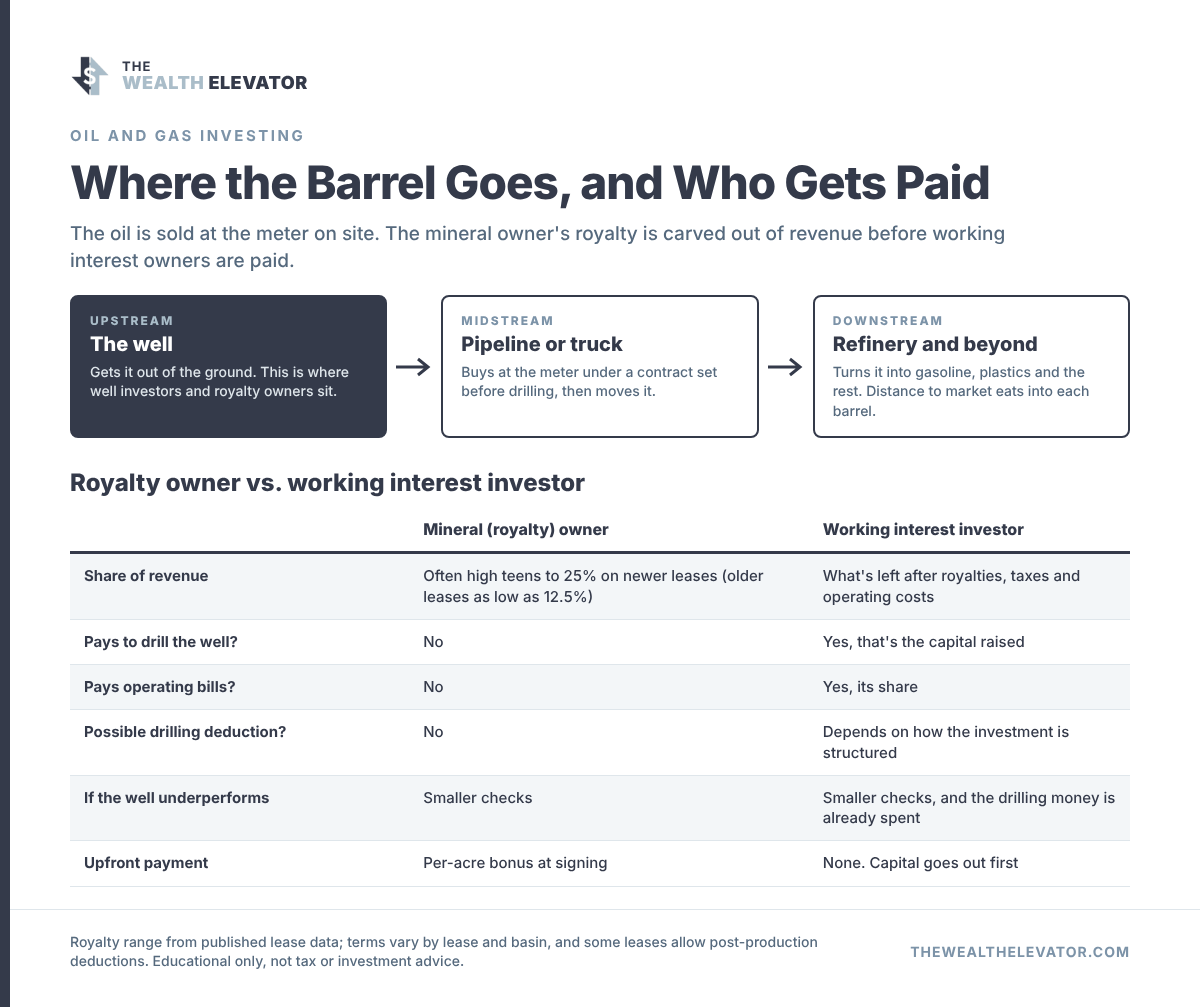
The mineral owner gets two things. First is an upfront bonus paid per acre. If you own 100 acres and the going rate is $1,000 an acre, that’s a $100,000 check for signing. Second is a royalty, a share of everything sold from the lease. My guest put typical royalties at 18% to 25%. Published lease data runs a bit wider than that: the old standard was one-eighth (12.5%), and newer leases mostly sit in the high teens to 25% depending on the basin. In some basins, typical royalties still run below 20%.
Here’s the part that matters for comparison later. The royalty owner pays none of the drilling or operating bills. Depending on the lease and the state, some post-production costs such as transportation or processing may still be deducted from their share. The working interest investors are the ones who pay to drill the wells. Depending on how the investment is structured, part of that drilling cost may be deductible, which is a big reason people look at oil in the first place.
Two lease clauses shape everything after this:
- Primary term: The operator has a set window to get drilling started, often around three years (leases commonly run three to five). Miss it and the lease expires.
- Held by production: Once a well on the lease is producing, the lease stays in force as long as production continues. Many leases also carry a continuous drilling clause, so the operator has to keep drilling across the acreage or lose the undrilled part.
The people knocking on doors to sign these leases are landmen. At the large operators it’s an in-house team. At smaller shops it’s often a local who knows every family in the county. The lease also covers surface access and a damages clause, so if the operator builds a road through a farmer’s field, the farmer gets paid for that too.
My guest said that when he takes investors out to the field, you can often spot the royalty owners. There’s the old farmhouse with the beat-up tractor, and then up the hill a new house with new trucks in the driveway.
2. Geology and picking the spot
In a mature field, a lot of this is what he called “closeology” more than geology. It’s like building a house in a neighborhood full of houses that already sold. You know what you’re going to get because the wells around you already told you.
In older fields, operators can have records from wells drilled decades ago, so they already know where the target rock sits. That’s development drilling. The other side of the business is wildcatting, looking for a new field, and that carries much more risk.
Geologists are usually on staff at the big operators. Smaller operators often use a third-party geologist, sometimes the person who brought the idea for the prospect in the first place.
3. Building the pad
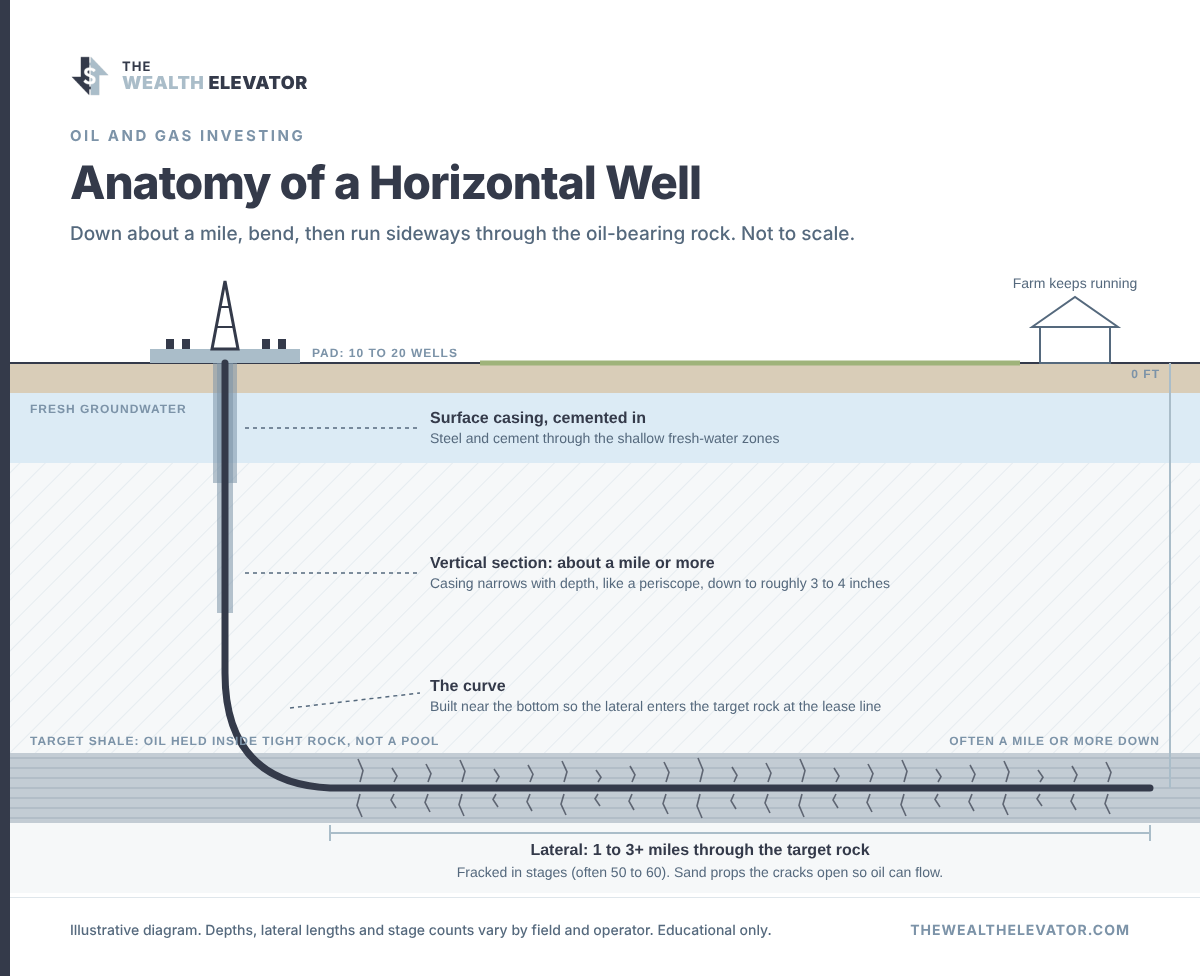
Once they know where the wellheads go, a dirt contractor levels a pad of about one to two acres. From that one pad the operator will drill 10 to 20 wells, fanning out underground like spokes on a wagon wheel. Keeping everything on one small footprint means less of the farmer’s land gets torn up.
Moving a drilling rig in takes somewhere between 25 and 50 semi trucks. It’s a small city. Once it starts, the rig runs around the clock, holidays included.
He couldn’t break out the pad cost because investors see total well cost, which he put at roughly $15 million to $20 million per well for the long-lateral wells he works with. I spent years building bridges, signals and foundations for the railroad, and my guess for just the site work is a quarter million to half a million dollars, mostly equipment time. Dirt is cheap. Machines and days are not.
4. Drilling: the vertical, the curve and the lateral
The rig sits on a track so it can slide from well to well on the pad. It drills and cements in the surface casing first, then drills the vertical section of each well. Depending on the field, that’s often a mile or more down.
Near the bottom of the vertical they start building the curve, then drill the horizontal section, called the lateral. Twenty years ago a one-mile lateral was a big deal. Now operators drill laterals of three miles or more, so you get more rock exposed to the wellbore without moving the rig.
The casing telescopes as it goes deeper, a bit like a periscope. By the far end of the lateral, the production casing is only about three to four inches across.
One thing that surprised me: the old practice of running a logging tool down a finished well to see where the oil is has largely been replaced. Modern bits use measurement while drilling, so the crew knows in real time where the bit is and whether it’s still in the target formation.
5. Fracking the well
With the casing cemented in, the crew sets plugs along the lateral and uses shaped charges to punch holes through the casing into the rock. Then they pump water, sand and additives in at high pressure to crack open the formation. A long lateral can be fracked in 50 to 60 separate stages.
The sand is the key ingredient. It’s called proppant because it props the cracks open after the pressure comes off. Without it, the rock closes back up.
This was the biggest misconception he hears: oil isn’t sitting in an underground lake waiting for a straw. It’s trapped inside rock that he compared to the porosity of the sidewalk in front of your house. The fracking is what gives it a path to flow.
When all the stages are done, they drill out the plugs and the well is ready to turn on.
6. Flowback
The first thing out of a newly fracked well is mostly the water they pumped in. That’s flowback. As the well cleans up, the oil cut (the share of oil versus water) rises. Separators at the surface split oil, gas and water, and he said most of the frack water gets recycled. Once most of that fluid has come back, the well is considered on full production.
7. The ramp, the crest and the long decline
This is where horizontal wells behave differently from what most people picture.
A vertical well’s best day is usually its first day. A horizontal well ramps up as the frack water clears, then crests, then plateaus, then starts a long decline. He said the crest usually shows up four to six months after the well is turned on. A well might start at a few barrels a day while it’s still giving back water and climb toward 1,000 barrels a day.
Early production is called flush production, and it’s the reason he prefers buying into brand-new wells rather than wells that are already five, ten or fifteen years into their life, or reworks of old wells.
A few terms you’ll see on reports:
- IP (initial production), IP24, IP30: First day, first 24 hours, first 30 days. These came from the vertical-well era. Because horizontal wells ramp up, an early IP number tells you less than it used to.
- BOE per day: Barrels of oil equivalent. Many wells produce both oil and gas, so the gas is converted into an oil-equivalent number to give one figure. The oil and gas mix depends on the formation. Some fields are mostly oil, some are almost all gas, and many are somewhere in between.
Every well declines. The question is how fast and from what peak. He put the productive life of a typical horizontal well at roughly 10 to 25 years.
8. Who buys it and when it stops being “yours”
Every well has a purchase contract in place before it’s drilled. Once the oil passes the meter into the tank, it’s sold.
The industry splits into three parts. Upstream gets it out of the ground (this is where the well investor sits). Midstream moves it by pipeline or truck. Downstream refines it into gasoline, plastics and everything else.
Location matters more than people think. A field with a refinery or major pipeline nearby loses less of each barrel to transportation. Remote basins far from refineries and pipelines give up more of every barrel just to get it to market.
9. Getting paid
This was the part I wish someone had explained before my first oil deal.
Once a well starts producing, expect roughly six to seven months before the first check. Revenue is accruing during that time, it just hasn’t been paid out. The first check usually catches you up on two or three months at once, and after that you’re paid monthly, in arrears.
That lag isn’t the operator being slow. States set the rules. Texas, for example, gives the payer up to 120 days after the end of the month of first sale to make the first payment, and Colorado allows up to six months. After that, both generally require monthly payments within 60 days for oil and 90 days for gas unless the lease says otherwise.
The checks also won’t look like rent. When I started in multifamily, I’d test the first few renovated units against the pro forma, and once rents came in, the monthly number was fairly steady. Oil checks move every month because two things move every month: production and price. Neither is something you or the operator controls.
10. Day-to-day operations
After the drilling and frack crews leave, the field gets much quieter. A pumper visits each site, often daily, to check gauges and look for leaks. Pressures and rates are watched remotely and adjusted, sometimes hour by hour on new wells, to get the most out of the well over its life without damaging it.
He was clear about one thing: the crews who drill and complete these wells have one of the hardest jobs out there. Two weeks on, two weeks off, every kind of weather, no holidays.
11. Artificial lift
Eventually every well loses the natural pressure that pushes fluid a mile or more to the surface. That’s when artificial lift comes in.
The pumpjack you picture from the movies (the “horse head”) uses rods going up and down, which doesn’t work well in a well that turns horizontal. Electric submersible pumps work but can multiply the electric bill. A common approach years down the road is gas lift: injecting natural gas back into the well to lighten the fluid column and get it moving again. Some operators install that equipment when the wells are new so it’s ready.
12. Plugging and reclamation
When a well no longer pays for itself, it gets plugged with cement, the wellhead equipment is removed, and the pad is reclaimed. He said that once that’s done, it goes back to farmland and you’d never know a well was there.
What about the price of oil?
He told me the price where most people are comfortable is around $75 to $80 a barrel. At $100 producers do very well but the rest of the economy starts to strain. At $50 to $60 it’s harder to justify new drilling, though existing wells keep running.
I checked his longer-term view against the data. Using IMF annual averages for WTI from 2016 through 2025, the ten-year average works out to roughly $64 a barrel, not the low $70s. The lowest year was 2020 at about $39, and the highest was 2022 at about $95. That gap between the comfortable price and the historical average is why I look at how a project holds up at lower prices, not at the price on the day I’m reading the deck.
One more thing that surprised me: low prices don’t automatically stop drilling. Because of primary terms and continuous drilling clauses, operators often have to keep drilling to hold their leases. Projects can get pushed out, but wells that are already producing usually stay on.
What I look at as a passive investor
This is how I think about it for my own money, not a recommendation for yours.
- Horizontal over vertical: My first oil investment in 2019 was a set of vertical wells with a small operator. I learned a lot, and I’d do it differently now. I wrote about that in Majors vs. Mom-and-Pop Drillers.
- Proven fields over exploration: Development drilling next to hundreds of existing wells is a different risk than wildcatting.
- New wells over old ones: Flush production is where the volume is. Reworks of tired wells are a different bet.
- Many wells, not one: Every field has great wells and weak wells. Spreading across more wells and more pads smooths that out, for the same reason most people would rather own a slice of 200 apartment units than one rental house.
- Who’s paying the bills: This business eats cash. Well-capitalized operators can keep drilling through a rough patch. Small operators are the ones who run short, and in some structures that means cash calls to investors.
- The tax side depends on structure: How the deduction works for you depends on how the investment is set up and your own tax picture. I went through the details in Passive Oil and Gas Investing: 11 Technical Tax and Cash Flow Checks. Run it by your CPA.
And the cons, plainly: prices swing, every well declines, the first check takes most of a year, the checks vary month to month, these interests are hard to sell, and a well can underperform even in a good field.
Why this felt simpler than apartments
When I went out to a well site for the first time, what struck me was how basic the business is. With apartments you’re renovating units, screening tenants, managing property managers, chasing rent. Here, from the investor’s seat, there are two numbers that move: how much comes out of the ground and what it sells for. My guest’s point was that investors tend to overcomplicate it. I’d add that simple doesn’t mean predictable. You just have fewer levers, and none of them are yours.
Quick glossary
- Bonus: the upfront per-acre payment to the mineral owner for signing a lease.
- Royalty: the mineral owner’s share of revenue, with no share of costs.
- Primary term: the window the operator has to start drilling before a lease expires.
- Held by production: a lease stays in force as long as it’s producing.
- Pad: the small surface site where multiple wells are drilled.
- Lateral: the horizontal section of the well.
- Measurement while drilling (MWD): sensors near the bit that report its position and the rock in real time.
- Proppant: sand that holds the fractures open.
- Flowback: frack fluid returning after the well is turned on.
- Oil cut: the share of oil versus water in what’s produced.
- Flush production: the high early output of a new well.
- BOE: barrels of oil equivalent, combining oil and gas into one number.
- Upstream, midstream, downstream: production, transportation, refining.
- Pumper: the field operator who checks the wells.
- Artificial lift: pumps or gas injection used once natural pressure fades.
FAQ
How long after an oil well starts producing do investors get paid?
Expect roughly six to seven months before the first check. That first payment usually covers two or three months of production at once, and after that you’re paid monthly, in arrears. State law sets the deadlines. Texas, for example, allows up to 120 days after the end of the month of first sale for the first payment, and Colorado up to six months.
Why does a horizontal well peak months after it’s turned on?
The well first has to give back the water pumped in during fracking. As that flowback clears, the oil share rises and production climbs to a crest, usually four to six months after turn-on, before a long decline. A vertical well is different: its best day is usually its first.
What’s the difference between a royalty owner and a working interest investor?
The royalty owner leased the minerals and gets a share of revenue, often in the high teens to 25% on newer leases, with no share of drilling or operating costs. Some leases still allow certain post-production deductions. Working interest investors pay to drill and operate the wells and receive what’s left after royalties, taxes and costs.
How long does an oil well produce?
Roughly 10 to 25 years for the horizontal wells discussed here. Production declines the whole time, artificial lift is often added years in, and when the well no longer pays for itself it’s plugged with cement and the land is reclaimed.
What happens to drilling when oil prices drop?
Wells already producing usually stay on. New drilling can get pushed out, but lease terms such as primary terms and continuous drilling clauses often require operators to keep drilling to hold their acreage.
Related reading
- How Oil and Gas Working Interests Can Offset W-2 Income (If You Structure Them Correctly)
- Oil and Gas IDCs and how the year-end deduction works
- The Myth of the Oil Crisis: 25 years of false alarms
- The Oil Investing Dossier
If you want to be around investors who think through these details before they write a check, come join our community at theWealthElevator.com/club.
This is educational content, not tax, legal, or investment advice. We are not attorneys, CPAs, or financial planners. Oil and gas investments carry real risk, including loss of principal. Please let us know if you need a referral to a CPA, lawyer, or other vendor here: thewealthelevator.com/vendor