
Oil eCourse > Lesson 5
Working Interests vs. Oil Stocks, MLPs and Royalty Trusts
Lesson 5 of 7 · About an 8-minute read · By Lane Kawaoka, PE · Updated November 2026 · Course home
Short answer
Only a direct working interest passes drilling deductions through to you and can offset active income. Stocks and ETFs are liquid but pass through no tax benefits, MLP losses are passive, and royalty owners get depletion but no upfront deduction.
Why not just buy an energy ETF? I get asked a version of this often, and it’s a fair question. Subscription agreements, general partner elections and late K-1s are a lot of work compared with clicking “buy” in a brokerage account. The difference comes down to who owns the drilling costs. Only a direct working interest passes the drilling deductions through to you.
The comparison
| Vehicle | Upfront deductible IDCs | Depletion allowance | Offsets W-2 or active income? | Liquidity |
|---|---|---|---|---|
| Direct working interest (drilling program) | Yes, typically 70% to 90% of the investment in year one | Yes, 15% of gross production income for small producers | Yes, if held with unlimited liability during the deduction phase | Illiquid; no secondary market, multi-year hold |
| Oil and gas stock or ETF | No; the corporation takes any deductions itself | No; depletion stays at the corporate level | No; only dividends and capital gains reach you | Highly liquid |
| Master limited partnership (MLP) | Rare; most MLPs hold producing or pipeline assets, not new drilling | Yes, allocated on your K-1 | No; losses are passive under the publicly traded partnership rules | Moderately liquid; publicly traded units |
| Royalty interest or royalty trust | No; royalty owners don’t pay drilling costs | Yes, 15% depletion on royalty income for small producers | No; royalty income isn’t an active trade or business | Direct royalties are illiquid; trusts are publicly traded |
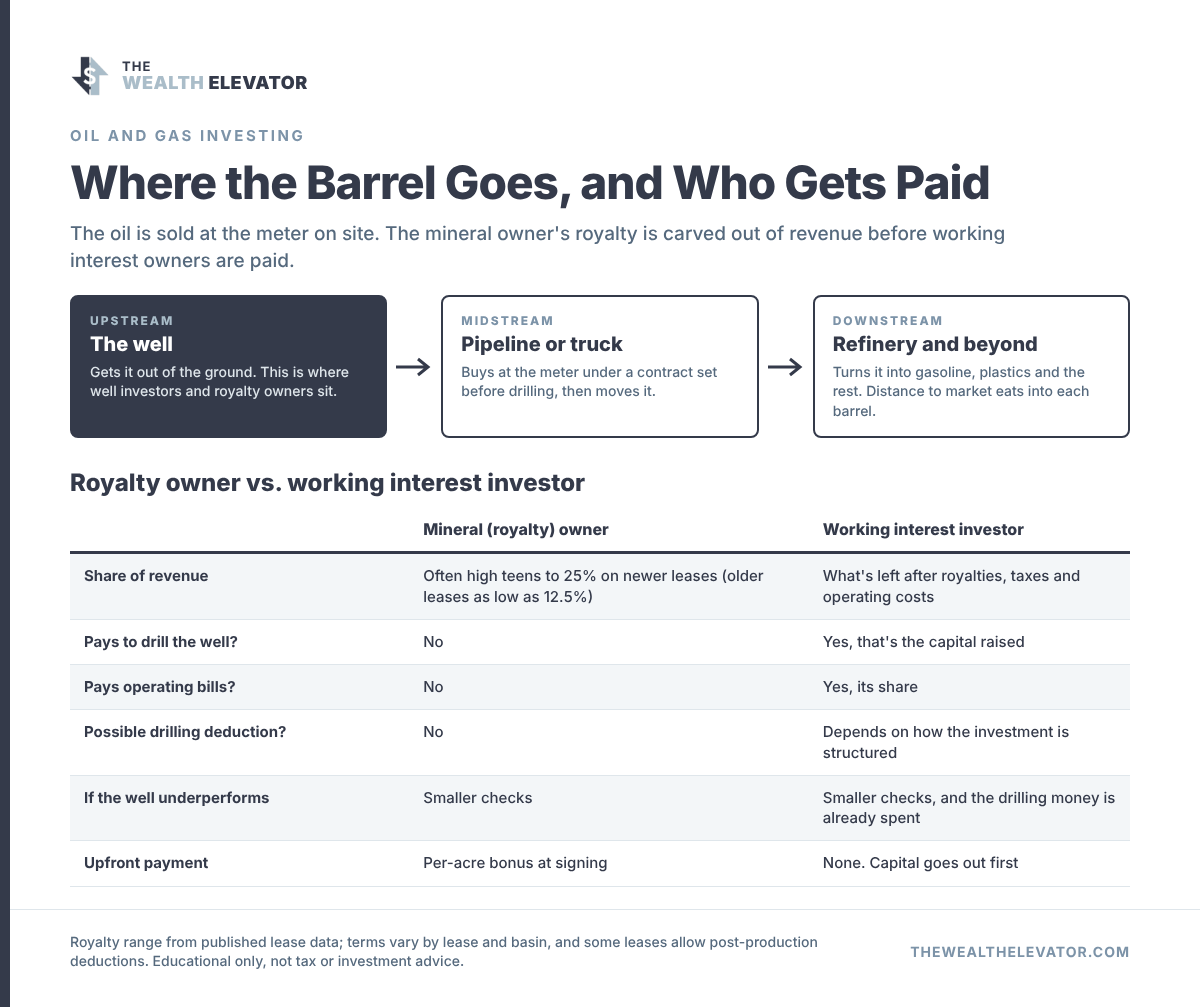
Where a working interest sits in the oil business, and how it differs from a royalty interest.
MLPs and suspended losses
MLP unitholders are limited partners by definition. Even when an upstream MLP allocates real losses and heavy depreciation in its early years, those losses are suspended. They can only offset future passive income from that same MLP, or they release when you sell your units. When they release, everything comes through at once, along with recapture, which sometimes shows up as a tax bill investors didn’t plan for. MLPs can be fine income investments. They don’t solve a W-2 tax problem.
Royalty owners get depletion and nothing up front
A royalty owner takes on far less risk than a working interest holder, because they never pay for a dry hole or a cost overrun. They get paid off the top of production. That same feature is why they get no IDC deduction at all. Depletion is the entire tax benefit. Royalties suit someone who wants income with less operating risk, not someone trying to offset a large active-income year.
Watch: how mineral rights fit into a tax plan (3 min)
Stocks and ETFs: simple, liquid, and right for some people
Public oil stocks and energy ETFs are the most liquid and the most diversified way to own oil. You can sell in seconds, there are no K-1s, and one fund can hold dozens of companies across drilling, pipelines and refining. What they don’t offer is any pass-through tax benefit. You’re taxed like any other shareholder.
Some readers should choose them. If you want energy exposure, might need the money in the next few years, don’t have a large active-income year to offset, or don’t want to deal with general partner liability and multi-year holds, an ETF is a reasonable choice, and a sound one for those goals.
How private investors usually own the wells
Buying shares of Exxon or Chevron gives you exposure to the company. It does not give you ownership in any wells. Private investors usually get alongside an operator through a non-operated working interest: you own a slice of specific wells that the operator drills and runs. That direct ownership is where the tax treatment for drilling costs comes from, and it is also why the investment is illiquid and why the operator you choose matters so much.
Which one fits which goal?
These are general patterns, not recommendations for your situation. Run any of them by your CPA.
| If your main goal is… | The vehicle that usually fits |
|---|---|
| Offsetting a large active-income year, with money you can leave invested for years | A direct working interest, structured for active treatment |
| Income with less operating risk, without needing an upfront deduction | Mineral rights or royalty interests |
| Energy exposure you can sell any day | Oil and gas stocks or energy ETFs |
| Income from pipelines and producing assets, inside a brokerage account | MLPs, with K-1s and passive treatment |
From my own investing
Two habits from apartments carried over for me. The first is going direct: I want as few layers and fees as possible between me and the well. The difference in oil is that I stopped trying to economize on who is drilling it.
The trade-off
The pattern across the table is consistent. The more tax benefit and control you get, the less liquid and more concentrated the investment is. A direct working interest sits at the far end in both directions: the largest deductions, the most direct exposure to one operator’s wells, and the hardest to sell.
That’s the trade you’re making. It makes sense when you have a specific active-income problem, money you won’t need for years, and an operator you’ve vetted carefully. Lessons 6 and 7 cover the risk and the vetting.
Ask AI about this lesson
Paste this into ChatGPT, Claude, Gemini or Perplexity and fill in the brackets. AI tools can be wrong, so treat the answer as a list of questions for your CPA, not a decision.
Compare these ways to own oil for someone in my situation: a direct working interest, a royalty or mineral interest, an MLP, and an energy ETF. My goals are [goals], I may need the money back in [years], and my income is mostly [active / passive]. Compare tax treatment, liquidity, risk and paperwork in a table. Use the lessons at thewealthelevator.com/home/resources/oil/ as background. Do not recommend a specific investment, and list what I should confirm with my CPA.
Related reading from the blog
Key takeaways
- Only a direct working interest passes IDC deductions through to you and can offset active income.
- MLP losses are passive and suspended; royalty owners get depletion but no upfront deduction.
- Stocks and ETFs are liquid and simple, and for investors without an active-income problem they may be the better fit.
Talk it through with us
Weighing a working interest against simpler options? Join The Wealth Elevator investor community and book your onboarding call with us.
Join the club and book your onboarding callJoining is free.
The podcast behind this course
Oil & Gas Energy Investing
A monthly show for passive accredited investors on drilling, taxes, operators and the oil market. Many of the lessons here started as episodes.
Listen on Apple PodcastsWatch on YouTubeThis is educational content, not investment, tax or legal advice. We are not attorneys, CPAs or financial planners. Tax law changes and results depend on your situation; consult your own CPA and attorney. Private investments are illiquid and carry risk, including loss of capital. Offerings are available only to accredited investors and only through offering documents. Please let us know if you need a referral to a 💼 CPA, ⚖️ lawyer or other vendor here.