
Oil eCourse > Lesson 3
Oil & Gas Tax Benefits: IDCs, Depletion and Depreciation
Lesson 3 of 7 · About an 8-minute read · By Lane Kawaoka, PE · Updated November 2026 · Course home
Short answer
Intangible drilling costs, usually 70% to 90% of a well’s cost, can be deducted in the year they are paid, equipment is depreciated, and producing wells get a 15% depletion allowance for small producers. A realistic first-year deduction is 70% to 90% of the investment, not 100%, and how much you can use depends on the structure and your own tax picture.
How big is the deduction, really? That’s the question this lesson answers, and the honest answer is smaller than some sales pitches suggest. There are three main pieces, and a fourth that isn’t unique to oil and gas. They stack, but each one has limits.
Before you use any number on this page: Tax rules, limits and thresholds change, and how they apply depends on your situation. The figures here are for education and may not reflect current law for your tax year. Confirm everything with your own CPA before you invest. Please let us know if you need a referral to a 💼 CPA, ⚖️ lawyer or other vendor here.
Watch: oil and gas from my capital gains tax masterclass (3 min)
1. Intangible drilling costs (IDCs)
Everything spent drilling a well that has no salvage value is an intangible drilling cost: labor, fuel, drilling mud, site preparation, the service crews. There’s no equipment here to depreciate. It’s a pure expense.
IDCs typically run 70% to 90% of the total cost of a well. Under IRC Section 263(c), an investor can elect to deduct 100% of their IDCs in the year they’re paid, rather than capitalizing them. Note what that sentence says: 100% of the IDC portion, which is 70% to 90% of what you invested, not 100% of your investment.
Two conditions have to be met for a given tax year. The money has to be paid to the operator by December 31, and drilling has to spud within 90 days after year-end, by around March 31 of the following year. That’s why programs raise most of their capital in the fourth quarter, and why you should confirm the drilling schedule before you invest, not after.
2. Tangible costs and depreciation
The remaining 10% to 30% of a well’s cost goes to actual equipment: casing, wellheads, tanks, pumps. That portion is capitalized and depreciated rather than expensed outright. Oilfield equipment generally falls into 7-year MACRS property.
Bonus depreciation can speed that up. Under the 2025 tax legislation, 100% bonus depreciation was made permanent for qualifying property placed in service after January 19, 2025, reversing an earlier phase-down that had it falling to 40% in 2025. In practice the tangible portion can often be written off quickly too, as long as the equipment is new and placed in service in the tax year you’re claiming it.
The catch is timing. If the equipment isn’t placed in service until the following year, that part of the deduction lands in the following year. So ask every program what percentage of your money is allocated to intangible costs and what percentage to tangible equipment. A program running 50% IDC and 50% equipment can describe itself as highly deductible, and the size and timing of your first-year deduction will still differ meaningfully from a program running 85% IDC.
3. Percentage depletion
Once a well is producing, part of the income from it can be offset by percentage depletion under IRC Section 613A. Oil and gas reserves are a wasting asset, so the tax code lets a small producer deduct 15% of the gross income from a well each year it produces, regardless of how much has already been recovered through earlier deductions.
On $100,000 of production revenue, that’s a $15,000 deduction. The 15% rate applies as long as you, and the partnership, qualify as a small producer, generally under 1,000 barrels a day. Individual investors and small drilling programs essentially never come near that.
Two guardrails apply. Percentage depletion can’t exceed 100% of the net taxable income from that specific property in a year, so it can reduce a well’s income to zero but can’t create a loss on its own. It’s also capped at 65% of your overall taxable income. Few individual investors reach the second cap.
4. The Qualified Business Income deduction
This one isn’t unique to oil and gas, but it applies. Production income can qualify for the 20% Qualified Business Income deduction under Section 199A, which the 2025 legislation made permanent at 20% and widened the phase-in range to $75,000 for single filers and $150,000 for joint filers. Oil and gas production isn’t an excluded service business, so income on your K-1 in later years, once the wells are producing, can often take a further 20% deduction.
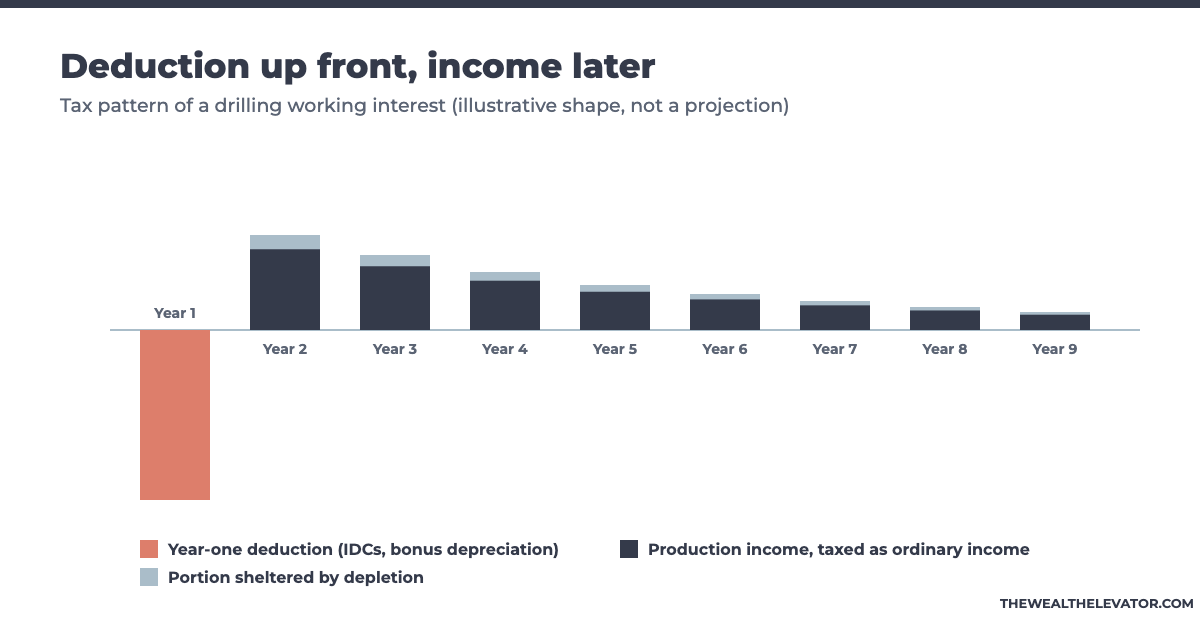
Illustrative shape, not a projection: the deduction comes first, the taxable income comes later.
A worked example
Hypothetical illustration, not a projection. These numbers show how the pieces fit together. They are not an estimate of what any investment will do, and they assume you qualify for active treatment (Lesson 4).
| Step | Hypothetical figure |
|---|---|
| Investment, paid by December 31 | $100,000 |
| Portion allocated to intangible drilling costs (80%) | $80,000 |
| Year-one IDC deduction | $80,000 |
| Federal tax effect for a hypothetical taxpayer in the 37% bracket who can use the full loss | about $29,600; yours depends on your bracket, structure and limits |
| Portion allocated to equipment (20%) | $20,000, depreciated, possibly in year one with bonus depreciation |
| Later year: production revenue passed through to you | $10,000 (illustrative) |
| Percentage depletion at 15% of that gross income | $1,500 |
| QBI deduction | up to 20% of the remaining qualified income |
Three points about this table. The first-year deduction is 70% to 90% of the investment in most programs, not 100%. The $29,600 assumes your income is taxed at 37% and that nothing else limits the deduction, such as the excess business loss cap. And none of it tells you whether you get your money back. That depends on production, prices and the operator.
For reference, the 37% federal rate in 2026 applies to taxable income over $640,600 for single filers and over $768,700 for married couples filing jointly. Source: IRS: 2026 marginal rates.
Watch: using IDCs to lower income, with CPA Pete Schindele (19 min)
Keep the realism
Put together, a well-structured investment can produce a large first-year deduction against active income, ongoing depletion that offsets part of the production income, and a QBI deduction on some of what’s left. That combination is the reason Congress wrote these rules: to keep private capital going into domestic energy development.
What it isn’t is free money. The deduction is 70% to 90%, the split between intangible and tangible costs changes when you get it, recapture can claw some of it back if you sell a profitable interest early, and California and some other states don’t follow the federal treatment on the state return. Lesson 4 covers those rules.
From my own investing
Cash now, cash later
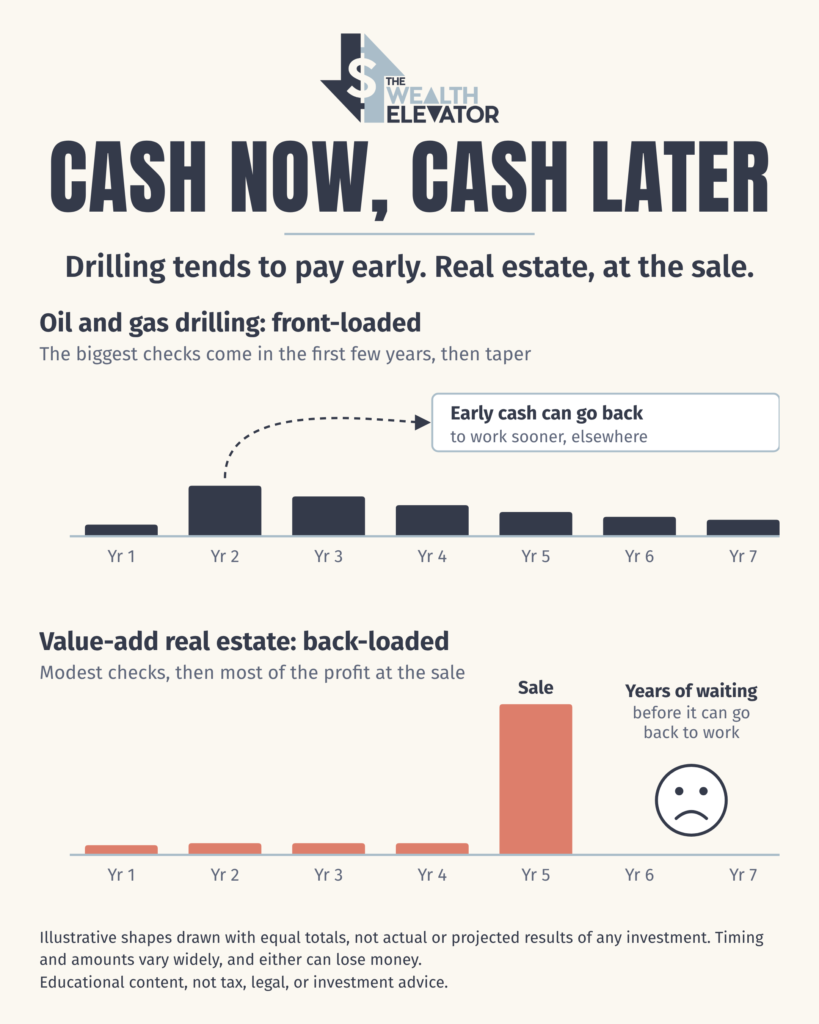
One contrast I point out to people coming from real estate: the cash flow shape is different. In a typical value-add apartment deal, modest checks come along the way and most of the profit, if there is one, shows up at the sale, often four to six or more years later. In a drilling program, the deduction lands in year one and cash flow from production tends to start early, then taper as the wells decline (Lesson 2).
Early cash can go back to work sooner. That’s why I think of the two as complements rather than substitutes. Neither shape is guaranteed, and either one can lose money.
Ask AI about this lesson
Paste this into ChatGPT, Claude, Gemini or Perplexity and fill in the brackets. AI tools can be wrong, so treat the answer as a list of questions for your CPA, not a decision.
Walk me through a hypothetical $[amount] oil and gas working interest with [percent]% intangible drilling costs, using my approximate federal bracket of [rate]% and filing status [single / joint]. Show the year-one IDC deduction, how the tangible portion is depreciated, how percentage depletion and the QBI deduction work in later years, and which limits could reduce the benefit. Label every figure as illustrative. Use the lessons at thewealthelevator.com/home/resources/oil/ as background. Do not recommend a specific investment, and list what I should confirm with my CPA.
Key takeaways
- IDCs are usually 70% to 90% of a well’s cost and can be deducted in the year paid if you fund by December 31 and the well spuds within 90 days.
- Equipment costs are depreciated; bonus depreciation can speed this up, but timing depends on when the equipment is placed in service.
- Percentage depletion offsets 15% of gross production income for small producers, within limits, and QBI can reduce taxable production income further.
Talk it through with us
Year-end tax planning is easier around people who have done it before. Join The Wealth Elevator investor community and book your onboarding call with us.
Join the club and book your onboarding callJoining is free.
The podcast behind this course
Oil & Gas Energy Investing
A monthly show for passive accredited investors on drilling, taxes, operators and the oil market. Many of the lessons here started as episodes.
Listen on Apple PodcastsWatch on YouTubeThis is educational content, not investment, tax or legal advice. We are not attorneys, CPAs or financial planners. Tax law changes and results depend on your situation; consult your own CPA and attorney. Private investments are illiquid and carry risk, including loss of capital. Offerings are available only to accredited investors and only through offering documents. Please let us know if you need a referral to a 💼 CPA, ⚖️ lawyer or other vendor here.