
Passive Oil and Gas Investing: 11 Technical Tax and Cash Flow Checks Most Investors Overlook

Short answer: Passive oil and gas investing can produce large first-year deductions, but the number on the K-1 is only usable if it clears five limits: a valid allocation, outside basis, amount at risk, the passive activity rules and the annual business loss cap. How you hold the interest decides most of it, and the wells still have to produce.
A projected tax deduction and a deduction you can use this year are two separate numbers. Neither one tells you whether the wells will make money. Most of what gets written about passive oil and gas investing stops at intangible drilling costs and a headline percentage, so I wrote this for readers who want the mechanics: accredited investors, the CPAs who prepare their returns, and advisors who get asked about these programs every fourth quarter.
The eleven checks below reconcile five things that marketing materials tend to blur together: what the money is spent on, how the investor holds the interest, which loss limits apply on the investor’s own return, what the wells produce, and what happens to the tax bill at exit. Every example is hypothetical and simplified. None of it is a forecast.
Tax deductions and investment returns are different quantities
A deduction reduces taxable income. Its value is the deduction multiplied by your marginal rate, and only in the year you are allowed to use it. A return is cash back from production, net of royalties, operating costs, taxes and fees. A project can deliver a large first-year deduction and still return less cash than you put in. A project can also produce good cash flow while your share of the loss sits suspended on your return for years.
Two offerings with the same advertised deduction percentage can therefore produce very different results for the same investor, and the same offering can produce different results for two investors who hold their interests differently. The checks below are ordered to show where those differences come from.
1. Passive involvement is not the same as passive tax treatment
In everyday speech, a passive investor is someone who does not run the business. The tax code uses the word differently. Under IRC Section 469, losses from a passive activity can generally offset only passive income. Section 469(c)(3) then carves out an exception: a working interest in an oil or gas property is not a passive activity if the taxpayer holds it directly or through an entity that does not limit the taxpayer’s liability. The exception applies whether or not the taxpayer materially participates.
So the test turns on liability exposure, and the name on the offering document does not settle it. Under Temp. Reg. 1.469-1T(e)(4), a limited partnership interest held as a limited partner, corporate stock, and other interests where state law caps the holder’s liability are all treated as limiting liability. A general partnership interest is not. Insurance, indemnities and stop-loss arrangements do not turn an unlimited-liability interest into a limited one for this purpose.
| Investor with a qualifying working interest | Limited partner or LLC member | |
|---|---|---|
| Liability | Unlimited for the venture’s obligations | Capped at the investment |
| Year-one drilling loss | Non-passive, can offset wages and other income, subject to the other limits below | Passive, usable only against passive income |
| Later income from the property | Non-passive | Passive |
| Self-employment tax | May apply to a general partner’s share of income | Generally not |
Some programs admit investors as general partners during drilling and convert them to limited partners afterward. The timing of that conversion relative to when costs are incurred, and how the regulations treat a mid-year change, is a question for the program’s tax opinion and your own advisor. Ask for it in writing.
2. The five-gate tax deduction test
A loss on a Schedule K-1 has to pass five tests, in order, before it reduces this year’s tax. I call this the five-gate test.
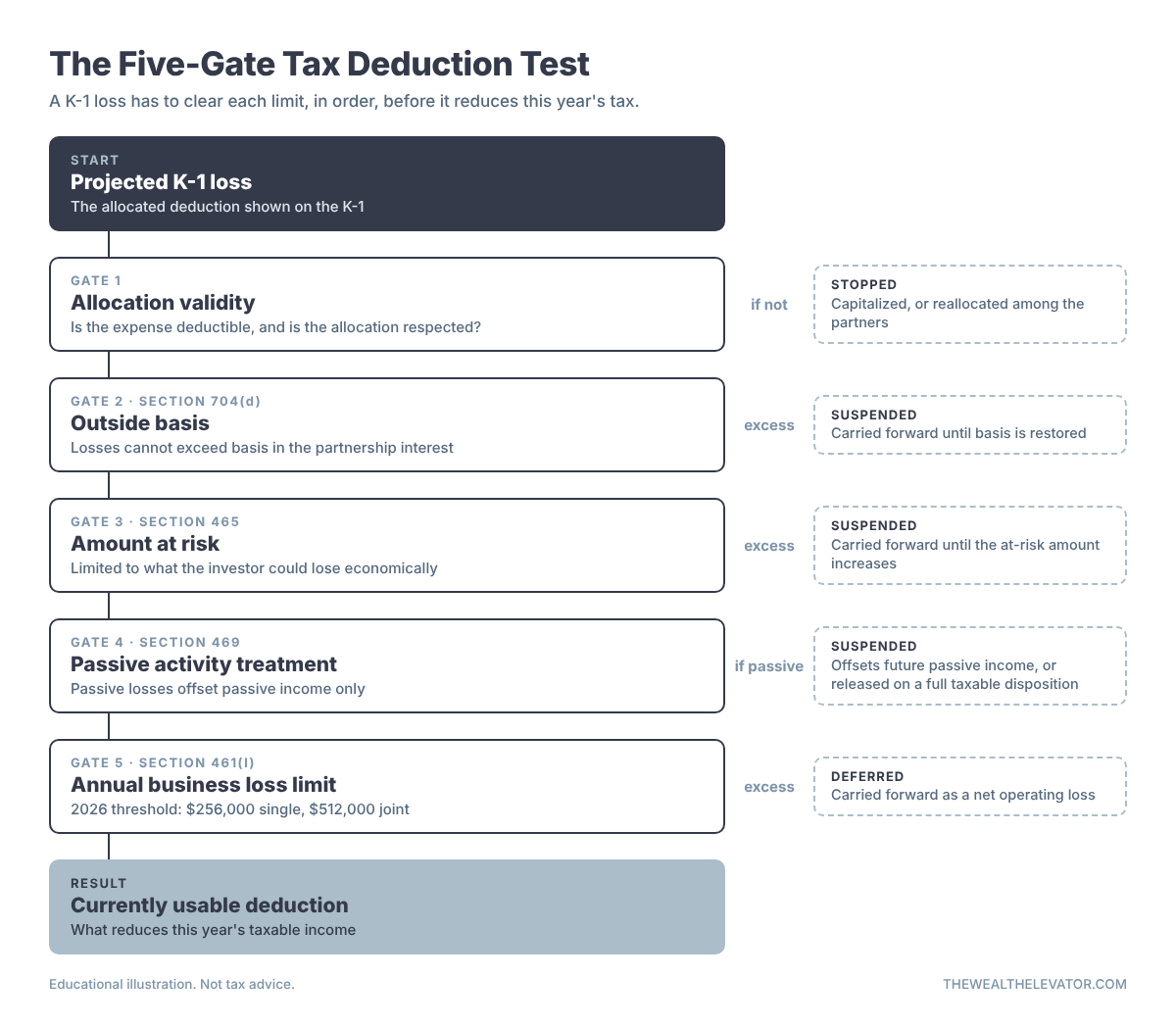
- Allocation. The expense has to be deductible in the first place, and the partnership’s allocation of it to you has to be respected under the partnership tax rules.
- Outside basis. Under Section 704(d), you cannot deduct losses beyond your adjusted basis in the partnership interest.
- Amount at risk. Section 465 limits losses to what you could lose economically.
- Passive activity treatment. Section 469 decides whether the loss can reach wages, business income and portfolio income, or only passive income.
- Annual limits. Section 461(l) caps net business losses that a noncorporate taxpayer can use against non-business income. For 2026 the threshold is $256,000 for single filers and $512,000 for joint filers under Rev. Proc. 2025-32, and the excess carries forward as a net operating loss.
A loss stopped at any gate is suspended, and each gate has its own carryforward rules.
Hypothetical example: an investor contributes $250,000 and receives a K-1 showing a $190,000 ordinary loss. If she is a limited partner with no passive income from other sources, gate four stops the whole amount. Her usable deduction against W-2 wages this year is zero, and $190,000 carries forward as a suspended passive loss. If she instead holds a qualifying working interest, has full basis and at-risk amounts, and has no other business losses, the $190,000 may clear all five gates. The K-1 is identical in both cases.
Three labels help keep this straight: the allocated deduction (what the K-1 shows), the currently usable deduction (what clears all five gates this year), and the suspended loss (the difference).
3. The IDC denominator problem
Section 263(c) and Treas. Reg. 1.612-4 let an operator or working-interest owner elect to deduct intangible drilling and development costs instead of capitalizing them. These are costs with no salvage value that are incident to and necessary for drilling: wages, fuel, repairs, hauling, supplies, site preparation. Casing, tubing, tanks, pumping units and the lease itself are outside the definition.
A statement such as “IDCs are 75 percent of the well” is measured against drilling and completion cost. Your deduction percentage is measured against what you wrote the check for. Those denominators differ because part of every subscription goes to items that are not drilling costs.
Hypothetical example:
| Line | Amount |
|---|---|
| Investor subscription | $400,000 |
| Capital reaching drilling and completion | $320,000 |
| Estimated qualifying IDCs (75% of drilling and completion) | $240,000 |
| IDCs as a share of the subscription | 60% |
The other $80,000 in this example went to lease acquisition, offering and organization costs, management fees and reserves, each of which has its own and usually slower tax treatment. Actual allocations and deductible amounts can differ from estimates once the wells are drilled and the return is prepared. Ask the sponsor for a subscription-to-expenditure reconciliation that ties every subscription dollar to a cost category and a tax treatment.
4. Year-end drilling timing and IDC election mechanics
A December subscription does not by itself create a December deduction. The year depends on when the costs are paid or incurred, when economic performance occurs, and how the drilling contract is written.
Prepaid drilling costs get the most attention. Section 461(i)(2) provides a special rule for entities classified as tax shelters: economic performance for drilling a well is treated as occurring when the well is spudded, if drilling begins within 90 days after the close of the tax year. That provision has conditions. The deduction it allows is limited to the investor’s cash basis in the venture, the prepayment still needs a business purpose and cannot be a refundable deposit, and the contract terms matter. It should not be read as a general rule that any well started by late March supports a prior-year deduction.
The election mechanics matter too. The election to expense IDCs is made by the partnership on its return for the first year it pays or incurs those costs, and it binds later years. An individual partner can separately elect under Section 59(e) to amortize a share of IDCs over 60 months, which some investors use to manage alternative minimum tax exposure or to avoid creating a loss they cannot use.
Questions to put to the sponsor: what supports the claimed deduction year, when are the wells scheduled to spud, what does the drilling contract say about prepayment and refunds, and has the partnership made the IDC election.
5. Partnership basis, debt, and the at-risk rules
Three numbers get confused here. Outside basis is your tax basis in the partnership interest: contributions, plus your share of income, minus distributions and losses, plus your share of partnership liabilities under Section 752. Amount at risk under Section 465 is narrower. It counts cash contributed and borrowed amounts for which you are personally liable, and it excludes amounts protected against loss through nonrecourse financing, guarantees, stop-loss agreements or similar arrangements.
The consequence is that partnership debt can raise your basis without raising your at-risk amount. Real estate investors are used to qualified nonrecourse financing counting as at risk. That exception applies to the activity of holding real property, and Section 465(b)(6) excludes mineral property from it. A leveraged drilling program can therefore show plenty of basis at gate two and still be stopped at gate three.
Read the financing terms for what they do to your real exposure. A personal guarantee or an obligation to meet capital calls can increase the amount at risk. An indemnity from the sponsor or a put right can reduce it. If a later change drops your at-risk amount below zero, Section 465(e) can pull previously deducted losses back into income.
6. Working interest versus net revenue interest
A working interest (WI) is your share of the costs of drilling and operating the well. A net revenue interest (NRI) is your share of production revenue after royalty and overriding royalty burdens. The NRI is always smaller than the WI on a burdened lease, and the gap is what the landowner and any override holders take off the top without paying costs.
Hypothetical example for one year of production:
| Line | Amount |
|---|---|
| Working interest | 10% |
| Net revenue interest | 7.5% |
| Gross well revenue | $1,000,000 |
| Gross well operating expenses | $200,000 |
| Investor revenue (7.5% of revenue) | $75,000 |
| Investor operating expenses (10% of expenses) | $20,000 |
| Investor cash before other charges | $55,000 |
The investor pays 10 percent of costs and receives 7.5 percent of revenue. The $55,000 is still before severance and ad valorem taxes, gathering and transportation, operator overhead charged under the joint operating agreement, partnership-level expenses and any reserve the manager holds back. A working-interest percentage alone tells you your share of the bills. You need the NRI, the lease operating statement and the fee schedule before you can estimate cash yield.
7. Percentage depletion is not an automatic 15% tax-free distribution
Depletion is the cost recovery method for the mineral property itself. An owner computes cost depletion and percentage depletion each year and takes the larger. Section 613A allows percentage depletion at 15 percent of gross income from the property for independent producers and royalty owners, and then limits it in several ways:
- It is unavailable to retailers and refiners above the statutory thresholds.
- It applies only up to a depletable quantity of 1,000 barrels of oil a day on average, or the natural gas equivalent at 6,000 cubic feet per barrel.
- It cannot exceed 100 percent of the taxable income from the property, so a property with no net income in a year supports no percentage depletion that year.
- It cannot exceed 65 percent of the taxpayer’s overall taxable income, computed with the adjustments the statute specifies. The disallowed amount carries forward.
For partnerships, depletion is computed by each partner, not by the partnership. The K-1 reports the information and the limits are applied on the investor’s own return. That is why two partners in the same program can end up with different depletion deductions.
The calculation base is gross income from the property. It is not the distribution you received. Hypothetical example: your share of qualifying gross income is $80,000, so the preliminary percentage depletion figure is $12,000. Whether you deduct $12,000, something less, or cost depletion instead depends on the property-level and taxpayer-level limits above. Describing this as “15 percent of your cash flow is tax free” skips every one of those steps.
8. Tangible drilling costs and bonus depreciation
Whatever is not an IDC falls into another category with its own recovery rule.
| Cost | Typical federal treatment |
|---|---|
| Intangible drilling costs | Deductible if the election is made, or amortized over 60 months by election |
| Tangible equipment (casing, tubing, wellhead, tanks, pumping units) | Depreciated under MACRS, generally as 7-year property, and may qualify for bonus depreciation |
| Lease acquisition and bonus | Capitalized and recovered through depletion |
| Syndication and offering costs | Not deductible and not amortizable |
| Organization costs | Limited deduction, the rest amortized |
| Reserves and working capital | No deduction until spent on something deductible |
Bonus depreciation law has changed more than once in the last few years, so the percentage in an older deck may be wrong. As of this writing, legislation enacted in 2025 restored 100 percent bonus depreciation under Section 168(k) for qualified property acquired after January 19, 2025, and the IRS issued interim guidance in Notice 2026-11. Property acquired earlier, including under a binding contract signed earlier, can still fall under the old phase-down. Depreciation also starts when equipment is placed in service, which for a well finished after year-end is the following year.
Accelerated deductions lower your basis in the equipment, and the depreciation taken is subject to recapture as ordinary income when the equipment or the interest is sold.
9. PDP, PUD, decline curves, and commodity stress testing
The tax analysis only matters if the wells produce. Reserve engineers classify reserves by certainty and development status. Proved developed producing (PDP) reserves come from wells that are flowing today. Proved undeveloped (PUD) reserves require future drilling and capital. An offering weighted toward PUD locations carries drilling, timing and cost risk that a PDP acquisition does not, even when both are labeled proved. The SPE Petroleum Resources Management System and the SEC’s reserve definitions are the reference standards.
PV-10 is the present value of estimated future net revenue from proved reserves, discounted at 10 percent, before income taxes. It is a well-level or asset-level number. It is not the value of your interest after fund fees, promote, debt and your own taxes.
Decline assumptions drive everything. Unconventional wells often lose more than half of their initial rate in the first year, and the forecast is sensitive to the curve parameters the engineer selects. Ask who prepared the reserve report, whether that firm is independent of the sponsor, and what price deck and cost assumptions it used.
Illustrative stress test, using the first-year figures from check 6. These are not forecasts.
| Base case | Downside case | |
|---|---|---|
| Commodity price | As modeled | 20% lower |
| First production | On schedule | Six months late |
| Decline | As modeled | Steeper, volumes 10% lower |
| Operating expenses | As modeled | 15% higher |
| Investor revenue, first 12 months | $75,000 | $27,000 |
| Investor operating expenses | $20,000 | $11,500 |
| Investor cash before other charges | $55,000 | $15,500 |
The downside revenue is $75,000 x 0.80 x 0.50 x 0.90. Expenses are half a year at a 15 percent higher rate. First-year cash falls about 72 percent, before any capital overrun, and a working-interest owner funds overruns through a cash call. Hedging can narrow the price exposure. It does not help with delays, decline or costs.
10. Reconcile K-1 taxable income with distributions
Cash distributed and taxable income reported rarely match in an oil and gas partnership. Depletion and depreciation reduce taxable income without using cash. Retained cash for workovers or new wells is taxable to you even though you never received it. Distributions reduce basis and are not themselves income until basis runs out. Many states where the wells sit require nonresident filings or withhold on your share.
I suggest keeping three records for each program:
- A capital ledger: contributions, capital calls, distributions, and running outside basis and at-risk amounts.
- A tax ledger: each year’s K-1 items, depletion taken, losses used, losses suspended at each gate, and state filings.
- A production ledger: volumes, realized prices, lease operating expenses and NRI-level revenue by well, from the operator statements.
An advertised distribution yield is one year’s cash divided by invested capital. With a declining asset, part of every distribution is a return of your own capital. Yield does not establish the internal rate of return, and it says nothing about taxable income.
11. Model the exit tax and loss release
First-year deductions come with a later cost. Under Section 1254, gain on the disposition of oil and gas property is ordinary income to the extent of IDCs previously deducted and depletion that reduced basis. Depreciation on equipment is recaptured under Section 1245. When the interest is held through a partnership, the regulations and the hot-asset rules carry that ordinary character through to a sale of the partnership interest. Part of what looks like capital gain on exit can be taxed at ordinary rates.
For investors with suspended passive losses, Section 469(g) releases them when the taxpayer disposes of the entire interest in a fully taxable transaction with an unrelated party. A partial sale generally does not release them, and neither does a sale to a related party until the interest later leaves the related group.
There is also a rule that surprises investors who took the working-interest exception. Under Section 469(c)(3)(B), if a property produced a loss that was treated as non-passive under that exception, net income from that property in later years is also treated as non-passive. You cannot deduct the drilling loss against wages in year one and then treat the production income as passive income to absorb other passive losses.
A first-year deduction should be evaluated together with the character of the income that follows and the tax on the way out.
Worked example: the tax-to-cash reconciliation
This hypothetical ties five quantities together: subscription capital, qualifying tax expenditures, the K-1 loss, the currently usable deduction, and after-tax cash. It is simplified. It assumes a 37 percent federal rate in every year, a single filer in 2026, and it ignores state tax, self-employment tax, the net investment income tax, AMT and the time value of money. Actual results will differ.
Two investors each subscribe $400,000 to the same program from check 3. Investor A holds a qualifying unlimited-liability working interest. Investor B is a limited partner with no other passive income. The wells underperform: lifetime distributions total $300,000, taxable income from production after depletion and depreciation totals $140,000, and the interest is worth nothing at the end.
| Quantity | Investor A | Investor B |
|---|---|---|
| 1. Subscription capital | $400,000 | $400,000 |
| 2. Qualifying IDCs | $240,000 | $240,000 |
| 3. Year-one K-1 loss | $240,000 | $240,000 |
| 4. Currently usable in year one | $240,000 | $0 |
| Suspended after year one | $0 | $240,000 |
| Year-one federal tax reduction at 37% | $88,800 | $0 |
| Lifetime distributions | $300,000 | $300,000 |
| Tax on $140,000 of production income | $51,800 | $0 (absorbed by suspended losses) |
| Tax reduction when remaining $100,000 loss is released at exit | Not applicable | $37,000 |
| 5. Lifetime after-tax cash | $337,000 | $337,000 |
| After-tax result on $400,000 | $63,000 loss | $63,000 loss |
Three points come out of this. A 60 percent first-year deduction did not make the investment profitable for either investor, because the wells returned $300,000 on $400,000. The limited partner’s deduction was deferred, and it ended up sheltering the program’s own income and then releasing at exit. And the difference between the two investors is timing: Investor A had $88,800 of tax reduction in hand in year one, in exchange for unlimited liability during drilling and ordinary, non-passive income afterward. Whether that trade is worth it is a judgment call that depends on the investor’s income, other passive activities and tolerance for liability.
Investor due-diligence checklist
- How will I hold the interest, and does that form limit my liability under state law?
- Is there a written tax opinion on the working-interest exception and on any conversion from general to limited partner?
- Can the sponsor reconcile my subscription to IDCs, tangibles, lease costs, fees and reserves?
- What supports the deduction year: spud dates, contract terms, and the partnership’s IDC election?
- What are my outside basis and at-risk amounts after any debt, guarantees or indemnities?
- What are the WI and NRI on each well, and what burdens sit between them?
- Who prepared the reserve report, and how much of the value is PDP versus PUD?
- What does the downside case look like at lower prices, later production and higher costs?
- Am I obligated to fund cash calls, and what happens if I do not?
- Which states will I have to file in?
- What is the expected exit, and how much of the gain would be ordinary under recapture?
- Has my own CPA run the five gates against my return, not a generic one?
Frequently asked questions
Can passive oil and gas investments offset W-2 income?
Only in specific structures. Losses from a working interest held directly or through an entity that does not limit liability are non-passive under Section 469(c)(3) and can offset wages if they also clear the basis, at-risk and excess business loss limits. Losses allocated to a limited partner or LLC member are passive and generally cannot.
What percentage of an oil and gas investment is deductible in the first year?
There is no fixed percentage. It depends on how much of the subscription funds qualifying IDCs, when the costs are incurred, and whether the investor can use the loss that year. In the hypothetical above, IDCs were 60 percent of the subscription and the usable amount ranged from all of it to none.
Are unused oil and gas passive losses carried forward?
Yes. Suspended passive losses carry forward without expiring. They offset future passive income, including income from the same program, and any remainder is generally released on a fully taxable disposition of the entire interest to an unrelated party.
Is percentage depletion always 15%?
No. Fifteen percent of gross income from the property is the starting rate for eligible independent producers and royalty owners. The deduction is then limited by the depletable quantity, by 100 percent of the property’s taxable income, and by 65 percent of the taxpayer’s taxable income, and some taxpayers are not eligible at all.
What is the difference between working interest and net revenue interest?
Working interest is your share of costs. Net revenue interest is your share of revenue after royalties and overrides. A 10 percent working interest with a 7.5 percent net revenue interest pays 10 percent of the bills and receives 7.5 percent of the revenue.
What happens to IDC deductions when an oil and gas investment is sold?
Section 1254 treats gain as ordinary income up to the amount of IDCs previously deducted and depletion that reduced basis. The deduction is partly a timing benefit, and the sale can convert expected capital gain into ordinary income.
Can investors deduct drilling expenses without operating a well?
Yes. A non-operating working-interest owner can deduct a share of IDCs if the election is made. Whether the resulting loss is passive depends on liability exposure, not on who operates the well.
Conclusion
Oil and gas tax benefits are written into the code and they are substantial for investors who qualify. They are also conditional at every step. The useful questions are how much of my capital becomes a qualifying cost, how much of the resulting loss I can use and when, what the wells have to produce for me to get my money back, and what I will owe on the way out. An offering that answers those with documents is easier to evaluate than one that answers with a percentage.
If you want to be around investors who work through details like these, come join our community at theWealthElevator.com/club.
Related reading
- How oil and gas working interests can offset W-2 income when they are structured correctly
- Oil and gas IDCs and year-end timing
- Majors vs. mom-and-pop drillers: why operator size matters
- Cost segregation and bonus depreciation in real estate
- The Oil Investing Dossier for passive investors
- The life of an oil well, stage by stage, and when investors get paid
References
- IRC Section 263(c) and Treas. Reg. 1.612-4: intangible drilling and development costs
- IRC Section 704(d): partner loss limitation to basis
- IRC Section 752: treatment of partnership liabilities
- IRC Section 465: at-risk limitation
- IRC Section 469 and Temp. Reg. 1.469-1T: passive activity rules and the working-interest exception
- IRC Section 461: economic performance, the 90-day spudding rule, and the excess business loss limitation; Rev. Proc. 2025-32 for 2026 thresholds
- IRC Section 613A: percentage depletion for oil and gas
- IRC Section 168 and IRS Notice 2026-11: bonus depreciation
- IRC Section 1254: recapture on disposition of oil and gas property
- IRS Publication 925: passive activity and at-risk rules
- IRS Oil and Gas Handbook, IRM 4.41.1
- SPE Petroleum Resources Management System (Society of Petroleum Engineers, 2018 update)
Disclaimer
This is educational content, not tax, legal, or investment advice. We are not attorneys, CPAs, or financial planners. All examples are hypothetical, and tax outcomes depend on current law, ownership structure, elections, project facts and your own circumstances. Please let us know if you need a referral to a CPA, lawyer, or other vendor here: thewealthelevator.com/vendor