
Rental property owners get put on a fixed depreciation schedule the moment a property is placed in service: 27.5 years for residential, 39 for commercial. A small deduction every year, for decades, regardless of when the cash flow would actually help.
There’s a legal, IRS-recognized way to change that timeline, and it’s been around since the 1960s: cost segregation.
What cost segregation actually does
A cost segregation study looks at a property and separates out the components the IRS treats as non-structural: interior finishes, certain site improvements, land improvements like fencing and paving. Instead of depreciating those pieces over 27.5 or 39 years alongside the building’s structure, they get reclassified onto a 5-year or 15-year schedule.
The total deduction over the life of the property doesn’t change. What changes is when you get to use it. Instead of a trickle for three decades, you can take a large chunk of it in year one.
A concrete example
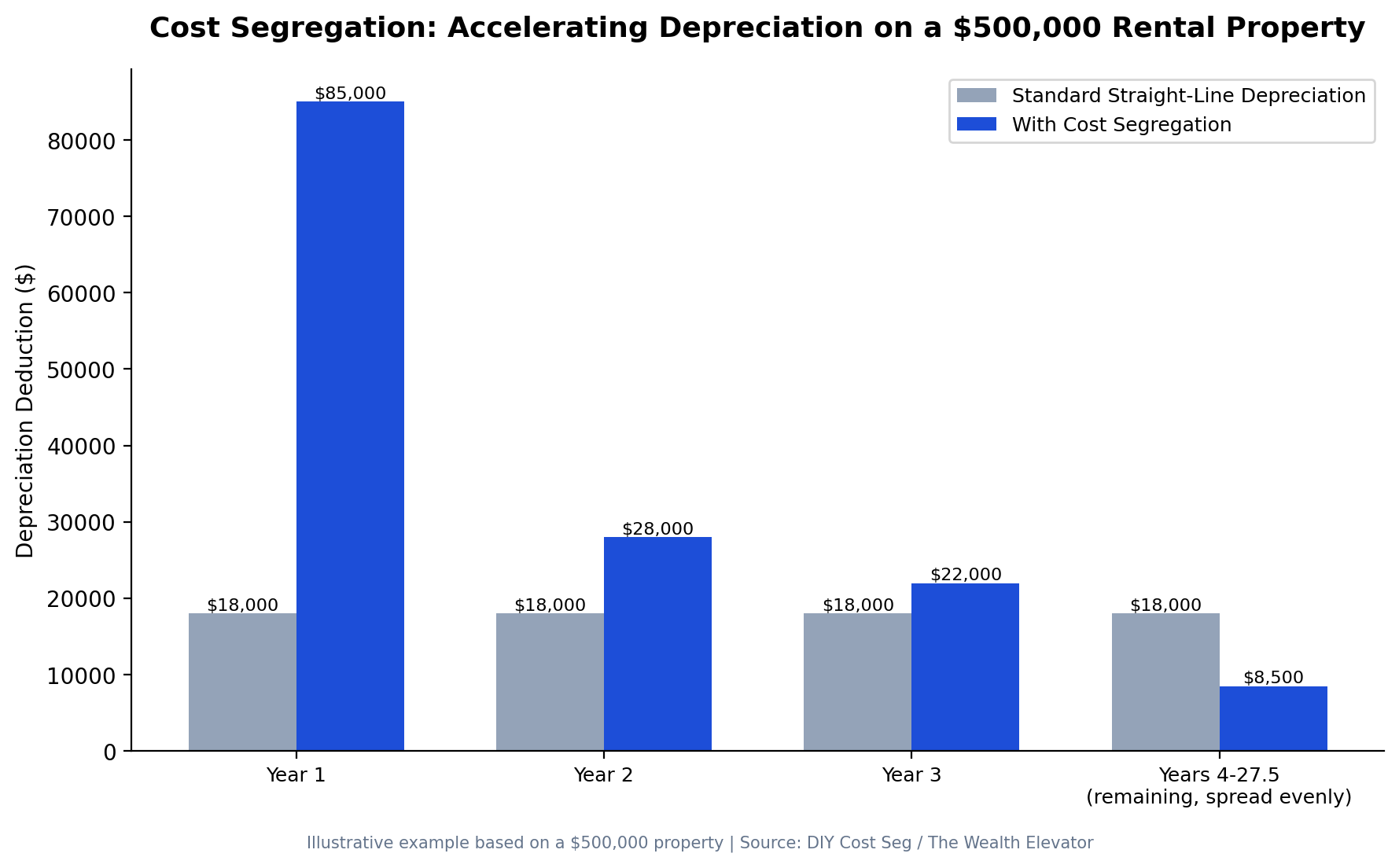
On a $500,000 property, standard depreciation runs about $18,000 a year. A cost segregation study might reallocate that to roughly $85,000 in year one, $28,000 in year two, and $22,000 in year three, tapering after that. If the property qualifies for 100% bonus depreciation (automatic for commercial; available on residential through real estate professional status or the short-term rental loophole), the entire accelerated amount can be taken in year one instead of being spread across 5 or 15 years.
Why this used to be out of reach for small owners, and isn’t anymore
A fully engineered cost segregation study, the kind with an in-person site visit, has historically run $5,000 to $6,000 or more. That made sense on a $10 million apartment complex. It didn’t make sense on a single rental house.
That’s changed. Studies that pull property details directly from the owner (photos, purchase price, square footage, an appraisal or online estimate) instead of sending someone on-site have brought the cost down to a few hundred dollars. One real example: a single-family home in rural Kansas with a cost basis of $43,000 still produced about $12,000 in accelerated depreciation, worth roughly $3,000 to $4,000 in tax savings, on a report that cost under $500.
Where it doesn’t make sense
Depreciation you accelerate gets recaptured, and taxed, when you sell. This is a timing benefit, not free money. If you’re planning to sell within a year or two, the numbers usually don’t work in your favor. It’s a much better fit if you plan to hold for years, where it functions closer to an interest-free loan against your own future tax bill. Past about 15 years already on a standard depreciation schedule, it’s typically too late to go back and capture meaningful value, though a Form 3115 accounting method change can help inside a shorter window.
How to tell if it’s worth it for a specific property
Get an estimate of the accelerated depreciation amount, multiply by your tax bracket to get the actual dollar savings, and compare that to what the study costs. If the study runs a few hundred dollars and the savings are in the thousands, it’s usually a clear yes.
If you want a referral to run the numbers on your own property, go to thewealthelevator.com/costseg.