

A pre-IPO investment gives accredited investors exposure to a privately held company before its shares begin trading on a public stock exchange. This guide explains how private-market access works, what to evaluate before committing capital, and how The Wealth Elevator approaches pre-IPO opportunities on behalf of its investor community.
Pre-IPO Investing, In Plain English
A pre-IPO investment provides exposure to a privately held company before its shares begin trading on a public stock exchange. Unlike buying a public stock, private-company investments typically come with less public information, more restrictions on selling, and no guarantee that the company will ultimately complete an IPO.
The Private Company Lifecycle
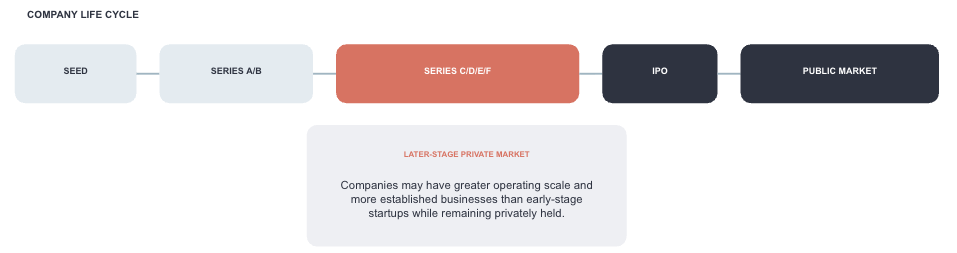
Private companies typically move through a series of financing rounds as they grow: seed, Series A/B, Series C through F, and eventually an IPO or acquisition that brings shares onto the public market. Companies raising Series C through F rounds are considered later-stage private companies, meaning they may have greater operating scale and more established businesses than early-stage startups while still remaining privately held.
“Late stage” does not mean low risk, and an IPO is never guaranteed. In fact, any type of this investing is relatively high risk, and there is a real possibility of losing all your capital.
Two Common Ways to Get Pre-IPO Exposure
Primary investments involve newly issued securities as part of a company financing. Capital generally goes to the company.
Secondary investments involve existing private securities sold by a current shareholder or through another private-market structure. Capital generally goes to the selling holder rather than directly to the company. Private secondary securities may be restricted, subject to company approval, or difficult to resell.
New securities are issued as part of a company financing. Capital generally goes to the company.
Existing private securities are sold by a current shareholder. Capital generally goes to the seller, not the company.
Private Does Not Mean “Public Stock, Earlier”
Private investments can involve limited liquidity, less public information, transfer restrictions, valuation uncertainty, and concentration risk. FINRA also cautions that some pre-IPO exposure is obtained indirectly through funds rather than through direct ownership of the underlying company’s shares.
Access Is Only the First Layer
Getting into a private company is one question. Understanding what you are actually buying is another. Before committing capital, accredited investors should evaluate six things:
What Is an Anchor Investor?
An anchor investor is an investor making a meaningful early commitment that helps establish scale for a fund or allocation. For The Wealth Elevator, an anchor commitment can help the fund approach an opportunity with a larger aggregate capital base.
What Is an “Access Fund”?
The Wealth Elevator uses this term to describe a private investment vehicle through which exposure to a sought-after private company may be secured. An access fund may hold the underlying company interest directly or through another structure, depending on the transaction.
Investing Individually vs. Investing Through a Pooled Fund
An individual investor evaluates a private-market opportunity and negotiates the structure and terms available to them alone. A pooled fund combines anchor capital with investor subscriptions into one TWE-managed fund, creating a larger aggregate commitment. That fund then seeks allocation and negotiates the economics available for the underlying private-market exposure.
Pooled capital does not guarantee better terms or access. It can, however, change the size of the conversation a fund manager is able to have with counterparties.
How The Wealth Elevator Approaches Pre-IPO Access
Many of the private-market opportunities we evaluate come through relationships and private networks rather than a traditional public marketplace. Our role is to manage the investment fund that seeks and acquires an allocation. Investors subscribe to the fund; The Wealth Elevator manages the fund and coordinates the investment process.
Our Five-Step Process
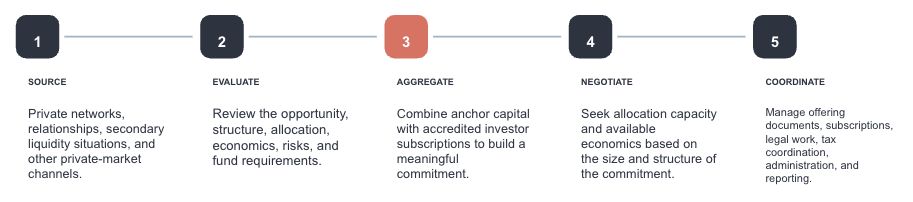
- Source. Identify opportunities through private networks, relationships, secondary liquidity situations, and other private-market channels.
- Evaluate. Review the opportunity, structure, available allocation, economics, risks, and fund requirements.
- Aggregate. Combine anchor capital with subscriptions from accredited investors to build a meaningful fund-level commitment.
- Negotiate. Seek allocation capacity and, where available, improved economics or terms based on the size and structure of the fund commitment.
- Coordinate. Manage fund formation, offering documents, subscriptions, legal work, tax coordination, administration, and ongoing investor reporting.
Why Invest Together?
Curated access. Opportunities sourced through relationships that may not appear in a traditional brokerage account.
Aggregated negotiating position. A multimillion-dollar fund commitment may have a different negotiating position than an investor approaching an opportunity alone.
Structure and coordination. One managed vehicle can consolidate legal, tax, subscription, and administrative work.
Alignment. The Wealth Elevator participates as fund manager in the same investment structure alongside the investors in the fund.

Pre-IPO Investing: Frequently Asked Questions
What is a pre-IPO investment?
A pre-IPO investment provides exposure to a privately held company before its shares begin trading on a public stock exchange, typically through a primary financing or a secondary purchase from an existing shareholder.
What is the difference between primary and secondary pre-IPO investments?
In a primary investment, new securities are issued and capital generally goes to the company. In a secondary investment, existing private securities are sold by a current shareholder, and capital generally goes to that seller rather than the company.
What is an anchor investor?
An anchor investor makes a meaningful early commitment that helps a fund or allocation reach the scale needed to access an opportunity.
Is pre-IPO investing risky?
Yes. Private investments are speculative and illiquid, and involve risks including limited liquidity, less public information, transfer restrictions, valuation uncertainty, and concentration risk. An IPO or other liquidity event is never guaranteed.
This material is for educational purposes only and does not constitute an offer to sell or a solicitation to purchase any security. Private investments are speculative, illiquid, and involve substantial risk, including the potential loss of the entire investment. Past or illustrative transactions do not guarantee future results. Investors should review the applicable offering documents and consult their own legal, tax, and financial advisers.
Join our Investor Community!
Free resources to help you take action, reduce taxes, and invest smarter — just for readers of The Wealth Elevator.

Unlock Your
Wealth Elevator Toolkit!
Enter your email to unlock instant access to my 12-part Masterclass.

📦 What You’ll Get:
✅ Join our investor club to gain access to our 12-module Passive Investor MasterClass!
✅ Audio Video Version – Perfect for on-the-go learning and reference
✅ Early invites to investor-only webinars and behind-the-scenes deal reviews
✅ Accredited Investor access to exclusive deals hand-picked by us

begin your journey to financial freedom!
My name is Lane Kawaoka, and I hope my blog/podcast will help families realize the powerful wealth-building effects of real estate so they can spend their time on more important, instead of working long hours and worrying about their financial troubles. There are a lot of successful families with good jobs (teachers / engineers / programmers / finance) yet they struggle to make ends meet financially. It is their kiddos who ultimately get the short end of the stick. Being a Latch-Key Child growing up, both my parents had to work and I was left home alone after school to fiddle with my thumbs.
With Real Estate you are able to grow your wealth exponentially faster than the conventional 401K’s and stock investing, therefore you are able to escape the dogma of working 50+ hour weeks at a job that is unfulfilling. And if you are one of the lucky ones who happen to do what you enjoy… well good for you 😛
Money is not everything but it is important because it gives you the freedom to live life on your terms.
Annoyed by the bogus real estate education programs out there (that take money from people who don’t have it in the first place), I set out to make this free website to help other hard-working professionals, the shrinking middle-class. I hope to dispel the Wall-Street dogma of traditional wealth-building, and offer an alternative to “garbage” investments in the 401K/mutual funds that only make the insiders rich. We help the hard-working middle-class build real asset portfolios, by providing free investing education, podcasts, and networking, plus access to investment opportunities not offered to the general public.
“The true meaning of wealth is having the freedom to do what you want, when you want, and with whom you want.
Building cash flow via real estate is the simple part. The difficult part occurs after you are free financially to find your calling and fulfillment.
But that’s a great problem to have ;)”
excerpt from The One Thing That Changed Everything