

10,000+
total rental units
2x
bestselling author
15 years
experience in
alternative investing
$2.1 billion
real estate owned
$230 million
from investors
like you
928
investors
contributing over $50k
65+
active projects





After twelve years as a Licensed Professional Engineer in civil and industrial engineering, I left my engineering career to focus full-time on investing, private real estate, and helping other accredited investors build passive income outside the traditional Wall Street path. Join the community I have curated Here.
My path was not glamorous. I started like a lot of people: working a W-2 job, saving aggressively, and trying to do the “right” things I was told to do.
2007 — Graduated college and started working as an engineer.
I started with little to no net worth and did what most responsible people are told to do: get a good job, save money, contribute to retirement accounts, and eventually buy a home.
2009 — Bought my first property in rainy Seattle.
I was a ramen-eating cheapo just a couple years out of college, and I saved enough to buy my first house. Because I was traveling constantly for work, I barely lived in the place. I rented it out and accidentally became a landlord. If you are still a non-accredited investor on the first floor of the wealth elevator, take a look at this free e-course here.
2009–2015 — Learned the difference between cashflow and speculation.
That first rental helped me understand the difference between cashflow investing and appreciation-only investing. In my view, buying something only because you hope it goes up in price is closer to gambling or speculation. Cashflow gives you options lets you make decisions from a place of strength. That said, true wealth is created by forced appreciation or by adding value to the assets, so you are able to realize that on an exit.
By 2015 — Built a portfolio of eleven rentals.
I moved my portfolio into single-family rentals in markets such as Birmingham, Atlanta, Indianapolis, and Pennsylvania. Those rentals helped me become a real estate millionaire by age thirty-one, but they also taught me that owning scattered rentals is not truly passive forever. Even with property managers, there are still tenants, repairs, vacancies, insurance issues, and plenty of little headaches.
2015 and beyond — Moved into syndications and private placements.
As my net worth grew, I started investing in syndications, private placements, and private funds. That is where I saw how higher-net-worth investors were accessing better operators, larger assets, and more scalable opportunities than the typical retail investor buying one house at a time.
By age thirty-five — Left engineering.
The passive income from my investments gave me the ability to move back home to Hawaii, where the cost of paradise is higher living expenses and often lower wages compared to the mainland. At first, financial freedom meant being able to bike to work and live closer to family. Eventually, it meant leaving the day job altogether.
my motivations for creating this site
2) I saw too many bogus real estate education programs taking money from people who did not have much money to begin with. So I started sharing what I was learning through free education, podcasts, investor resources, and eventually an investor community. The goal was simple: help people who are good earners and good savers learn how real assets, private placements, taxes, and passive income actually work. The Wealth Elevator today is no longer just beginner real estate education. Our community includes accredited investors, business owners after liquidity events, doctors, lawyers, engineers, executives, retirees, and families trying to turn accumulated wealth into passive income and long-term legacy.
3) Those on the path to building their own financial legacy is lonely… The true meaning of wealth is having the freedom to do what you want, when you want, and with whom you want. Building cashflow through real assets is the simple part. The harder part is deciding what to do with your freedom once you have it. And a big part of that is creating this community of like-minded individuals. We welcome you to join us on our next Hawaii retreat!








my professional resume
BS Industrial Engineering (University of Washington)
ㅤMS Civil Engineering (University of Washington)
ㅤProfessional Engineer (PE)
2007-2012 Supervisor of 100% traveling Union Capital / Maintenance Crew
ㅤ– Rail grinding, undercutting, track geometry, tie replacement program, and steel replacement
[More about this project here]
2013-2015 Project Engineer
ㅤ– Design/Permit/Construct $250M WSDOT ARRA High Speed Rail, Seattle to Portland
2015 – 2017 City Engineer
ㅤ– Sidewalk, Signal, Streets, Drainage, Erosion Control
2017 – 2018 Airfield Engineer
ㅤ– Capital work to upkeep State airport taxiway, runways, and navigational aids
2018 – 2019 Facilities Engineer (GS12) at Tripler Hospital in Honolulu, Hawaii
4/9/2019 Quit JOB and became Full-time investors and Real Estate Mentor

Today, I focus on private investments such as real estate syndications, multifamily apartments, mobile home communities, RV parks, assisted living, self-storage, oil and gas investments that may provide intangible drilling cost tax benefits, private equity, private credit, and select angel investments for more asymmetric upside exposure.
The common thread is not hype or chasing whatever is hot this year. I am looking for investments aligned with long-term human necessities and durable trends that should still matter ten years from now and beyond or with a team/operation that has an unfair competitive advantage or moat. People need housing. Businesses need capital. Energy demand is not going away. Aging populations need care. Best-of-Class Entrepreneurs will continue building companies that solve real problems.
That does not mean every deal works or that alternatives are risk-free. There are bad operators, bad structures, bad incentives, and plenty of people online pretending to know what they are doing. A big part of my mission is helping investors become educated enough to avoid the obvious traps.
At this stage, I am less interested in one-off speculation and more interested in building a tax-aware, diversified private investment portfolio with strong operators, real demand, and multiple ways to win.
other footnotes for consuming my content
I built The Wealth Elevator for a few reasons.
Some of them are practical. Some are personal. Some are probably a little too raw for a normal “About” page, but that is kind of the point. I do not want this site to sound like it was written by a committee of compliance people or some AI bot trying to make me look polished.
I want people to understand how I actually think and attract those people to be apart of our community long term.
1. Begin With the End in Mind
We are only here for a finite period of time.
One exercise that has always stuck with me is deciding what you want your obituary to read. It sounds a little dark, but it cuts through the noise pretty quickly.
Rich Cohen wrote that there are four rungs of being remembered after death: newly dead, dead but remembered, dead and all those who knew you dead, and dead and all those who knew those who knew you dead.
In other words, fame is not really the game.
Your legacy will not give you much pleasure after you are gone. What matters is what you do while you are still here. Who did you help? What did you build? Did you spend your best years doing what actually mattered to you, or did you just follow the path everyone else told you to follow?
For me, The Wealth Elevator is part of that answer.
I do not need this website to make me famous. I want it to help people get out of the rat race, stop blindly following bad financial dogma, and learn how real investors think about cashflow, taxes, private deals, and freedom. If I were to honestly define my vision, it would be to have our annual retreat in Hawaii with 40-80 people, where some are new, some are old, and the old people and I are nurturing the new people and paying it forward and we continue perpetually to build a cohesive group of a thousand or two more. In fact as of 2026, I think we’re already at a thousand past investors.
2. Create a Repository of How I Think
I also built this site as a repository. AI has been a godsend for y’all, so you don’t have to go through the hours and hours of e-courses that we have haha.
Part of it is for my children and family. Part of it is for investors. Part of it is for the random hard-working professional who finds this site at 11:30 p.m. after realizing they are tired of doing everything “right” and still not feeling free.
I wanted a place where people could see what I was thinking at different stages of my journey. What I believed about money. What I got wrong. What I changed my mind about. What I learned after going from nearly zero net worth in 2007, to eleven rentals by 2015, to syndications, private placements, funds, oil and gas, private credit, private equity, and other alternatives.
One example of that is when I was in my day job as an engineer about 1M net worth. I was so desperate to get out of it that I was so focused on building up cash flow to replace my salary with these really annoying rental properties that drove me crazy. As I started to become a more mature, accredited investor and more especially get around other accredited investors, the focus on cash flow was a lot less, because you had that confidence in your net worth base. You didn’t have to be seeing what came in every month or every quarter or even year-to-year from a cash basis. You could count on it, and it became more of a focus on net worth and equity appreciation and getting over that eight-figure mark. One example of that is when I was in my day job as an engineer. I was so desperate to get out of it that I was so focused on building up cash flow with these really annoying rental properties that drove me crazy. As I started to become a more mature, accredited investor and more especially get around other accredited investors, the focus on cash flow was a lot less, because you had that confidence in your net worth base. You didn’t have to be seeing what came in every month or every quarter or even year-to-year from a cash basis. You could count on it, and it became more of a focus on net worth and equity appreciation and getting over that eight-figure mark.
Plus, I got tired of giving the same advice to friends who asked for help and then did nothing with it.
So instead of repeating myself over and over, I started writing, recording podcasts, building courses, and organizing the information. If someone is serious, the information is here. They can go as deep as they want.
3. Why a Podcast?
I jumped on the podcast bandwagon early in 2016 because I was working on the road and did not always have friends nearby.
Podcasts became my mobile university.
They got me into CrossFit in 2008, Paleo in 2009, real estate investing around 2010, intermittent fasting in 2013, internet marketing in 2015, and eventually connected me with a lot of people who became friends, investors, partners, and members of this community.
Some call it “Automobile University,” and that phrase is pretty accurate.
A few of those interests came and went. Some stuck. But the bigger lesson was that podcasts taught me how to keep learning outside the traditional school system. That mattered because most of what actually made me financially free was not taught in school, engineering, corporate training, or the 401(k) lunch-and-learn sessions.
The podcast also helped me find my people. The phrase “we met on the internet” used to sound weird. Now it is pretty much how most of my best relationships started.
4. Teach People to Fish
While I am alive, I want to teach and empower people to fish for themselves.
In real estate, we use leverage. Education works the same way. If one person learns how to evaluate a deal, avoid a bad operator, understand passive losses, or stop blindly handing money to Wall Street, that knowledge can spread to their spouse, children, friends, business partners, and future generations.
I poke fun at MLMs a lot, but in a strange way I would like to create a pyramid scheme of philanthropy.
Not the scammy kind.
The kind where people learn, get free, help their family, then turn around and help other good people do the same.
I will be honest. Early on, a lot of this came from anger. I saw how much Wall Street and the traditional mutual fund industry extracted from people who were just trying to save for retirement. I saw my own parents work hard, save, follow the rules, and still not really get ahead in the way they should have.
That pissed me off.
Anger can get you started, but it will not keep you going forever.
Over time, the fuel changed. I started seeing the positive impact. I saw investors buy back time. I saw people reduce taxes legally. I saw professionals build passive income. I saw families become more confident about their future. That became the more sustainable mission behind The Wealth Elevator.
5. Faith, Stewardship, and Giving Back
I was baptized on Easter in 2016, and that pushed me to think more seriously about how to give back.
I will admit something that may sound bad: I struggle with simply giving money away.
Not because I do not want to help. I do.
But because I know I can grow capital faster than most organizations can deploy it efficiently. I am also probably more frugal than most philanthropic organizations. That is just how my brain works.
Bill Gates gave back after he amassed a fortune. I understand that logic. Tithing as you go along can be meaningful, but from a purely compounding standpoint, it may have a smaller cumulative impact than growing the capital first and then deploying it later in a bigger way.
My end game is to give away wealth to rightful causes, likely through structures such as a Charitable Remainder Trust or other thoughtful vehicles. I do not have all of that perfectly figured out yet.
As I grow my local community in Hawaii and the broader Wealth Elevator community, I want to surround myself with people who are trying to help other good people financially. Not in the lame for-profit coaching way built on referral fees and fake guru energy, but in a real way.
I do not know exactly how all of this comes together yet, but I am conscious of building it the right way.
6. Help Families Buy Back Time
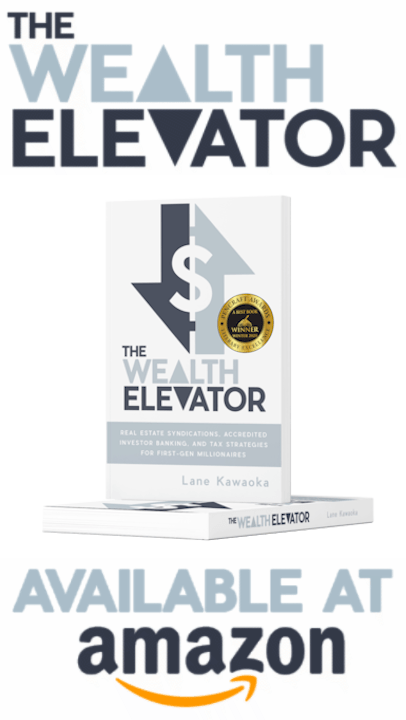
I hope this blog, podcast, book, and community help families realize how powerful real assets and private investments can be when used correctly.
There are a lot of successful families with good jobs who still feel trapped. Teachers, engineers, programmers, doctors, finance professionals, business owners, executives, and dual-income households can all look successful from the outside and still feel like they are running on a treadmill.
Their kids often get the short end of the stick.
I was a latchkey kid growing up. Both of my parents had to work, and I was left home alone after school to figure things out. I am not bitter about it. They did what they had to do. But it shaped how I think about money.
Money is not everything, but it is important because it gives you the freedom to live life on your terms.
For some people, that means leaving a job. For others, it means staying in a job they actually enjoy, but no longer needing it. For a business owner after a liquidity event, it may mean figuring out how to replace active income without making one huge irreversible mistake. For a retiree, it may mean creating more stable income outside the stock market. For a family, it may mean giving the next generation better tools than we had.
We live in an incredible time. There is more access to information, technology, and private investment opportunities than ever before.
But there is also a quiet war being waged on good savers.
A lot of people are told that the only responsible path is to work for decades, max out retirement accounts, buy index funds, and hope the market cooperates when they are finally ready to stop working.
That may work for some people.
But it is not the only path.
The Wealth Elevator exists to show a different one: real assets, private investments, cashflow, tax efficiency, operator relationships, and a community of people trying to become better stewards of capital.
I walked the linear path for much of my life. I studied hard, checked the boxes, got the grades, became an engineer, saved money, and tried to live a practical life. Growing up, we were told to waste nothing and turn off the lights every time we left a room.
I still feel guilty ordering a soft drink at a restaurant instead of tap water.
That frugality helped me get started. But at some point, saving alone is not enough. You have to learn how to put capital to work in ways that create freedom, protect your time, and eventually help other people.
That is why this site exists.
Money is not everything, but it is important because it gives you the freedom to live life on your terms.
It is a great time in history to be alive, with general peace and technological convenience. But I see a silent war being waged upon the shrinking Middle Class. This is the Civil Rights movement of my time. In a way, people have a kind of Stockholm Syndrome, with Wall Street profiteers being the captors. Let’s work together to redirect money from the Wall-Street casinos and corrupt financial institutions… to help the endangered ‘Middle Class’ savers find safer, more profitable investments in Main Street opportunities, benefiting local communities!
“I walked the linear path for much of my life. Raised as part of the disappearing “middle-class” programmed me to study hard in school, checking the boxes on extracurricular activities, cramming for the SATs, and getting a high GPA to get into college, all to live a “practical” life. Growing up, we were told to “waste nothing” and turn off the lights every time you leave a room. I still feel guilty to order a soft drink at a restaurant as opposed to tap water.”
excerpt from The One Thing That Changed Everything