
What to Put in a Self-Directed IRA or Solo 401(k), and What to Keep Out

Short answer: Deals whose main tax perk is a deduction, like oil and gas working interests and depreciating real estate, often do more held in your own name, because the deductions get trapped inside an IRA or Solo 401(k). Interest and stock gains, like private credit and pre-IPO shares, tend to fit inside. Watch for UBTI and, in an IRA, UDFI, which the account pays tax on.
Most accredited investors I talk to have the same problem. A large share of their net worth sits in an old 401(k) or IRA, and they want some of it working in private deals. Once they learn a Solo 401(k) or self-directed IRA can hold real estate, oil and gas, or pre-IPO shares, the next move feels obvious: open the account and start investing.
The better question comes first. Which investments belong inside the account, and which ones should you hold in your own name?
The answer matters more than the account setup. A retirement account shelters gains, but it also traps deductions and, in some deals, owes its own tax. The same investment can be a smart fit in one account and a poor one in another. If you have not read my Retirement Plans guide yet, start there for the basics. This article picks up where it leaves off.
This came out of a webinar I hosted with a self-directed plan provider, along with a story from one of our investors that I think every QRP holder should hear.
Three ways a retirement account works against you
People assume a retirement account never pays tax. That is mostly true for stocks and bonds. Private deals are different, and three issues decide whether a deal fits.
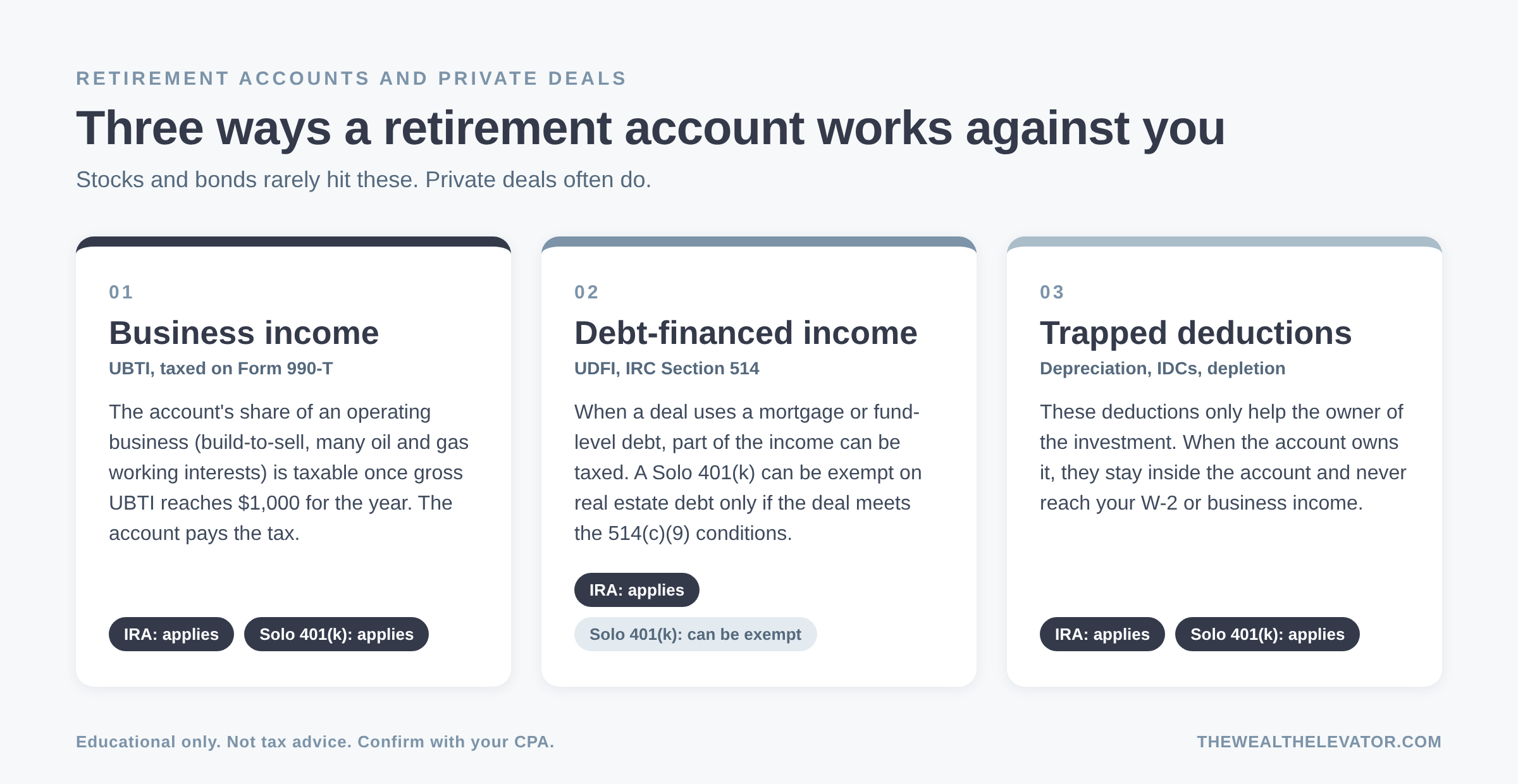
1. Business income (UBTI). When a tax-exempt account owns a share of an operating business through a partnership, its share of that business income is unrelated business taxable income. If the account has $1,000 or more of gross UBTI for the year, the account files Form 990-T and pays the tax out of the account. The first $1,000 is covered by a specific deduction, so tax generally applies only above that. This applies to IRAs and Solo 401(k)s alike.
2. Debt-financed income (UDFI). When a deal uses a mortgage or other debt, part of an IRA’s income from it can be taxed under the same 990-T system. A Solo 401(k) can be exempt from this on real estate debt, but only when the deal meets the conditions in the tax code. The price has to be fixed, the loan terms can’t depend on the property’s profits, and the property can’t be leased back to the seller or a related party. When the property sits in a partnership, which is how most syndications are set up, the partnership has to meet extra allocation rules (often called the fractions rule) or the exemption doesn’t apply. IRAs don’t get this exemption at all. It also covers only debt on real property. It does not cover operating business income from point 1.
3. Trapped deductions. Depreciation, intangible drilling costs and depletion only help the taxpayer who owns the investment. When your IRA owns it, the deductions stay inside the IRA. They never reach your W-2 or business income.
One investor in our community learned point 1 the hard way. They put Solo 401(k) money into a new-build development deal. Then the K-1 arrived with the profit in Box 1, ordinary business income, because the houses were built to sell. The plan owed about $10,000 in tax, paid from the 401(k). The bill was a surprise, and it took a tax preparer who knew how to file a 990-T.
The K-1 tells you a lot. Box 1 (ordinary business income) is where UBTI usually shows up. Box 2 (rental real estate income) is where a typical buy-and-hold apartment deal reports. Ask the sponsor which boxes their past K-1s have used before you send retirement money.
Deal by deal: where each type tends to fit
Oil and gas. Most of the tax appeal of oil and gas comes from intangible drilling costs and depletion. Whether you can use IDCs against ordinary income depends on how you hold the investment. A direct working interest is generally what makes that possible, which is why high earners look at these deals (see my Oil & Gas Tax Benefits guide). Inside an IRA those deductions do nothing for you. Working-interest income is also usually business income, so it can create UBTI. Royalty income is generally excluded from UBTI, so royalty-style deals are a different conversation. For that reason, many high earners who look at oil and gas for the tax benefits hold it in their own name with taxable money. Whether that fits your situation is a question for your CPA.
Depreciating real estate (buy-and-hold apartments, value-add). Rental income generally is not UBTI. The issue is debt. In an IRA, leveraged real estate can produce UDFI. In a Solo 401(k), the real estate debt exemption can remove that problem if the deal meets the code’s conditions, including the partnership rules above. Ask the sponsor before you assume it does. Either way, the depreciation stays in the account. If you can use passive losses personally, or you qualify as a real estate professional, these deals usually do more for you outside the account. If you cannot use the losses anyway, holding them in a Solo 401(k) loses less.
Build-to-sell development. Profit from building and selling homes is business income. It can trigger UBTI in an IRA or a Solo 401(k), with or without debt. Some sponsors offer a blocker, a C corporation that sits between the deal and retirement investors. The blocker pays corporate tax, and the account avoids filing a 990-T. Whether the blocker’s tax cost beats the 990-T is a question for your CPA.
Pre-IPO and private company shares. This is often the cleanest fit. Gains on the sale of stock are generally excluded from UBTI, and there are no depreciation or drilling deductions to waste. They also carry a wide range of outcomes, including losing the entire investment. Gains inside a Roth account can come out tax-free if you meet the qualified distribution rules. One caution: stock that might qualify for the Qualified Small Business Stock exclusion can be worth more held personally. Many late-stage companies no longer qualify, but ask. Read the Pre-IPOs guide for how these deals are structured.
Private credit and debt funds. Interest is taxed as ordinary income when you hold it personally, at your top rate. Interest is generally excluded from UBTI, so these funds are tax-efficient inside a retirement account. The exception is a fund that borrows to lend more, which can create UDFI for IRA holders. Ask about fund-level leverage.
Quick reference
These are general tendencies, not rules. The structure of a specific deal can change the answer.
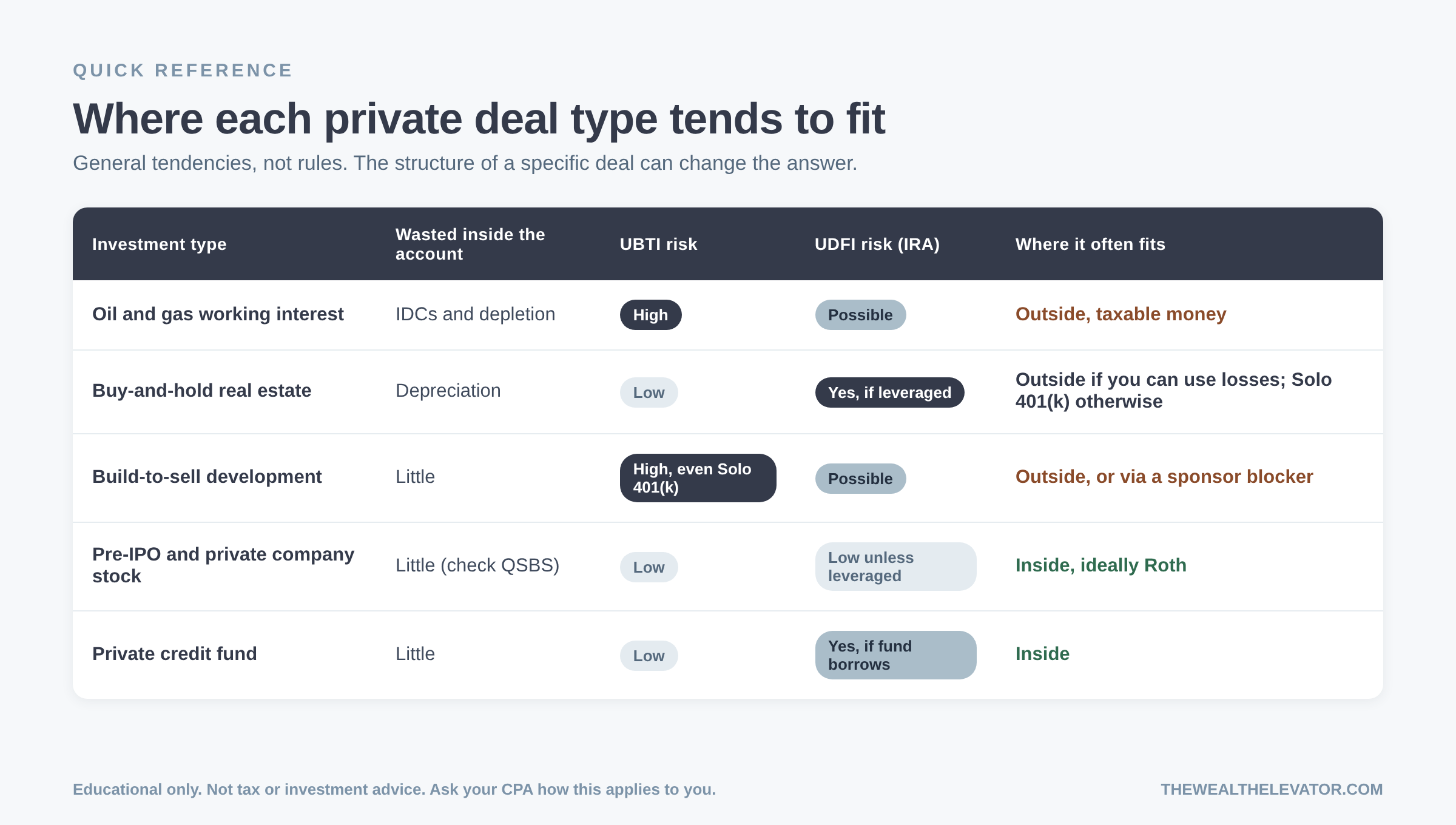
| Investment type | Wasted inside the account? | UBTI risk | UDFI risk in an IRA | Where it often fits |
|---|---|---|---|---|
| Oil and gas working interest | IDCs and depletion | High | Possible | Outside, taxable money |
| Buy-and-hold real estate | Depreciation | Low | Yes, if leveraged | Outside if you can use losses; Solo 401(k) otherwise |
| Build-to-sell development | Little | High, even in a Solo 401(k) | Possible | Outside, or through a sponsor blocker |
| Pre-IPO and private company stock | Little (check QSBS) | Low | Low unless leveraged | Inside, ideally Roth |
| Private credit fund | Little | Low | Yes, if the fund borrows | Inside |
Four mistakes that cost people deals or worse
An account labeled “self-directed” that cannot buy private deals. Several people in our community have run into this recently. They thought they were set up. Their account said “self-directed,” but it was at a large brokerage, which only meant they could pick from that brokerage’s own menu. A real self-directed IRA uses a custodian that holds alternative assets, usually with an LLC or trust the IRA owns. A Solo 401(k) can be its own trustee and bank wherever you choose. If your account is at a big-name brokerage, assume it cannot hold a private placement until someone confirms in writing that it can.
Dealing with a disqualified person. Your IRA cannot transact with you, your spouse, your parents and grandparents, your children and grandchildren, or their spouses. Renting an IRA-owned vacation home to your own child at full market rent is still a prohibited transaction. Siblings, aunts, uncles and cousins are generally not disqualified, but swap arrangements designed to get around the rules invite scrutiny. The penalty for an IRA is severe: the whole account can be treated as distributed as of January 1 of that year.
Buying collectibles. IRAs cannot hold collectibles such as art, wine, spirits, classic cars, gems or most coins, with narrow exceptions for certain bullion. IRAs also cannot hold life insurance contracts. A simple test: if you could enjoy the asset personally, it probably does not belong in the account.
Waiting until you find a deal. Opening the account, transferring funds and forming the LLC typically takes two to three weeks, sometimes longer depending on your state and your current custodian. Private deals often fund in a week or two, so set the account up before you need it.
Checkbook control means you manage an IRA-owned LLC or act as your own 401(k) trustee. It lets you fund a deal by writing the check yourself. A custodian-controlled account adds review time for every investment. The trade-off is that with checkbook control nobody checks your work, so the prohibited-transaction rules are entirely on you.
Questions to ask before you send retirement money
Ask the sponsor:
- Do you accept IRA and Solo 401(k) investors, and do you offer a blocker for them?
- Which K-1 boxes have past investors’ income shown up in, Box 1 or Box 2?
- How much debt does the deal or fund use, at the property level and at the fund level?
- Is the profit expected to come from operations, a sale of property held for investment, or selling inventory such as new homes?
- For Solo 401(k) investors: has your tax counsel confirmed the partnership meets the Section 514(c)(9) requirements, including the fractions rule?
Ask your CPA:
- Can I use passive losses or drilling deductions on my own return this year? If so, what am I giving up by investing through the account?
- Have you filed a Form 990-T for a retirement account before?
- Traditional or Roth: which bucket should hold my highest-upside positions?
FAQ
Does a Solo 401(k) avoid all tax on private deals? No. It can be exempt from UDFI on real estate debt when the deal meets the conditions in Section 514(c)(9), and many partnership deals need extra structuring to qualify. It is not exempt from UBTI on operating business income, such as build-to-sell development or many oil and gas working interests.
Can my IRA invest in an oil and gas fund? Often yes, if the sponsor accepts IRA money. The question is whether it should. The drilling deductions that make oil and gas attractive to high earners do nothing inside an IRA, and working-interest income can create UBTI.
Who pays the UBIT bill? The account pays it, from account assets, on Form 990-T. You do not pay it from personal funds.
Is the $1,000 UBTI threshold per deal? No. It applies to the account’s gross UBTI for the year across all its investments.
Related reading
- Year-end tax planning for high earners
- The oil well life cycle, from lease to plug
- How to vet a sponsor before you invest
IRS references
If you want to check these points yourself or hand them to your CPA, these are the sections behind them:
- Instructions for Form 990-T: who files, the $1,000 gross income threshold, and the custodian filing for an IRA
- IRC Section 511: the tax on unrelated business income of exempt trusts
- IRC Section 512: exclusions for interest, royalties, real property rents and gains on sale (other than inventory or property held for sale to customers), plus the $1,000 specific deduction
- Treasury Regulation 1.512(b)-1: royalties versus working interests in mineral property
- IRC Section 514: debt-financed income and the real property exception for qualified plans in 514(c)(9)
- IRS Retirement Topics: Prohibited Transactions: disqualified persons and what happens to an IRA that breaks the rules (IRC Sections 4975 and 408(e)(2))
- IRS: Investments in Collectibles: what counts as a collectible and the bullion exception (IRC Section 408(m))
- IRC Section 408A: Roth IRA qualified distributions
Related reading: how to run your retirement like a family office, including the income map, the tax calendar before RMDs, and the binder your spouse could run alone.
Next step
If most of your net worth is in a retirement account and you are deciding what to do with it, talk it through with other accredited investors in the Wealth Elevator community.
Please let us know if you need a referral to 💼 CPA ⚖️ Lawyer or other vendor here.
This is educational content, not tax, legal or investment advice. We are not attorneys, CPAs or financial planners. Tax treatment depends on your situation and on how each deal is structured. Confirm everything here with your own tax professional before you invest.