
Year-End Tax Planning for High Earners: Getting Under the 24% Bracket Before December 31

Short answer: For 2026, the 24% bracket ends at $403,550 of taxable income for married couples filing jointly and $201,775 for single filers. Getting under that line before December 31 usually means timing income, using deductions that can offset W-2 income, such as oil and gas IDCs, and avoiding strategies that hang on hour logs or appraisals.
The October 15 extension deadline just passed, so a lot of you wrapped up your 2025 returns in the last week or two. The return you can still change is 2026, and that window closes on December 31. After New Year’s, your CPA is mostly writing down what already happened.
I sat down with my own CPA last week, and this is the list I walked through on our office hours call afterward. It is aimed at single filers making more than about $200,000 and married couples making more than about $400,000. Below those levels, most of what follows is more paperwork than it is worth.
I’m not a CPA or an attorney. This is what I’ve seen work, and not work, for investors in our community, written so you can have a sharper conversation with your own tax professional.
AGI is the number to watch
Your federal tax starts from your adjusted gross income (AGI). If you don’t know last year’s, open page one of your 1040 and find it. Then estimate where 2026 is going to land. The more sophisticated investors I know steer that number during the year instead of finding out what it was in April.
Two colors of money
I split income into two buckets. Ordinary income is W-2 wages, business income and 1099 work. Passive income is rent, syndication distributions and other investments you don’t run day to day. On the way up the Wealth Elevator, below roughly $5 million of net worth, most people’s income sits in the ordinary bucket.
Passive income can be zeroed out with passive activity losses (I call them PALs), and real estate depreciation produces a lot of them. There is a wall between the buckets, though. Passive losses offset passive income. They don’t offset your salary.
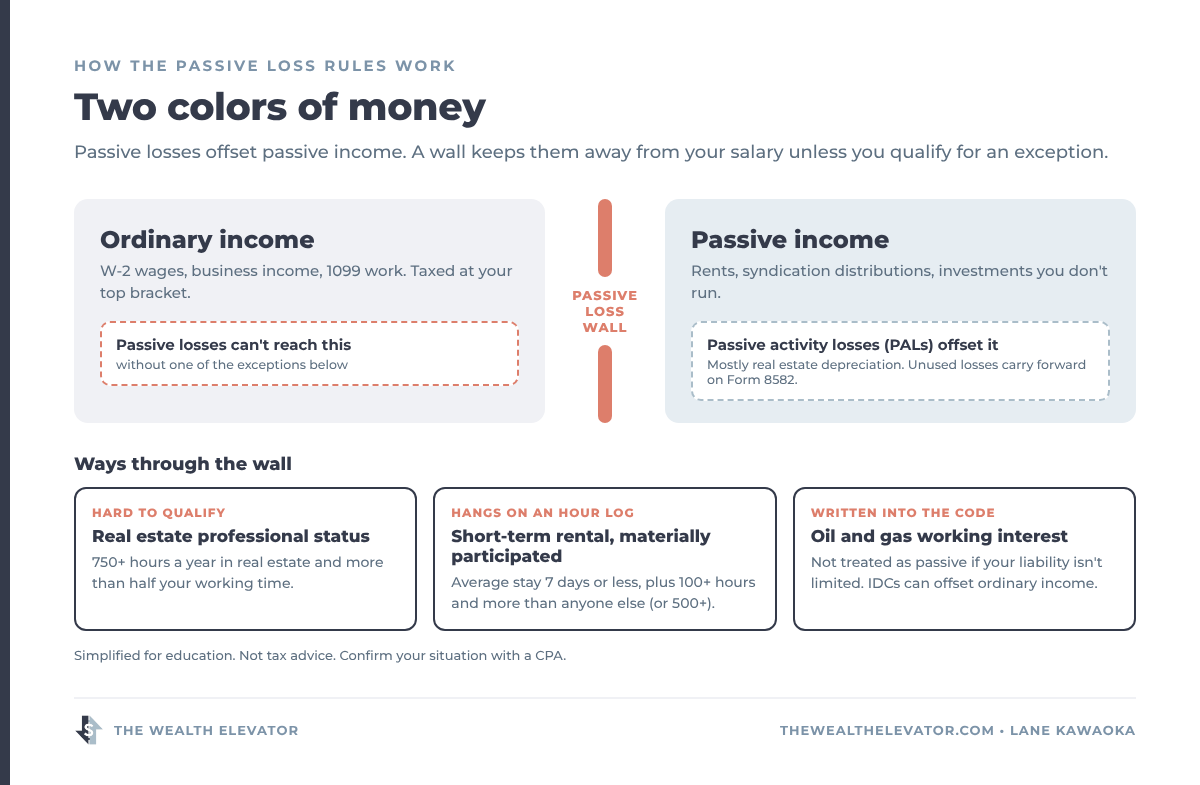
The standard way through the wall is real estate professional status, which requires more than 750 hours a year in real estate trades or businesses and more than half of your total working time. If you and your spouse both have full-time jobs outside real estate, it rarely works. I’ve seen preparers check that box for people anyway. I’m conservative here and I wouldn’t do it.
The analogy I use is a bow and arrows. Real estate professional status is the bow, and passive losses from rentals and syndications are the arrows. Arrows without a bow don’t do much, and plenty of investors have six or seven figures of suspended losses carrying forward on Form 8582 with no way to use them yet. Find that form in your return and know the number. Those losses aren’t lost. They wait for future passive income or a sale.
Why $400,000 is the line
For 2026, the 24% bracket runs up to $403,550 of taxable income for married couples filing jointly and $201,775 for single filers. Above that you’re in the 32% bracket. The other steps between brackets are small by comparison, so for most of our readers this 8-point jump is the one to watch.
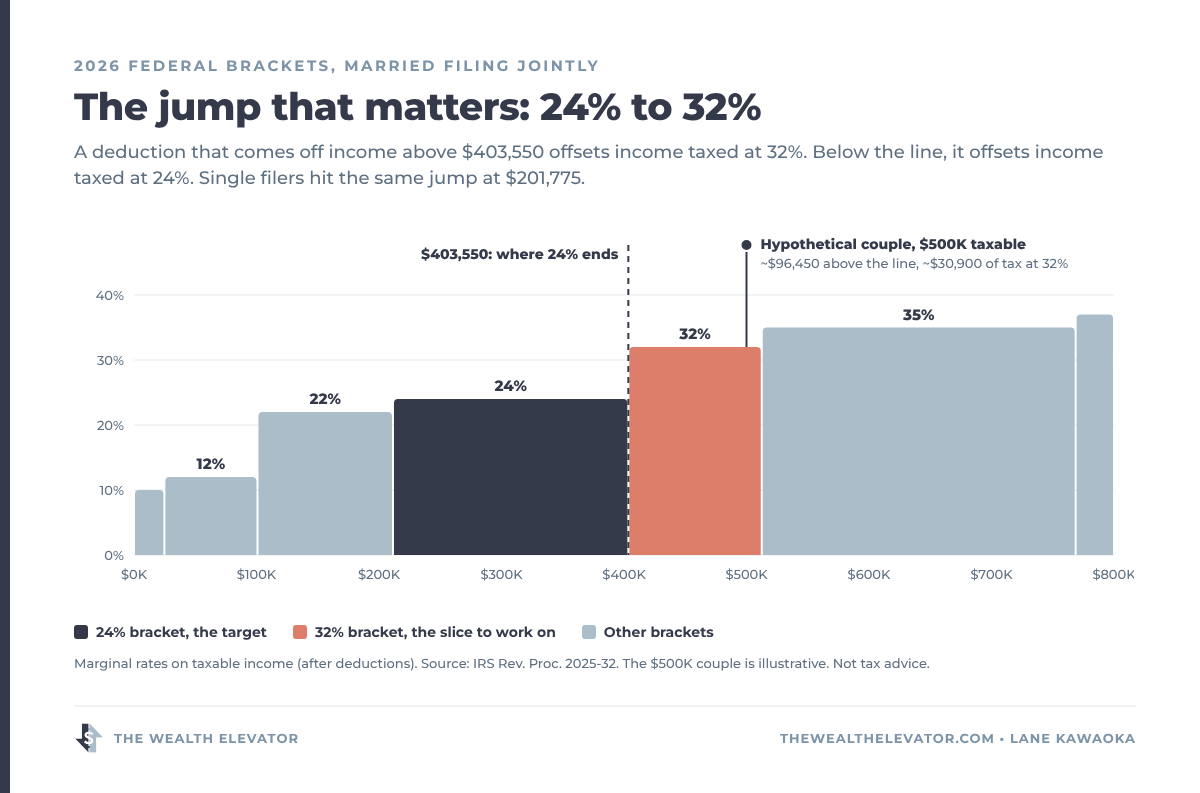
Take a hypothetical married couple with $500,000 of taxable income. About $96,450 of it sits above $403,550, and at 32% that slice carries roughly $30,900 of federal tax. A deduction that comes off income in that band offsets income taxed at 32%. Under the line, it offsets income taxed at 24%. That is why I treat the line as a target. The thresholds rise with inflation most years and Congress can change them, so check the current numbers each fall.
A word on deferral. If the only idea your CPA has is to max out your 401(k), that’s basic. Deferral is fine, but you still pay the tax later. Many investors reading this already own income-producing assets and could be in the same or a higher bracket in retirement, so pushing tax into the future isn’t automatically a win for them. Run it for your own situation.
Income smoothing
The concept I keep coming back to is income smoothing: evening out your income across years so you avoid the spikes and use the dips.
Dips happen when someone gets laid off, takes a sabbatical or steps back to be home with young kids. If a $500,000 household drops to $200,000 because one spouse takes half the year off, that year has room under the 24% line. It may be the year to consider pulling money out of a 401(k) or other retirement plan at a lower rate.
Spikes are one-time events: selling a business, a big stock gain, cashing out pre-IPO shares. If you control the timing, splitting a gain across two tax years, or moving a closing from December to January, can keep more of it out of the top brackets.
The big movers, and where each one breaks
Here is the comparison I use. The rest of this section goes through each one.
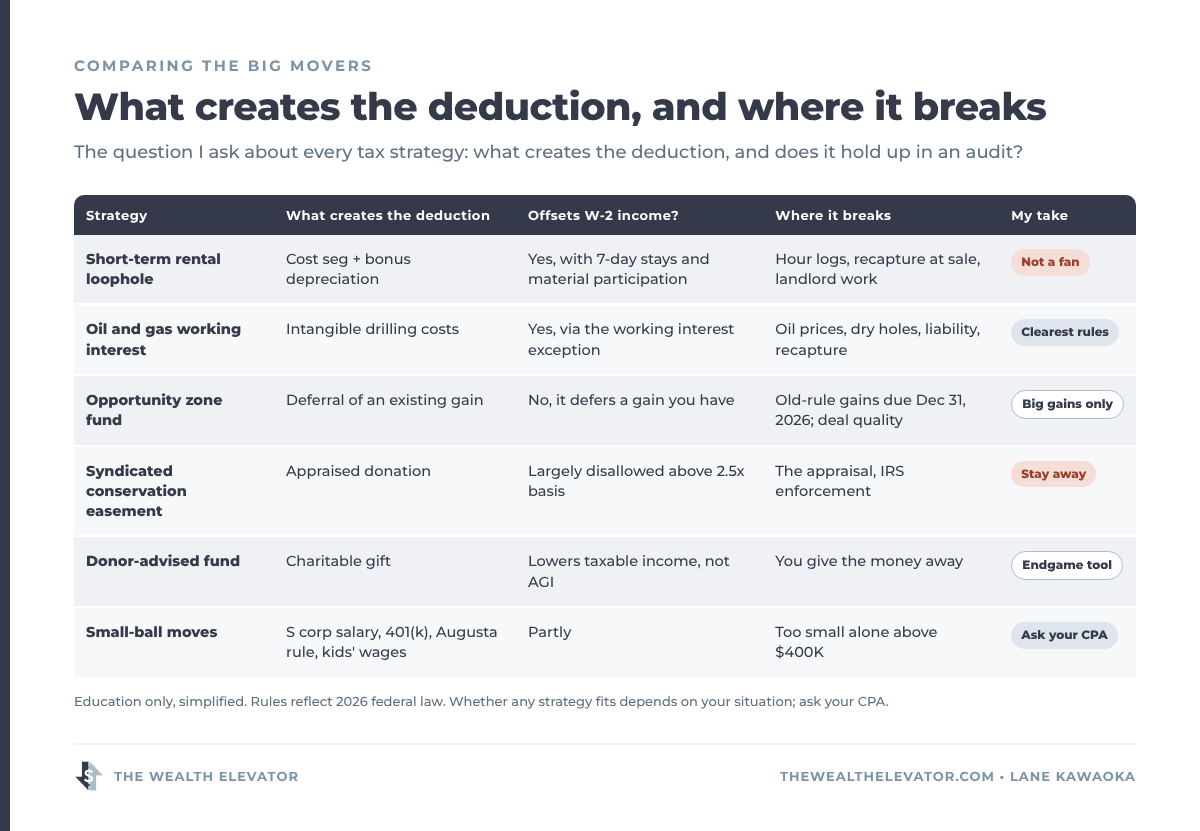
| Strategy | What creates the deduction | Can it offset W-2 income? | Where it breaks |
|---|---|---|---|
| Short-term rental loophole | Cost segregation plus bonus depreciation | Yes, if average stays are 7 days or less and you materially participate | Hour logs, recapture at sale, landlord work and liability |
| Oil and gas working interest | Intangible drilling costs, deductible in year one under the tax code | Yes, through the working interest exception | Oil prices, dry holes, liability, recapture at sale |
| Opportunity zone fund | Deferral of an existing capital gain | No. It defers a gain you already have | Old-rule gains all come due Dec 31, 2026; project quality |
| Syndicated conservation easement | An appraised donation | Deduction is largely disallowed above 2.5 times basis | The appraisal, and IRS enforcement |
| Donor-advised fund | A charitable gift | Lowers taxable income as an itemized deduction, not AGI | The money is given away |
| Small-ball moves | Salary design, retirement deferrals, income shifting | Partly | Too small on their own above $400,000 |
The short-term rental loophole
This is the one I get asked about most, and I’m not a big fan. A rental where the average guest stay is seven days or less isn’t treated as a rental activity under the passive loss rules. If you also materially participate, which for most owners means more than 100 hours a year and at least as many hours as anyone else involved (your cleaner and your property manager included), or more than 500 hours, the losses become non-passive. Add a cost segregation study and 100% bonus depreciation, which applies to property acquired after January 19, 2025, and you can create a large first-year loss against W-2 income without real estate professional status.
It works on paper. A physician I talked with was in the top bracket, bought a short-term rental and took about $380,000 of bonus depreciation. At roughly 37 cents on the dollar, that was around $140,000 of federal tax she didn’t pay that year. The problems showed up later, and they tend to show up in three places.
The first is recapture. Depreciation is deferred, not forgiven. When you sell, the bonus depreciation taken on the short-life components comes back as ordinary income, and an installment sale won’t spread it out because recapture is recognized in the year of the sale. One entrepreneur in my EO circle bought two short-term rentals, did cost seg on both, and 14 months later decided his time belonged in his business. By his account the recapture tax bill was about $192,000.
The second is the hour log. I don’t own short-term rentals myself, but this one scared me when I looked into it. In one case the property manager logged 140 hours, more than the owner, and the treatment fell apart. In another, a corporate VP making $650,000 bought a short-term rental to bring his income down toward $300,000 and lost the treatment because he was two hours short of 100. You need a log you can hand an auditor, and there isn’t clean guidance on gray areas, like whether a manager who only runs your listing or turns over the sheets counts against you.
The third is that it is a job with legal liability attached. Once you’re over $1 million of net worth, owning property directly means slip-and-fall lawsuits aimed at your insurance limits, so carry umbrella coverage. Two or three years in, people tell me the tax savings were real and now they own properties they don’t want.
I wrote up the exit math in more detail in The Cons of the Short-Term Rental Loophole.
Someone on the call asked about a related move: buying a lake house, renting it short-term for a couple of years to take the depreciation, then keeping it for the kids. I’ve seen it done. My issue is that it looks like what it is, a house for personal use with a rental period attached. If it’s audited, or your life changes and you sell in five to seven years like most people do, the recapture is waiting. If you’re under $10 million of net worth, I’d also ask whether 10% or 20% of it belongs in one vacation house. Compare it with putting the same $1 million or $2 million in T-bills and paying for hotels wherever the family wants to go. If the real goal is bringing the family together, you can set money aside for that in your trust or in a letter of wishes.
Oil and gas: intangible drilling costs
Of everything on this list, this one has the clearest basis in the tax code, because Congress wrote the deduction in to encourage domestic drilling. Intangible drilling costs (IDCs) are the non-salvageable costs of drilling a well, such as labor, drilling mud, chemicals and site preparation. Under Section 263(c) they can generally be deducted in the year they’re paid instead of being capitalized. They’re often the majority of a well’s cost. One attendee put it at 60% to 70% for the projects he’s seen, and it varies by project.
What makes it work for a W-2 earner is the working interest exception. A working interest held directly, or through an entity that doesn’t limit your liability, isn’t treated as passive, even if you never set foot on the lease. So the IDC deduction can offset ordinary income. That’s why a lot of doctors who will never qualify as real estate professionals go this route, and why some investors size the investment to land their AGI where they want it.
After year one, you have depreciation on the tangible equipment and the depletion allowance. For independent producers and royalty owners, percentage depletion is generally 15% of the gross income from the property, limited to the property’s net income and to 65% of your overall taxable income. It shelters part of the income each year. It isn’t a blanket rule that the first 15% of your return is tax-free.
The trade-offs: oil prices and operator quality drive the results, a well can come up dry, the liability that comes with a working interest is real, and IDCs can be recaptured as ordinary income when you sell the interest. Production is front-loaded, the reverse of real estate, where the early checks are small and the payday comes at the sale. So your year-one income from the well can exceed the depletion shelter and then taper. Use the right words with your CPA, too. An IDC is a deduction, not a credit. More detail is in Passive Oil and Gas Investing: 11 Tax and Cash Flow Checks.
Opportunity zone funds
An opportunity zone fund lets you defer an existing capital gain by reinvesting it within 180 days, and if you hold the fund for 10 years, its own appreciation can come out tax-free. Timing matters a lot right now. Under the original program, every deferred gain comes due on December 31, 2026, so putting a gain in this year buys almost no deferral. The permanent version passed in 2025 applies to investments made after December 31, 2026, with a rolling five-year deferral and a 10% basis step-up (30% in rural zones). A gain realized late in 2026 may still be investable in early 2027 inside the 180-day window. Ask your CPA which set of rules your gain falls under.
My view hasn’t changed much. Unless the gain is in the half-million to million-dollar range, the complexity usually isn’t worth it, and many projects sit in weaker areas, which is exactly why the incentive exists. Underwrite the deal as if there were no tax break.
Conservation easements and other appraisal-based donations
I bring these up only so you recognize the pitch. A conservation easement permanently restricts development on land, and the owner donates that restriction for a deduction based on an appraisal. Syndicated versions were sold at deductions of four or five times the investment, sometimes far more, because the appraisal set the number. SECURE 2.0, passed in December 2022, disallows deductions from syndicated easements above 2.5 times an investor’s basis, and the IRS treats these deals as listed transactions. Some promoters still pitch them. I’d stay away.
I use the same filter on art donation programs and on land easements bolted onto solar projects. Ask what creates the deduction. If the answer is an appraisal of something with no real market price, that’s where an auditor will push, sometimes three years later.
Donor-advised funds
A donor-advised fund is cleaner because nobody is playing games with the value. You contribute cash or appreciated stock, take the deduction that year, and recommend grants to charities over time. Three details: it’s an itemized deduction, so it lowers taxable income rather than AGI; starting in 2026, only charitable gifts above 0.5% of AGI count for itemizers; and if you’re in the 37% bracket, itemized deductions are worth at most 35 cents per dollar. I see a DAF as an endgame tool for when giving money away no longer slows your climb. It does let you choose where the money goes.
Small-ball strategies
These are worth asking your CPA about, but on their own they won’t move a $500,000 household very far:
- An S corporation paying a reasonable salary, with the rest taken as distributions that aren’t subject to payroll tax
- The Augusta rule, renting your home to your business for up to 14 days of legitimate meetings
- 401(k) deferrals of up to $24,500 in 2026, with up to $72,000 total including employer contributions
- Paying your kids reasonable wages for real work, which shifts income to a lower bracket
One-off credits, such as historic rehabilitation credits, usually need a large check into a single project. I don’t like putting more than 5% to 10% of net worth into any one thing, so most of those are out of reach until you’re well into eight figures.
My filter: what creates the deduction?
Every strategy above runs through one of a few channels: depreciation, a deduction written into the code, deferral of a gain, or a donation. When I evaluate one, I ask what creates the deduction and how it holds up in an audit. IDCs are close to black and white. The short-term rental loophole hangs on an hour log. Easements hang on an appraisal. I also try to follow the spirit of the law. When a structure exists mainly to get around the purpose of a rule, I put a red flag on it.
The rules also change. Easements were popular until Congress shut them down. If a method that holds up can lower your AGI this year, I’d use it, but titrate in. I watched people put half a million dollars into easements in a single year and get audited three years later.
Don’t overcorrect
Once people learn they can steer their AGI, some swing too far. I hear things like, “I don’t want that 10% private lending return because it’s ordinary income.” You’ll pay tax on it, sure, but where else are you getting that return for the risk? Leaving money idle to avoid tax doesn’t make sense to me.
Use AI to get up to speed, then let your CPA do the work
Last year I gave my whole return, 800 or 900 pages with the K-1s, to ChatGPT and asked it to show me my suspended passive losses, what’s carrying forward, and what each one could offset if I had a large business gain the next year. It explained which losses can offset which income. I still don’t follow all of it, but I can talk to my CPA in the right terms, and he knows I’ll hold him to it. I leave the final call to him. Think about which tool you trust with a full tax return before you upload one.
When to talk to your CPA
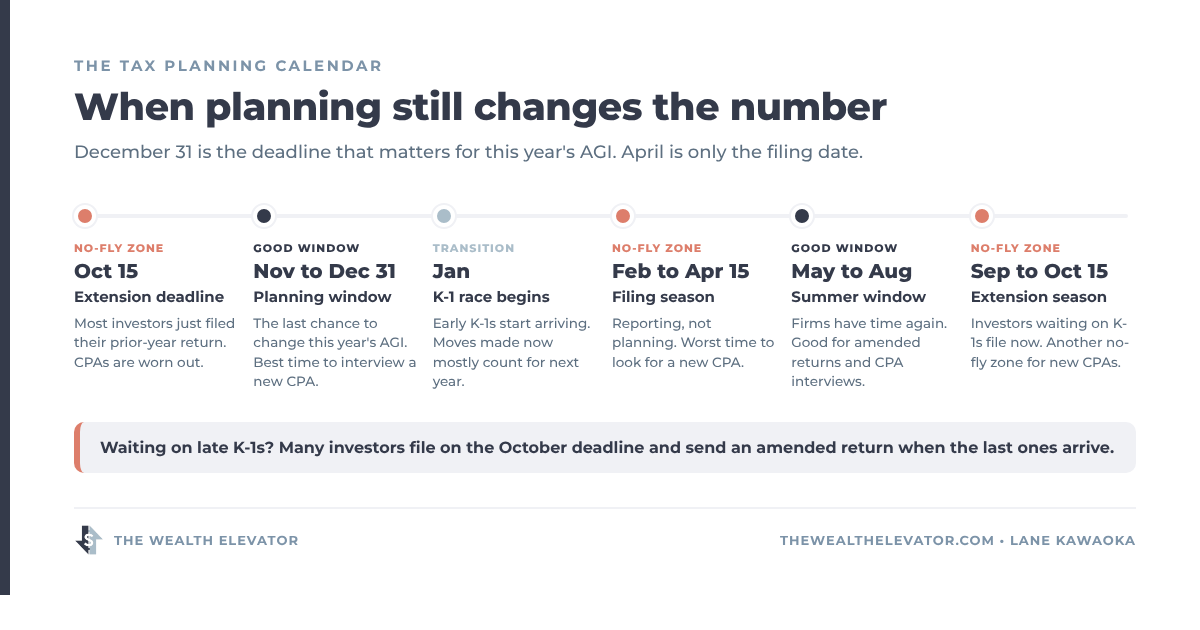
Planning happens between now and December 31. In April you’re reporting, not planning. The worst times to interview a new CPA are February through April and September through mid-October, when firms are buried in returns and extensions. November, December and the summer are the open windows. January starts the race for early K-1s.
I wait on about 80 K-1s, so I file on the October deadline and I’m usually still missing one or two. Then I file an amended return later in the fall or the next summer.
Many investors switch CPAs because theirs doesn’t know these strategies. Good firms also get bought by private equity and the service slips. I look for younger, hungrier firms that are open to this kind of planning, and I’d rather you have choices than one name. Our referral list for CPAs, cost segregation firms and attorneys is at thewealthelevator.com/vendor.
Frequently asked questions
What is the 24% tax bracket limit for 2026?
The 24% bracket runs up to $403,550 of taxable income for married couples filing jointly and $201,775 for single filers. Income above those lines is taxed at 32%, which is the largest jump most high earners face.
Can real estate losses offset my W-2 income?
Usually not. Passive losses from rentals and syndications offset passive income only, unless you qualify as a real estate professional or materially participate in a short-term rental with average stays of seven days or less. Unused losses carry forward on Form 8582.
Does the short-term rental loophole still work in 2026?
The rules still allow it when average guest stays are seven days or less and you materially participate, usually more than 100 hours and at least as much as anyone else, or more than 500 hours. The depreciation is recaptured when you sell, and an installment sale doesn’t spread that recapture out.
How can oil and gas investments lower taxable income?
Intangible drilling costs can generally be deducted in the year paid under Section 263(c). If you hold a working interest that doesn’t limit your liability, it isn’t treated as passive, so the deduction can offset ordinary income. Eligibility depends on how the interest is owned, and the investment carries oil price, drilling and liability risk.
When is the best time to find a new CPA?
November and December, and the summer months. February through April and September through mid-October are when firms are busiest with returns and extensions.
If you want to be around other investors who plan this way, come join our community at theWealthElevator.com/club.
This is educational content, not tax, legal, or investment advice. We are not attorneys, CPAs, or financial planners. Examples are illustrative or are stories investors shared, tax figures are for 2026 and change, and whether any strategy fits depends on your full situation. Talk to your own tax professional before acting. Please let us know if you need a referral to a CPA, lawyer or other vendor here: thewealthelevator.com/vendor.
Related reading
- The cons of the short-term rental loophole: the recapture bill at exit
- Passive oil and gas investing: 11 tax and cash flow checks
- How cost segregation works
- Advanced tax strategies for high net worth investors
- What a letter of wishes adds to your trust
Sources
- IRS, Rev. Proc. 2025-32 (2026 tax brackets)
- IRS, Publication 925, Passive Activity and At-Risk Rules (material participation tests, real estate professional status)
- Journal of Accountancy, Short-term rentals classified as passive activity losses (seven-day rule and a case where the manager out-logged the owners)
- BDO, One Big Beautiful Bill Act expands 100% depreciation expensing
- NATP, Installment sale reporting pitfalls (Section 453(i) recapture in the year of sale)
- Cornell LII, 26 U.S.C. 263(c), 26 U.S.C. 469 and 26 U.S.C. 613A
- EY Tax News, IRS announces transitional guidance on opportunity zones (Notice 2026-40)
- The Tax Adviser, Final regs issued on conservation easement deduction disallowance
- CASE, FAQ: charitable giving provisions in the OBBBA
- IFEBP, IRS releases 401(k) limits for 2026 (Notice 2025-67)