
Run Your Retirement Like a Family Office
Short answer: You don’t need a family office to retire well, but you can borrow its habits. Write down what the money is for, map every income source and when it starts, turn it into one monthly paycheck with a cash cushion, put taxes on a year-by-year calendar, and keep a binder your spouse could run alone.
The paycheck stopped and the pitches started
A retiree with $3 million to $7 million will never need a family office, but the way family offices organize money fits retirement better than almost any other stage of life.
Meet Dave. He is 63 and just retired after 31 years as an engineer at a large utility. Between his 401(k), a pension he has to choose a payout option for, a taxable brokerage account and a paid-off house, the household is worth about $5 million. His wife, Linda, retired from teaching two years ago.
For three decades a payroll department handled Dave’s paycheck, withholding, health insurance and retirement match. That machine shut off on his last day. Now he has a rollover decision, a pension election, a Medicare enrollment window coming, and a Social Security claiming choice that can’t be fully undone. His mailbox also has three dinner seminar invites and an annuity brochure.
Dave is no longer saving for retirement. He is running it, and that is a job. The wealthiest families hand that job to a family office. This guide covers the parts of that model worth borrowing when your goal is a dependable income for 30 years rather than growing a fortune.
Why family office thinking fits a retiree
A family office exists so one family has a single team seeing its whole financial picture, with no conflicts of interest. A retiree needs exactly that, because the decisions in the first ten years of retirement interact with each other more than at any other time.
The job is different from a founder’s family office playbook after an exit. A business owner who just sold is usually thinking about what to do with a pile of cash. Dave’s question is how to turn a pile of accounts into a paycheck that lasts as long as he and Linda do. That shifts the priorities:
| Founder after an exit | Corporate retiree | |
|---|---|---|
| Main question | Where should this capital go? | How do we replace the paycheck for 30 years? |
| Biggest risk | Bad deals, concentration, moving too fast | Running short late in life, bad timing early on, taxes |
| Key decisions | Allocation, structure, deal vetting | Social Security timing, pension election, withdrawal order, Medicare, Roth conversions |
| Who it serves | Often several generations | Mostly the couple, then the survivor |
The family office habits still apply: one person who sees everything, written rules, careful vetting, and honest reporting. They just point at income, taxes and continuity instead of growth.
The ages that shape the next 15 years
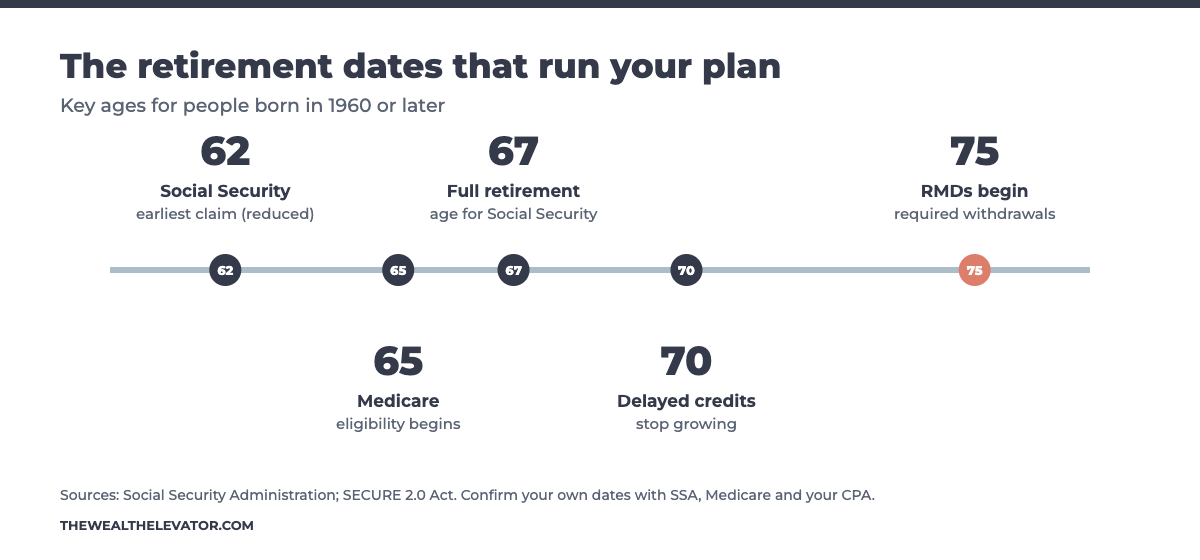
The years between retiring and the first required distribution are often the lowest-income years a retiree will see, which is why many families use them for Roth conversions and other tax planning with their CPA. Social Security grows by roughly 8% a year for each year you wait past full retirement age, up to 70, but waiting only pays if the rest of the plan can carry the gap. Sources: Social Security full retirement age by birth year, SECURE 2.0 required distribution ages.
Building your own paycheck
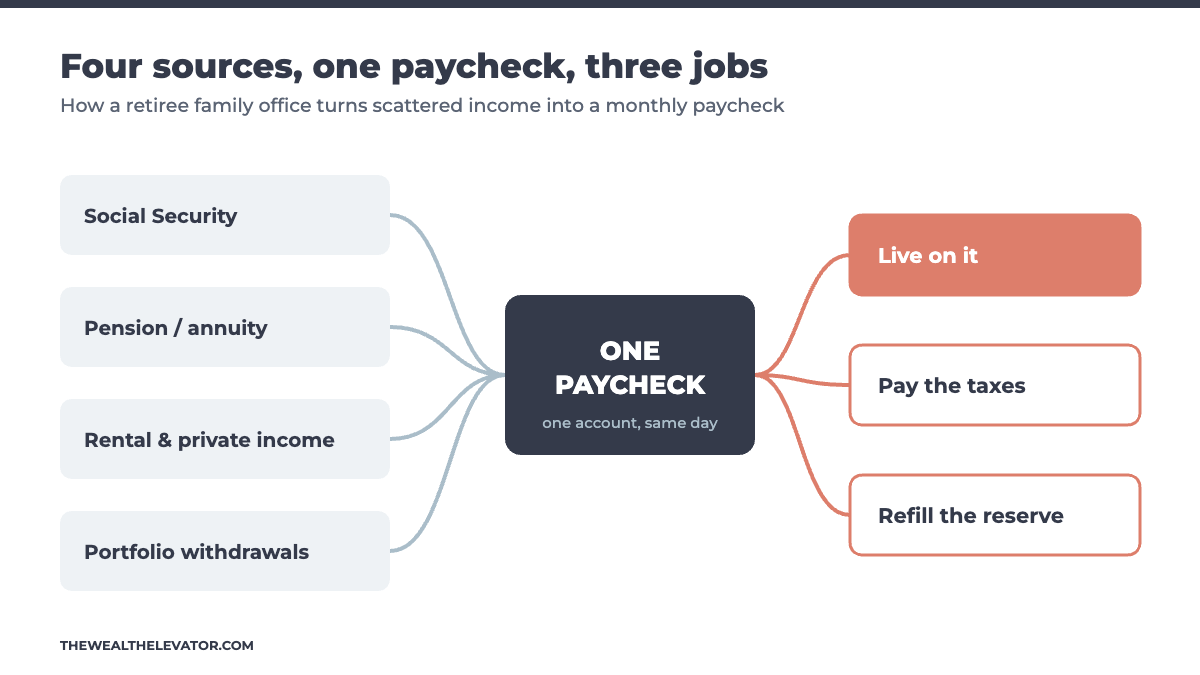
Family offices run every inflow and outflow through a single view. For a retiree, that means each source lands in one account that pays the household a set amount each month, so spending decisions are made once rather than every time a bill shows up. The cash cushion is used mainly in down markets, so investments are not sold at low prices to cover bills.
The building blocks, retiree edition
A family office starts with planning documents before it touches a dollar. Dave and Linda can build the retiree version in a few sessions at the kitchen table, then review it with a CPA and an estate attorney.
- Purpose. Two or three sentences on what the money is for. “Keep our current lifestyle, travel for the first ten years, help with grandkids’ college, and never be a burden on the kids” gives every later decision something to be checked against.
- The spending number. Family offices budget, and so should retirees. Separate the essentials (housing, food, insurance, taxes, health care) from the flexible spending (travel, gifts, hobbies). The essentials are what the reliable income needs to cover.
- The income map. List every source and when it starts: pension, Social Security for each spouse, required distributions, dividends, any rental income. The flow above shows how these come together.
- The tax calendar. Retirement taxes are decided year by year: which account to draw from, whether to do Roth conversions in the lower-income years before Social Security and required distributions start, and how to stay clear of Medicare premium surcharges tied to income. Your CPA should see this calendar every year, and our year-end tax planning guide for high earners covers the moves to discuss.
- Estate and incapacity documents. Wills or a revocable trust, durable powers of attorney, health care directives, and beneficiary designations that match the plan. For a couple in their 60s, incapacity planning matters as much as what happens after death.
- A one-binder household manual. Every account, policy, password-manager instruction, and advisor phone number in one place, kept current. This is the retiree’s version of a family office contingency plan, and it is the piece most households skip.
None of this needs staff. It needs one afternoon a quarter and someone who owns the process.
Who is on the team
A big family office fills each seat below with an employee. At Dave’s size, each seat is a person or firm you hire for the job, plus one spouse who owns the overall process.
| Seat | What the job is | At Dave’s size |
|---|---|---|
| Quarterback | Sees the whole picture, runs the quarterly review, keeps the binder current | Dave or Linda, or one advisor paid a flat or hourly fee |
| Income and investments | Withdrawal plan, allocation, rebalancing, vetting anything new | A fee-only advisor, or Dave with a second opinion before any big move |
| Tax | Annual returns, withdrawal order, Roth conversions, Medicare surcharge watch | A CPA who works with retirees, engaged before year-end, not just in April |
| Legal | Trust, powers of attorney, health directives, beneficiary review | An estate attorney, with a review every three to five years |
| Insurance | Health and Medicare, long-term care, umbrella, home and auto | An independent broker plus a Medicare specialist |
| Bookkeeping | Bill pay, records, the household binder | Usually a spouse, sometimes a part-time bookkeeper |
The one family office rule that matters most here: know how each person on the team gets paid. A commission on a product is a different incentive than a flat fee for advice, and retirees get more product pitches than almost anyone.
Continuity: what if the household CFO is gone?
The biggest governance problem in a big family office is the founder who knows everything and wrote nothing down. In a retired couple, that founder is whichever spouse handles the money.
In Dave and Linda’s house, Dave does it all. He knows which account the pension lands in, when the estimated taxes are due, which advisor gets paid how, and where the passwords live. If he has a stroke at 74, Linda inherits a puzzle at the worst possible moment, and every salesperson in town will be happy to help her solve it.
Family offices handle this with written roles and a successor who has been trained. The retiree version:
- The other spouse sits in on every quarterly review and every advisor meeting, even just to listen.
- The household binder is written for the person who did not build it. A good test: could Linda pay every bill for three months using only the binder?
- Durable powers of attorney are signed and the institutions have accepted them, before they are needed. Some banks and brokers want their own forms.
- A trusted contact is listed on each investment account, so the firm has someone to call if something looks wrong.
- Adult children know who the attorney, CPA and advisor are, even if they never see the balances. A short family meeting every year or two, with a simple agenda, covers it.
Cognitive decline deserves a direct word. Financial judgment often slips before anyone notices, and it tends to show up first in the money. Agreeing now, while everyone is sharp, on a second signature for large or unusual moves is a quiet form of protection.
The risks aimed at retirees
Family offices earn their keep by catching risk early, and retirees face a specific set of it.
- Bad timing early on. A deep market drop in the first few years of withdrawals hurts far more than the same drop at 85, because you are selling shares while prices are low. Many retirees keep a few years of planned withdrawals in cash or short-term bonds so they are not forced sellers. Talk through the size of that cushion with your advisor.
- Inflation over a long horizon. A couple retiring in their early 60s may need income for 30 years or more. Income that does not adjust for inflation buys less every year, which matters when choosing a pension option or a fixed product.
- Products sold, not chosen. Retirees with a fresh rollover are a prime target for complex products that carry high commissions and long surrender periods. Some of these products fit some people. Before signing anything, get the total annual cost, the surrender schedule and the seller’s commission in writing, and have someone who is not paid on the sale read it.
- Scams and fraud. Impersonation calls, fake bank alerts and “urgent” requests from a grandchild target retirees heavily. A family rule helps: nobody moves money because of an unexpected call or text, ever, without hanging up and calling a known number.
- The insider problem. Family offices background-check anyone who touches the money. For retirees, that means caregivers, new “friends” and anyone asking to be added to an account.
Reporting is the other half. Big offices consolidate every account into one view. A one-page quarterly summary of balances, income received, withdrawals and taxes paid does the same job for Dave, and it is the page Linda would need first if she ever took over.
Common mistakes, and when this does not fit
Most retirement mistakes come from making one-time decisions in isolation, without seeing how they affect each other.
| Mistake | What it looks like | The family office way |
|---|---|---|
| Deciding Social Security alone | Claiming early because a neighbor did, without looking at the survivor benefit | Model it with the pension, taxes and the spouse’s benefit together |
| Picking a pension option fast | Choosing the biggest single-life payout and leaving the spouse exposed | Compare the survivor options against life insurance and other income |
| Rolling over to whoever calls first | The rollover lands in a product chosen by the seller | Write the income plan first, then decide where the money goes |
| Ignoring the tax years before distributions start | Low-income years go by with no conversions or bracket planning | Map taxes year by year with the CPA before Social Security and RMDs begin |
| One spouse knows everything | No binder, no trained successor | Both spouses in every review, binder written for the other one |
| No cash cushion | Selling investments in a down market to cover bills | Hold a planned buffer for near-term spending |
This level of structure may be more than you need if your income is simple (a pension and Social Security that cover the essentials), your accounts are few, and a trusted advisor already coordinates your tax and estate work.
Frequently asked questions
Do I need a family office to manage my retirement?
No. A retiree with $3 million to $7 million will never need a family office, but the way family offices organize money fits retirement well: one person who sees everything, written rules, careful vetting and honest reporting, pointed at income, taxes and continuity.
What are the key ages in a retirement plan?
For people born in 1960 or later: Social Security can start at 62 (reduced), Medicare eligibility begins at 65, full retirement age is 67, delayed retirement credits stop at 70, and required minimum distributions begin at 75. Confirm your own dates with SSA, Medicare and your CPA.
Why do the years before required distributions matter for taxes?
The years between retiring and the first required distribution are often the lowest-income years a retiree will see, which is why many families use them for Roth conversions and other tax planning with their CPA.
How do I protect my spouse if the person who manages the money can’t?
Have the other spouse sit in on every quarterly review, keep a household binder written for the person who did not build it, sign durable powers of attorney before they are needed, and list a trusted contact on each investment account.
The takeaway for Dave
Retirement is the first time in 30 years that nobody else is running payroll for you. The families who handle wealth best treat that as a job with a purpose, a plan, a small team, written rules and a successor, and none of that requires a family office budget. For Dave and Linda it comes down to a written income map, a tax calendar, a binder Linda could run alone, and the habit of asking how everyone gets paid.
This is the second piece in our family office series. The first covered the family office playbook after an exit, and the third covers the high earner’s tax problem, family office style for a two-physician household.
If you are working through this transition, you do not have to do it alone. Our community is where accredited investors compare notes with peers who have already been through it. Join The Wealth Elevator community here.
This is educational content, not tax, legal, or investment advice. We are not attorneys, CPAs, or financial planners. Social Security, Medicare and required distribution rules change, so confirm your own dates with the agencies and your CPA. Please let us know if you need a referral to a CPA, lawyer, or other vendor here: The Wealth Elevator vendor list.