
The High-Earner’s Tax Problem, Family Office Style
Short answer: Most tax strategies high earners hear about create passive losses, which generally cannot offset a W-2 salary. A working interest in oil and gas, held without a liability shield, is the main exception, but loss caps, the alternative minimum tax, risk and fees all apply. Insurance, retirement accounts and estate documents come first.
Two great incomes, one giant tax bill
For a young high-income family, the biggest line item in the budget is usually taxes, and that makes tax planning the main job of their family office.
Meet Lou. He is 44, an anesthesiologist, and his wife Priya is a dermatologist. Between two W-2 salaries and her share of a practice, the household earns well over $600,000 a year. They have two kids, 9 and 12, a mortgage, two retirement plans that hit their contribution limits by spring, and a CPA who prepares the return every April and mostly reports bad news.
Lou and Priya are not looking for a business exit or a retirement income plan. They have a different problem. They earn a lot, they will keep earning a lot for another 15 to 20 years, and a big share of every extra dollar goes to federal and state income tax before it can be saved. They do not have the time to manage it, because both of them work long clinical weeks.
This is the third piece in our family office series. The first covered an entrepreneur after an exit, and the second covered a corporate retiree. This one is about the household whose wealth is still being built from a paycheck, and how a family office mindset, including a careful look at oil and gas drilling deductions, applies to them.
Why taxes are the family office’s main job here
A family office looks at the whole balance sheet and asks where the biggest leak is. For Lou and Priya it is not investment returns. It is the slice of income that goes to taxes every year, which is larger than their mortgage, their kids’ school costs and their savings combined.
The three households in this series have very different main jobs:
| Founder after an exit | Corporate retiree | High-income professional couple | |
|---|---|---|---|
| Main question | Where should this capital go? | How do we replace the paycheck? | How do we keep more of what we earn? |
| Biggest leak | Bad deals, moving too fast | Running short, bad timing, taxes | Ordinary income tax on W-2 wages |
| Time available | Plenty | Plenty | Very little |
| Planning horizon | Generations | 30 years | Next 15 to 20 earning years |
The key point for Lou is that W-2 income is the hardest income to shelter. Most popular tax strategies people hear about at a dinner party produce passive losses, which do nothing for a salary. The next section shows why.
Why most tax losses can’t touch a salary
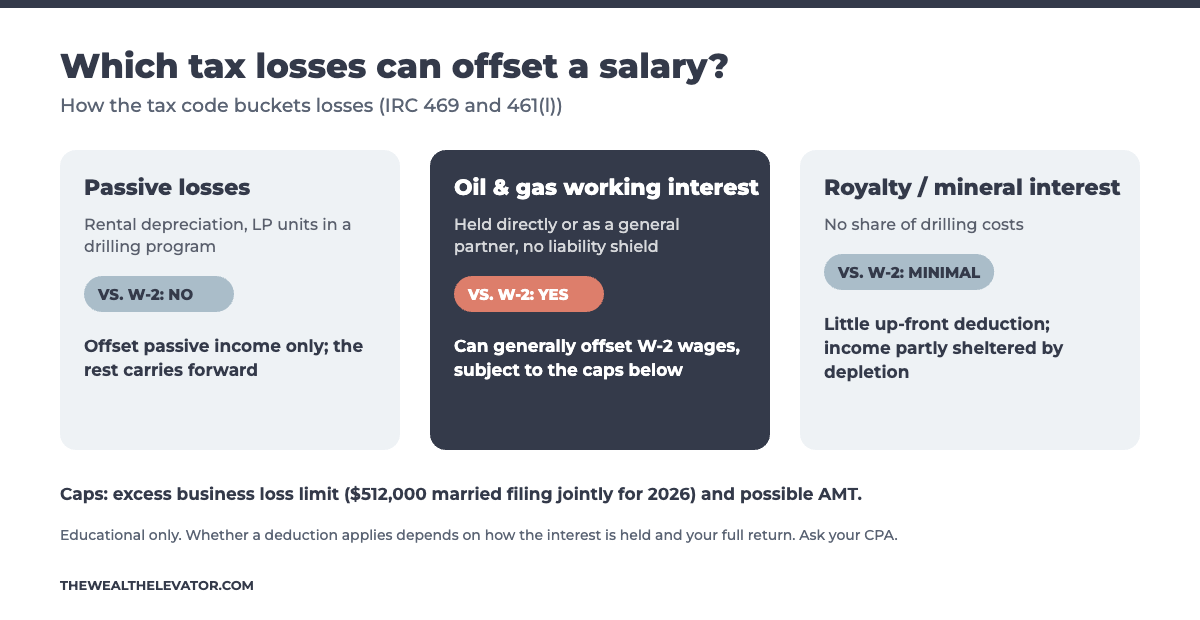
The tax code sorts income into buckets. Passive losses, such as depreciation from rental real estate or a limited partner unit, generally offset only passive income and otherwise carry forward. A working interest in oil or gas held without a liability shield is the main exception, which is why it shows up in so many tax conversations among physicians.
How oil and gas drilling deductions work
Oil and gas drilling is one of the few places in the tax code where an investment can create a deduction that may offset W-2 income, but only when the interest is held in the right structure. Here are the moving parts, in plain English.
- Intangible drilling costs (IDCs). These are the costs of drilling that leave nothing to salvage: labor, site preparation, drilling fluids, fuel. They are often cited as 60% to 80% of the cost of drilling a well. Under IRC Section 263(c), the owner of a working interest can elect to deduct them in the year they are paid instead of spreading them out.
- Tangible drilling costs. The equipment that stays (casing, wellhead, pumps) is depreciated. Since the 2025 tax law made 100% bonus depreciation permanent for qualifying property acquired after January 19, 2025, much of that equipment may also be deductible up front.
- Depletion. Once a well produces, a portion of the income is sheltered by a depletion allowance. Smaller independent producers and royalty owners can often use percentage depletion, commonly 15% of gross income from the property, subject to limits.
- The working interest exception. This is the piece that matters most for a W-2 earner. Normally, investment losses are passive and can only offset passive income. IRC Section 469(c)(3) says a working interest in oil or gas is not passive if you hold it directly or through an entity that does not limit your liability. Losses from that kind of interest can generally offset wages. A limited partnership unit does not qualify, so its losses stay passive.
Two caps sit on top. First, the excess business loss limit (Section 461(l)) caps how much net business loss can offset non-business income in a year. For 2026 that cap is $512,000 for married couples filing jointly, and anything above it carries forward. Second, a large IDC deduction can create alternative minimum tax exposure for some taxpayers, which can take back part of the benefit.
Whether any of this applies to you depends on how the interest is held, your bracket, your state, and the rest of your return. Run the numbers with your CPA before investing, not after.
Structure decides the tax result
The same well can produce very different tax results depending on how you own your piece of it. This is the question to settle first.
| How you own it | Pays drilling costs? | Losses vs. W-2 income | Liability | Typical fit |
|---|---|---|---|---|
| Working interest, held directly or as a general partner | Yes | Generally can offset wages under the working interest exception, subject to the caps above | Not limited; you can be on the hook beyond your investment | High earners focused on current-year deductions who accept the risk |
| Limited partner unit in a drilling program | Yes, indirectly | Passive; offsets only passive income | Limited to your investment | Investors who already have passive income to shelter |
| Royalty or mineral interest | No | Little up-front deduction; income is sheltered in part by depletion | Limited | Investors who want income, not a deduction |
Some drilling programs let investors start as general partners for the drilling year and convert to limited partners afterward, and many carry insurance for the general partner exposure. Ask the sponsor how both work, and have your attorney read the documents.
What it looks like over time
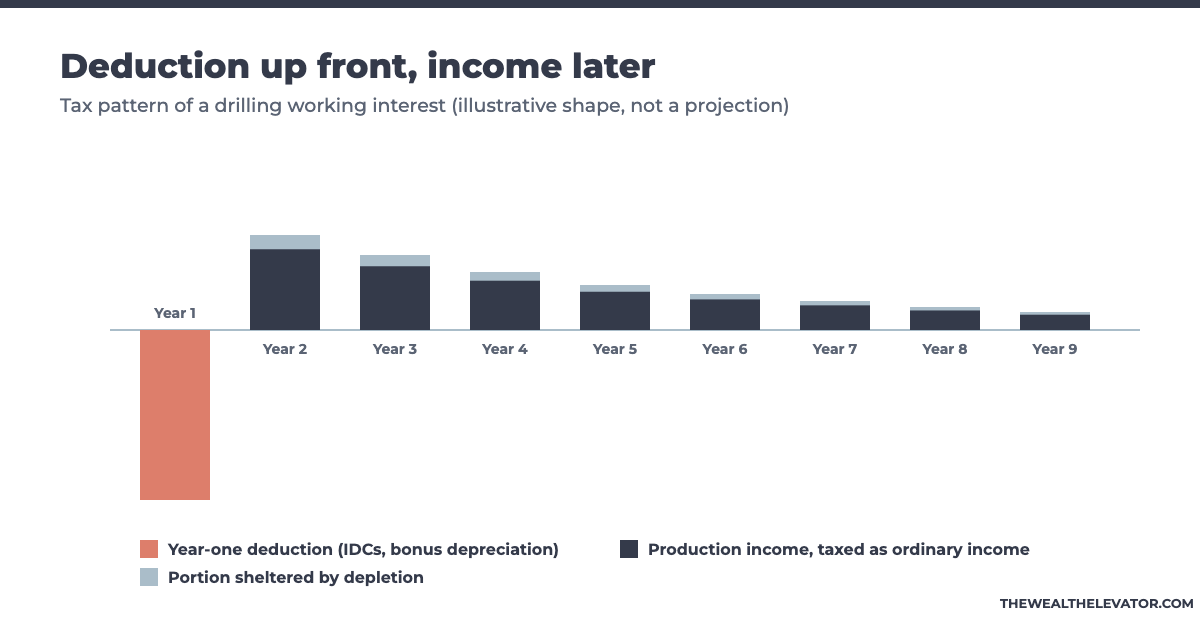
The deduction is front-loaded and the income arrives later, when it is taxed as ordinary income with part of it sheltered by depletion. That shape is why the decision should be judged on the well’s economics over its life, not on the first-year tax savings.
The risks and limits nobody puts on the first slide
A deduction is not a return. If the investment loses money, a tax break only softens the loss. A family office would vet the investment first and treat the tax benefit as a bonus.
- Dry holes and declining wells. Some wells never produce. The ones that do usually produce the most in the first few years and then decline.
- Commodity prices. Income rises and falls with oil and gas prices, which can swing hard over short periods.
- Operator risk. The skill and honesty of the operator matter more than the geology pitch. Check track record, audited financials, and who holds the investor money.
- Liability. The working interest structure that unlocks the deduction is the same one that leaves you exposed beyond your investment. Understand the insurance and any conversion feature.
- Illiquidity. You usually cannot sell a working interest quickly or at a fair price.
- Timing rules. To deduct prepaid drilling costs in the year you invest, drilling generally has to start within 90 days after year-end. Late-December deals deserve extra scrutiny.
- Recapture. If you sell the interest later, deducted IDCs can be recaptured as ordinary income.
- The caps. The excess business loss limit and the alternative minimum tax can both reduce the first-year benefit.
- Fees. Programs carry sponsor fees and markups on drilling costs. Get them in writing and compare.
The rest of the family office checklist for Lou and Priya
Oil and gas is one tool, and it comes late in the list. A family office for a young high-income household would make sure the basics are done first, because they are cheaper, safer and often worth more.
- Purpose and a savings target. Two or three sentences on what the money is for (college, financial independence by a target age, a practice buy-in) and how much they want to save each year.
- Max the tax-advantaged accounts. Both 401(k) or 403(b) plans, any 457(b), a backdoor Roth if their CPA agrees it fits, HSAs if eligible, and 529 plans for the kids.
- Protect the income. For two physicians, the earning power is the biggest asset. Own-occupation disability insurance and enough term life insurance come before any alternative investment.
- Liability and asset protection. An umbrella policy, malpractice coverage reviewed, and property titled with an attorney’s input.
- Estate documents. Wills naming guardians for the kids, a revocable trust, powers of attorney and health care directives. Young parents skip this more than anyone.
- A tax calendar. A meeting with the CPA in September or October, not April, so year-end moves are planned instead of rushed. Track the excess business loss cap and AMT before committing to any large deduction.
- Then the alternatives. Once the basics are covered, look at strategies like oil and gas working interests, with structure, risk and fees vetted the way a family office would.
A quarterly one-page report (net worth, savings rate, taxes paid, what changed) keeps two busy people in charge without taking much of their time.
Common mistakes, and when this does not fit
The most expensive mistake is buying a tax deduction instead of an investment.
| Mistake | What it looks like | The family office way |
|---|---|---|
| Chasing the deduction in December | Signing a drilling deal in the last week of the year to cut this year’s bill | Vet the operator and terms first; the deduction is the bonus |
| Wrong structure | Buying a limited partner unit and expecting it to offset salary | Confirm working interest status with the CPA before funding |
| Ignoring the caps | Planning a deduction far above the excess business loss limit or into AMT | Model the full return with the CPA first |
| Skipping the basics | Alternatives before disability insurance, retirement accounts and wills | Protect income and fill tax-advantaged accounts first |
| Concentration | Putting a large share of savings into one well or one operator | Size it so a dry hole is a setback, not a crisis |
| April-only tax planning | Meeting the CPA only to file | A fall planning meeting every year |
This is likely not a fit if you are not in the higher federal brackets, you would lose sleep over unlimited liability or illiquid holdings, or you have not yet covered insurance, retirement accounts and estate documents.
Frequently asked questions
Can rental real estate depreciation offset my W-2 salary?
Generally not. Depreciation from rental real estate or a limited partner unit is a passive loss. Passive losses generally offset only passive income, and anything unused carries forward to future years.
Why can oil and gas drilling deductions offset wages?
The tax code has a working interest exception. A working interest in an oil or gas well held without a liability shield, such as directly or as a general partner, is not treated as passive, so its losses can generally offset wages, subject to the caps.
Is there a limit on how much I can deduct against my salary?
Yes. The excess business loss limit caps how much net business loss can offset non-business income in a year. For 2026 it is $512,000 for married couples filing jointly, and the excess carries forward. A large drilling deduction can also trigger alternative minimum tax.
What should a high-earning family do before looking at oil and gas?
Cover the basics first: disability and term life insurance, maxed retirement accounts, an umbrella policy, estate documents, and a fall meeting with the CPA so year-end moves are planned rather than rushed.
Related reading: passive oil and gas investing: tax and due diligence and year-end tax planning for high earners.
The takeaway for Lou and Priya
For a young high-income family, the family office’s job is to plug the tax leak without taking on risks the family does not understand. That starts with insurance, retirement accounts and a fall meeting with the CPA. Oil and gas working interests can be a powerful next step for W-2 earners because of how the tax code treats them, but only in the right structure, within the loss caps, and with an operator that has been vetted as carefully as any other investment.
If you are a high-income professional working through these questions, you do not have to figure it out alone. Our community is where accredited investors compare notes with peers who have already been through it. Join The Wealth Elevator community here.
This is educational content, not tax, legal, or investment advice. We are not attorneys, CPAs, or financial planners. Tax rules and limits change every year, and whether any deduction applies depends on how an interest is held and on your full return. Please let us know if you need a referral to a CPA, lawyer, or other vendor here: The Wealth Elevator vendor list.