
The Family Office Playbook After an Exit
Short answer: A full single family office rarely makes sense below about $100 million, because even a lean one costs $700,000 to $1.2 million a year. If you sold a business for $5 million to $15 million, copy the playbook instead: a written purpose, one person watching the whole balance sheet, real due diligence and one quarterly report.
Your exit just turned you into a business owner again
Most families with $5 million to $15 million do not need a full family office, but almost all of them need to run their money the way one does. That is the short version of this guide.
Picture Ron. He is 54, spent 22 years building a commercial HVAC company, and sold it last spring. After taxes he has about $11 million in cash and a brokerage account, plus his house, a 401(k) and a rental duplex he bought in his thirties.
Within a month of closing, his inbox filled up. The private bank that handled the sale wants to manage the whole relationship. His brother-in-law’s advisor wants a meeting. Two syndicators found him on LinkedIn. His CPA, who was great on the business returns, is now out of his depth on trusts and K-1s.
Ron is running a small business again whether he likes it or not, and that business is his family’s money. The wealthiest families in the country hit this problem more than a century ago and built a structure for it called the single family office. Below is how those offices work, what they cost, and which pieces are worth borrowing when you are at $11 million instead of $500 million.
What a family office actually is
A single family office (SFO) is a private company whose only client is one family. Its people handle the family’s investments, taxes, legal structures, insurance and often the personal logistics, and they answer to nobody else.
The idea is old. Wealthy households have always had a head steward who ran the estate. The modern version took shape in the late 1800s, when American industrial fortunes got big enough to need full-time staff.
In practice you will run into three versions:
- Single family office: one family with dedicated staff, often at $100M+ in investable assets. Full control and privacy, at the highest cost.
- Multi-family office: several unrelated families share one team. Lower cost, but you share attention and the firm has its own business to run.
- Virtual family office: one family with coordinated outside specialists, often at $5M to $50M. The cheapest and most flexible option, but someone has to quarterback it.
Plenty of wealth management firms call themselves a “family office” in their marketing. When you hear the phrase, ask two things: whose interests does this firm answer to, and exactly how does it get paid?
What it costs, and why size decides everything
A lean single family office with a small staff and decent reporting tools can easily run $700,000 to $1.2 million a year before legal, audit, insurance and rent. That fixed cost is the whole story for a family at Ron’s level.
The ranges below are rough illustrations of what small family offices have paid for each seat. Actual pay varies by city and has likely risen, so treat this as a sketch, not a quote.
- Chief executive or chief investment officer (runs the office, sets strategy, picks managers): $300,000 to $600,000
- CFO or controller (family tax returns, cash flow, reporting): $175,000 to $250,000
- Executive assistant (calendar, household, vendors): $75,000 to $135,000
- Bookkeeper (bills, payroll, receivables): $50,000 to $90,000
- Account aggregation and reporting software (one consolidated view of every account): $75,000 to $135,000
- Total, before legal, audit, insurance and office: about $675,000 to $1.2 million
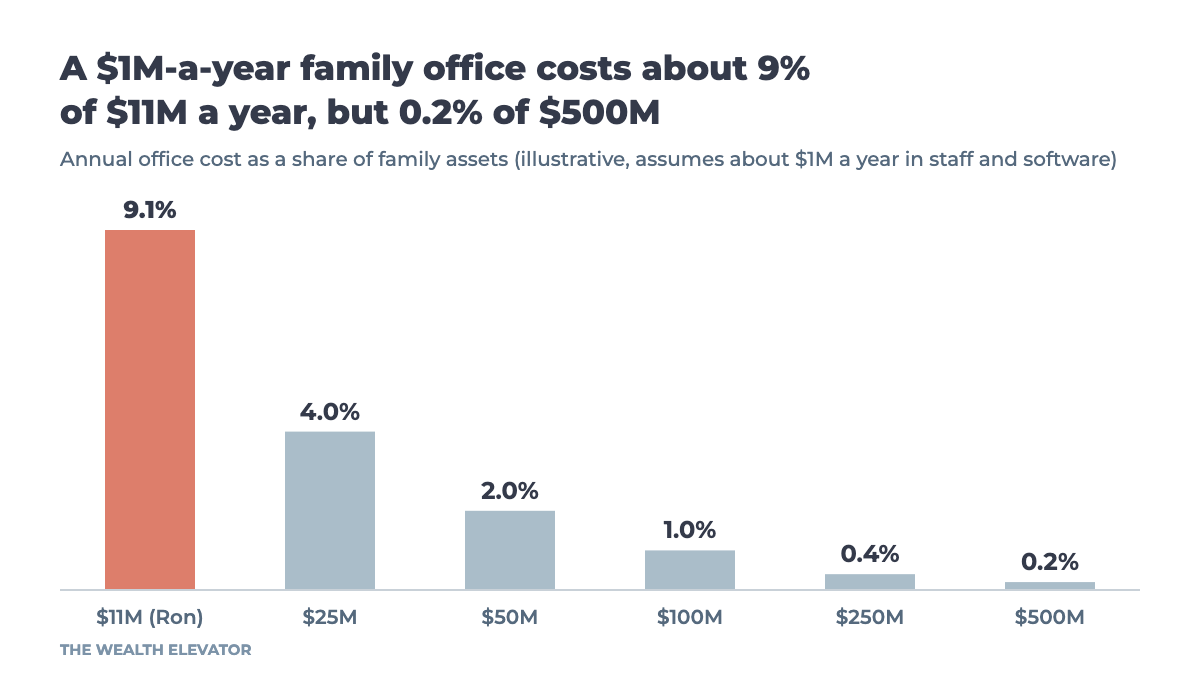
Run the math on a $1 million budget. For a $500 million family it is 0.2% of assets a year, cheaper than most advisory fees. For Ron at $11 million it is about 9% a year, which no portfolio can carry. The number that matters is not net worth but cost as a share of assets, and it falls off fast as wealth grows.
So Ron is not going to hire a CIO. What he can do is copy the playbook: the planning documents, the coordination, the due diligence habits and the reporting discipline, delivered by outside specialists he quarterbacks himself or hires one person to quarterback.
Why wealthy families build one in the first place
Families build their own office because the default setup, a handful of banks, brokers and advisors who never talk to each other, quietly costs them money and exposes them to risks nobody is watching.
The problems tend to look like this:
- Fragmented relationships. Three advisors each see a slice of the balance sheet, so nobody sees concentration risk, duplicate holdings or the tax drag of one account undoing another.
- Fees you cannot see. Layered fees on funds, wrap accounts and insurance products are often not fully disclosed, which makes them hard to compare or negotiate.
- Built-in conflicts. A salesperson may earn more for placing you in the firm’s own product than in the one that fits you best.
- No capacity to vet deals. When a fund manager or private deal shows up, most families have nobody on staff who knows what to check. The Madoff collapse is the extreme case, but plenty of ordinary bad deals get through the same gap.
The family office flips the incentive. The staff work for the family, are paid by the family, and get judged on whether the family’s goals are met. Ron can get most of that alignment without the overhead by paying for advice directly (hourly or flat fee) and by keeping one person responsible for seeing the whole picture.
The first 24 months, at a glance
The order matters more than the exact months: money goes to work only after the plan is written and the structure is in place.
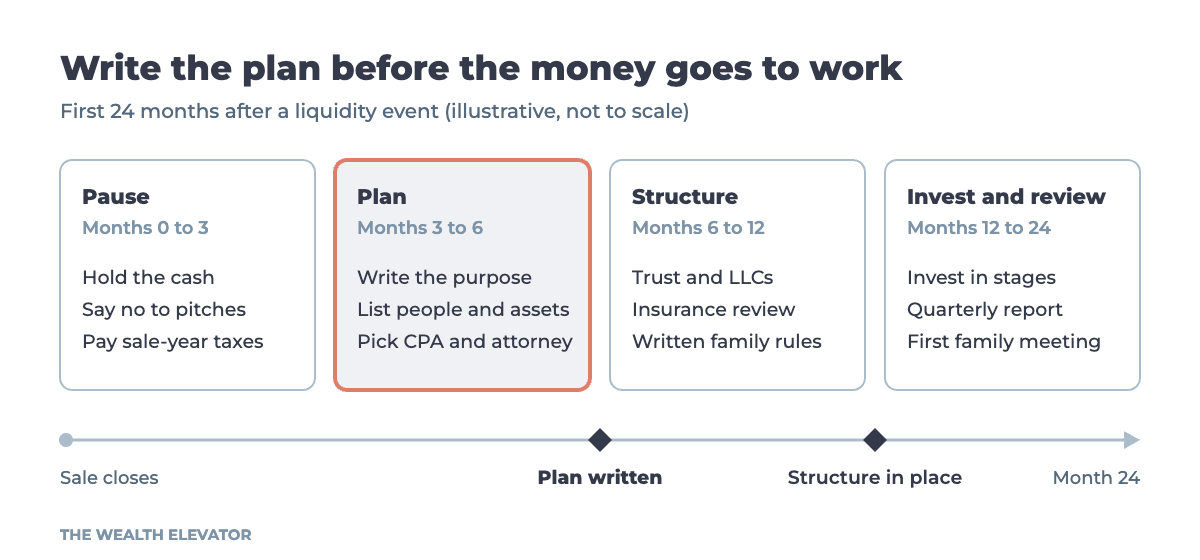
Every well-run family office starts with the same planning work, and none of it requires staff. A family at Ron’s size can do all six of the building blocks below in a few working sessions with a spouse, a CPA and an estate attorney.
The six building blocks, scaled down for Ron
- Purpose. Write two or three sentences on what the money is for. “Fund our retirement at today’s lifestyle, pay for four grandkids’ college, and leave the rest to a donor-advised fund” is useful. “Preserve our legacy” is not, because it cannot settle a single decision. A short, specific purpose also stops the office from drifting into whatever the latest pitch is.
- Who is served. List every person and entity in scope: Ron, his wife, two adult kids, the revocable trust, the duplex LLC, the old company’s earnout. Each has different needs and timelines.
- What is owned. List every asset type: cash, brokerage, retirement accounts, the rental, any private placements, the earnout note. Each type needs someone who actually understands it.
- What services are needed. For most families this means investment oversight, tax filing and planning, estate documents, insurance review, and one consolidated report. Bill pay and concierge help are optional.
- Budget and who pays. Decide what all of this should cost per year and write it down. When adult children are involved, agree up front how costs get shared, because “nice to have” turns into “not today” the moment someone sees the bill.
- A contingency plan. Who gets the passwords, statements and attorney’s phone number if Ron is in the hospital tomorrow? A one-page binder kept with the estate documents covers most of it.
The output is a short business plan for the family’s money. Big offices produce a thick one. Ron’s can fit on four pages, and it will save him from most of the pitches in his inbox.
How family offices are structured
Large family offices are usually an LLC or limited partnership that owns nothing itself. It is a service company, and the family’s assets sit in separate entities that the office manages under contract. For more on how these entities get set up, see structuring trends on holding companies for family offices.
A few structural ideas carry down to any size:
- One entity per risky asset. Each rental property or operating business typically sits in its own LLC. If a tenant sues over an injury at one building, a claim beyond the insurance limits is generally limited to that entity’s assets instead of reaching everything else. Your attorney sets this up for your state. I walk through the layers in The Asset Protection Ladder.
- Registration rules. Since the Dodd-Frank rules took effect in 2011, anyone giving investment advice for pay generally has to register as an investment adviser unless an exemption applies. A true single family office can qualify for the SEC’s family office exclusion, but the definition is narrow. Bringing in outside clients or giving staff certain profit interests can break it. This is a question for securities counsel, not a blog post.
- Private trust companies. Some very large families form their own trust company to act as trustee for family trusts, which gives them more say and more privacy. A few states, South Dakota being a well-known one, allow this for families who live elsewhere. It is overkill at $11 million but worth knowing exists.
- Insurance as structure. A family office reviews property, liability, umbrella, life and, for anyone on a board, directors and officers coverage as one program. How an asset is titled and insured often matters as much as the asset itself when a lawsuit or divorce shows up.
For Ron, structure usually means a revocable living trust, an LLC for the duplex, a properly sized umbrella policy, and beneficiary designations that match the estate plan. Unglamorous, but it is the same logic the big offices use. If you are weighing the more advanced options later, here is how IDGTs, SLATs, GRATs, dynasty trusts and ILITs compare.
Who is on the team
A big office fills the roles below with full-time employees. Ron fills the same roles with a mix of himself, his spouse and outside professionals paid by the hour or by the project.
- Quarterback (CEO): sees the whole picture, coordinates everyone, runs family meetings. At Ron’s size, that is Ron himself or one trusted advisor paid a flat fee.
- Investment oversight (CIO): sets the allocation plan, vets managers and deals, monitors results. At Ron’s size, Ron with a fee-only advisor or a vetted peer group for second opinions.
- Tax and accounting (CFO): family returns, K-1s, estimated payments, cash flow. At Ron’s size, a CPA firm comfortable with trusts and partnership income.
- Legal (CLO): entities, trusts, contracts, estate plan. At Ron’s size, an estate attorney on retainer, others as needed.
- Insurance: one program across homes, cars, rentals and liability. At Ron’s size, an independent broker who reviews it all yearly.
- Bookkeeping and admin: bills, records, document storage. At Ron’s size, a spouse, a part-time assistant, or bank bill pay.
- Security and privacy: home, travel, cyber, identity. At Ron’s size, a password manager, credit freezes and a careful social media policy.
Two habits from big offices are worth copying no matter the size. First, background-check anyone who will touch the money, because the largest risk to a wealthy family is usually an insider, not a stranger. Second, line up incentives: big offices often let key staff co-invest beside the family, so they win only when the family wins. At Ron’s size, the version of that is paying advisors directly and asking every one of them how else they get paid.
Governance and the next generation
Governance is just the written rules for who decides what, and the time to write them is while the founder is still around to explain them.
Most family offices begin the way Ron’s finances run today. One person made the money, knows every account, and decides on the fly. That works fine for years. The trouble starts when the founder dies or steps back and the money passes to a spouse, kids or trusts. Suddenly nobody knows who is in charge or how decisions get made, and the family either fights for control or freezes up. There is an old line for how this usually ends: shirtsleeves to shirtsleeves in three generations.
The governance pieces big offices use, sized down:
- A written purpose that the next generation helped write, so it reads as theirs and not as Dad’s rules.
- Clear roles. Who can make an investment decision alone, and what needs a spouse or trustee to sign off?
- A regular family meeting with an agenda, a one-page report, and notes kept afterward. Once a year is fine to start.
- Education for the kids. Bring them into a meeting, let them read the report, have them shadow a CPA review. Some families give adult children a small amount to invest and report back on.
- Liquidity rules. Decide in advance how a family member can get money out of shared holdings, or borrow against them, so nobody improvises during a crisis. Some larger families set up a family bank that lends to members on set terms for exactly this reason.
- A separate home for giving. Keep charitable money in its own vehicle, such as a donor-advised fund or foundation, and give a family member ownership of it. It is one of the easiest ways to get younger family members engaged.
Family offices are not forever, either. As a family grows to dozens of members with modest individual shares, many offices split up, narrow their services, or merge into a multi-family office. Writing down how that would work is part of good governance too.
Risk, due diligence and reporting
Most families set up an office for investing, but its most valuable job is often catching risk before it costs money. One team watching everything can spot problems that three disconnected advisors miss.
- Hidden overlap. Owning five funds can feel diversified while all five hold the same handful of stocks or the same sector. Ask each manager for top holdings and compare them side by side once a year.
- Style drift. A manager hired for one strategy can wander into another chasing returns. Re-read the strategy description each year and ask what changed.
- Liquidity traps. Private funds and some hedge funds limit withdrawals, sometimes exactly when markets are falling. Know every lockup and redemption gate before you need cash.
- Fraud and weak oversight. Regulators do not check most private investments in real time. Before wiring money, find out who holds the cash (the custodian or administrator), who audits the books, and who the outside counsel is. Then call them, not just the sponsor. Here is how next-gen family wealth stewards vet a sponsor.
- The insider problem. Run a background check on anyone with access to accounts, from a bookkeeper to a house manager.
Reporting ties it all together. Wealthy families routinely make decisions off statements that are months stale and in five different formats. Big offices spend real money on software that pulls every account into one view. Ron can start with a quarterly one-page net worth and cash flow summary, built by a bookkeeper or an aggregation tool, and reviewed with his CPA. Put tax reporting on the same calendar so K-1s, estimated payments and filing deadlines do not surprise anyone.
Common mistakes, and when this approach does not fit
The most common mistake after an exit is moving fast on investments before the planning work is done.
- Deploying cash in the first 90 days, such as saying yes to the first private deal or the bank’s model portfolio. A family office would park the cash, write the purpose and plan, then invest. If you are already comparing options, start with DST vs. real estate syndication after selling your business.
- Hiring for technical skill alone, such as picking the smartest investor as the quarterback. A family office picks someone who can coordinate people and explain things to the family.
- Running the family money out of the business, with the company’s accountant also doing the family’s personal books. A family office keeps family finances separate, with people trained on trusts and partnership tax.
- No written rules, with the founder deciding everything in his head. A family office keeps short written roles, a meeting cadence and liquidity rules.
- Reporting as an afterthought, with decisions made off stale, scattered statements. A family office uses one consolidated report on a fixed schedule.
- Unclear advisor pay, such as not knowing commissions, revenue sharing or fund-level fees. A family office asks every advisor in writing how they get paid.
This approach is probably not a fit if your finances are simple (a house, retirement accounts and an index fund portfolio), if you have no interest in being involved, or if a single trusted advisor already coordinates your tax, legal and investment work well. In those cases a good fee-only planner may be all the “office” you need.
Frequently asked questions
How much money do you need to justify a single family office?
Dedicated single family offices are usually found at $100 million or more in investable assets. A lean office can cost $700,000 to $1.2 million a year, which is about 0.2% of $500 million but about 9% of $11 million.
What is a virtual family office?
A virtual family office is one family working with coordinated outside specialists (a CPA, an estate attorney, an insurance broker and an investment advisor) instead of full-time staff. It is common at $5 million to $50 million, but someone still has to quarterback it.
What should I do with the money right after selling my business?
Slow down. Park the cash, pay the sale-year taxes and say no to pitches for the first few months. Write down what the money is for and get the structure in place before you invest in stages.
Does a single family office have to register with the SEC?
Anyone giving investment advice for pay generally has to register as an investment adviser unless an exemption applies. A true single family office can qualify for the SEC’s family office exclusion, but the definition is narrow, so get securities counsel involved.
The takeaway for Ron
A family office is less about staff and more about a way of running money: a clear purpose, one person seeing the whole picture, written rules, real due diligence and honest reporting. The billionaire version costs seven figures a year. The version Ron needs costs some planning sessions, a few well-chosen professionals, and the discipline to say “not yet” to the pitches until the plan is written.
This is the first piece in our family office series. The second, how to run your retirement like a family office, follows a corporate retiree, and the third, the high earner’s tax problem, family office style, follows a two-physician household still building wealth from a paycheck.
If you are working through this after an exit, you do not have to figure it out alone. Our community is a place to compare notes with other accredited investors and business owners who have been through the same transition. Join The Wealth Elevator community here.
This is educational content, not tax, legal, or investment advice. We are not attorneys, CPAs, or financial planners. Please let us know if you need a referral to a CPA, lawyer, or other vendor here: The Wealth Elevator vendor list.