
IDGT, SLAT, BDIT, GRAT, Dynasty Trust, ILIT: What Each Trust Does and Where It Breaks (2026 Rules)
Short answer: A revocable living trust handles probate and incapacity and changes nothing for tax. An IDGT, SLAT, BDIT, GRAT, dynasty trust or ILIT each moves future growth, a death benefit or creditor exposure out of your estate, and each gives up access, control or a basis step-up to do it. The right fit depends on your net worth against the $15 million federal exemption.
Most investors first run into these acronyms in an attorney’s proposal, or from another investor at dinner who says he “did a SLAT” last year. The names sound like seven different products. They are closer to seven settings on the same machine, and the settings are who owns the asset for income tax, who owns it for estate tax, and who can get at it.
I’m an engineer by training and I am not an attorney, so I sort this kind of thing into a table and then check each cell against the code section or ruling behind it. This article is that table with the rules as they stand in October 2026. It gets technical on purpose, because the technical parts are where these plans succeed or fail.
The short answer
A revocable living trust changes nothing for tax or creditors. It handles probate and incapacity. An IDGT, SLAT, BDIT, GRAT, dynasty trust or ILIT each moves future growth, a death benefit or creditor exposure off your personal balance sheet, and each one gives something up to do it: access, control, a basis step-up, or simplicity.
Which one fits depends on four things. Your net worth against the $15 million federal exemption, your state’s estate tax, whose access you are willing to give up, and how fast the asset is expected to grow.
The 2026 numbers that drive the decision
| Item | 2026 figure | Why it matters |
|---|---|---|
| Federal estate and gift tax exemption | $15 million per person, $30 million for a married couple using both | Above this, the excess is taxed at 40%. Below it, federal estate tax is not the reason to plan. |
| Annual gift exclusion | $19,000 per recipient, per giver | Gifts at or under this use no lifetime exemption. |
| GST exemption | $15 million per person | Covers gifts that skip to grandchildren or to long-term trusts. It is a separate exemption and it is not portable between spouses. |
| Top estate, gift and GST tax rate | 40% | The GST tax is charged on top of estate or gift tax. |
| State estate tax | Varies. None in California, a $3 million exclusion in Washington, $5.49 million in Hawaii | In a state with its own estate tax, you can owe the state with no federal tax due. |
| Top income tax bracket for a trust | 37% above $16,000 of taxable income | A trust that pays its own tax reaches the top rate almost immediately. |
| Section 7520 rate, October 2026 | 5.6% | The hurdle a GRAT has to beat. It resets every month. |
| Mid-term AFR, October 2026 | 4.61% (annual compounding) | The minimum interest on a family note longer than three years and up to nine. |
The $15 million figure comes from Public Law 119-21, the 2025 tax act. It has no scheduled sunset and is set to adjust for inflation after 2026. “Permanent” in tax law means there is no expiration date written in. A future Congress can still change it.
Here is why the exemption matters more than the acronym. Take a hypothetical married couple with $12 million and no state estate tax. They have no federal estate tax exposure today, so their reasons for an irrevocable trust would be creditor protection or growth they expect later. A hypothetical couple with $40 million sits about $10 million above their combined exemption. At 40% that is roughly $4 million of federal tax before deductions, state tax or future growth, and it is the problem most of these structures were built for.
Six questions that sort every trust
The same trust can give a different answer to each of these, and that is by design. A grantor trust can put its income on your personal return while its assets sit outside your taxable estate. Calling a document “irrevocable” settles none of them.
| Question | What the answer decides |
|---|---|
| Who transferred the property, and was it a gift or a sale? | How much exemption is used, what has to be appraised and reported, and whether the transfer can be challenged later. |
| Who reports the income and deductions? | Whether it is a grantor trust under Sections 671 to 679 or a separate taxpayer with its own return. |
| Who can receive distributions? | Your practical access, creditor exposure, and the risk of a retained benefit pulling assets back into your estate. |
| Who controls investments and distributions? | Retained-power analysis under Sections 2036 and 2038, and who is accountable as a fiduciary. |
| Whose estate includes the assets? | Estate tax, and whether heirs get a basis step-up at death. |
| Which state’s law governs, and who are the trustees? | Creditor protection, how long the trust can last, and whether a court elsewhere will respect it. |
The main structures side by side
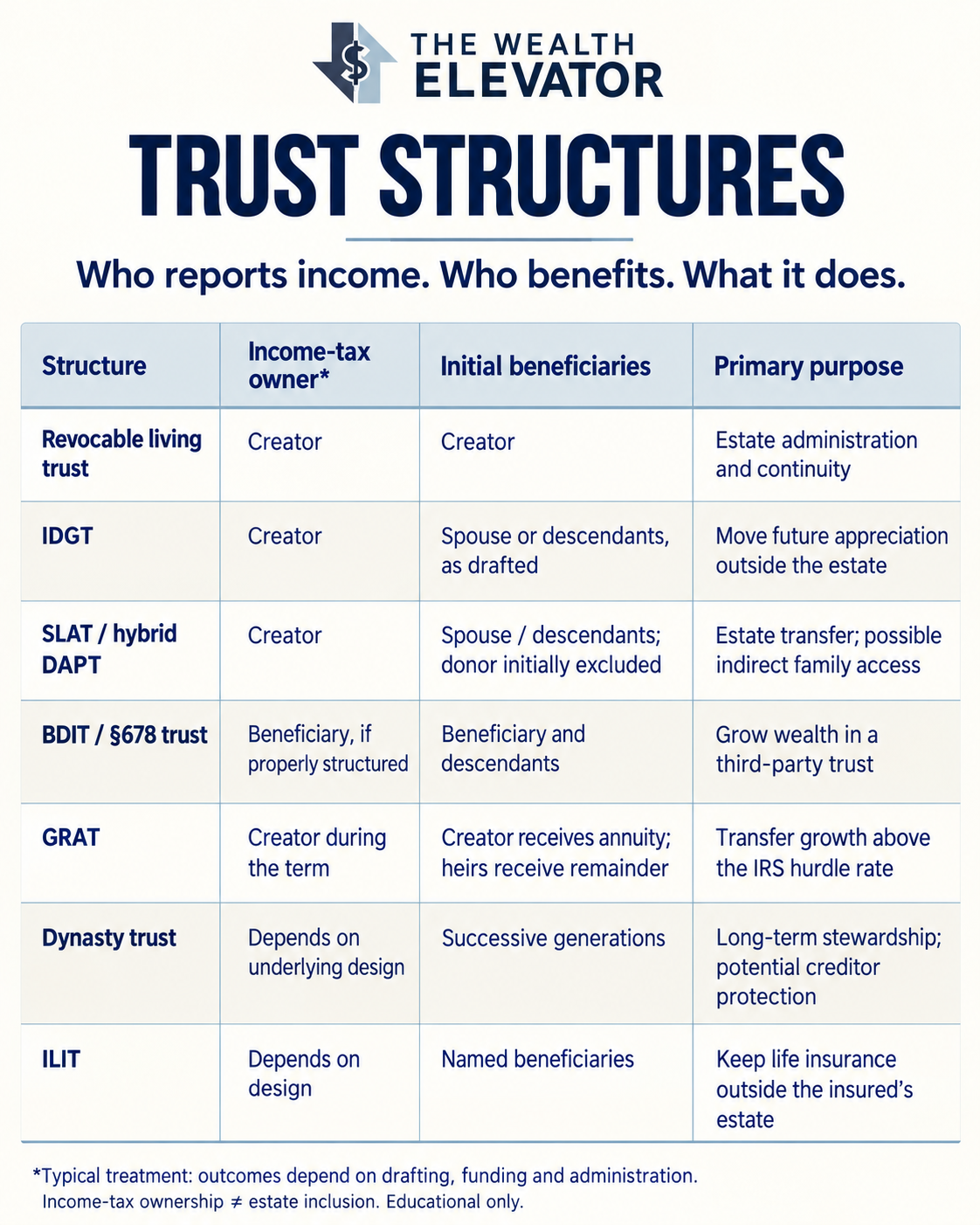
| Structure | Who usually reports the income? | Who can initially benefit? | Primary purpose |
|---|---|---|---|
| Revocable living trust | Creator | Creator | Estate administration and continuity |
| IDGT | Creator | Spouse or descendants, as drafted | Move future appreciation outside the estate |
| SLAT or hybrid DAPT | Creator | Spouse and descendants; creator generally excluded at first | Estate transfer with possible indirect family access |
| BDIT or Section 678 trust | Beneficiary, if properly structured | Beneficiary and descendants | Grow wealth in a third-party trust |
| GRAT | Creator during the annuity term | Creator receives the annuity; heirs receive any remainder | Transfer growth above an IRS hurdle rate |
| Dynasty trust | Depends on its underlying design | Successive generations | Long-term stewardship and creditor protection |
| ILIT | Depends on design | Named beneficiaries | Hold life insurance outside the insured’s estate |
These are not seven separate boxes. A SLAT is usually an IDGT with a spouse as beneficiary. A dynasty trust is a duration and tax feature that can sit on top of an IDGT, a SLAT or a BDIT. An ILIT is often drafted as a grantor trust too. Attorneys combine them, which is why two proposals for the same family can use different names for nearly the same plan.
Revocable living trust: administration only
A revocable living trust holds title to your assets so your family skips probate and someone can step in if you are incapacitated. You can amend or revoke it, you report all the income on your own return, and everything in it counts in your taxable estate. It does nothing against your own creditors.
The planning value shows up at the first death, when part of the trust usually becomes irrevocable. That is where a married couple chooses between two ways of using the first spouse’s exemption.
- Portability lets the survivor inherit the unused federal exemption, but only if the executor files a federal estate tax return (Form 706), even when no tax is due. Rev. Proc. 2022-32 gives estates that were not otherwise required to file up to five years after death to make that election.
- A bypass or credit shelter trust uses the first exemption at the first death. Growth inside it stays out of the survivor’s estate, and it can use the first spouse’s GST exemption, which portability cannot carry over.
- The cost of the bypass trust is basis. Assets in it do not get a second step-up when the survivor dies. Assets left outright to the survivor do.
Where it breaks: the trust was signed and never funded. Accounts and LLC interests still titled in your own name go through probate anyway.
IDGT: the standard estate freeze
An intentionally defective grantor trust is a completed gift for estate and gift tax, while you are still treated as the owner for income tax. The “defect” is deliberate. It is usually created with a power to swap assets of equal value under Section 675(4)(C), or because your spouse is a beneficiary under Section 677.
Assets get into an IDGT two ways. You can gift them, which uses lifetime exemption. Or you can sell them to the trust for a promissory note, which uses little or none.
How the installment sale works
Under Rev. Rul. 85-13, a transaction between you and your own grantor trust is ignored for income tax. You recognize no gain on the sale and no interest income on the note. The note has to carry at least the applicable federal rate, which is 4.61% for a mid-term note written in October 2026.
A hypothetical with round numbers. You gift $1 million to the trust as a seed, then sell it $9 million of LLC interests for a nine-year, interest-only note at 4.61%. The trust pays you about $414,900 a year. If the assets compound at 8%, the trust holds roughly $5.8 million after repaying the $9 million note at the end of year nine. That $5.8 million is outside your estate, and the only exemption used was the $1 million seed.
The same math runs in reverse. If the assets earn less than 4.61%, the trust falls behind the note and nothing moves. And the note itself, plus every interest payment you did not spend, is still in your estate. The sale freezes your estate at today’s value without shrinking it. Actual results depend on valuation, growth and how the trust is run.
Many attorneys want the trust to hold assets worth about 10% of the purchase price before the sale. That figure is a practitioner rule of thumb. It is not in the Code, and a thinly funded trust invites the argument that the “sale” was a gift with a retained interest.
The tax payment, and the ruling that surprised people
Because you are the income tax owner, you pay tax on income the trust keeps. Rev. Rul. 2004-64 says that payment is not an additional gift. Each year it moves more value to the trust without using exemption.
The same ruling draws a line on reimbursement. If the trust must reimburse you, the assets can be pulled back into your estate. A reimbursement power that an independent trustee may use at its discretion is generally fine, as long as there is no side understanding and state law does not open the trust to your creditors.
In late 2023 the IRS Chief Counsel went further in CCA 202352018. Adding a reimbursement clause to an existing trust, with the beneficiaries’ consent, was treated as a taxable gift from the beneficiaries to the grantor. The practical lesson is to settle the reimbursement language in the original document, because fixing it later may carry a tax cost.
Basis is the price
Rev. Rul. 2023-2 confirmed what most attorneys already assumed. Assets in a completed-gift grantor trust that are not in your taxable estate get no basis step-up at your death. Your heirs take your old basis.
The swap power is the usual workaround. Before death you can exchange cash or high-basis assets for the trust’s low-basis assets, so the appreciated assets come back into your estate and get the step-up. Rev. Rul. 2008-22 says holding that power does not by itself cause estate inclusion when the trustee has a duty to confirm equal value. It only works if someone is paying attention while you are still alive and able to act.
Where it breaks: you keep using the asset as if you still own it, the appraisal does not hold up, note payments are skipped, or you run short of cash to pay tax on income you never receive. Turning grantor status off while the note is unpaid can itself trigger gain, and the law on a note still outstanding at death is unsettled.
SLAT: a completed gift your spouse can still reach
A spousal lifetime access trust is an irrevocable trust one spouse funds for the other spouse and usually the kids. The donor is not a beneficiary. The beneficiary spouse can receive distributions, so the household keeps indirect access while the assets grow outside both estates.
A SLAT is a grantor trust automatically, because income can be paid to the donor’s spouse (Section 677). It uses the donor’s exemption only. Gift-splitting is generally unavailable when the other spouse is a beneficiary, so a couple who wants to use both exemptions needs two trusts.
Two trusts is where the reciprocal trust doctrine comes in. In United States v. Estate of Grace (1969), the Supreme Court “uncrossed” mirror-image trusts and treated each spouse as having created a trust for himself or herself. Attorneys avoid that by making the two trusts differ in substance: different assets, timing, trustees, distribution standards and powers.
Funding is a second trap. In Smaldino v. Commissioner (T.C. Memo. 2021-127), a husband gave his wife LLC interests and she transferred them to a trust the next day. The Tax Court treated it as his gift. Assets moved between spouses to fund a SLAT need time and real ownership in between.
What happens in a divorce or a death
The indirect access runs through your spouse. If your spouse dies first, it ends. If you divorce, your ex-spouse usually remains the beneficiary unless the trust defines “spouse” as whoever you are married to at the time, which planners call a floating spouse clause.
The income tax result surprises people. Under Section 672(e), you are treated as holding any interest held by the person who was your spouse when the trust was created. Section 682, which used to shift that income to the ex-spouse, was repealed for divorces finalized after 2018. So a donor can end up paying income tax on trust income that benefits an ex-spouse. This belongs in the prenup or settlement conversation, and in the trust’s reimbursement language.
Hybrid DAPT: a SLAT with a back door
A domestic asset protection trust (DAPT) is a trust you create and can benefit from, in one of roughly 20 states that allow it. Hawaii’s version is the Permitted Transfers in Trust Act, chapter 554G of the Hawaii Revised Statutes.
A hybrid DAPT starts with you excluded as a beneficiary, like a SLAT, and gives an independent person a limited power to add you later. Some firms sell this under a proprietary name. It is a drafting approach, and you will not find it as a category in the Internal Revenue Code.
The risks are specific. If you are added, a creditor or the IRS may argue you had access all along. A court in a state without a DAPT statute may apply its own law to its own resident. And federal bankruptcy law lets a trustee reach back ten years for transfers to a self-settled trust made with intent to hinder creditors. The power to add you is a contingency, and it works best if it is never used.
BDIT: the trust someone else sets up for you
A beneficiary defective inheritor’s trust is created and funded by a third party, usually a parent, for an adult child. The design goal is for the child to be the income tax owner under Section 678 without ever having made a gift to the trust.
The mechanics explain why these are almost always seeded with $5,000.
- The parent contributes cash and the child gets a temporary right to withdraw it.
- The child lets that right lapse. A lapse is not treated as a taxable release as long as it stays within the greater of $5,000 or 5% of the trust.
- Because the child held that withdrawal power, Section 678 treats the child as the owner for income tax.
- The trust must not be a grantor trust as to the parent. Under Section 678(b), the original grantor’s ownership would override the child’s.
From there the child can be a beneficiary and can manage the investments. Since the child never contributed anything, this is a third-party spendthrift trust, which generally stands up to the child’s creditors better than a self-settled trust does.
The hard part is the next step, where the child sells a business or investment interests to a trust that holds $5,000. A trust that thin cannot support a multimillion-dollar note on its own, so these sales usually rely on guarantees from other family members or trusts, with a fee paid for the guarantee. Since 2013 the IRS has listed this fact pattern, a sale to a nominally funded Section 678 trust for a note, among the issues it will not rule on in advance.
That does not make the structure invalid. It means you are relying on your attorney’s opinion without IRS confirmation. If the sale is recharacterized, the assets could be back in the child’s estate.
A note on real estate losses, because investors ask. If you are properly treated as the income tax owner, the trust’s depreciation and losses flow to your return. Whether you can use them still depends on basis, the at-risk rules and the passive activity rules. No trust turns a suspended passive loss into a current deduction.
Where it breaks: the child adds money to the trust, the withdrawal power is drafted or lapses incorrectly, the sale is undercapitalized, or the child treats the trust’s accounts as personal accounts.
GRAT: a bet against the IRS hurdle rate
A grantor retained annuity trust pays you a fixed annuity for a set number of years. Whatever is left at the end goes to your heirs or a trust for them. The gift is measured on day one as the amount funded minus the present value of your annuity, discounted at the Section 7520 rate.
Set the annuity high enough and the calculated gift is close to zero. That is the “zeroed-out” GRAT the Tax Court allowed in Walton v. Commissioner (2000). Almost no exemption is used, which is the appeal for someone who has already spent theirs.
A worked hypothetical at October 2026 rates
Assume $1 million goes into a two-year GRAT funded this month, when the Section 7520 rate is 5.6%. A level annuity of roughly $542,400 a year for two years zeroes out the gift.
| Annual growth of the GRAT assets | Left for heirs after two annuity payments |
|---|---|
| 12% | About $104,600 |
| 8% | About $38,200 |
| 5.6% (the hurdle) | $0 |
| 3% | $0. The trust runs out before the second payment is fully made. |
These figures are illustrations of the arithmetic with annual payments at year end. A real GRAT is calculated by counsel using the exact payment terms, and actual results will differ.
Two things stand out. Only growth above 5.6% transfers, so a GRAT is a poor home for a stabilized property yielding less than the hurdle. And when it fails, the assets come back to you and the cost is the legal and appraisal fees. The Section 7520 rate was below 1% in late 2020, which is why older GRAT examples look far better than anything you can set up at today’s rates.
Why they are short and “rolling”
If you die during the annuity term, some or all of the GRAT is pulled back into your estate. A short term reduces that mortality risk. A rolling program puts each annuity payment into a new GRAT, so one strong year is captured instead of being averaged against a weak one. The regulations also let the annuity rise by up to 20% a year, which back-loads the payments.
A GRAT is a weak tool for grandchildren. GST exemption cannot be allocated efficiently until the annuity term ends, a rule known as the ETIP rule, so the remainder normally goes to children or a trust for them.
Where it breaks: the assets underperform, you die during the term, a hard-to-value asset has to be reappraised every time an annuity is paid in kind, or the annuity payments pile back up in your estate unspent.
Dynasty trust: a feature layered on other trusts
“Dynasty trust” describes how long a trust lasts and how it handles the generation-skipping transfer tax. An IDGT, a SLAT remainder trust or a BDIT can each be drafted as one.
The GST tax is a flat 40% on transfers that skip a generation, and it is charged in addition to estate or gift tax. Each person has a $15 million GST exemption in 2026. Allocate enough of it when the trust is funded, and the trust and all its later growth are exempt for as long as the trust lasts. That allocation is made on a gift tax return, and getting it wrong is one of the more expensive paperwork errors in this field.
Duration is set by state law. Many states cap a trust at about 90 years. South Dakota and Delaware have largely removed the limit, and Nevada allows 365 years. Hawaii follows the 90-year statutory rule, but section 525-4 of the Hawaii Revised Statutes excludes trusts described in chapter 554G, the Permitted Transfers in Trust Act.
The income tax side gets less attention than it should. Once the creator dies, the trust is no longer a grantor trust and pays its own tax, reaching the 37% bracket at $16,000 of taxable income in 2026. Trustees manage that by distributing income to beneficiaries in lower brackets, which sends the money out of the protected trust. Protection and tax efficiency pull in opposite directions here.
Where it breaks: a beneficiary is given a right to demand distributions, which gives that beneficiary’s creditors something to reach. Other common problems are a trustee who cannot say no and a trust protector with powers so broad that the creator looks like the one in control.
ILIT: keeping the death benefit out of the estate
Life insurance proceeds are generally income-tax-free to the beneficiary. They are still counted in your taxable estate if you own the policy or hold any “incident of ownership” over it, such as the right to change the beneficiary or borrow against it (Section 2042). An irrevocable life insurance trust owns the policy instead.
Three rules do most of the damage when they are missed.
- The three-year rule. If you transfer a policy you already own and die within three years, the proceeds are pulled back into your estate (Section 2035). Having the trust apply for and own a new policy from the start avoids it.
- Crummey notices. A gift to a trust is normally a future interest that does not qualify for the $19,000 annual exclusion. Giving each beneficiary a short window to withdraw the contribution fixes that, a technique named for Crummey v. Commissioner (9th Cir. 1968). The notices have to be sent and the right has to be real.
- The $5,000 or 5% lapse limit. When a beneficiary lets a withdrawal right lapse above that amount, the excess can be a gift by the beneficiary. Attorneys handle larger premiums with “hanging” powers that lapse gradually.
Premiums larger than the available annual exclusions use lifetime exemption, or they are funded by a loan to the trust. A loan avoids an immediate gift only if it is a real loan, with interest at the applicable federal rate or higher and a credible way to repay it. Personal guarantees and pledged collateral can create gift issues of their own, and the loan balance grows if interest accrues. Financing has a cost, and that cost needs to be modeled against simply using exemption.
I covered the insurance products themselves in The Life Insurance Playbook Most People Never See, and two points in that earlier piece are simpler than what I’ve laid out here. It says a bank loan to an irrevocable trust means no gift tax no matter how large the premium, where this article says that result depends on the loan being a real loan with adequate interest and a way to repay it. It also uses an example of a $15 million estate owing about $6 million of federal estate tax, which does not match the 2026 exemption of $15 million per person. Everything here depends on the guidance, and the future defense, of your own attorney, so I wanted to point out these inconsistencies.
One more detail for long-term trusts. A Crummey gift that qualifies for the gift tax annual exclusion does not automatically qualify for the GST annual exclusion. If the ILIT is meant to last for grandchildren, GST exemption usually has to be allocated on a gift tax return.
PPLI is a wrapper, and it has its own rules
Private placement life insurance is a policy structure. It can be owned by you or by one of the trusts above. Investment growth inside a qualifying policy is not taxed currently, which is why it comes up for tax-inefficient assets.
The qualifications are strict, and “private” does not exempt a policy from any of them.
- The contract has to meet the definition of life insurance in Section 7702.
- If it is funded faster than the seven-pay test in Section 7702A allows, it becomes a modified endowment contract. Loans and withdrawals are then taxed income-first, with a possible 10% additional tax before age 59 and a half.
- The underlying accounts must be diversified under Section 817(h). In general that means at least five investments, with no single one above 55% of the account.
- You cannot direct the investments. In Webber v. Commissioner (2015), a policyholder who picked the deals himself was taxed as if he owned the assets directly.
Purchasers generally have to be accredited investors and qualified purchasers. Costs include state premium tax, insurance charges and manager fees, and they need to be modeled against holding the same assets directly.
The basis trade-off most people skip
Assets you own at death generally get a new income tax basis equal to their value at death. Assets you moved out of your estate keep your old basis. Every completed-gift trust trades one tax for the other.
A hypothetical asset has a $1 million basis and is worth $10 million when you die.
| Where the asset sits | Estate tax | Capital gains tax if heirs sell |
|---|---|---|
| In your estate, and your estate is over the exemption | About $4 million at 40% | None on the $9 million of past growth |
| Outside your estate in a completed-gift trust | None | About $2.1 million at 23.8% federal |
| In your estate, and your estate is under the exemption | None | None on the $9 million of past growth |
These are simplified federal figures that ignore state tax and deductions. The third row is the one to study if your net worth is between $1 million and $15 million. For a family under the exemption, moving an appreciated asset into an irrevocable trust can leave heirs with a larger tax bill, because it gives up a step-up and saves no estate tax.
This matters more for real estate investors than for most people. A step-up at death also resets depreciation, including the recapture that has built up on rentals and syndication interests. Giving that up is a real cost, and it belongs in the model next to the estate tax savings. For a partnership interest, the inside basis generally adjusts only if the partnership has a Section 754 election in place, so ask how that is handled.
Your state can change the answer
State estate tax is separate from the federal tax, and California, Washington and Hawaii show how far the results can differ.
| State | Estate tax in 2026 | What that means |
|---|---|---|
| California | No estate or inheritance tax | The federal $15 million exemption is the only estate tax threshold. State income tax on trust income is a separate question. |
| Washington | $3 million exclusion, rates from 10% to 20% for deaths on or after July 1, 2026 | No state income tax, but an estate tax that starts far below the federal exemption. |
| Hawaii | $5.49 million exclusion, rates from 10% to 20% | Portability between spouses is allowed if the first estate files a timely return (Form M-6, due nine months after death). |
Take the same hypothetical couple with $9 million in each state. None of them has federal exposure. The California couple has no estate tax at all, while the Washington and Hawaii couples may owe their state, depending on how the first estate is handled. For the California couple, a completed-gift trust mostly costs a step-up. For the other two it may save state tax, so ask counsel to run your state’s numbers separately.
The paperwork that makes it hold up
Many of these plans fail on how the trust was run after signing. These are the items worth confirming with your attorney and CPA.
- A gift tax return (Form 709) for any gift above the annual exclusion, and to allocate GST exemption.
- Adequate disclosure on that return, including a qualified appraisal. That starts a three-year clock for the IRS to challenge the value. Without it, the clock never starts.
- Reporting a sale to a grantor trust as a non-gift transaction, so the same clock runs on the sale.
- A defined-value clause for hard-to-value interests, which transfers a dollar amount instead of a fixed percentage. The Tax Court accepted one in Wandry v. Commissioner (2012). The IRS has not agreed with that decision.
- A separate bank account for the trust, note payments made on time, Crummey notices sent, and no personal expenses paid from trust funds.
I’ve seen people quoted $10,000 to $50,000 or more for these structures, before appraisals and annual administration. That is a reason to match the tool to the size of the problem.
How attorneys tend to match the structure to the situation
These are general patterns for discussion with counsel. They are hypothetical and none of them is a recommendation for your situation.
- A family under the exemption in a state with no estate tax often stops at a well-funded revocable trust, with irrevocable trusts used mainly for creditor protection.
- A married couple with unused exemption and assets they expect to grow may look at a SLAT, or at a gift plus installment sale to an IDGT.
- An owner expecting a sharp rise in value in the next few years, with little exemption left, may test a short-term GRAT.
- A founder early in a company’s life, with parents willing to act as settlor, may look at a Section 678 trust and should budget for the legal uncertainty.
- A family with illiquid real estate and a projected estate tax bill may use an ILIT to fund that bill.
- Any of these can be drafted to continue for descendants as a dynasty trust if GST exemption is available.
What to ask your attorney before you sign
Ask for a one-page diagram and a side-by-side model. Mine would cover these.
- Who is the settlor, who is the income tax owner, and who are the trustees for investments and for distributions?
- Is the transfer a gift, a sale or both, and how much exemption does it use?
- Which of my powers or benefits could pull the assets back into my estate under Sections 2036, 2038 or 2042?
- What happens to access and to the income tax bill if my spouse dies or we divorce?
- What basis do my heirs take, and is there a swap power and a plan to use it?
- How is GST exemption being allocated, and which state’s law sets the trust’s duration?
- What is my annual cash cost, including income tax on trust income I do not receive?
- What does the model look like under current federal law and my state’s law, at low, expected and high growth?
- What has to be filed, appraised and documented every year, and who is responsible for it?
Frequently asked questions
Do I need an irrevocable trust if my net worth is under $15 million?
Federal estate tax is not the reason at that level, since the 2026 exemption is $15 million per person. Creditor protection, a state estate tax such as Washington’s at $3 million or Hawaii’s at $5.49 million, or growth you expect later can still be reasons. Weigh them against the basis step-up your heirs give up.
What is the difference between an IDGT and a SLAT?
A SLAT is a type of IDGT. Both are completed gifts that remain grantor trusts for income tax. A SLAT names your spouse as a beneficiary, which keeps indirect household access and adds divorce, death and reciprocal trust risks.
Does an irrevocable trust get a step-up in basis at death?
Only if its assets are included in your taxable estate. Rev. Rul. 2023-2 confirms that assets in a completed-gift grantor trust outside your estate keep their carryover basis.
Who pays the income tax on a grantor trust?
The person treated as owner under Sections 671 to 679. That is usually the creator, or the beneficiary in a Section 678 trust. Rev. Rul. 2004-64 says the creator’s payment of that tax is not an additional gift.
Can I be the trustee of my own irrevocable trust?
Often you can direct investments. Holding discretion over distributions is what usually causes estate inclusion, so that role typically goes to an independent trustee. Rev. Rul. 95-58 allows you to keep the power to remove and replace a trustee, as long as the replacement is not related or subordinate to you.
What is the GRAT hurdle rate right now?
The Section 7520 rate is 5.6% for October 2026 under Rev. Rul. 2026-19. It changes monthly, and the rate in the month the GRAT is funded applies for its whole term.
Is a dynasty trust its own kind of trust?
No. It describes a trust built to last for multiple generations with GST exemption allocated to it. The income tax treatment comes from the underlying design.
Can an irrevocable trust be changed later?
Often yes, through decanting, a nonjudicial settlement agreement or a trust protector, depending on state law. Changes can have tax consequences. In CCA 202352018 the IRS treated a beneficiary-approved modification as a taxable gift.
My own takeaway from building the table is that the acronym matters less than the answers to the six ownership questions. Two families with the same net worth can reasonably end up with different structures, and a family under the exemption may be better served by doing less.
If you want to be around other investors who are working through these same decisions, come join our community at theWealthElevator.com/club.
This is educational content, not tax, legal, or investment advice. We are not attorneys, CPAs, or financial planners. The examples are hypothetical, rates and exemption amounts change, and the outcome of any trust depends on its documents, funding, state law and administration. Please let us know if you need a referral to a CPA, lawyer, or other vendor here: thewealthelevator.com/vendor.
Related reading
- The Asset Protection Ladder: LLCs, holding companies and trust tiers
- What a letter of wishes adds to a trust you already have
- The Life Insurance Playbook: GUL, IUL, VUL, whole life and PPLI
- The 1042 Rollover for business owners selling to an ESOP
- Legal Basics guide to asset protection
Sources
- IRS, What’s new: estate and gift tax (2026 basic exclusion of $15,000,000 and annual exclusion of $19,000)
- IRS, Rev. Rul. 2026-19 (October 2026 applicable federal rates and Section 7520 rate)
- IRS, Rev. Rul. 2023-2 (no basis adjustment for completed-gift grantor trust assets outside the estate)
- IRS, Rev. Proc. 2025-32 (2026 income tax brackets for estates and trusts)
- IRS, Rev. Rul. 85-13, Rev. Rul. 95-58, Rev. Rul. 2004-64, Rev. Rul. 2008-22 and Rev. Proc. 2022-32
- The Tax Adviser, Recent CCA raises concerns for irrevocable grantor trust modifications (CCA 202352018)
- Hawaii Department of Taxation, Instructions for Form M-6 (Hawaii exclusion, rate schedule and portability)
- Hawaii Revised Statutes, section 525-4 (exclusions from the statutory rule against perpetuities)
- Washington Department of Revenue, Filing thresholds and exclusion amounts, and Washington Legislature, final bill report on ESB 6347 (2026 exclusion and rate schedule)
- California State Controller, Estate tax (no California estate tax for deaths on or after January 1, 2005)
- Cases: United States v. Estate of Grace, 395 U.S. 316 (1969); Crummey v. Commissioner, 397 F.2d 82 (9th Cir. 1968); Walton v. Commissioner, 115 T.C. 589 (2000); Wandry v. Commissioner, T.C. Memo. 2012-88; Webber v. Commissioner, 144 T.C. 324 (2015); Smaldino v. Commissioner, T.C. Memo. 2021-127