If you’re a professional between 50 and 65 with aging parents on one side and kids still needing financial support on the other, there’s a specific tax you’re paying that nobody talks about. It doesn’t show up on your 1040. It doesn’t show up on your brokerage statement. But I’ve watched it cost sharp, successful investors ten to fifteen years of compounding — and by the time they realize what happened, they’re already on the other side of it.
I’m going to walk you through what the sandwich generation actually costs, why private alternatives are uniquely vulnerable to this dynamic, and how to stay in the game without either burning out or going fully defensive.
The Big Idea
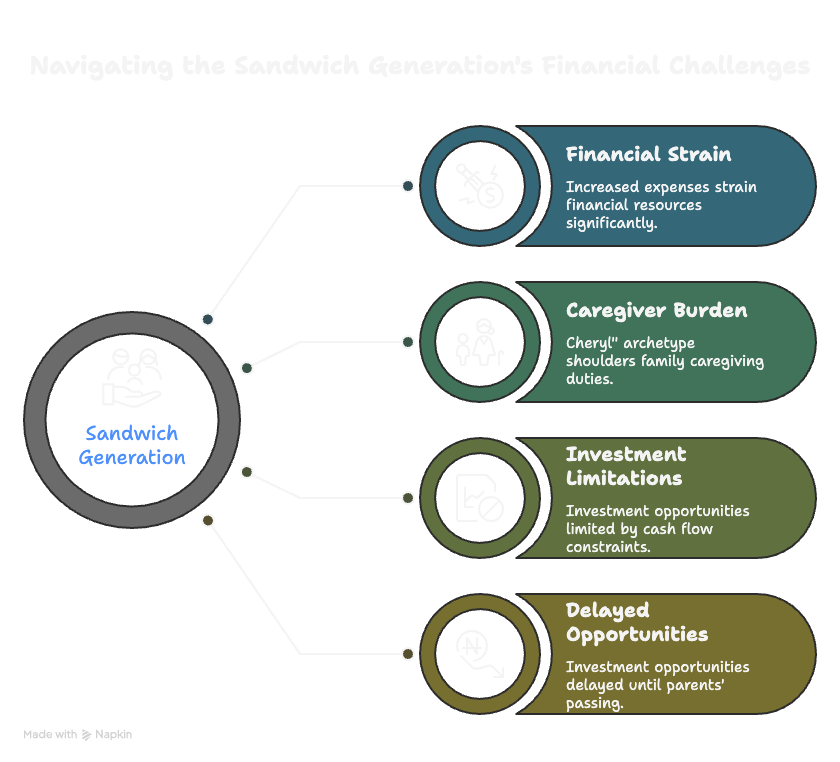
The sandwich generation is the stage of life where you’re financially and emotionally responsible for two generations at once: dependent children on one side, aging parents on the other. It’s not a new concept, but the investment-specific version of it is rarely discussed.
Here’s the short version. During this decade, your cash flow gets quietly redirected. Tuition checks. In-home care. Taking over your parents’ archaic checking account and insurance policies. Managing the estate your dad never quite got around to formalizing. None of these are individually catastrophic. Combined, they compress your discretionary capital — the exact capital that would have been going into private real estate deals, private credit, and other alternatives.
And the thing is, most people don’t notice it happening. They notice they feel busy. They notice cash flow is tighter. What they don’t notice is that they’ve silently shifted from wealth-building mode into wealth-preservation mode — two fundamentally different games, played with fundamentally different assets.
Why It Matters Now
There’s a demographic reality at play here that makes this decade more brutal for my generation than it was for my parents’.
Rising education and professional achievement correlate with later family formation. So most of the accredited investors I work with had their first kid in their late 30s or early 40s. Which means when those kids hit college age, the parents are in their 70s and 80s — often simultaneously. That’s the sandwich, and it’s math, not bad luck.
Layer on top of this the current reality of private alternative investing. Minimums are higher than they used to be. Good operators are selective about who they let into their deals. And relationships matter more than they ever have — if you’ve been cold to a sponsor for five years, you’re at the back of the line when the next fund opens. The cost of going dormant during the sandwich decade is materially higher now than it would have been twenty years ago.
A Real-World Example
Let me give you a concrete picture. This is a composite of several clients, but the numbers are realistic.
Physician, 55. Household income around $700K. In a world without the sandwich, he’d be deploying roughly $150K a year into syndications — call it two to three deals annually at $50K–$75K each.
Instead, here’s what the last ten years looked like. Two kids in private colleges, each running about $90K a year all-in. His mother had a stroke six years ago and needed in-home care, averaging about $60K a year after insurance. His father passed without a completed trust, which cost the family roughly three years and low six figures in legal fees and family conflict before things settled. He scaled his syndication allocation down to one deal every other year at $50K — so $25K annualized instead of $150K.
Lost allocation over the decade: about $1.25M that didn’t go into deals.
But the bigger cost isn’t the dollars. It’s the depreciation cycles he didn’t get to stack against his practice income. It’s the K-1 losses that would have sheltered hundreds of thousands in active earnings. It’s the operator relationships that went cold. By the time he called me, he was starting nearly from scratch on networks he should have been compounding for ten years.
When he finally was ready to re-engage, his mother had passed and both kids had launched. The capacity was there. But he’d lost a decade of compounding that he couldn’t buy back.
Mistakes to Avoid and Myths to Bust
Myth one: “I’ll catch up after my parents pass.” I see this assumption everywhere, and it’s quietly one of the worst financial plans you can have. Even if an inheritance does come, you’ve already lost the depreciation cycles, the K-1 losses, and the operator relationships that build over years, not months. And more importantly, counting on your parents passing as your investment strategy is a terrible plan and a worse way to live.
Myth two: “Going defensive is the responsible move.” Defense during the sandwich years usually isn’t a strategy — it’s the path of least resistance dressed up as prudence. If you still have a 20 to 30 year time horizon, fully exiting alternatives is almost never the right call. Scale down. Don’t stop.
Myth three: “If we just don’t talk about it, my parents’ estate will work itself out.” It won’t. The single biggest destroyer of family wealth I’ve watched isn’t taxes or bad deals — it’s parents who refused to pick winners and left illiquid assets split evenly between siblings who didn’t want to co-own them. If you’re the kid, push for clarity while your parents are healthy. If you’re the parent reading this, be the leader. Give one child the house and the others the cash equivalent. Whoever’s briefly mad at you will get over it. What they won’t get over is thirty years of fighting with their siblings.
How to Apply This
Here’s what I’d actually do if I were in the middle of the sandwich decade right now.
First, make a ten-year minimum viable investment plan. What’s the smallest allocation you can maintain to stay active in the private alternative space? For most people, that’s one deal a year, somewhere between $25K and $75K. That’s your floor. Anything above that is upside. The goal is to never be fully dormant.
Second, force the estate conversation with your parents while they’re still sharp. The right questions to ask: Do you have a revocable trust, and is it funded? Who’s the successor trustee? Is there a durable power of attorney and a healthcare proxy? How are assets going to be divided between the kids, and has that been written down, not just discussed? If your parents resist, bring in a third party — an estate attorney can often say things that you can’t say as their child.
Third, get explicit with your siblings about caregiving roles before a crisis forces the issue. Who lives closest? Who handles medical decisions? Who manages the finances? Name it out loud and put it in writing. Silent assumptions are what breed resentment.
Fourth, ask your CPA about accelerated depreciation strategies in the deals you are doing. Even a single well-structured syndication a year can generate meaningful paper losses that shelter your active income. That’s often the difference between breaking even on the sandwich decade and coming out ahead.
Finally, protect your relationships. With operators. With siblings. With your spouse. One of the things I’ve come to believe is that social relationships are the currency of the wealthy, and the sandwich decade tests that currency in every direction.
The Bottom Line
The sandwich decade is where a lot of otherwise sharp investors quietly lose ten to fifteen years of compounding. Not because they made bad decisions, but because they made no decisions — they let the squeeze dictate their investment posture instead of designing one that could survive it.
The ones who come out ahead aren’t the ones who timed the market or caught the perfect deal. They’re the ones who kept showing up, even at reduced size, who had the uncomfortable estate conversations early, and who refused to let a hard season turn into a lost decade.
If you’re in this stage right now, the most important thing I can tell you is this: you’re not alone, the squeeze is more common than anyo