
Two Economies Under One Headline: 5 Takeaways on the AI Build-Out

Short answer: The AI build-out is splitting the US economy in two. High-tech production has nearly doubled since 2017 while the rest of industry has gone sideways. Data center construction is still growing fast, and the spillover shows up as higher construction, HVAC, electricity and tech costs, plus more white-collar layoffs, based on ITR Economics data.
I read a lot of economic data, mostly because the headlines rarely show what’s moving underneath. Last month I sat in on the October insider webinar from ITR Economics, where economist Lauren Saidel-Baker walked through the high-tech and data center build-out. A lot of it matched what I’ve been hearing from operators and investors in our community.
She called it a tale of two cities. I’d describe it as two economies running on very different engines, sitting under one headline number. Below are the five takeaways I think matter most for people in our world, and the reasoning behind each. None of this is a call to buy or sell anything. The goal is to understand what’s shifting so you can ask better questions of your own advisors and the operators you work with.
1. The “average” economy is hiding a split
US industrial production is growing about 1.3% a year. If that’s all you saw, you’d call the economy sleepy.
Pull high tech out and the picture changes. The legacy industrial index (everything except high tech) sits right around where it was in 2017 and has moved sideways for roughly two decades. The high-tech production index is near 189 on the same 2017 = 100 scale, which is about as close to an exponential curve as you see in economic data. Semiconductor production is up around 30% year over year and electronics about 13%.
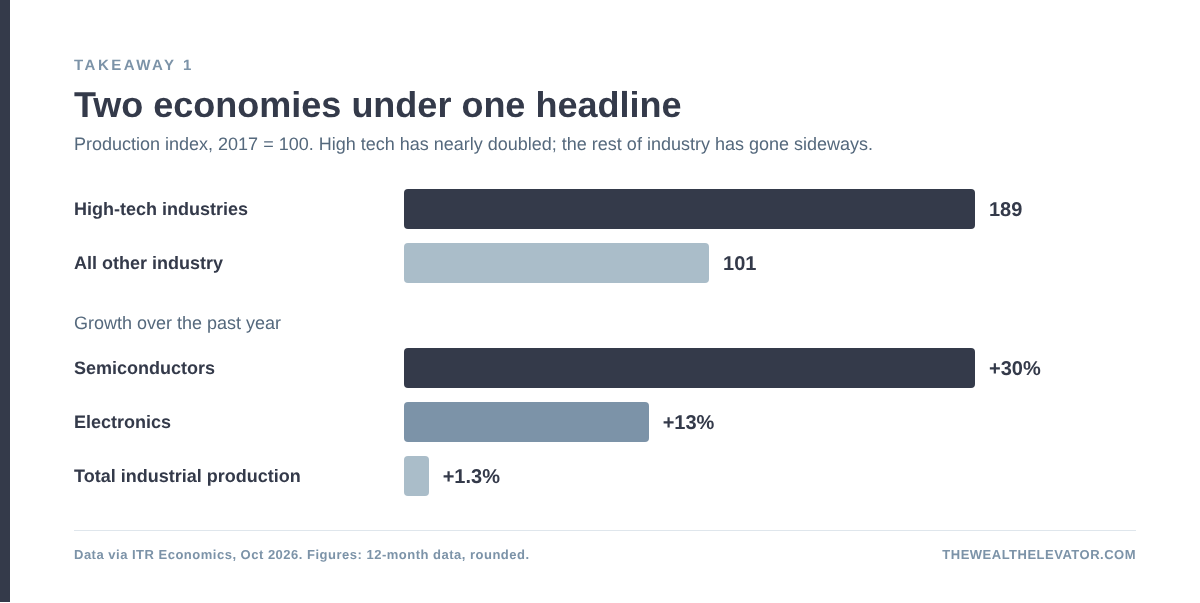
Why this matters: averages blend a booming slice with a flat one, so the blended number describes almost nobody. It’s the industrial version of the K-shaped consumer economy people keep talking about. If you own real assets, the economy that counts is the one your tenants, their employers and your local market actually sit in. ITR’s own outlook calls for industrial growth to flatten into 2027 with a mild pullback, which Saidel-Baker said she does not see as a hard landing. I wrote about the broader cycle in the post-COVID stimulus era.
2. The data center build-out isn’t finished, but it’s lumpy
Private data center construction ran about $63 billion over the past 12 months, up roughly 38.5% from a year earlier. ITR’s forecast calls for another stretch of accelerating growth over the next four or so quarters and positive activity into late 2028 or early 2029. Saidel-Baker said she isn’t seeing signs of overbuilding yet, and that if this is a bubble, she doesn’t expect it to pop soon. She was also clear that risks sit under the surface. For the investor side of that question, see the signals a former Wall Street banker watches to tell if the AI boom is ending.
Two things stood out to me. First, the activity is concentrated. A handful of states are hotspots and others see almost nothing, and the main brake isn’t money. It’s permitting, local pushback (nobody wants a data center in their backyard) and how many construction crews exist. Second, there’s already a finished cycle to learn from. Chip and electronics factory construction, boosted by the CHIPS Act, peaked in 2022 and 2023 and is now down around 40% year over year to about $65 billion. Once a factory is built, nobody builds it again the next year.
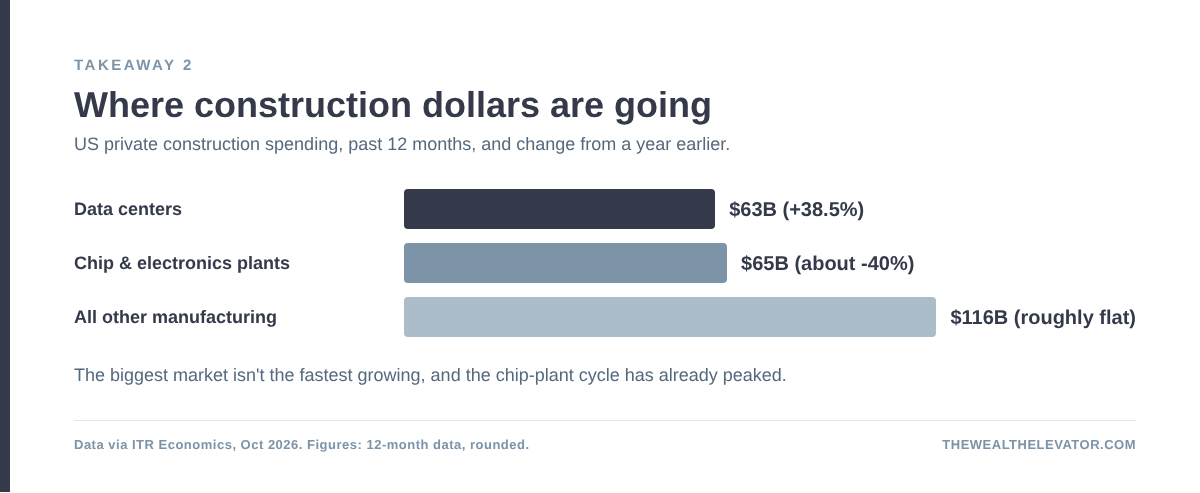
| US private construction (past 12 months) | Spending | Change from a year earlier |
|---|---|---|
| Data centers | $63B | +38.5% |
| Chip, electronics and electrical plants | $65B | About -40% |
| All other manufacturing | $116B | Roughly flat |
Why this matters: physical booms are regional and they end. Her other point is one I repeat to our members all the time in a different context: don’t confuse the size of a market with its growth rate. Legacy manufacturing construction is still the bigger pie at around $116 billion. It just isn’t growing.
3. You pay for the boom even if you’re not in it
The companies behind data centers have very deep pockets, and they’re soaking up construction labor, machinery and equipment. Construction machinery orders are up double digits. Industrial machinery orders are up sharply too, with higher prices doing part of the lifting.
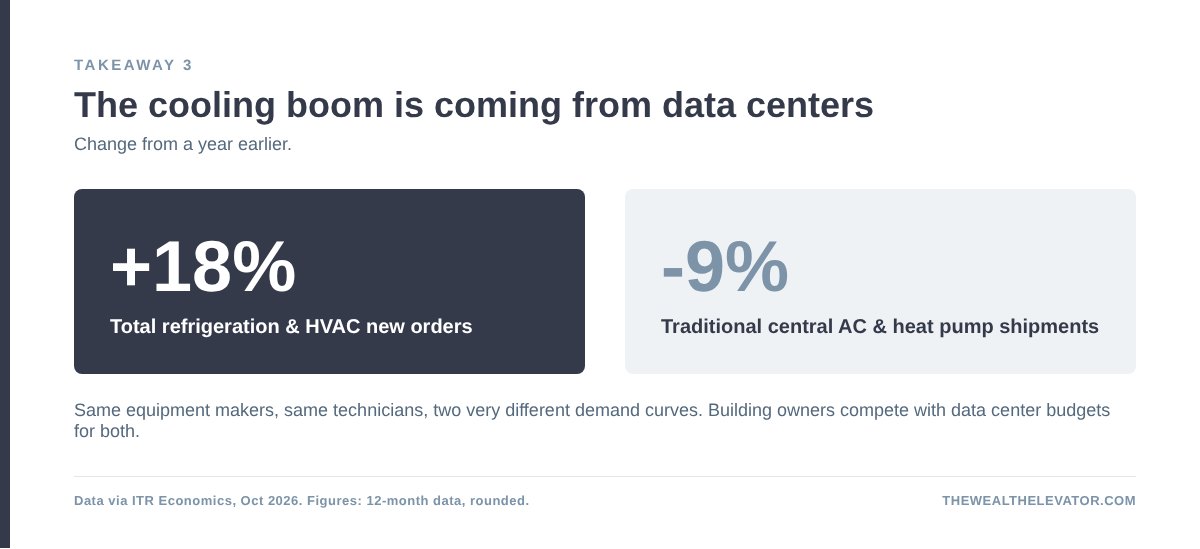
The HVAC chart was the clearest example. Total refrigeration and HVAC new orders are up about 18%, while shipments of traditional central AC units and air-source heat pumps are down about 9%. Cooling for data centers is driving the orders, and the regular residential and commercial market is not. Same components, same technicians, two very different demand curves.
Then there’s power. The electric power producer price index is at its highest level in the 20 years on ITR’s chart, and it started climbing right around when data centers came online at scale. Saidel-Baker made the point that everyone is focused on oil and the Middle East, so the data center side of rising electricity costs is getting missed. She doesn’t expect power prices to level off, let alone decline, anytime soon.
Why this matters: if you own apartments or commercial buildings, you’re bidding for the same contractors, the same HVAC equipment and the same kilowatt-hours as companies with nearly unlimited budgets. As an engineer, my first question for any operator right now is whether their repair, replacement and utility assumptions were set before this pressure showed up. (I go deeper on that in the underwriting games in multifamily deals.) Even businesses that aren’t serving data centers are feeling higher prices without the extra revenue.
4. Tech is getting more expensive again
For most of our lives, technology got cheaper every year. Computers went from filling a room to fitting in a pocket, and prices followed. That trend has bent. Producer prices for computer storage devices are up about 39% year over year, electronic components about 18%, semiconductors about 17% and computers and electronics overall about 10%. Total producer prices are up about 4.8%.
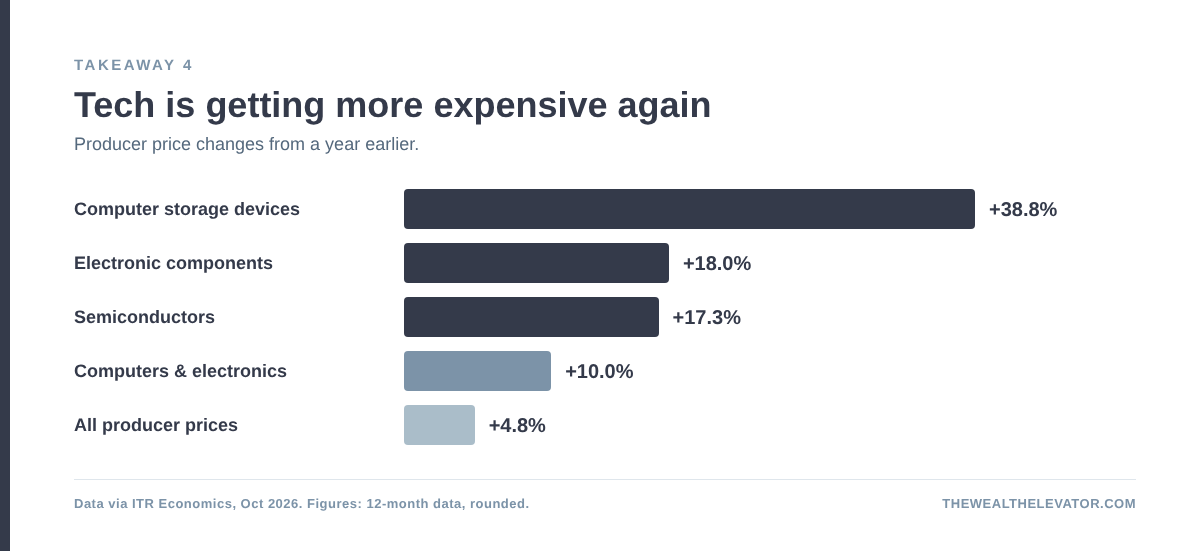
| Producer price index | Change from a year earlier |
|---|---|
| Computer storage devices | +38.8% |
| Electronic components | +18.0% |
| Semiconductors | +17.3% |
| Computers and electronics | +10.0% |
| All producer prices | +4.8% |
Saidel-Baker described this as adding a floor under inflation on top of whatever oil is doing. She also raised the possibility of demand destruction: when a new computer system costs that much more, a lot of businesses will just run the old equipment longer. That’s part of why ITR sees 2027 as a softer year, though again not a severe one.
Why this matters: a lot of people assume the latest inflation bump is an oil story that fades when oil does. (I’ve written before about 25 years of false alarms on oil.) Part of it is structural demand for chips and servers, and that piece doesn’t fade on the same schedule. For anyone thinking about purchasing power over the next decade, that’s a different conversation than it was five years ago.
5. AI is hitting white-collar work first, and the productivity proof isn’t in yet
Adoption is lower than the hype suggests. The industries furthest along (finance and insurance, information, professional services) sit around half of companies using AI in some way. Manufacturing is just over 20%, and agriculture, transportation and warehousing are lower still.
On productivity, Saidel-Baker said the jury is still out. The productivity trend may have steepened since 2021 or so, but the bend we got from PCs and the internet in the 1990s and early 2000s was much steeper than anything AI has shown so far. AI is the latest round of technology, not the first.
The labor data is where it gets personal. Overall layoffs are low. But layoffs in information services are running about 26% above their 10-year average, and financial services about 8% above. Manufacturing and construction layoffs are running about 15% to 17% below average, because AI can’t do the plumbing or the finish carpentry and employers are holding onto those workers tightly. In computer programming, employment is down slightly while average earnings are up about 4%. Fewer people, paid more.
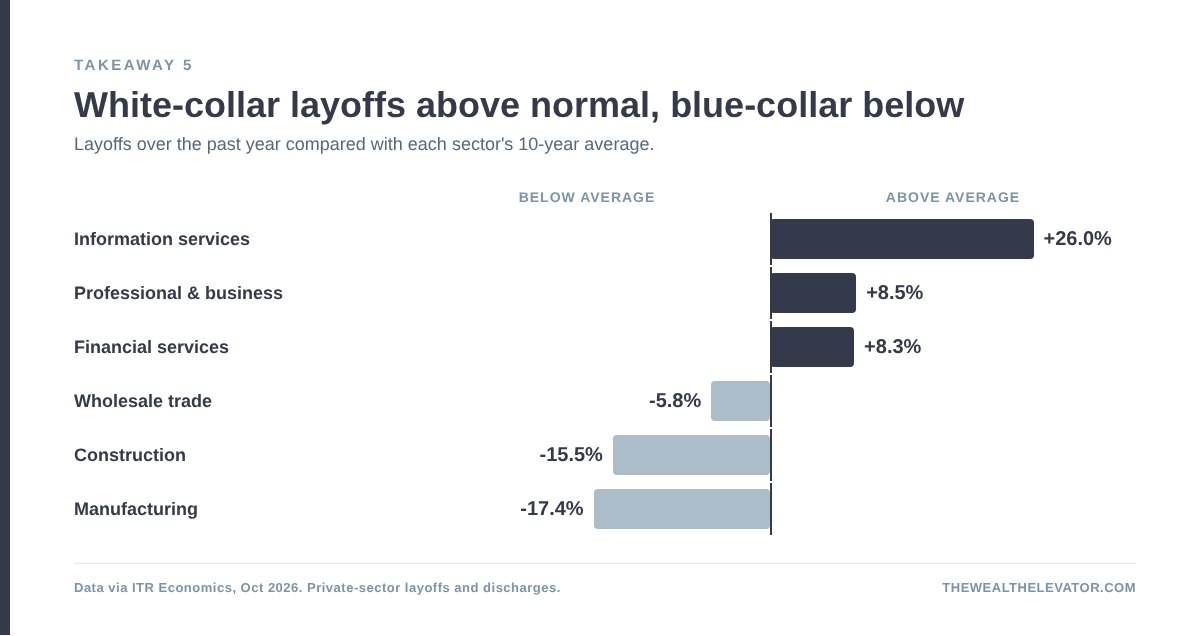
Why this matters: many of the people I talk with are high-earning professionals in exactly the fields where layoffs are running above average. The job that felt safest ten years ago may be the one most exposed now, while the trades stay scarce and expensive (which loops right back to takeaway three).
What I’m watching
Saidel-Baker closed with four things that decide how far this cycle runs: power, productivity, returns and capacity. Can the grid keep up? Does productivity actually bend upward? Do the returns justify the spending? Does infrastructure keep pace with demand?
I’m not trying to pick which AI company wins. I pay more attention to the second-order effects, like what it costs to fix a roof, cool a building or hire an electrician, and where construction dollars are flowing. Her caution to companies applies to investors too: be intentional, and don’t get out over your skis just because a space is exciting.
FAQ
Is the data center construction boom over?
Not according to ITR Economics. Data center construction was about $63 billion over the past 12 months, up roughly 38.5%, and ITR expects another stretch of accelerating growth before it slows, with positive activity into late 2028 or early 2029. Growth is concentrated in certain states, and risks remain.
Why are electricity prices rising?
Oil gets the headlines, but data centers are a big and often missed driver. The electric power producer price index is at its highest level in 20 years on ITR’s chart, and ITR doesn’t expect power prices to level off soon.
Is AI making the economy more productive yet?
The evidence isn’t conclusive. Productivity may have steepened since about 2021, but the gains from PCs and the internet in the 1990s and early 2000s were much larger than anything AI has shown so far.
Which jobs is AI affecting most?
White-collar fields so far. Layoffs in information services are about 26% above their 10-year average and financial services about 8% above, while manufacturing and construction layoffs are running below average.
If you want to be around investors who think this way, come join our community inside the club.
Data via ITR Economics.
This is educational content, not tax, legal, or investment advice. We are not attorneys, CPAs, or financial planners. Please let us know if you need a referral to a 💼 CPA, ⚖️ Lawyer, or other vendor here.