Is the AI Boom Ending? The Signals a Former Wall Street Banker Watches

Short answer: Nobody can time the end of the AI trade, but a few signals show whether the build-out is still working: whether hyperscalers earn enough new revenue on what they spend, whether renting AI chips is getting cheaper or pricier, which supply bottleneck is binding, and how far paid AI models stay ahead of cheap open ones.
Almost every investor call I get lately has some version of the same question: is AI a bubble, and when does it pop?
I’m not a stock picker, and I’m not a financial planner. But I’m an engineer by training, and I like having a real measuring stick instead of a gut feeling. So on a recent episode of the podcast I sat down with Daniel Anderson, who writes The Money Maniac blog and newsletter. Daniel studied engineering and finance at Cornell, then worked as an investment banking analyst at JPMorgan in a specialty M&A group before leaving to write and run his own AI-driven business.
What I liked about his take is that he doesn’t argue AI is great or AI is doomed. He gave me a short list of things you can actually watch to see whether the build-out is still working. I’m going to walk through those here, along with where I agree and where I’d push back.
You’re probably already in the AI trade
Before the signals, a reality check. A lot of people tell me they “don’t own any AI stocks.” Then I ask what’s in their 401(k).
Nvidia alone was about 8% of the S&P 500 in September 2026 (State Street had it at 8.08% of SPY on September 10). The ten biggest companies in the index now make up roughly 38% of it, up from about 23% in 2019. Add Microsoft, Alphabet, Amazon, Meta, Broadcom and the rest of the names riding the data center build-out, and Daniel’s estimate was that a plain S&P 500 index fund carries something like 30% to 40% exposure to the AI theme.
On the episode I brought up a business owner who had about 13% of her net worth in Nvidia stock, and my first reaction was that it sounded aggressive. Then I did the math. Anyone holding the S&P 500 already has around 8% in that one company without ever deciding to buy it. Her position wasn’t that far off from what most index investors hold by default.
So whether or not you think of yourself as an AI investor, the question of when this cycle turns probably matters to your portfolio.
How the AI trade actually works
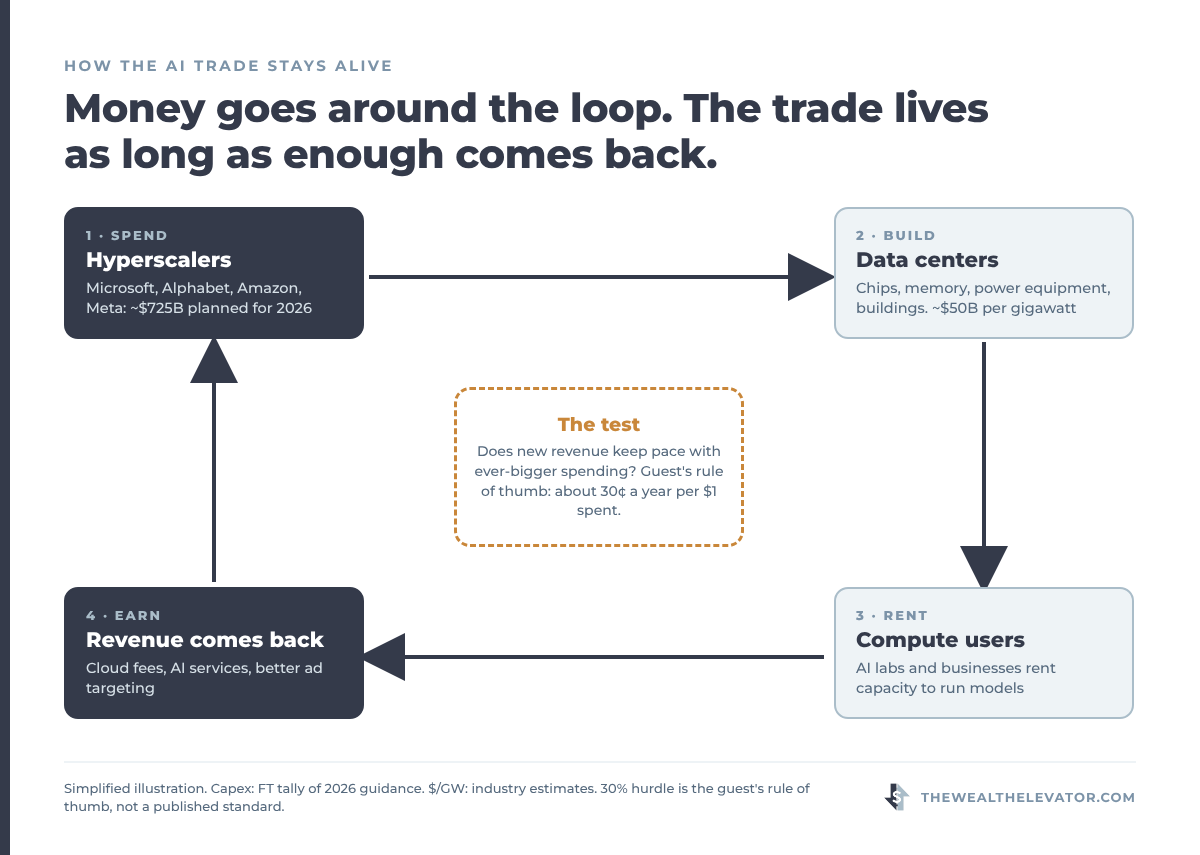
Here’s the simple version of the machine. A handful of hyperscalers (Microsoft, Alphabet, Amazon, Meta) spend enormous sums building data centers. That money buys chips, memory, power equipment and buildings. The finished capacity gets rented out to AI labs and businesses, who use it to run models and sell tokens and services. That revenue flows back to the hyperscalers, which justifies the next round of spending.
As long as the money coming back is big enough relative to the money going in, the loop keeps spinning. If the returns stop showing up, the spending gets cut, and everything downstream of that spending (chip makers, memory makers, power equipment suppliers and a big chunk of the S&P 500) feels it.
Signal 1: Are the hyperscalers earning a return on what they spend?
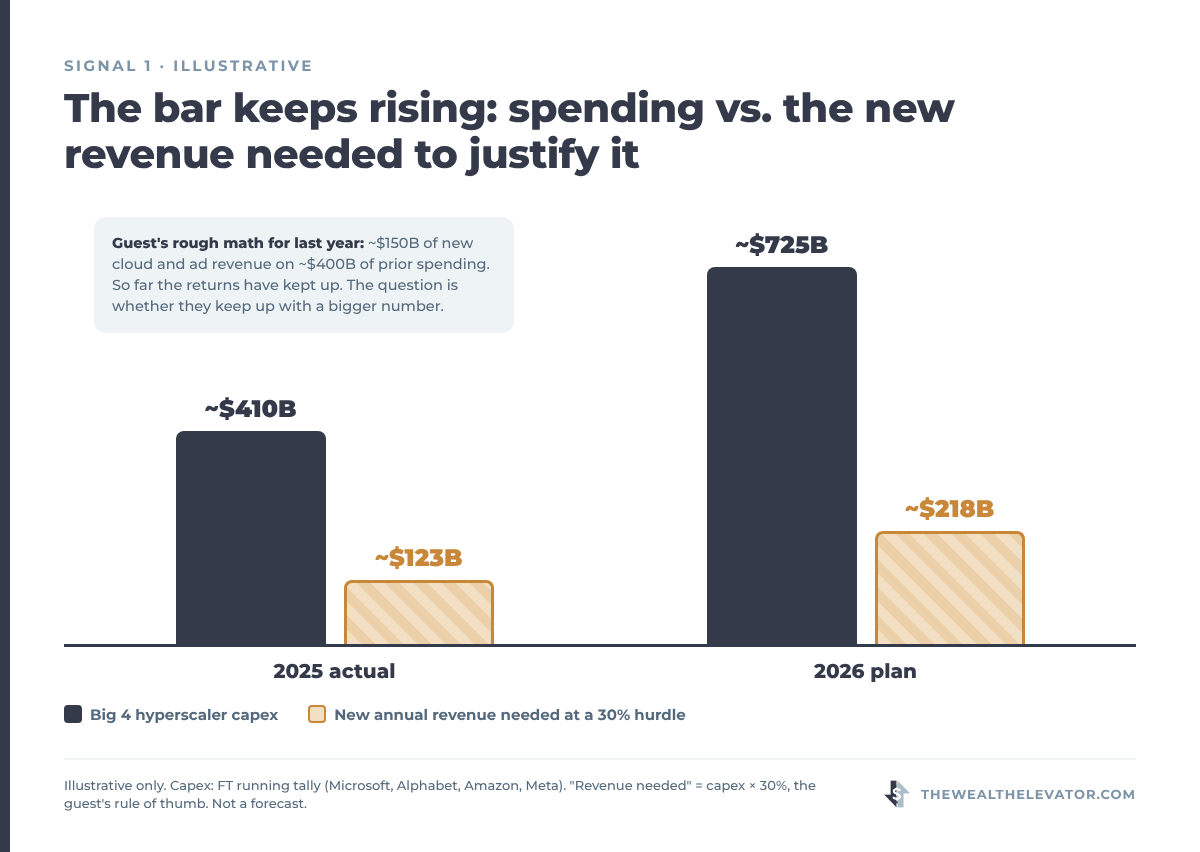
The scale here is hard to wrap your head around. Industry estimates put the cost of a one-gigawatt AI data center at roughly $50 billion. Going into 2026, the big four guided to about $725 billion of capital spending for the year, up around 77% from roughly $410 billion in 2025, according to the Financial Times’ running tally.
Daniel’s rule of thumb is that this spending needs to produce about 30 cents of new annual revenue per dollar invested for it to make sense. When I worked at a Fortune 50 company, we used a similar 20% to 30% hurdle before we’d put new infrastructure in the ground, so the logic felt familiar to me.
At 30%, $725 billion of spending implies the need for something on the order of $200 billion of new, recurring revenue. Daniel’s back-of-envelope on last year was that cloud revenue growth at Amazon, Google and Microsoft plus Meta’s ad growth added roughly $150 billion of revenue against about $400 billion of prior-year spending. That’s his rough math, and you can’t credit all of Meta’s growth to AI, but it suggests the returns have kept up so far.
The catch is that the bar keeps rising. Every year the spending gets bigger, so the revenue needed to justify it gets bigger too. Free cash flow has dropped at several of these companies, and some are issuing bonds to help pay for the build-out. This is the signal I’d watch most closely: when the revenue growth stops keeping pace with the capex growth, the story changes.
Signal 2: What does it cost to rent a chip?
This was the indicator Daniel called one of the most important, and I agree with him.
If you’re an AI startup, you don’t buy chips. You rent compute by the hour from a cloud provider. So rental prices tell you, in near real time, whether demand is outrunning supply.
Here’s what got my attention. Nvidia’s H100 is an older chip at this point. Normally older hardware gets cheaper to rent as newer chips come out. Instead, one-year H100 contract rates climbed nearly 40% between October 2025 and March 2026, from about $1.70 to $2.35 per GPU-hour, according to SemiAnalysis data. Several providers raised list prices again this fall.
An aging chip getting more expensive tells you capacity is still sold out. The day that reverses and rental rates start sliding for a sustained stretch, it probably means supply has caught up with demand. That’s usually when the build-out slows, and an early sign the trade could be ending.
Signal 3: Where is the bottleneck now?
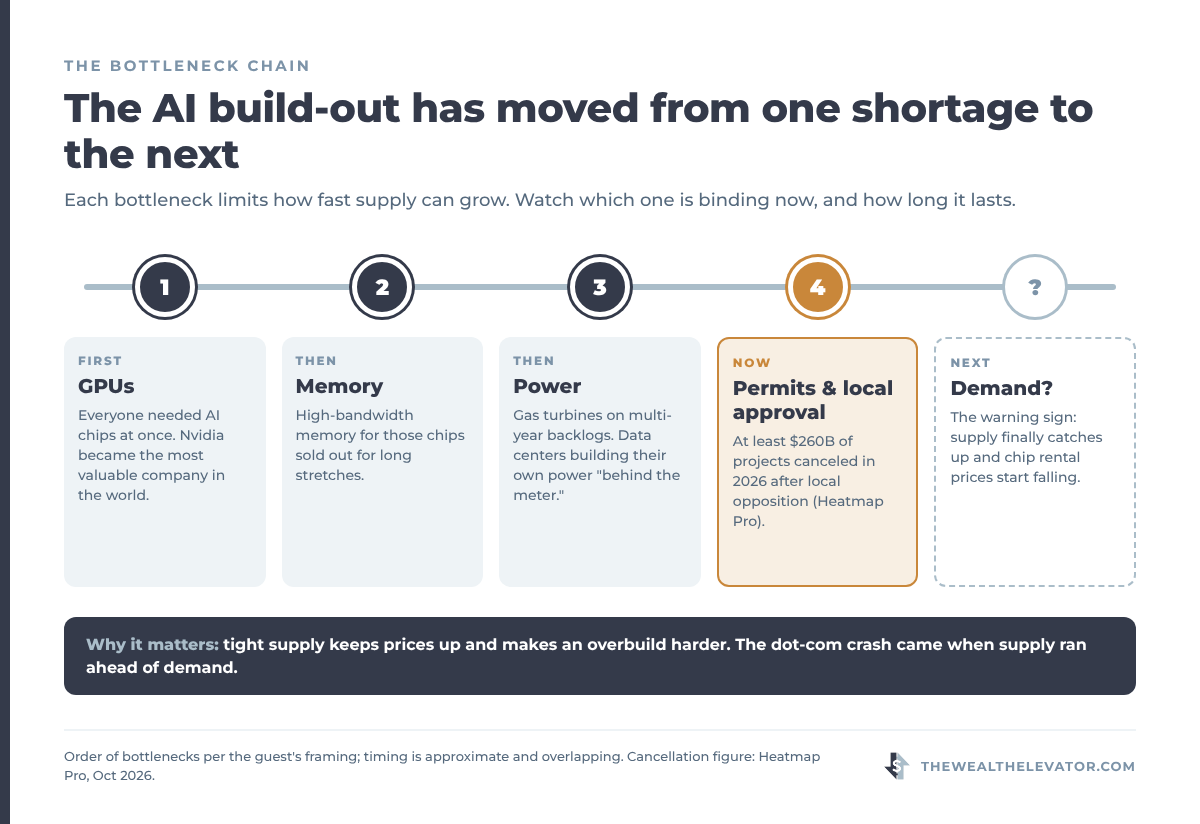
Daniel made a point I hadn’t thought about this way. The AI trade has moved from one bottleneck to the next, and each shortage has become its own mini boom.
First it was GPUs, which is how Nvidia became the most valuable company in the world. Then memory got tight, specifically the high-bandwidth memory these chips need. Then power: gas turbines are on multi-year backlogs, and data centers are building their own generation behind the meter. Now it’s permits and local approval.
On that last one, the pushback is real. Heatmap Pro tracked at least $260 billion of data center investment canceled in 2026 after sustained local opposition, and roughly half of the projects that met local backlash this year ended up canceled.
Here’s the part I found interesting. Daniel argued that all this friction is actually protecting the trade. You can’t overbuild something when you’re short on turbines, short on memory and fighting a county board for every site. Those limits keep supply tight, which keeps prices up.
Signal 4: How far ahead are the paid models?
The last risk we talked about was cheap, open models. An open-source model is one you can download and run on your own server (or for smaller ones, a laptop or a Mac Mini that runs around the clock). Your data stays with you and there’s no per-token bill. Daniel’s estimate was that for routine work like sorting email, these models can be close to 90% as good as the frontier models from the big labs.
That puts the big labs on a treadmill. They have to stay meaningfully ahead to justify charging a premium. Daniel put the US labs at maybe six months ahead of the best Chinese open models. If that lead disappears, a lot of the revenue that’s supposed to justify all this spending gets harder to earn.
I compared it on the show to buying a knockoff sports jersey for a fraction of the price. If the knockoff is nearly as good, most people stop paying full price. The counterpoint is that in competitive industries, businesses will keep paying for the best model because they can’t afford to fall behind. Both of those forces are playing out at once.
Why this isn’t the dot-com crash (yet)
The obvious comparison is 1999 to 2001. What sank the telecom side of that cycle was overbuilding. Companies laid far more fiber than the internet needed at the time. By 2001, industry estimates put only a few percent of that capacity in use, and a lot of the companies that built it went bankrupt. The internet did eventually grow into all that fiber, but there was a painful gap first.
The AI build-out looks different in a couple of ways. The spending is concentrated in a handful of very profitable companies instead of thousands of startups. And instead of unlimited supply, it’s running into hard physical limits. The open question is whether those limits hold, or whether the industry eventually builds more than it needs.
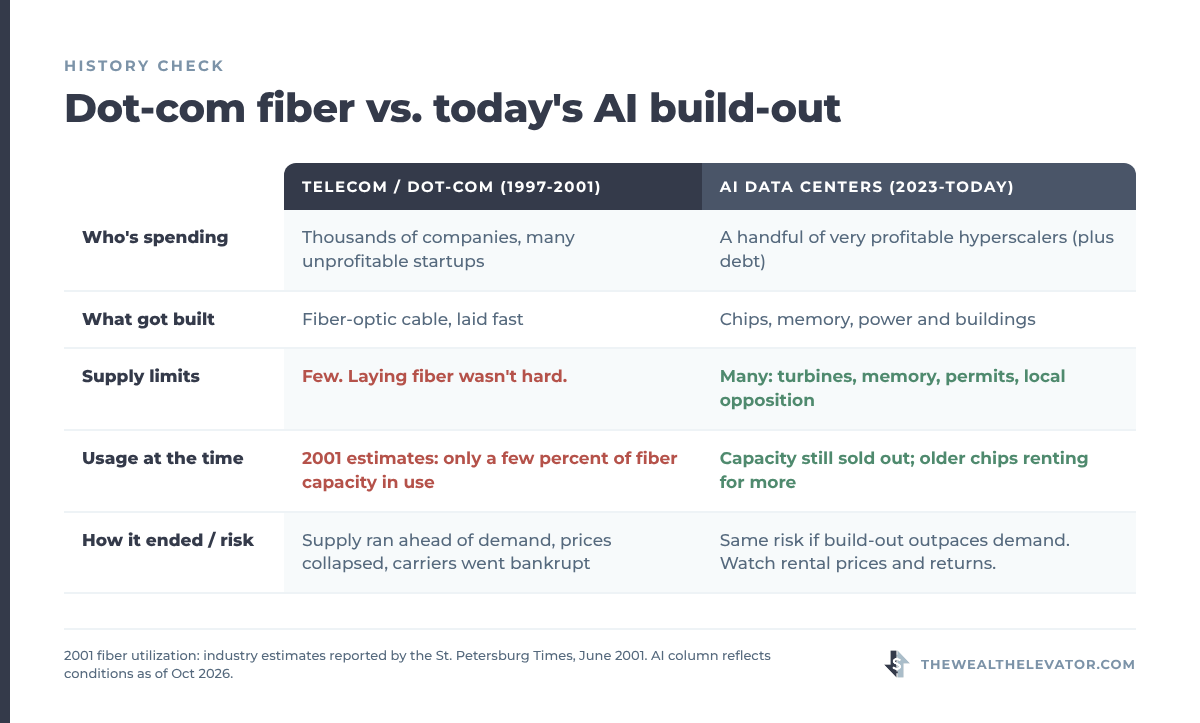
| Telecom / dot-com (1997-2001) | AI data centers (2023-today) | |
|---|---|---|
| Who’s spending | Thousands of companies, many unprofitable startups | A handful of very profitable hyperscalers, plus debt |
| What got built | Fiber-optic cable | Chips, memory, power and buildings |
| Supply limits | Few; laying fiber wasn’t hard | Many: turbines, memory, permits, local opposition |
| Usage at the time | 2001 estimates: only a few percent of fiber capacity in use | Capacity still sold out; older chips renting for more |
| Risk | Supply ran ahead of demand; prices collapsed | Same risk if build-out outpaces demand |
What I take from this
I’m not going to tell you what to do with your portfolio. That depends on your timeline, what else you own and when you need the money.
What I will share is a lesson from my own investing. Looking back at past corrections, in stocks and in real estate, my mistake usually wasn’t greed. It was that I never decided ahead of time what my exit point was. Things ran, emotions got involved, and I kept moving the goalposts. Daniel said he sees the same pattern: people pick a number, hit it, then decide they want a little more.
So whatever you think about AI, it’s worth writing down two things before the next big move: what would make you change your mind (one of the signals above is a good place to start), and what your number is. A younger investor with 20 years ahead can ride out a full cycle. Someone a few years from retirement may not want to.
On the episode Daniel also mentioned the barbell idea: if you’re going to take concentrated risk on one side, balance it with steadier assets on the other side, like bonds or real estate.
FAQ
How much of the S&P 500 is tied to AI?
Nvidia alone was about 8% of the S&P 500 in September 2026. My guest, Daniel Anderson, estimated that a plain S&P 500 index fund carries roughly 30% to 40% exposure to the AI theme once you add the other big tech names.
What is an early warning sign that the AI boom is ending?
Daniel’s top indicator is the price to rent AI chips. Prices rising, even on older chips like Nvidia’s H100, mean demand still outruns supply. A sustained drop would suggest supply has caught up and the build-out may slow.
How much does an AI data center cost to build?
Industry estimates put a one-gigawatt AI data center at roughly $50 billion, most of it chips and other hardware.
Is the AI boom like the dot-com bubble?
The risk is similar (building more capacity than demand can absorb), but the setup differs. Spending is concentrated in a few very profitable companies, and the build-out keeps running into physical limits like turbines, memory and local permits that slow overbuilding.
Related reading
- The Myth of the Oil Crisis: what 25 years of false alarms teach about doom headlines
- How retirees weigh stock market risk against private real estate
- How to check the person behind a financial advisor’s credentials
If you want to be around investors who think through cycles like this, come join our community at theWealthElevator.com/club.
You can find Daniel’s writing at themoneymaniac.com.
This is educational content, not tax, legal, or investment advice. We are not attorneys, CPAs, or financial planners. Please let us know if you need a referral to a 💼 CPA, ⚖️ Lawyer, or other vendor here: thewealthelevator.com/vendor. Figures cited are from public sources as of October 2026 and may change.
Sources
- State Street SPY holdings via Mezzi, Nvidia 8.08% of SPY (Sept 10, 2026)
- ChartRow, S&P 500 top-10 concentration
- FT tally via AI Weekly, $725B 2026 hyperscaler capex
- Global Data Center Hub, ~$50B per gigawatt
- Akash / SemiAnalysis, H100 rental prices 2026
- Heatmap, $260B of data center projects canceled
- Tampa Bay Times archive, 2001 fiber glut