

We were walking down the street a while back and passed a house. Nice place, probably $2 million, and it turned out it was being rented out for $10,000 a month. My wife looked at it and said something like, “That’s crazy. Who can even afford that, and how does that math work?”
I went home and actually ran the numbers. This is that breakdown.
If you’ve always assumed buying beats renting, full stop, this one’s for you.
The Cash You Don’t See Again
Say you buy that $2 million house with 20% down. That’s $400,000 out of pocket before you even get to closing costs, which run you another $40,000 or so once the lending and real estate brokers take their cut. Now you’re at $440,000 in cash just to get the keys.
That $440,000 doesn’t disappear. It becomes equity. But it also becomes dead equity, meaning it’s sitting in a house instead of working anywhere else. As a business owner and an investor, cash today is what lets you load new investments when they show up. Once it’s tied up in a down payment, it’s off the table until you sell or refinance.
What Owning Actually Costs You Every Month
On the remaining $1.6 million mortgage at a jumbo rate around 6.5%, you’re looking at roughly $10,100 a month in principal and interest. Add property taxes and insurance and you’re at about $11,000 PITI.
Then there’s maintenance. I use 0.75% of the home’s value a year as a base case, which comes out to about $1,250 a month. That might feel low the first year you own a new build, but appliances break, and if you’re in a place that gets hurricanes, you’ll eat through that cushion faster than you think.
Last piece: opportunity cost. If you rent instead, that $440,000 doesn’t have to sit still. I’m going to assume a conservative 5% return on it (through something like a properly structured life insurance policy, for example), which is roughly $1,833 a month. I could probably do better than 5% elsewhere, but I’d rather sandbag this assumption than oversell my own argument.
Add it up and owning runs you about $14,000 a month once you count the mortgage, maintenance, and what that down payment could have been earning elsewhere. Compare that to $10,000 a month in rent, and renting comes out about $4,000 a month ahead before you even factor in anything else.
Give Ownership Its Fair Credit
None of this means owning is a bad deal. It means the comparison has to include the parts that favor buying too.
Part of that $11,000 PITI is paying down principal, not disappearing. On a $1.6 million loan at 6.5%, you’d pay down roughly $102,000 of principal in the first five years and about $244,000 over ten. That’s real equity building, and it belongs on the buy side of the ledger.
Then there’s appreciation, which is the part most people jump to first and the part I trust the least. Here’s how the math shakes out at three different assumptions:
- At 1% annual appreciation, renting stays ahead by roughly $174,000 after five years and $121,000 after ten.
- At 3% annual appreciation, buying pulls ahead by about $28,000 after five years and $316,000 after ten.
- At 5% annual appreciation, buying is ahead by roughly $247,000 after five years and $839,000 after ten.
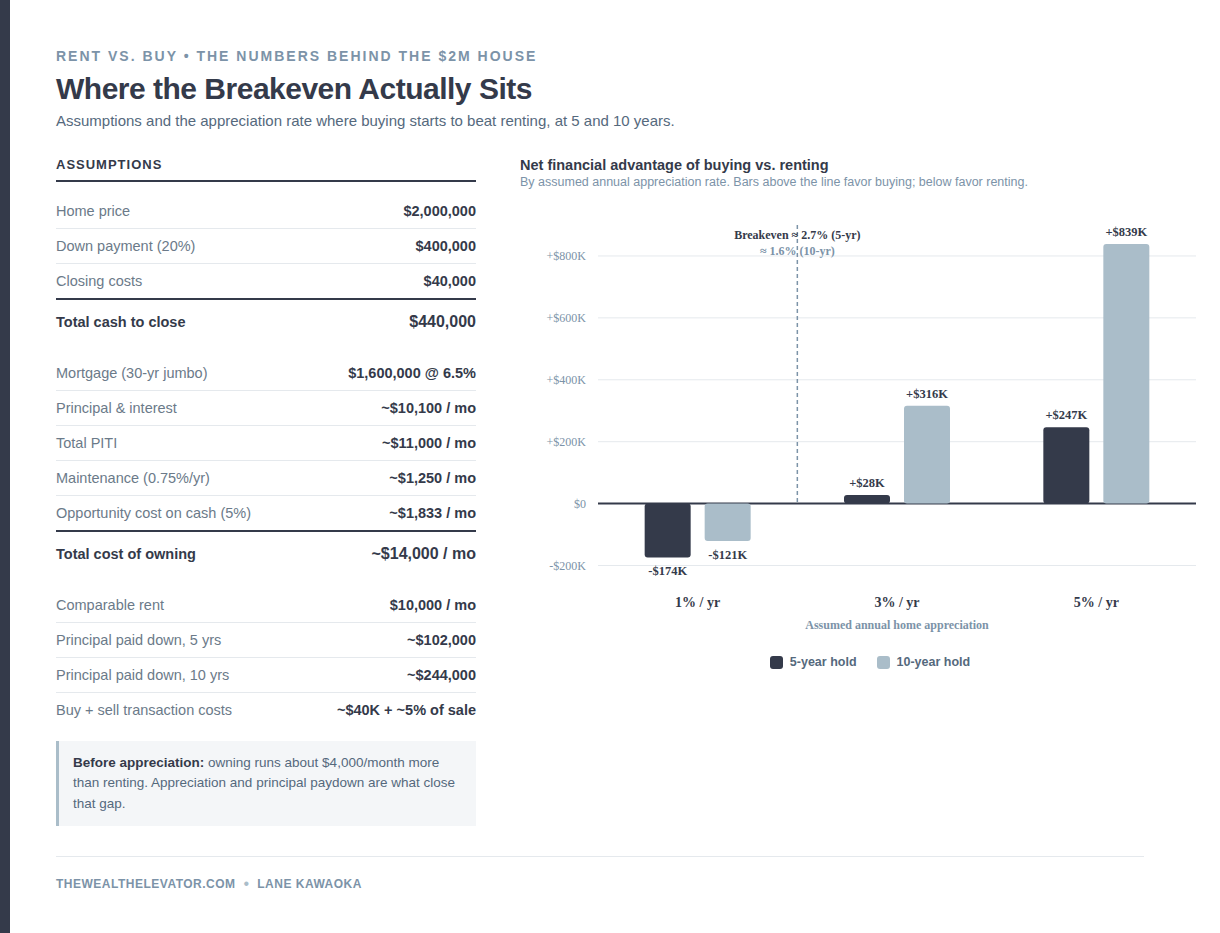
I don’t build my own assumptions above 2% to 3% appreciation, and I’d encourage you not to either. At that rate, the five-year comparison is close enough that it barely matters which way you go. The ten-year comparison is where owning starts to separate itself, assuming you actually hold that long.
That “assuming you hold that long” part matters more than people give it credit for. Buying and selling this house costs you real money: about $40,000 going in and another 5% of the sale price going out. On a $2.32 million sale five years from now, that’s another $116,000 gone to transaction costs alone. Most people don’t stay in a house past five to ten years. If you’re not confident you’ll hold long enough to absorb that friction, renting starts looking a lot more rational.
What About the Mortgage Interest Deduction?
This is the argument I hear most often, and it’s the weakest one on the list.
First, the technical problem: the mortgage interest deduction only applies to acquisition debt up to $750,000 under current law. On a $1.6 million loan, more than half the interest you’re paying every month isn’t even eligible for the deduction in the first place.
Second, the bigger problem: even on the portion that is deductible, you’re paying a full dollar of interest to save a fraction of that dollar in taxes. That’s not wealth creation. It’s a real benefit, and I’ll take it when it applies, but I’m not going to let it turn a mediocre financial decision into a good one.
When Buying Actually Wins
If you’re confident you’ll hold the property for ten or more years and you’re comfortable assuming 3% appreciation, the math tips toward buying, mainly because of leveraged appreciation and principal paydown, not the tax deduction.
There’s also a longer game here worth mentioning. The IRS lets you exclude up to $250,000 in gains ($500,000 for married couples) on the sale of a primary residence, as long as you’ve lived in it for two of the last five years. If you’re the type who moves every few years anyway, stacking that exclusion house to house is one of the few ways to actually extinguish a tax bill instead of just deferring it. You’ll pay your realtor more often for the privilege, but it’s a real tool.
The Pattern I See Once People Actually Get There
Something I’ve noticed with clients who cross the $4 million to $5 million net worth mark: they tend to do two things. They move to lower-tax states. And, somewhat counterintuitively, they stop needing the third, fourth, or fifth bedroom and downsize, which often means they go back to renting. Once your timeline gets less certain (you don’t know who’s still going to be living in that house with you in fifteen years), renting starts to make more sense again, not less.
The same logic applies to vacation homes, maybe even more so. If you ran the numbers on a Four Seasons at $1,000 to $2,000 a night and stretched that out to $300,000 a year, you’d probably rather have the flexibility to go somewhere different every time than own one property you visit twice a year. It’s an extreme example, but it’s the same math.
So I Know What You’re Thinking
“You’re ignoring appreciation.” I’m not. It’s the single strongest argument for buying, because you’re leveraged into a $2 million asset with $440,000 of your own money. I just don’t think a housing decision should require betting on appreciation above 3% to make sense.
“What about the tax deduction?” It’s real, and it should be in your spreadsheet. It just shouldn’t be the reason you buy a house you’d otherwise rent.
Paying $10,000 a month to rent a $2 million house isn’t throwing money away. It’s paying for the use of a $2 million asset without tying up $440,000, without taking on maintenance risk, and without absorbing transaction costs you’d only recover by holding for years. The strongest case for buying instead is leveraged appreciation plus principal paydown over a long hold, not the deduction everyone brings up first.
Run your own numbers before you decide either way. Every situation is different, and the answer changes with your timeline, not just the price tag.
If you want to see how I structure the “opportunity fund” side of this (the capital I keep liquid instead of parking it in a house), that’s part of what I walk through at the club.