



What is Turnkey Real Estate Property?
A turnkey rental is a house that has already been renovated, rented and placed with a property manager before you buy it. You own the property and collect the rent while a local team runs it. It suits investors who live in expensive markets and want cash-flowing rentals in cheaper ones.
This content is a sample of our comprehensive Remote Rental eCourse, which is FREE for everyone.
Looking for the free rental property analyzer? Download it in the Deal Analysis section of the eCourse.
What are the benefits and risks?
Benefits of turnkey rentals:
Risks of turnkey rentals:
Benefits of turnkey rentals:
- Create relatively stable passive income that requires only a couple hours a month to manage
- Potential to build net worth through appreciation, mortgage pay-down and tax deductions, none of which are guaranteed.
- Built-in referral base. Turnkey companies can reduce the amount of guesswork by providing referrals to property managers, property inspectors, lenders, and insurance agents.
- There is usually a tenant in place before you close, so rent can start right away. Whether the property is profitable depends on your expenses.
Risks of turnkey rentals:
- No investment opportunity is free of risk and Turnkey Investment is no different. Here are a few of the factors that must be strongly considered before investing:
- The condition and maintenance of the property - While everyone would like to buy a property that is either new or in excellent condition, the reality is that some of the properties are not in the best shape and are even located in low income areas. The responsibility falls on you, the investor, to make sure the condition of the property does not prevent your Turnkey from being profitable.
- You will pay market value at minimum for the property.
- Your profits are tied to the housing market.
- Not all Turnkey Rental companies are reliable.
Is Turnkey Investing Right for You?
Turnkey investing can be a great entry point for beginners. Turnkey properties are essentially move in ready properties. Meaning once you buy it - you can start renting it out!
This strategy can work especially well if:
- You live in an expensive area and want to invest out of state for higher returns, lower upfront cash requirements or both.
- You have a full-time job and can’t dedicate a couple hours each day to real estate investing, so you need something that will not take that much time.
- You’re a new real estate investor and are feeling a bit overwhelmed with everything it takes to find, rehab, and lease a property.
- You’re primarily interested in receiving passive cash flow from your rental properties, and are less interested in price appreciation.
Another thing to keep in mind is that buying turnkey properties doesn’t have to be your “be all, end all” approach. You can start by buying one or more turnkeys and later transition to other strategies as you become more experienced.
When I started off my real estate journey, I was working a W-2 job, I was not looking for another job or chore. I am all about leveraging my money and more importantly, time. I did not want to spend my time painting walls, fixing toilets, collecting rents, and deal with late-night calls from tenants.
For people like you and me who live in places (Seattle, West Coast, Hawaii, East Coast, to name a few) where the Rent to Value ratio is 0.5% or less, we have no other option but to invest out of state. It bothers me when people on investor forums say we are overpaying. Our time is better spent at our high paid professions that we busted our butts going through a couple decades of schooling for.
Are we going to make money?
Buying assets where the Rent-to-Value Ratio of more than 1% is needed to be able to cash flow after expenses. You find the Rent-to-Value Ratio by taking the monthly rent dividing by the purchase price.
When I am looking at potential investment properties the rent-to-value ratio is the very first metric I look at with evaluating an investment. To calculate this metric you take the monthly rent divided by the purchase price/value. For example a home that rents for $1000/month that costs $100,000 has a rent to value ratio of 1% (1,000/100,000=1%). The higher the better.
I typically look at a huge list of properties so using excel to make this calculation is the best practice.
Cash flow is one of four ways a rental pays you. For the math behind each piece, see The Four Ways a Rental Property Pays You.
Single-Family vs. Multi-Family Homes
The vast majority of turnkey properties are single-family homes – typically individual houses on their own lot, and less frequently – condos.
Occasionally, you will see multi-family turnkey properties. These are buildings consisting of multiple units (or living spaces). A duplex is a home with two units, a tri-plex has three and a quad has four.
It’s unlikely that you will come across multi-family turnkey properties often, but when you do, I encourage you to evaluate them just like you would a single-family home, but keep their unique advantages and disadvantages in mind.
One type of property is not inherently better than the other, and oftentimes which one you like better will come down to personal preference. Here are the pros and cons of each.
Single-family homes
Pros:
- Easier to rent out – most people prefer their own space rather than having other tenants close by with shared walls
- They are easier to sell
- May appreciate more than multi-family homes
Cons:
- The per unit price on a single family home vs the per unit price on a duplex is much higher
- If the property is vacant one month, you are covering the entire mortgage
- The value of the property is determined by other comparable sold properties in the neighborhood
Multi-family homes
Pros:
- Often have a lower price per square foot, which can help returns
- May have lower maintenance costs per square foot, as all units share one roof, yard, etc.
Cons:
- Often located in lower-quality neighborhoods and may not attract the same quality tenants as comparable single-family homes.
Directly investing in a turnkey rental or small MFH is a good way to start to learn and build up the war chest to go into my scalable investments such as private placement syndications. Whatever you do, try to be as close to the investment as possible. This is the fundamental problem I have with Wall Street who take too much fees off the hard-working efforts of the middle class.
I currently work with one business who I can align with because they offer sort of a hybrid between the marketers (I know you know the reasons why to stay away from them), and going straight to the TKPs.
Since you lose a lot of the protections when you do that and it’s sort like signing agreements in the “wild wild west”. The reason I do it this way is that I get a licensed agent that has a fiduciary responsibility to your best interests and guides you through the transaction as you buy through the TKP. Basically, it’s like having MLS agent to cover you for the off market deals. All the properties are aggregated from only the good TKPs and the same price that you will find on the weekly digest that is sent out by the local TKP.
This is the way I buy my properties and if nothing else it’s good for browsing what’s out there. I may earn a referral fee if you buy through this link.
What is the Turnkey Process?
This is the general overview of the turnkey process:
A turnkey company (which essentially is a large-scale home flipper) finds and buys a run-down house. These houses are often foreclosures, short sales, bank-owned properties or bought at auction. They are cheap, but often need significant repairs before they can be rented out.
The turnkey company uses its in-house rehab team to renovate the house and bring it to a rent-ready condition (which just means it will be competitive on the rental market).
Oftentimes, the turnkey company will find and place a tenant in the property before selling it. This isn’t always the case, but most turnkey providers will do this.
The turnkey company sells the rehabbed rental to you, the investor. These sales are usually off-market, meaning they are not listed on the MLS or available to the general public, so you don’t have to worry about a bidding competition. You buy it for the advertised price.
Once the purchase process is complete, you own the home and can start collecting rental income. The turnkey company will often set you up with their in-house or preferred property manager, or you can pick your own.
There are three ways to purchase a turnkey rental:
Marketer’s Path (Caution Advised)
- Pros: Streamlined process; time-saving.
- Cons: Marketers often lack investment experience; potential overpayment; limited value addition.
- Advice: Opt for this path only if you seek efficiency, but exercise caution. Be prepared to miss nuanced details and potentially overpay.
Direct from Turnkey Provider (The Prada of Providers)
- Pros: Direct sourcing for potentially better prices.
- Cons: Lack of broker representation; transactions follow provider’s rules; risk of overpaying (up to 105% of retail).
- Advice: Approach with caution. Known as the “Prada of Providers,” costs may exceed the property’s actual value. Consider if confident in your due diligence.
Hybrid Method (Balancing Act for the Informed Buyer)
- Pros: Utilizes off-market avenues through an agent with fiduciary responsibility.
- Cons: Agents may lack investment insights; buyer needs to drive the process.
- Advice: Recommended for experienced buyers; balances the advantages of direct access with agent support.
Browse turnkey rentals through the hybrid method here >>
(Bonus) Roofstock: An Alternative Platform
- Pros: Online platform; potential streamlined process.
- Cons: Limited control over transaction terms; suitability depends on individual needs.
- Advice: Explore as an alternative; offers convenience, though be mindful of potential limitations.
Avoid Turnkey Providers Who:
- Restrict financing or a finance contingency, indicating potential overpricing.
- Limit independent property inspections or referrals.
- Present unrealistic pro formas without accounting for vacancy or maintenance.
- Demand upfront renovation payments without a proven track record.
- Primarily sell in low-quality neighborhoods (Class C or D); verify property class independently.
- Fail to provide a detailed scope of work or references from repeat investors.
Starting Fresh: A Smart Move
- Consider starting anew by cleaning house with tenants, setting clear expectations.
- Pay a lease-up fee to eliminate inherited tenant issues and avoid excuses from property management.
Getting an Appraisal: Navigate with Caution
- Appraisal challenges exist, especially for non-owner-occupied properties.
- Pre-2008, appraisers were less regulated; post-2008, the use of appraisal management companies (AMCs) became common.
- Preferred panels of appraisers can reduce the risk of short valuations.
Out-of-State Markets: A Strategic Approach
- Local market dynamics matter; focus on workforce housing over upper-class properties.
- Be wary of properties priced for out-of-state buyers; aim for rents above $900 per month.
- Prioritize return on deployable equity; avoid distractions of low cash flow and focus on long-term profitability.
Pick the path that fits your experience and how much risk you can take, and do your own due diligence whichever you choose.
Out of State (Remote/Absentee) Landlord Abuse
These photos below are examples of what happens if your property manager doesn’t properly screen your tenants. Check out these disaster photos from an eviction that ended up being a $37K repair bill…







It’s no mistake that all of your providers/property managers/maintenance staff know you are not there to verify every little repair or check every bid of potential in-house or third party work 🙁
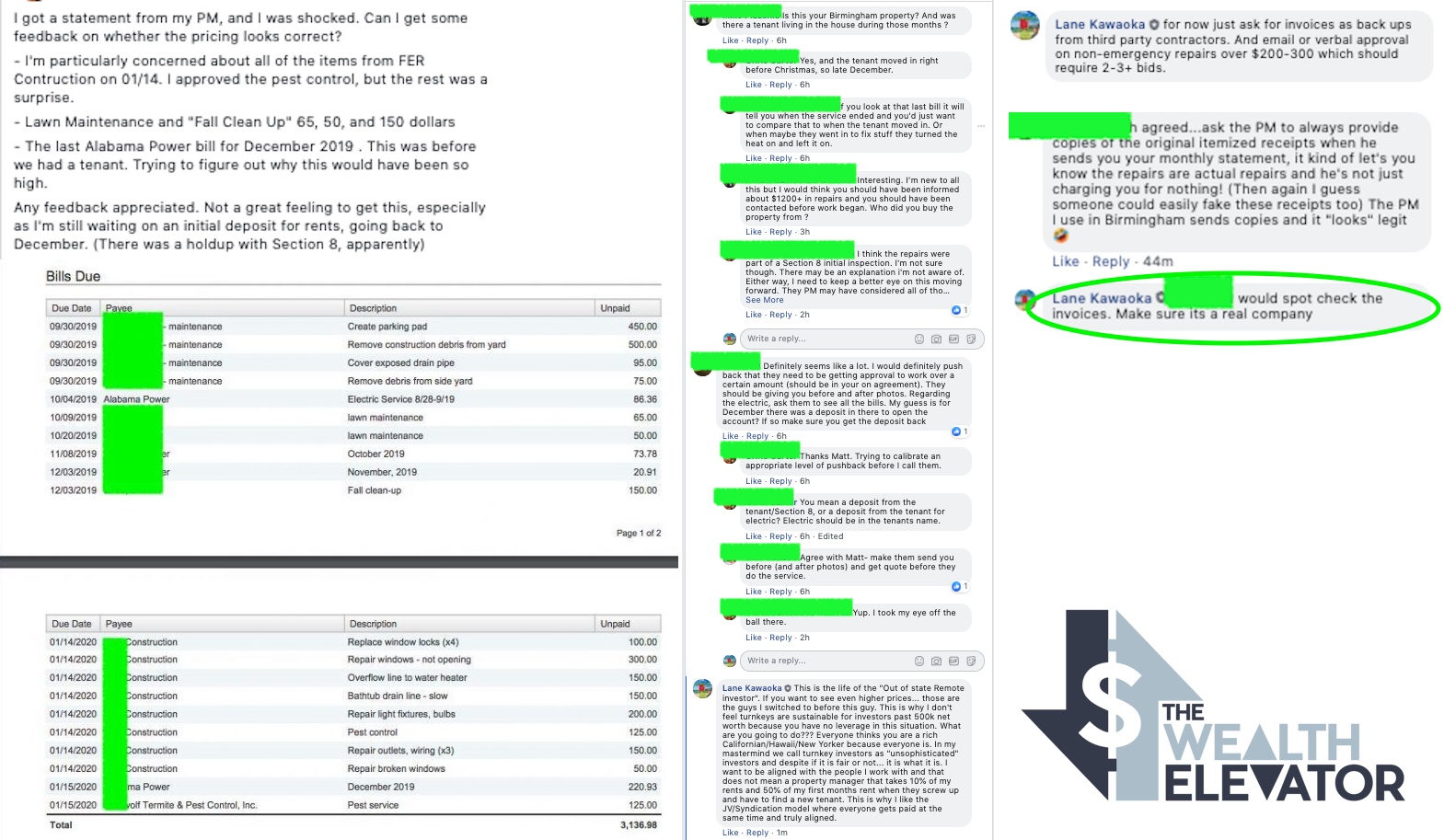
This stresses the importance of building the right team!
“I honestly believe it is a fine balancing game. You can have a PM that is methodical and takes their time finding a “better” long term tenant and it may cost you a couple months of rent but you hopefully make it up on longer tenancies, less evictions, and less turnover costs.
On the other hand, you can be like one of my prior TK PMs and burn and turn the property quickly fill with a “decent” tenant but may have more risk of evicting and a costly turnover due to damages. The type and class of market greatly affects which side is easier.
When I start learning about the small margins PMs make for the amount of work they do, I can see why some prefer the latter. They don’t have to pay for the evictions, fines, and renovations. Also, since margins are small, they more likely have to take on more rentals, which then gives less time and attention to your property. The task is finding a PM with a great system in place and operates in line with your investing strategy but you have to understand it may be hard to get it all.
Work the PM, see if they can get it leased using promos or by lowering rent. Lowering rent by $25-50 a month for a year is less than another month vacant (unless your rent is less than $600).
This is from my limited knowledge and experience but is one of the reasons I got away from SFH. With my limited time, I didn’t want to have to deal with emails about missed rents or costly make readies. I also don’t have the capital to scale quickly enough to mitigate the effects of each incident.
What I found worked well was to rehab the 3-5 of the properties after the tenants just happen to turn over. Each time I was able to do 10-25K of rehab to get it close to retail status. Part of that cost was to just get the property cleaned up which I would have incurred anyway if I got it back online as a rental.”
“Even if you have a portfolio of 10-15 properties, you’re bound to have a big loss at one of your properties every year – whether it be HVAC, eviction, roof, vandalism, etc. I think, for me, I will concentrate on only syndications going forward unless a great deal presents itself. I believe in being really good at one or a couple of things and trying not to spread myself too thin trying in order to learn all sorts of different asset classes at this point in my journey.”
– Mastermind member & Accredited investor
Who Should Invest in Turnkeys?
After countless strategy calls and coaching sessions with investors, here’s the bottom line: If you can save over $30k annually or have substantial liquidity (over $200k), being a landlord or flipping properties is labor-intensive. While some may enjoy it, the key is to remember our initial goal – freedom from a job.
Consider the math: Earning $300 per property after two months of due diligence for a turnkey rental means you’d need 20-40 of these to replace your income. Even with systems in place, having 11 such properties resulted in 1-2 evictions annually and 3-4 major issues. Imagine the challenges with 30 properties, magnifying those numbers.
Directly investing in turnkey rentals or small multifamily homes is a solid starting point to learn and build a war chest for scalable investments like private placement syndications.
Investors with a smaller net worth often start with turnkey rentals. How much to put into any one deal depends on your own situation.
I see newbies buying 2-8 unit properties after hearing all the good things about multi-family and scaling. I think most highly paid professionals will graduate to syndications (which is why I structure business and own investing around them) and therefore will need to sell these SFHs to move up. The exit strategy on selling 2-8+ just is not there. They look good on paper but the exit strategy kills you.
If you are thinking you are going to hold on to these properties for cashflow for 7+years think again because that is not what sophisticated investors do because they monitor their ROE and they know the cap-ex tidal wave will hit them in year 5-12 taking back all those profits from the earlier years.
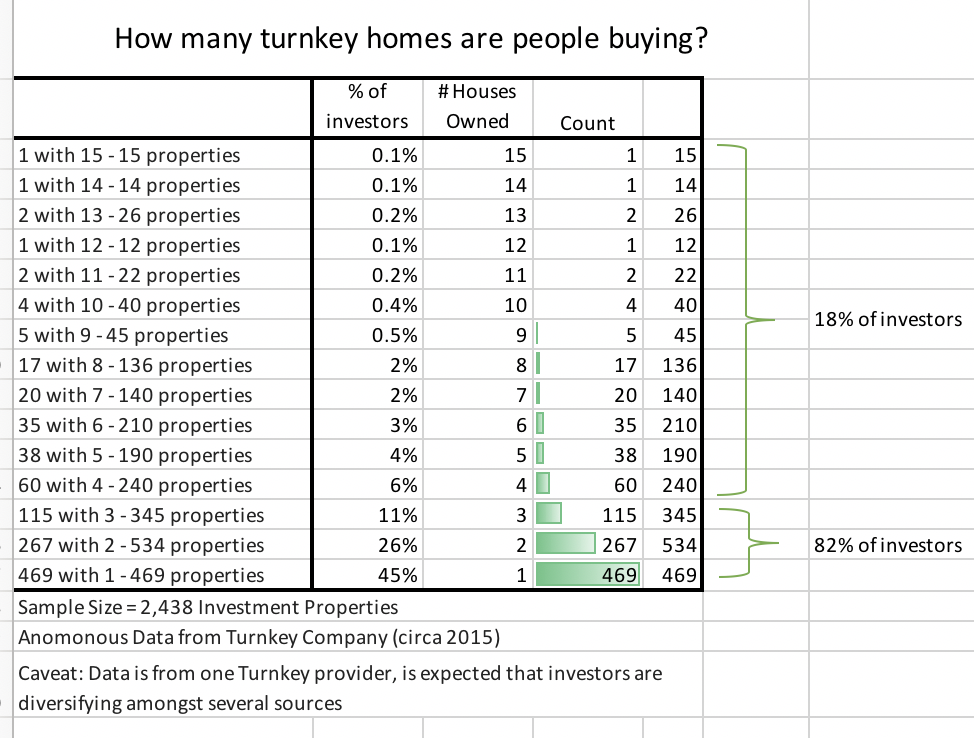
How many turnkey homes are people buying? Here is one data set I found from one popular turnkey provider. Takeaway – most buyers (82% in this provider’s data) stop at a few properties.
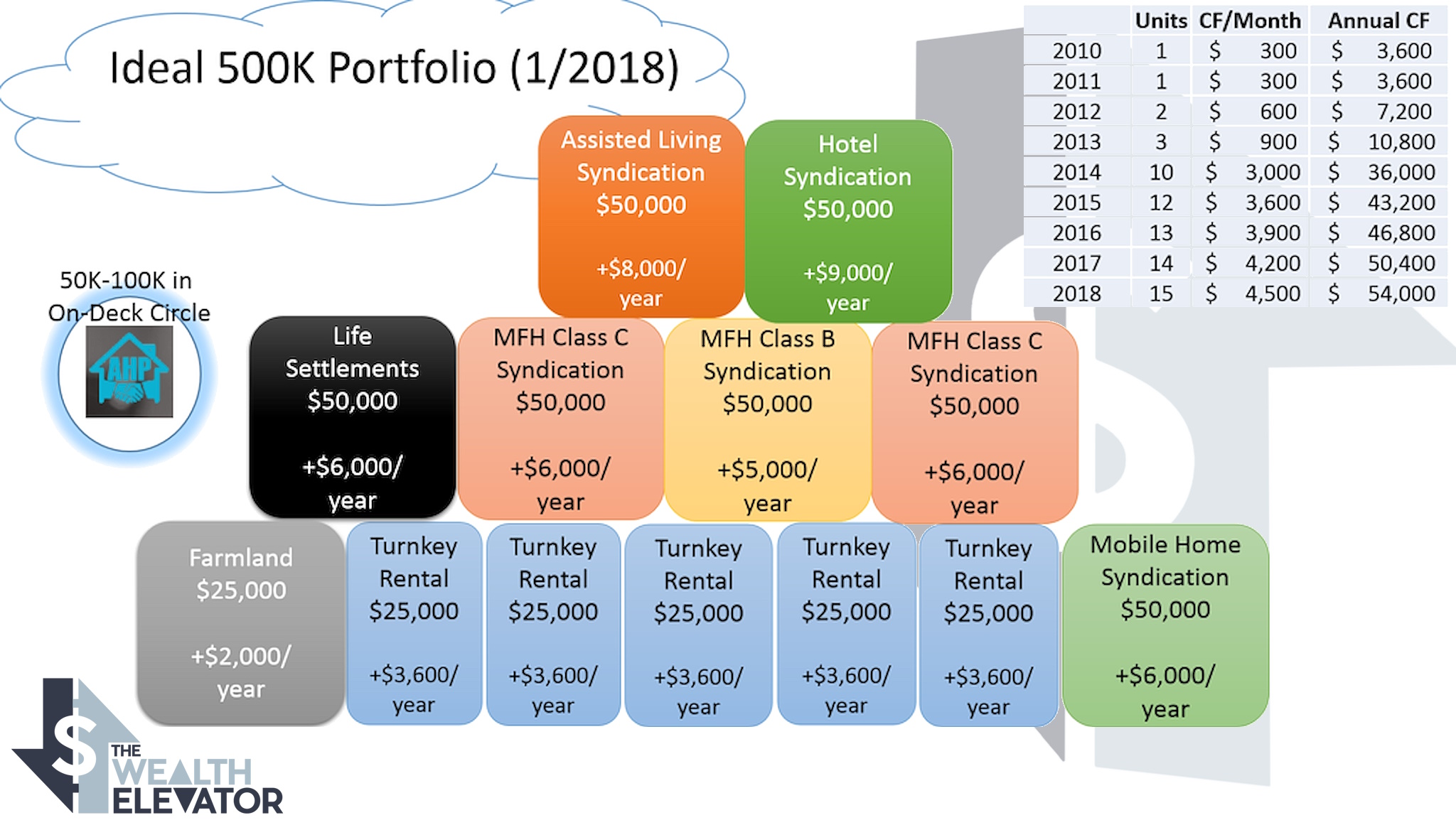
What's the path forward after Turnkeys?
Here’s a quick summary of the properties that I sold (I still have a couple). NOI is the net operating income is calculated by the rent minus expenses (maintenance / repairs, property tax, insurance, property management fee, etc.). NOTE that the ROI shown below does not include the taxes, tax deductions, broker commissions, etc. to simplify things.
You may notice that for the entire time I held properties #2 and #8 the income I generated was actually negative or close to zero, this stresses the importance of having multiple properties to average out the bad apples!
Reminder:
For those who have rentals, you understand how ~20% of renters are like gold. They stay a long time (3 years plus) and are perfect citizens. A couple of my rentals had such tenants which I still own today and will likely rehab a bit to sell retail then. Part of this protocol is contributed to the fact that I don’t really need the proceeds of these sales to go into the next syndication because my W2 day job and cashflow kept me going. Only a couple of the renters I felt I sort of “forced” or did not renew their leases because I felt I needed to get my equity out and working again.
Don’t worry I was nice about that and I gave them a heads up and worked with their schedule while waiting till the springtime so I could time a summertime sale.
| Property # | Years Held | Initial Capital | Equity | NOI | ROI |
|---|---|---|---|---|---|
|
1 |
4 |
$26,975 |
$2,950 |
$9,069 |
45% |
|
2 |
4 |
$30,773 |
$41,900 |
– $4,472 |
122% |
|
3 |
3 |
$27,165 |
$7,500 |
$16,838 |
90% |
|
4 |
3 |
$30,773 |
$25,500 |
$16,553 |
137% |
|
5 |
4 |
$25,603 |
$46,900 |
$2,775 |
194% |
|
6 |
3 |
$25,535 |
$5,750 |
$13,707 |
76% |
|
7 |
3 |
$24,348 |
$70,000 |
$8,870 |
324%
|
|
8 |
3 |
$24,348 |
$44,900
|
$361
|
186% |
Additional FAQ's
Join our Investor Club to build a network of other investors to bounce vendors off of!
Here is just a tip of the iceberg but for now, I would dig up data on population growth of area and median income. Make sure you dig a bit deeper on submarket think Arlington vs Dallas. The details are in the Sub market which needs to ultimately verified in a site visit. The thought here is that the more desirable areas have that built into the pricing. You are trying to find value. Also, check up large employers moving in or other new development. Those are the signs or future expansion.
If you need the provider list, sign-up for the Wealth Elevator Investor Club.
I would do your own due-diligence and learn about rentals by talking to as many people as you can.
When you are ready to look at properties, you can browse turnkey rentals through Rent To Retirement.
Typically, on financed transactions it’s about $650 split 50/50.
Normally, I don’t recommend these types of new builds especially in new areas. When a recession these are the first to go offline as opposed to mature communities that have been around for a while and established homeowners.
This is what I think of (First 2 min) – https://www.youtube.com/watch?v=MesrrYyuoa4
Numbers wise its 200k a unit and 1700 a month at best. This will not cashflow… its not 1% Rent-to-Value Ratio of more.
Here is a spreadsheet with the math behind making your own turnkey company.
First off do not go to a big bank lender like Chase, Bank of America, Wells Fargo. Even worse they use the same guy that got them their primary residence. Don’t use those guys cause now you are buying a remote non-owner occupied rental!
You are getting an investment property that you are not going to live in. It is going to be a little different and a typical residential owner occupied property and big-bank loan officers rarely handle investor loans well as the file gets passed from the sales guy (the one you interact with) to the underwriters (people who cover the banks butt).
Not all lenders are created equal. And it always preferred to work with a lender who is an investor too or works with other sophisticated investors to draw the best practices as opposed to it being a blind leading the blind experience.
If you are serious buyer join the club and I’ll connect you with who we use.
This is an example of knowing what you don’t know and where you are going to pay for your education in terms of a mentor or mistakes.
If you found me back in 2018-2019, I thought that Turnkey remote rentals were really easy and anyone could do them… that’s why it’s called freaking “turnkey”. But after realizing that most people don’t have the time to do anything these days (i.e. pick up a dumbbell or go on a light jog 2/3 times a week) there is no way they are going to build relationships with property managers, brokers, etc which is critical to setting up your organization.
Basically, most people don’t have the time to run a rental well just like how most people will never and should never attempt to start a business… and this is why we have day jobs).
Today my general advice is “it depends” if someone is technically inclined… well versed in project management skills, contracts, and/or good people skills it is very possible for them to go down this path as this ultimately will lead to a better understanding of this real estate rental business which will greatly improve their chances to vet syndication deals and build relationships with other accredited pure passive investors. Maybe I just want to shelter some people from failures or the few nightmare tenants I have had. Our offerings are open to accredited investors only, so the question for most people is how to get there. Hopefully they don’t invest with the wrong person who steals their money like what happened to me initially.
Someone’s net worth really has nothing to do with their level of “sophistication”, in fact, it is my observation that people with less money tend to do better due diligence, unfortunately, they often lack a network of other investors.
About the author
Lane Kawaoka, PE, is the founder of The Wealth Elevator and the author of two Amazon bestselling books, The Wealth Elevator and Simple Passive Cashflow. He spent 12 years as an engineer, bought his first rental in 2009, and left his job in 2019. He built his base in real estate and today is a general partner, operator and fund manager working with a community of accredited investors across real estate, oil and gas, and private companies. His track record: $2.1B of past real estate acquisitions, 10,000+ units acquired, 65+ projects, and $230M+ raised.
This site is free education for accredited investors and high-income professionals whose net worth sits mostly in stocks, a 401(k) and a salary. Start with the guides, the podcast or an event.
This is educational content, not tax, legal, or investment advice. We are not attorneys, CPAs, or financial planners. Please let us know if you need a referral to a CPA, lawyer, or other vendor here.
