


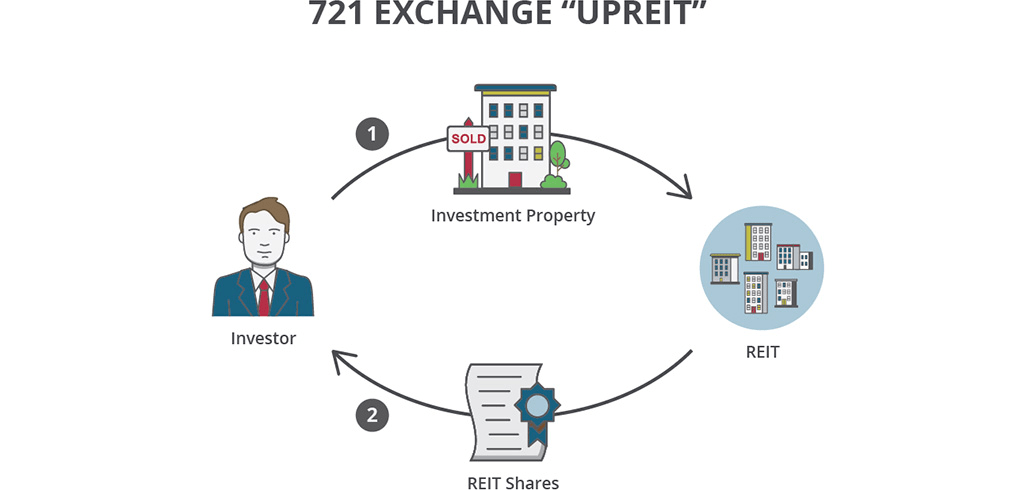

721 Exchange
The 721 exchange falls under the partnership tax code 721(a), which lets you contribute property to a partnership in exchange for partnership interests without triggering a tax event immediately.
Imagine you own “123 Main Street” and you contribute this to a partnership. What happens next? The partnership absorbs your property, and in return, you get a slice of the partnership pie. This is often seen with real estate funds or REITs, sometimes referred to as an “up REIT”.
In essence, you’re trading your property for partnership interests in a fund or REIT. No immediate taxes, but yes, you’ll face taxes when you sell those interests. However, you’ve got options. Sell them over time to spread out capital gains, or don’t sell at all and pass them onto your heirs. This can be a key move in estate planning, offering your heirs a piece of your legacy in a diversified, hands-off way.
So, to recap: contribute property to a fund, get partnership interests, avoid immediate taxes, and plan smartly for your estate. If you play your cards right (and legally), your heirs could inherit these at a stepped-up basis. We’ve dived deep into this in our podcast, where we discuss leveraging real estate for wealth building and tax advantages.

721 Use Case
As a side note, when we target private companies for our private equity mergers and acquisition funds, one exit strategy we often suggest to the exiting founder is a 721 exchange into our fund. This approach is particularly appealing for those with significant capital gains, especially if they believe in the continued growth of the company they’ve built. It allows them to extract value today while still retaining a stake in the future growth. After all, none of us knows what tomorrow holds, and it’s wise to secure and enjoy the fruits of their labor while they can.

This content is provided for informational and educational purposes only and does not constitute an offer to sell or a solicitation to buy any security or investment product. All investors must review and sign the official offering documents, including the Private Placement Memorandum (PPM), which governs and supersedes any prior communication. Tax and legal outcomes vary by individual circumstance. We do not provide tax, legal, or accounting advice—investors should consult qualified professionals before making investment decisions. Click Here to see full disclaimer.